
I. INTRODUCTION
C is a programming language that is one of the oldest and finest programming languages. The C Programming language was developed by Dennis Ritchie in 19721 for creating system applications that directly interact with the hardware devices such as drivers, kernels2, etc. C programming is considered the base for other programming languages, which is why it is known as the mother language. C is a System programming language, Procedural-oriented programming language, Structured programming language, Mid-level programming language, Compiled and Complete programming Language.
C, a successor to the programming language , was developed at the Bell Laboratories and implemented on the DEC PDP-115 computer. C was applied for re-implementing the kernel of the UNIX6 operating system. During the 1980s, C had become one of the most widely used programming languages. C has been standardized by ANSI since 1989 (ANSI C) and the International Organization for Standardization (ISO) due its functionality.
C is an imperative procedural language, flexible and versatile, allowing maximum control with minimal commands. It was designed to be compiled to provide low-level access to memory and language constructs that map efficiently to machine instructions.
C is a language that is rich in library functions, extensible, faster, and also has good memory management. Due to the following features - major parts of operating systems like Windows, Linux, Oracle, and Android are written in C. This language is used to write driver programs for devices like Printers, Tablets, etc. C is used to program embedded systems where programs need to run faster in limited memory. C is also used to develop games.
C has both, directly and indirectly, influenced many latest programming languages such as C++, C#, Unix's Cshell, D, Go, Java, JavaScript, Julia, Limbo, LPC, ObjectiveC, Perl, PHP, Python, Ruby, Rust, Swift, Verilog, SystemVerilog, and many more in which the most pervasive influence was the C programming Language syntax. Thus the C programming language is ruling language in the world to date.
II. PERCEPTIONS OF FEW PROFESSIONALS
- "The kind of programming that C provides will probably remain similar absolutely or slowly decline
in usage, but relatively, JavaScript or its variants, or XML, will continue to become more central." ~ Dennis Ritchie (Computer Scientist, Bell Labs, New Jersey, USA)
- "C: A programming language that is sort of like Pascal except more like assembly except that it is not very much like either one, or anything else. It is either the best language available to the art today, or it is not." ~ Raymond Simard (Former Clerk of the House of Commons of Canada, Canada)
- "Java is, in many ways, C++--." ~ Michael Feldman (Communications Consultant, The Glover Park Group, USA)
- Assembly, while extremely powerful, is simply too difficult to program large applications and hard to read or interpret in a logical way. C is a compiled language, which creates fast and efficient executable files. It is also a small "what you see is all you get language:" ~ (Wiki Books, C Programming)
- "C++ would make a decent teaching language if we could teach the ++ part without the C part." ~ Dr. Michael B. Feldman (Professor Emeritus Department of Computer Science, The George Washington University, Washington, DC)
III. REVIEW OF LITERATURE
C language is one of the easiest languages to learn.3 People all over the world prefer the C language to begin their programming because it is easy to understand and has easy syntaxes. Moreover, the C language has a fixed number of keywords, which are 32 long, with the fixed set of control primitives like if, for, while, switch, and do while. It also includes a set of standard C functions, which are commonly used while writing simple as well as complex programs.
One of the main reasons C has always been a popular language and is still in use is its portability. With slight modifications, one can run a C program on any other platform or computer system. C is a Portable Assembly language. It is as close to the machine as possible while it is almost universally available for all existing processor configurations. Because of this all the compilers , libraries, and interpreters of other programming languages are often implemented in C. Many interpreted languages like Python have their primary implementations written in C.
C is considered an essential and a vital programming language because of which it is still ruling the world: it is a powerful language that includes a collection of in-built functions and operators that help in writing any complex program. C programs are very efficient because they contain a variety of datatypes4 and robust operators. The capabilities of an assembly language and high-level languages are combined in the C compiler, which makes it the most suitable language for writing system software and commercial software.
Despite the prevalence of higher-level languages, the C programming language continues to empower the world. There are plenty of reasons to believe that C programming was, is, and will remain active for a long time. Here are some reasons why C is unbeatable:
Legacy: C has been around a long time, and virtually anything ever made, which can be called a computer, includes a C compiler. Even most better programming languages are built on and using C.
Portability: C is the oldest language which can generally be considered cross-platform. Although it requires being recompiled on the target platform, most C source runs precisely the same on any platform.
Libraries: Because C is as old as it is, it has the most extensive collection of optimized libraries and source code extent. C is the most hyper-efficient Programming language as part of the STL library. Also, one can extend libraries in C while programming.
Raw Performance: Because C is so old, much of it has been optimized to run extremely fast on 8-bit systems with less than RAM.
Low-Level Accessibility: Due to its age, C includes native support for inline Assembler for even greater optimization. No other language (except ) offers the full spectrum from high-level abstraction to low-level control.
Relationship with Machine Language: Most modern high-level languages take abstraction to such extremes that even veteran programmers have no real clue of how a CPU executes their code. By contrast, C is combination of high-level abstraction and low-level control keeps programmers mindful of precisely how a CPU functions - leading to better, faster, cleaner code.
Flexibility: C programming language is used widely because of the flexibility of its use for memory management. Programmers of C have opportunities to control how, when, and where to allocate and deallocate memory. Memory is allocated statically, automatically, or dynamically in C programming with the help of malloc and malloc functions.
Memory Manipulation: Arbitrary memory address access and pointer arithmetic is a vital feature that creates C as an ideal system programming. At the hardware/software boundary, computer systems and microcontrollers map their peripherals and I/O pins into memory addresses. System applications must read and write to those custom memory locations to communicate with the globe. So, C has the ability to control arbitrary memory addresses is imperative for system programming.
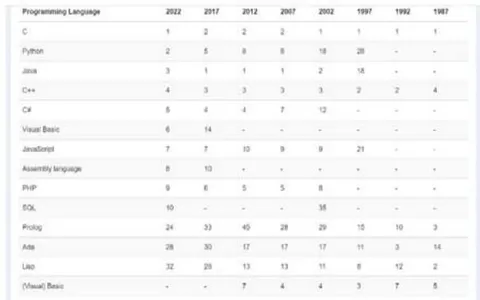
The TIOBE (The Importance of Being Earnest) Programming Community index indicates the popularity of programming languages. The ratings are based several skilled engineers worldwide, courses, and third-party vendors. Popular search engines such as Google, Bing, Yahoo!, Wikipedia, Amazon, and YouTube calculate the ratings. The index can be used to check whether one's programming skills are still up to date or to make a strategic decision about what programming language should be adopted when starting to build a new software system.
Below, is the graph showing TIOBE ratings throughout different years for the C Programming Language:

Below, are the TIOBE indexes for various programming languages:
C Programming Language in Operating Systems: C language was initially developed to write down UNIX software. Also, the execution time of the programs written in C language is reminiscent of the assembly language, which has made C language the foremost crucial part of the development of various operating systems. Most of the Operating Systems have lots of their features implemented in C because of its swiftness. Unix-Kernel, Microsoft Windows utilities and Operating Sysystem applications, and an enormous segment of Android have all been written in C language.
Though C is considered a high-level language, it is far closer to the hardware than most other languages. For that reason, many languages "higher" than C will use C to compile. Most modern programming languages have their compilers written in C because of the C Programming Language proximity to the hardware, whose response time is way better than high-level languages exerting easier control. Embedded systems used in electrical appliances like sensors, Arduino , and many more mostly run on the C platform or a platform whose libraries are coded in C and Also, C Programming Language has led to the development of several new languages such as C++, C#, Java, JavaScript, Python, Verilog, etc. C Programming language is also used for creating a variety of graphics and gaming applications.
IV. SURVEY
A standard procedure and Empirical Research Methodology was used to survey the chosen topic. Demographically, the total number of respondents were 623, among which 364 were Male, and 259 were Female. The tools used in performing this survey were: Direct Interaction, Emailing, social media, etc. The respondents were from various parts of the globe like India, the USA, the UK, China, Singapore, Australia, New Zealand, etc. The survey reports were as follows:
Question 1: Do you belong to the IT or Software Industry?
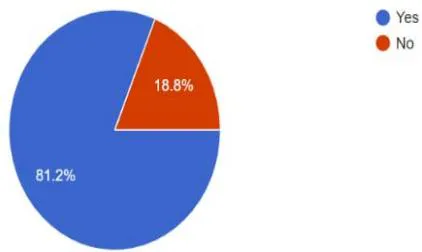
The above pie chart exhibits the survey result for the first question that states that of the respondents were from the Information Technology-IT or Software industry while of the respondents were not.
Question 2: Did you learn C Programming Language?

The above pie chart indicates the result of the survey for the second question, which states that of the respondents learned C programming language while of the respondents did not.
Question 3: Do you agree that the C Programming language helped learn other programming languages?
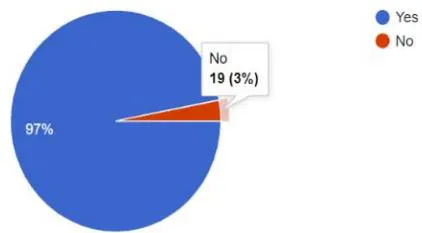
The above pie chart illustrates the survey result for the third question, which states that for of the respondents, C programming language helped in learning other programming languages, in comparison for of the respondents, it did not.
Question 4: Do you think that 'C' Programming is language the base for programming?

The above pie chart demonstrates the survey result for the fourth question, which states that of the respondents thought that C programming language is the base for programming while of the respondents did not.
Question 5: Do you feel that 'C' programming is language ruling the software world to date?
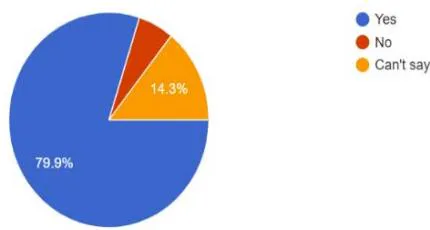
The above pie chart displays the result of the survey for the fifth question, which states that of the respondents felt that the C programming language is ruling the world to date, while of the respondents could not conclude that while of the respondents did not feel that.
V. CONCLUSION
C language is simple, elegant, and wicked fast; it's compact and efficient. Because C has raw pointers , bitwise operators , and the keywords: extern , volatile , static , and register , makes it focuses more on writing efficient code than one can glean from any higher-level language. C continues to empower the world.
Many latest programming languages have been borrowed directly or indirectly from C, such as: C++, C#, Unix's Cshell, D, Go, Java, JavaScript, Julia, Limbo, LPC, ObjectiveC, Perl, PHP, Ruby, Rust, Swift, Verilog, SystemVerilog, Python, etc. These languages have drawn many of their control structures and other basic features from C. Most of them express highly similar syntax to C, and they tend to combine the recognizable expression and statement syntax of C with underlying type systems, data models, and semantics that can be radically different.
The most commonly programmed language is the C, due to the language features such as: flexibility, efficiency, performance, and closeness to the hardware.
C is the foundation of: Operating systems (Unix, Linux), Compilers (C compilers, FORTRAN compilers, Pascal), Run Time libraries (for C, C++, FORTRAN), Interpreters (Python, Ruby, Smalltalk, Java Virtual Machine), Databases (Oracle), Shells (C Shell, Born Shell, Koran Shell).
The world is running on C-powered devices. C is the past, the present, and the future in many areas of software. Each, every programmer will start their programming journey with C as their first programming language because it is the base for all the programming languages as it is called the mother language of all the programming languages. So, this is also one of the main reasons for the C Programming Language to rule the software world to date.
Hence, it can be concluded that C PROGRAMMING LANGUAGE IS STILL RULING THE WORLD!
Footnotes
Reema Tharaja "Introduction to C Programming", Second Edition, OXFORD Press, 2015. (p.1) ↩
M.T. Somashekar "Problem Solving with C", 2nd Edition, Prentice-Hall India Learning Private Limited 2018 (p.1) ↩
Reema Tharaja "Introduction to C Programming", Second Edition, OXFORD Press, 2015. (p.2) ↩
Brian W. Kernighan and Dennis M. Ritchie, The C Programming Language, Prentice-Hall of India. (p.2) ↩