Findings regarding the Added Value for Organizations in Recruitment Processes and whether These Findings Are Applicable in the Context of Decision-Making on the Preventive Handling of Candidate Ghosting. Scientific Databases Were Reviewed to Identify Primary Research on the Subject. The Systematic Review Includes 10 Studies That Focus Exclusively on Ghosting in Professional Settings. Content Analysis Was Performed to Analyze and Weigh the Results in Accordance with Their Respective Applicability. The Research Landscape Lacks Studies That Specifically Focus on the Organization so Perspective on Candidate Ghosting.
Funding
No external funding was declared for this work.
Conflict of Interest
The authors declare no conflict of interest.
Ethical Approval
No ethics committee approval was required for this article type.
Data Availability
Not applicable for this article.
Laureana Teichert. 2026. \u201cCandidate Ghosting in the Hiring Process: A Systematic Review of Organizational Challenges and Responses in Professional Settings\u201d. Global Journal of Management and Business Research - A: Administration & Management GJMBR A Volume 25 (GJMBR Volume 25 Issue A3): .
## I. INTRODUCTION TO THE ADVENT OF CANDIDATE GHOSTING
Ghosting refers to the termination of contact between two individuals or parties, without providing any explanatory information regarding the reasons (Freedman et al., 2019). Furthermore, ghosting involves blocking the ghosted parties from communication channels and ignoring contact attempts (Osbert-Pociecha & Bielinska, 2019; Kay & Cortice, 2022). Koessler (2018) characterized ghosting as a dissolution strategy in relationships without the need to confront the other party with ceasing commitment or dealing with possible reactions. The term is derived from the nature of the phenomenon, which is characterized by a sudden disappearance.
This phenomenon originated in romantic relationships. Ghosting has gained momentum with the rise of online dating apps. Virtual communication gives online dating a quality comparable to online shopping (Aretz, 2017). The large number of options makes it challenging to ascertain the individual behind the profile, thus impeding the ability to make an informed decision and resulting in the loss of humanity (Zöllner, 2019). The possibility of initiating and terminating contact spontaneously, offered by advanced technologies and social media, contributes to the phenomenon becoming fashionable (LeFebvre et al., 2019), as evidenced by its emergence in recruiting and organizational processes (Pugh, 2022).
As demonstrated in the extant research, ghosting has infiltrated vocational settings (Gurchiek, 2018). Many applicants terminate recruitment processes without informing the respective organizations (Kumar & Narayana, 2019; German, 2021). Initially, organizations ghosted candidates. Meanwhile, companies are grappling with this behavioral trend (Kumar & Narayana, 2019; Hanigan, 2021), not only in recruitment processes but also company-internally (Vagas & Misko, 2018). Ghosting emerged in vocational settings as a consequence of a multitude of factors influencing labor markets on a global scale, for instance due to a surplus of vacant positions (Olten, 2021).
Although the phenomenon of ghosting in vocational settings has gained considerable attention in public discourse (Linkedin, 2023), it remains under represented in academic discourse (LeFebvre et al., 2019). The initial forays were non-academic approaches conducted by Delgado (2018) and Lewis (2019 (a), 2019 (b)) to gain a thorough understanding of the subject. The initial academic research by Vagas and Misko (2018) concentrates on company's internal ghosting tendencies. Subsequent research focused primarily on the candidate perspective (Osbert-Pociecha & Bielinska,
2019; Karl et al., 2021). The research landscape encompasses a range of aspects that are becoming increasingly detailed and specific, but lacks at the same time research that addresses the organizational perspective on ghosting to provide a database that would help companies to find a solution in organizational processes.
Existing research has focused on elucidating ghosting from the candidate's perspective. To organizations the information asymmetry in the recruitment processes is of interest (Spence, 1973). In accordance with the principal-agent theory, organizations search for prospective employees to fill open job requisitions. Candidates' pursuit of individual interests presents a challenge, leading to an information lack on the company side (Carr & Brower, 1996). Ghosting can be defined as the non-fulfillment of a psychological contract. Such contracts are formed through a voluntary declaration of mutual expectations and commitment (Lee et al., 2022; Ruchika, 2019; Madan & Madan, 2019; Basavaraj et al., 2022). The fulfillment of these conditions is the choice of each party (Rousseau & Schalk, 2000). Termination of communication during the recruitment process is perceived as a breach of such an informal agreement (Osbert-Pociecha & Bielinska, 2019). Candidates have information regarding hidden characteristics and intentions, such as ghosting tendencies or testing their market value, of which organizations are unaware (Alzaid & Dukhaykh, 2023). Companies can only recognize these characteristics based on the available information. Even in the case of incomplete information, recruitment activities are based on this information content (Deters, 2023).
Over half of the surveyed human resource managers expressed concerns about their preparedness to address candidate ghosting. The pivotal role for organizations is in a single ghosting incident to impair organizational processes rather than in the number of incidents. Consequently, organizations must implement tailored recruitment practices (Kumar & Narayana, 2019). It is necessary to provide a research basis that addresses the needs of organizations, which requires a review of previous research. It is important to determine whether the research results offer companies a basis for recruitment decisions. This systematic review aims to determine whether organizations in recruitment processes can utilize the findings, support the company perspective, and inform decision-making.
The extant literature primarily unveils the background of candidate ghosting and the rationale behind candidates' decisions to ghost. Particularly in the context of recruitment, a company is subject to criticism. The information available to organizations is restricted to application documents and data provided by the candidates without disclosing any indication of their psychological background (Frey, 2020; Going Global,
2005; Going Global, 2007(a)). Organizations make decisions based on available information. The aim is to determine which findings from previous research are available to organizations in recruitment processes and to support the company perspective and decision-making processes when applying activities to mitigate candidate ghosting. Consequently, the following review question is defined:
Does preceding research provide results applicable to companies' recruitment processes to prevent candidate ghosting?
## II. METHODOLOGY
Consolidating extant research facilitates the development of a research landscape capable of addressing hitherto unexplored questions and requirements. The potential application of the research findings is considered rather than adhering to the initial purpose of previous studies (Leucht et al., 2009). A systematic review was conducted to provide a synopsis of the current state of knowledge, identify and structure subjects and trends in ghosting in vocational settings, and examine preceding research results regarding the applicability of an alternative usage. This review applies a domain-framework-based approach (theory-context-method framework) to integrate the theories, contexts, and methods to structure and analyze the research landscape and outline future research directions (Harlen & Crick, 2004; Paul et al., 2021).
This systematic review aims to provide a structured overview of the research landscape. The review works towards the identification of the factors analyzed in previous research that are accessible to organizations in recruiting processes and are suitable for decision-making to prevent candidate ghosting tendencies from being triggered. A systematic literature review was conducted to identify relevant articles. The search strategy required consultation with academic databases and journals as the primary sources. Non-academic sources were considered, provided articles referred to those (Harlen & Crick, 2004). Given that the phenomenon of ghosting in vocational contexts has recently emerged in the research landscape, the sources were not limited in order to gain a comprehensive understanding of the phenomenon. Inclusion and exclusion criteria were established (Paul et al., 2021). First, the theory-context-method framework was applied to illustrate the research landscape, considering the distinct aspects of theories, contexts, and methods. Second, the method category was extended to facilitate a thorough examination of the research results. The category of methods was extended to encompass the data collection process, data sources, and corresponding research results. Selected studies were subjected to a detailed content analysis to elucidate the structure, subjects, and trends of ghosting in vocational settings and preceding findings accessible to organizations during recruiting processes to foster decision-making. The theory-context-method framework provides a distinct coding system. To extend the category of methods concerning the review question, a codebook delineated the information available to companies in the recruiting processes. A meta-analysis could not be performed because the extant research results were not purely quantitative. Instead, a content analysis was conducted. The results were summarized and evaluated in accordance with the review question (Dekkers et al., 2022).
## III. INCLUSION AND EXCLUSION CRITERIA
The included research examines ghosting in vocational settings by analyzing ghosting in recruitment processes from the candidate and company perspective. The research obtained data from participants who have been ghosted or engaged in ghosting behavior. The paucity of extant research precludes an examination of specific factors, implicating the inclusion of research that collected data from both the candidate and the company. An essential inclusion criterion was the definition of ghosting to assess conceptualization. Given the limited focus of previous research on ghosting from the candidate's perspective, the inclusion criteria have been expanded to encompass a holistic examination within the professional context. The methodology employed in each study has to be clearly delineated. Studies generating insights into the phenomenon in private contexts, secondary research, and studies lacking direct data from the parties involved, were excluded.
## IV. SEARCH STRATEGY
The search period was not limited, given that this phenomenon has recently occurred in academic discourse. Initially, the entire development is considered as relevant. Limitations were established using a recent overview of the literature. Articles published in scientific journals were included. Additional resources were considered for inclusion in the case of references in an identified article (Paul et al., 2021). First, Google Scholar and EBSCO were reviewed. Distinct search terminologies were examined: ghosting, candidate ghosting, candidate-side ghosting, workplace ghosting, employer ghosting, employee ghosting, company ghosting. Next, the bibliographies of the selected studies were reviewed for eligibility. Due to several articles citing research conducted by Indeed, the organization's website was consulted. To search for grey literature, a university library database was accessed (Dekkers et al., 2022).
## V. RESEARCH SELECTION PROCESS
The SPAR-4-SLR Protocol (Figure 1) illustrates the selection process. A total of 462 records was identified. Conference and proceeding papers, unpublished dissertations, book chapters, textbooks, and working papers were excluded (Herjanto et al., 2016; Islam & Amin, 2021). Reports addressing ghosting in contexts other than vocational settings were also excluded. Based on the titles and abstracts, 73 articles were evaluated for relevance. Articles that did not report research were excluded. 21 reports were retrieved. The research content is reviewed in detail. Studies that did not report primary research were excluded. 13 studies were assessed for eligibility. 3 additional articles were excluded due to insufficient information regarding the research design. In addition, 3 non-academic studies were included as these were referenced in the selected research. 10 studies met the inclusion criteria (Table 1).
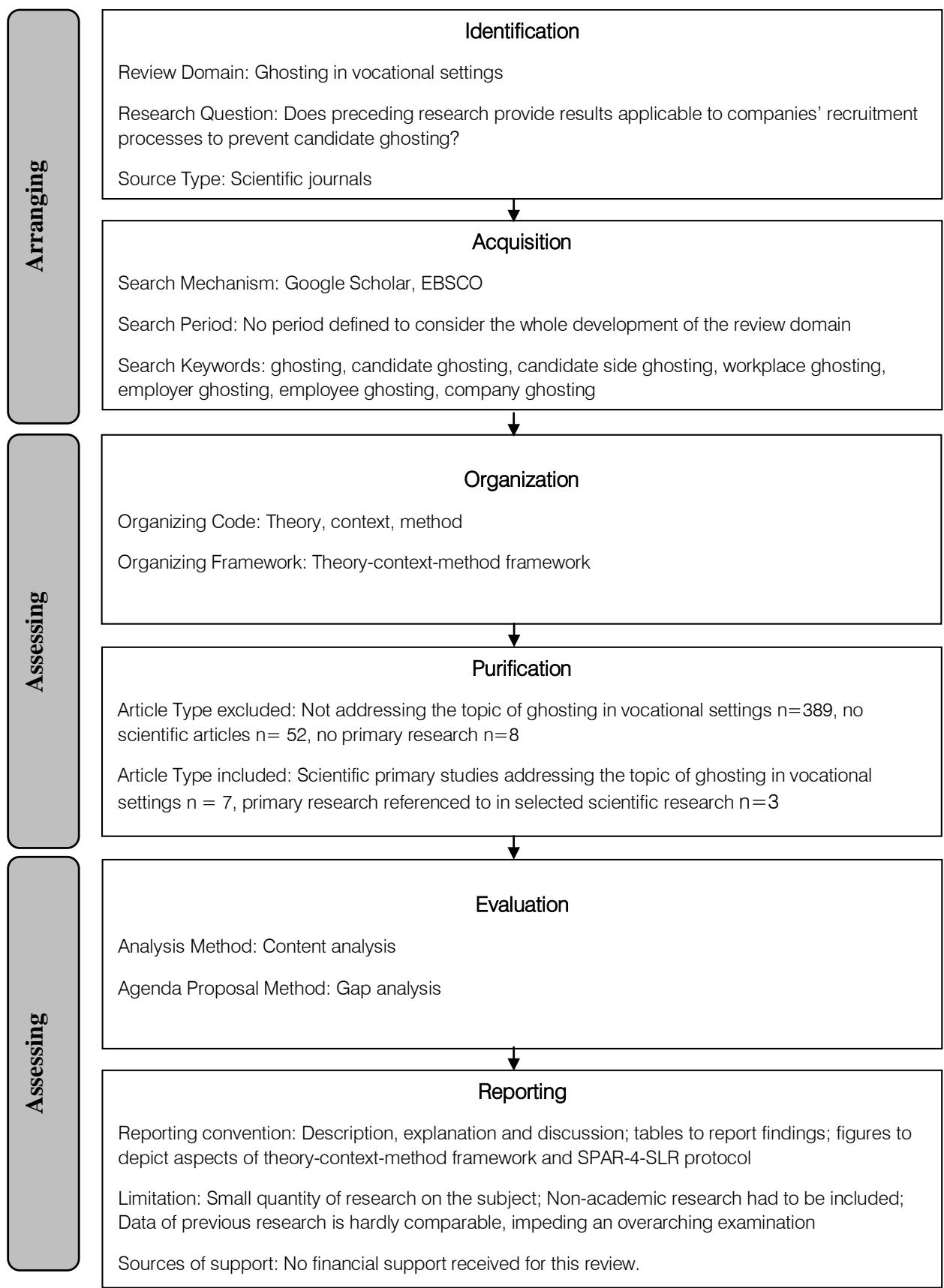 Figure 1: SPAR-4-SLR Protocol
Table 1: Previous Research Corresponding to Defined Inclusion Criteria Research Focus Data Source Publication Sample Key Results Delgado (2018): Clutch: What causes work-place ghosting? The acceptance of ghosting from the company and candidate side Candidate side Online Magazine HR 507 full-time employees Ghosting from company side is more accepted than from candidate side. Vagas & Misko (2018): Understanding of Ghosting in re-education of human resources in organization Development of a measurement concept to predict ghosting tendencies of employees Employee side Journal of Inter-Disciplinary Research 202 respondents The higher the Global Indicator of Ghosting the higher the tendencies to ghost. Men are more likely to ghost than women. Lewis (2019(a)): Indeed: The Ghosting Guide: An Inside Look at Why Job Seekers Disappear Examination of the reasons why candidates ghost organizations Candidate and company side Indeed website, Harvard Business Review 4,000 job-seekers, 900 companies Ghosting from candidate side differs in the age of candidates and in the reasons for ghosting behavior. Lewis (2019(b)): Indeed: Ghosting unmasked: Listen to the Voices Behind the Epidemic Examination of the background of the reasons why candidates ghost organizations Candidate side Indeed website, Harvard Business Review 250 job-seekers Ghosting behavior is used to terminate recruitment processes. Threlkeld (2021): Indeed: Employer Ghosting: A Troubling Workplace Trend The impact of the Covid pandemic on candidate ghosting tendencies Candidate and company side Indeed website, Harvard Business Review 500 employers, 500 job-seekers Job-seekers and employers are ghosting more frequently than before. Osbert-Pociecha & Bielinska (2019): Ghosting w polskich Przedsiębiorstwach – perspektywakandydata/pracownika. Wyzwania dlarekrutacji Examination of the reasons why candidates ghost organizations Candidate side AFE Facilities Engineering Journal >100 participants Labor market choices and also conditions of recruiting processes cause candidates to ghost companies. Kumar & Narayana (2019): Ghosting Behavior of Job Applicants: An Analysis of Factors Driving the Behavior Examination of the factors that affect ghosting tendencies Company side International Journal of Scientific & Technology 110 respondents The company's industry background and the applicant's field of education are associated with ghosting tendencies on the part of the applicant. Osbert-Pociecha & Bielinska (2021): Ghosting as a Manifestation of Inversion on the Polish Labor Market Identification and perceptions of ghosting on the polish labor market from the candidate and company perspective Candidate and company side International Business Information Management Association (IBIMA) Stage 1: 84 participants Stage 2: 174 participants Ghosting occurs most frequently in production and administrative positions.
<table><tr><th>Research Focus</th><th>Data Source</th><th>Publication</th><th>Sample</th><th>Key Results</th></tr><tr><td>Delgado (2018): Clutch: What causes work-place ghosting?</td><td>Candidate side</td><td>Online Magazine</td><td>HR 507 full-time employees</td><td>Ghosting from company side is more accepted than from candidate side.</td></tr><tr><td>Vagas & Misko (2018): Understanding of Ghosting in re-education of human resources in organization</td><td>Employee side</td><td>Journal of Inter-Disciplinary Research</td><td>202 respondents</td><td>The higher the Global Indicator of Ghosting the higher the tendencies to ghost. Men are more likely to ghost than women.</td></tr><tr><td> Lewis (2019(a)): Indeed: The Ghosting Guide: An Inside Look at Why Job Seekers Disappear</td><td>Candidate and company side</td><td>Indeed website, Harvard Business Review</td><td>4,000 job-seekers, 900 companies</td><td>Ghosting from candidate side differs in the age of candidates and in the reasons for ghosting behavior.</td></tr><tr><td> Lewis (2019(b)): Indeed: Ghosting unmasked: Listen to the Voices Behind the Epidemic</td><td>Candidate side</td><td>Indeed website, Harvard Business Review</td><td>250 job-seekers</td><td>Ghosting behavior is used to terminate recruitment processes.</td></tr><tr><td> Threlkeld (2021): Indeed: Employer Ghosting: A Troubling Workplace Trend</td><td>Candidate and company side</td><td>Indeed website, Harvard Business Review</td><td>500 employers, 500 job-seekers</td><td>Job-seekers and employers are ghosting more frequently than before.</td></tr><tr><td> Osbert-Pociecha & Bielinska (2019): Ghosting w polskich Przedsiębiorstwach – perspektywakandydata/pracownika. Wyzwania dlarekrutacji</td><td>Candidate side</td><td>AFE Facilities Engineering Journal</td><td> >100 participants</td><td>Labor market choices and also conditions of recruiting processes cause candidates to ghost companies.</td></tr><tr><td> Kumar & Narayana (2019): Ghosting Behavior of Job Applicants: An Analysis of Factors Driving the Behavior</td><td>Company side</td><td>International Journal of Scientific & Technology</td><td>110 respondents</td><td>The company's industry background and the applicant's field of education are associated with ghosting tendencies on the part of the applicant.</td></tr><tr><td> Osbert-Pociecha & Bielinska (2021): Ghosting as a Manifestation of Inversion on the Polish Labor Market</td><td>Candidate and company side</td><td>International Business Information Management Association (IBIMA)</td><td>Stage 1: 84 participants Stage 2: 174 participants</td><td>Ghosting occurs most frequently in production and administrative positions.</td></tr></table>
## VI. EXAMINATION OF RELEVANT EXTANT
### RESEARCH
The selected studies were reviewed in chronological order based on the publication year. The theory-context-method framework was applied to analyze the structure and subjects of the included research with regard to theories, contexts, and methods. Because the review question required a more detailed look at the methodological concept, the category of methods was extended to review data sources and research results. Each study was subjected to a detailed assessment in preparation for further analysis. Subsequently, the review results are described and explained.
### a) Acceptance of Ghosting by Delgado
"What causes workplace ghosting?", by Delgado (2018), examined the acceptance of ghosting from the company and candidate side in the US labor market. Ghosting is a permanent element of the hiring landscape. The findings indicate a divergence between companies' and candidates' acceptance of ghosting. The phenomenon is known as 'workplace ghosting.
'Candidates ceased participating in the interview process or after accepting a job offer. Organizations have neglected to follow-up on the next step. Ghosting is indicative of communication failure. A total of 507 full-time employees who had assumed a new position within the previous six months were surveyed. Participation was voluntary. Respondents worked across various business sizes (500+ employees: $35\%$, 250-500 employees: $20\%$, fewer than 250 employees: $19\%$, startups: $17\%$, others: $9\%$ ). The survey represented a variety of industries (retail/ hospitality: $21\%$, healthcare: $16\%$, technical services: $10\%$, legal/financial: $9\%$, education: $9\%$, government: $5\%$, marketing/media: $5\%$, other: $25\%$ ). Respondents were located in several regions of the US. $69\%$ of the participants were female and $31\%$ were male, aged 18-34 years (Millennials: $66\%$, Generation X (age 35-54): $29\%$, Baby Boomers (age $55+$ ): $5\%$ ). A questionnaire was provided to shareghosting experiences from the company's side. The data collected were based on statements from ghosters. The nature of this phenomenon makes it infeasible for organizations to collect such information. Data were analyzed using frequency analysis. $71\%$ of the respondents had already canceled a recruitment process by engaging in ghosting behavior. Candidates tended to disapprove of ghosting from the company's side more than from the candidate's side. $35\%$ of respondents rated company-side ghosting as disapproved, whereas only $21\%$ rated candidate ghosting accordingly. The emerging communication gap represents a significant challenge for organizations. It is recommended that transparent communication channels should be established to disseminate pertinent information. The frequent occurrence of ghosting should prompt reflection and the enhancement of recruitment processes (Delgado, 2018).
### b) Company Internal Ghosting by Vagas & Misko
The research "Understanding of ghosting inre-education of human resources in an organization", by Vag as and Misko (2018), sought to enhance awareness for ghosting incidents within Slovakian companies. This study drew on prior research postulating that ghosting impairs recruitment processes. The methodology designed the Global Indicator of Ghosting (GIG), working towards its verification. The GIG assesses ghosting tendencies among employees and comprises 12 items for self-evaluation on a six-point scale of agreement (Vagas & Misko, 2018). The methodology was designed for internal company contexts but could also be applied to the context of recruitment. The study included 202 participants (male: $45.5\%$, female: $54.5\%$; management positions: 44, general roles: 158). The age range of the participants was 18-61 years. The data were collected by distributing the GIG itself and subsequently analyzed through statistical test procedures of factor analysis with varimax rotation and the Mann-Whitney-U-Test. A higher GIG value indicated a greater potential for ghosting behavior among the respondents. Based on these findings, men were more likely to engage in ghosting behavior than women. Women are more likely to continue communication and therefore less likely to ghost (Vagas & Misko, 2018). Ghosting in workplace dynamics has consequences such as changed communication behavior of affected employees, absenteeism, or avoiding communication with certain colleagues. As communication is essential to an entrepreneurial business, training measures should focus on the phenomenon and its avoidance (Conrad, 2014).
### c) Candidates'Reasons to Ghost by Lewis & Threlkeld (Indeed)
The study is divided into three consecutive sections. The initial section, "The Ghosting Guide: An inside Look at Why Job Seekers Disappear", by Lewis (2019(a)), examined the reasons why candidates in the US labor market choose to ghost organizations. Although ghosting is perceived as a relatively recent phenomenon in the context of labor markets, it has an adverse effect on most organizations and recruitment processes. This study posits that candidates have disparate motivations for engaging in ghosting behavior. According to the findings, ghosting manifests in various ways, including the failure to attend the first day of work or withdrawal from the recruitment process. The study included 4,000 job-seekers and 900 employers from various sectors, either involved in or experienced ghosting in past hiring processes. Data were collected via questionnaires and analyzed using frequency analysis. The median age of the ghosters was 34 years (age groups: 18-34, 35-44, 45-65) (Lewis, 2019(a)).
The second part, "Ghosting Unmasked: Listen to the Voices Behind the Epidemic", by Lewis (2019(b)), provides a more detailed examination of the reasons why candidates ghost in recruiting processes. Data were collected from 250 job-seekers via questionnaires and subsequently analyzed using content analysis. Initially, ghosting occurred on the company side. Candidate ghosting was posited as a form of retribution. $70\%$ of ghosters were employed full-time. Ghosting can be divided into several categories. 'Partial ghosting' describes a cancellation shortly before an interview. Ghosting can also be characterized as a failure to provide feedback because the organization is not considered as a potential employer. Most respondents expressed concerns about the potential consequences of reputational damage. Improved communication strategies should be implemented to mitigate candidate ghosting (Lewis, 2019(b)).
The third section, "Employer Ghosting: A Troubling Workplace Trend", by Threlkeld (2021), posits that there have been changes in ghosting behavior due to the impact of Covid-19. There has been a notable increase in the frequency of ghosting behavior among job-seekers and employers. Most respondents did not cite Covid-19 as the reason. Ghosting has become a standard component of the hiring process. A total of 500 employers and 500 job-seekers across various industries in the United States with ghosting experiences were surveyed. Data were collected via questionnaires and analyzed using frequency analysis. During Covid-19, employers have taken a more proactive stance to protect their hiring processes from the impact of candidate ghosting. In 2020, $28\%$ of the surveyed job-seekers engaged in ghosting behavior towards a potential employer. Only $4\%$ of respondents indicated that the rationale was Covid-19. The proportion of job-seekers concerned about the potential consequences of ghosting increased from $41\%$ in 2019 to $65\%$ in 2020. $93\%$ of the surveyed organizations documented ghosting incidences. It was recommended to pay greater attention to enhancing communication throughout the entire candidate journey (Threlkeld, 2021).
### d) Generational Differences causing Ghosting by Osbert-Pociecha & Bielinska
Ghosting by candidates is becoming a significant challenge for the Polish labor market, as evidenced by the study "Ghosting w polskichprze dsiembiorstwach - perspektywakandydata/pracownika. Wyzwaniadlarekrutaci", conducted by Osbert-Pociecha and Bielinska (2019). Ghosting is assumed to affect recruitment adversely. Ghosting was defined as ceasing to participate in recruiting processes, including the subsequent stages of not signing the provided contract and not attending the first day of work. Younger generations are more prone to ghosting because they lack experience navigating conflictual situations. An online diagnostic survey was also administered. The sample comprised 101 participants, limited to respondents who had already engaged in ghosting behavior in recruiting processes. However, the sample did not meet there presentativeness criteria. A questionnaire was administered to examine the characteristics, requirements, motives, and future assessment from the candidate's perspective. Data were analyzed using frequency analysis. The research findings show that ghosting is observable in lower-paid jobs like the construction industry. This behavior was transferred to management positions. Labor market conditions push applicants to engage in ghosting as well do the conditions in recruitment processes. A further survey was conducted on the same sample to explore the challenges faced by human resource specialists. The diagnostic online survey included a metric for assessing participants' characteristics and identifying ghosting behavior. The study focused on the reasons, conditions, characteristics, and intentions of respondents who ghosted organizations and the consequences for future human resource management. Data were collected via questionnaires and analyzed using content and frequency analysis. Candidates of all ages engaged in ghosting, also with several years of professional experience. Ghosting on the first day of work is the most cost-intensive form for organizations. Several factors can cause this phenomenon, some of which are influenced by organizations themselves (Osbert-Pociecha & Bielinska, 2019).
### e) Factors Influencing Ghosting Tendencies collected on the Company Side by Kumar & Narayana
The research "Ghosting Behavior of Job Applicants: An Analysis of Factors Driving the Behavior", by Kumar and Narayana (2019), offers insights into the phenomenon of candidate ghosting within the Indian labor market. The study posits that organizational-level factors influence candidates' ghosting tendencies. The phenomenon was examined from the company perspective regarding the frequency of ghosting in various locations, the candidate's level of education, and the company's preparedness to face ghosting. Structured questionnaires were submitted to organizations via Google Forms. A non-probability convenience sampling method was used to select 150 participants; 127 completed forms were returned, and 110 were deemed appropriate for analysis. Most respondents were involved in recruiting activities within the previous year. This study primarily focuses on organizations operating within the information and technology sector. Secondary data were collected to confirm the results and provide recommendations. The data were subjected to statistical testing procedures, including percentage analysis, chi-square test, and cross-table analysis. $60\%$ of the surveyed organizations had already faced candidate ghosting. This behavior was found to decrease with increasing professional experience. The organization's industrial background and the applicant's field of education were associated with ghosting tendencies on the candidate's side. Over $60\%$ of human resource managers declared themselves unprepared to face candidate ghosting (Kumar & Narayana, 2019).
### f) Candidates' Perceptions of Ghosting by Osbert-Pociecha & Bielinska
In a second study, "Ghosting as a Manifestation of Inversion on the Polish Labor Market", Osbert-Pociecha and Bielinska (2021) deepened the identification of ghosting. They recorded the phenomenon on from the candidate and company perspective on the Polish labor market. It is assumed that ghosting is becoming increasingly prevalent. The sample did not meet there presentativeness criteria. The initial stage of the study (2018/2019) examined ghosting from a company perspective. The research aims to identify the premises, scale, and conditions associated with ghosting, as well as the effects of ghosting on companies and potential actions to prevent the phenomenon. Data were collected from 84 employers via questionnaires (local coverage: $25\%$, national coverage: $21\%$, international coverage: $16\%$, global coverage: $38\%$; production industry: $30\%$, IT: $22\%$, personal consultancy: $14\%$, logistics: $11\%$, automotive: $11\%$, other industries: $3\%$; business owners and managers: $15\%$, recruitment specialists/human resource managers: $48\%$, other management positions: $37\%$ ). The data were subjected to frequency analysis. More than half of the participants experienced ghosting on multiple occasions. The findings demonstrate that ghosting is most prevalent in production positions. $66\%$ of the participants stated that they believed that ghosting by candidates prevented companies from hiring irresponsible employees. The second stage of the survey (2019/2020) included candidate perspectives on ghosting. The questionnaire included a metric designed to record the participants' character traits and identify ghosting from a candidate's perspective. The sample comprised 174 Polish respondents, who had resigned at least once during the recruitment process. The collected data were analyzed using frequency analysis. $75\%$ of the respondents engaged in ghosting on a single occasion, while $25\%$ engaged in respective behavior on more than one occasion. Generation Y (born 1980 -1999) participated the most. Respondents with secondary education were twice as likely to engage in ghosting behavior. The most frequent instances of ghosting occurred in administrative or similar positions (Osbert-Pociecha & Bielinska, 2021).
g) Factors influencing Ghosting Tendencies collected on the Candidate Side by Karl et al.
"Slip Out the Back Jack: Why Applicants Ghost Potential Employers", by Karl et al. (2021), integrated signaling theory and information asymmetry between two parties. It is assumed that it is necessary to reduce information asymmetry by disseminating pertinent information (Spence, 1973). One example is the relationship between recruitment specialists and candidates. The study examined the predictors of ghosting behavior in the US labor market. A survey was conducted among 246 undergraduates at a medium-sized US university. Questionnaires were distributed during class. The sample consisted of 123 male and 123 female participants. The mean age was 22 years. A random selection was used to assign participants to one out of our scenarios. The initial scenario presented an invitation to a fictitious job interview, with the quality of the recruiter's communication behavior varying across cases. The information provided regarding the candidate's suitability for the organization also varied. The questionnaires comprised 6 distinct sections: study description and instructions, scenario describing the job, candidate's knowledge of the organization and the recruiter's communication level, candidate's attraction to the organization and the organization's interest in the candidate, conscientiousness, helicopter parenting, and ghosting. The data were subjected to statistical analysis, specifically correlation and variance analysis. The findings suggest that the recruiter's communication behavior, such as perceived fairness, can indicate general communication behavior. Specific behaviors positively affect an organization's perceived image and interest (McIntyre et al., 1980). Except for company knowledge, all predictor variables were significantly related to ghosting (Karl et al., 2021). The more effective the communication and the more comprehensive the information provided, the more attractive and interested organizations appear to respondents. Respondents with lower levels of conscientiousness were found to be more likely to ghost, as were female respondents, and those who preferred parental involvement (Karl et al., 2021).
### h) International Ghosting Trends by Indeed with Census wide
"When Candidates and Recruiters Vanish: Indeed's Ghosting in Hiring Report", conducted by Indeed with Census wide (2023), offers insights into the development of international ghosting trends in 2023, with a particular emphasis on the countries of the US,
UK, and Canada. This phenomenon was examined from both the candidate and company perspectives, assuming that the trend of ghosting developed in accordance with the findings of Lewis and Threlkeld from 2019. The study aims to thoroughly understand the phenomenon, its impact on hiring processes, and recommendations for corporate action. A total of 4,516 job-seekers (US: 1,507, UK: 1,506, Canada: 1,503) who admitted to engaged in ghosting during hiring processes and were employed or seeking employment within the US, aged 18-64, were surveyed via online questionnaires. In addition, 4,517 employers (US: 1,502, UK: 1,506, Canada: 1,509) were surveyed, who experienced ghosting during the hiring process. The findings affirmed that ghosting became more prevalent and a part of the hiring landscape. Ghosting was found to be a permanent element of the recruitment process in all three countries (Indeed Survey with Census wide, 2023).
i) The Impact of (Lacking) Feedback on Candidates by Wood et al.
The study "Ghosting from the workplace: The impact of feedback (or lack thereof) on applicants' psychological needs satisfaction", by Wood et al. (2023), examined the impact of recruiters' feedback, or the lack thereof, on the psychological needs' satisfaction of candidates within the US and UK. The research was based on the ostracism theory, which deals with the ignorance and exclusion of individuals from social groups. In this case, the focus was on the communication of rejection decisions in the hiring process. The study surveyed 600 unemployed participants from the US and UK, seeking employment in the US. The final sample comprised 554 participants. Respondents completed simulated online job applications, including different feedback scenarios with no feedback, impersonal feedback (receiving notes without personal information), and personal feedback (receiving notes with personal information). Subsequently, participants completed a feedback form to report their feelings after receiving the rejection feedback. Data were analyzed using statistical tests and one-way analysis of variance. Planned contrasts sequentially compared the cases of no-feedback to impersonal feedback and impersonal feedback to personal feedback. Contrary to the initial hypothesis, ghosted participants reported higher self-esteem than those who received personalized feedback (Wood et al., 2023).
j) Aberrant Dispositional Characteristics Influencing Ghosting Tendencies by Lyons et al.
The Research "The Vanishing Applicant: Uncovering aberrant antecedents to ghosting behaviour", by Lyons et al. (2024), examined the antecedents of candidate ghosting within the framework of maladaptive workplace behavior in the context of the US labor market. This research was grounded in the theoretical frameworks of psychological contracts, trait activation, and conservation of resources. The study focused on the impact of the dark triad, self-control, and fear of missing out on the prediction of ghosting behavior. Additionally, investigated was whether being ghosted previously moderates the relationship between aberrant dispositional characteristics and ghosting tendencies. The data were collected from full-time candidates using the Prolific Academic Platform. A two-wave online survey design was applied, with a final sample of 314 participants. Respondents reported character traits of the dark triad, self-control, and fear of missing out on respective item scales. For ghosting, a dichotomous item (Yes, No) was used. Ghosting behavior was measured using a five-item scale. The hypotheses were tested using a moderated regression method. The results indicated that psychopathy and fear of missing out significantly predict ghosting behavior. Furthermore, the experience of being ghosted was found to moderate the relationships between ghosting behavior and self
control and ghosting behavior and fear of missing out (Lyons et al., 2024).
## VII. CODING CATEGORIES
In the initial content analysis phase, the coding categories (theory, context, and method) of the theory-context-method framework were applied. The category of methods was extended by examining which research results are accessible to organizations during recruitment processes. A codebook was used to filter out the results that addressed the review question. The codebook identifies data that organizations have access to during recruitment processes and can be applied to support decision-making. Access is limited to information available from the initial phase of the recruitment process and is provided by the candidates themselves when submitting application documents. Thus, the codebook (Table 2) was defined based on the information available in application documents.
Table 2: Codebook
<table><tr><td>Factor</td><td>Specification</td><td>Reference</td><td>Instruction for Data Collection</td></tr><tr><td>Ghosting</td><td>Termination of communication during recruiting processes, no reaction to contact attempts</td><td>Freedman, 2019; Kumar & Narayana, 2019; Karl et al., 2021; Osbert-Pociecha & Bielinska, 2019</td><td>Results/findings regarding the definition, forms or specification of ghosting in vocational surroundings</td></tr><tr><td>Professional experience</td><td>Years spent working in the professional context, years of the career path</td><td>Frey, 2020; Going Global, 2005; Going Global, 2007(a); Going Global, 2007(b); Going Global, 2007(c); Pflaum, 2023</td><td>Results/findings regarding the years of professional experience, the professional maturity or the extent of the career path</td></tr><tr><td>Age</td><td>Age of the candidate</td><td>Frey, 2020; Going Global, 2005; Going Global, 2007(a); Going Global, 2007(b); Going Global, 2007(c); Pflaum, 2023</td><td>Results/findings regarding the age, average age or birth date of respondents</td></tr><tr><td>Type of employment</td><td>Type of the contractual situation a candidate is currently employed in</td><td>Frey, 2020; Going Global, 2005; Going Global, 2007(a); Going Global, 2007(b); Going Global, 2007(c); Pflaum, 2023</td><td>Results/findings regarding the contractual situation of candidates</td></tr><tr><td>Educational background of candidate</td><td>The area a candidate is educated in</td><td>Frey, 2020; Going Global, 2005; Going Global, 2007(a); Going Global, 2007(b); Going Global, 2007(c); Pflaum, 2023</td><td>Results/findings regarding the education, study or apprenticeship a candidate achieved</td></tr><tr><td>Highest educational degree</td><td>The highest degree a candidate achieved during the educational career considering all</td><td>Frey, 2020; Going Global, 2005; Going Global, 2007(a); Going Global, 2007(b);</td><td>Results/findings regarding educational degrees or achievements</td></tr></table>
## VIII. QUALITY ASSESSMENT
This review applies a systematic literature review and a domain framework-based approach. The theories applied in the selected studies were reviewed to either employ a scientific theory or a theoretical assumption that led to the conduction of the respective studies. The coding category of context relates to the study's setting, describing the field in which the results were generated and providing a basis for comparison with further research. The coding category of methods examined the methodological procedures, differing between qualitative and quantitative approaches. The objective of utilizing the theory-context-method framework is to provide a conceptual structure for understanding the research landscape, gain insights into the current state of knowledge, and identify upcoming research trends.
Considering the focus of the review question (the usability of research results in recruitment processes as a basis for decision-making by companies to mitigate candidate ghosting tendencies), a more detailed evaluation of the research results is needed.
The aim was to evaluate whether the results of extant research are available to organizations in recruitment processes and could be used for decision-making on the company side to prevent candidate ghosting or ghosting tendencies from being triggered. Therefore, focused was the data generation process. Potential biases in previous studies and the quality of applied methodological concepts were considered. The leading question was whether the information was accessible to organizations during recruitment processes. The second criterion was whether the results obtained could be used indecision-making. The third criterion pertains to data sources and collection methods. Quantitative results were classified as more suitable than qualitative results. This evaluation does not imply a general rating of quantitative or qualitative data. This rating determines the closest possible answer to the review question. A five-stage evaluation system was applied to determine the weighting of the research results: $1 =$ poor-quality implementation of the respective quality criteria, $5 =$ high-quality implementation of the respective quality criteria, and $0 =$ no information. The total evaluation score was used to rank the research results to identify implementation of the respective quality criteria, $5 =$ high-quality implementation of the respective quality criteria, and $0 = \mathrm{no}$ information. The total evaluation score was used to rank the research results to identify the highest scores and, therefore, most relevant findings (Table 3). The relevance of the results was categorized into three groups. Research by Delgado (2018) (rating 10), Lewis (2019(b)) (rating 10), Threlkeld (2021) (rating 14), Lewis (2019(a)) (rating 15), Osbert-Pociecha & Bielinska (2019) (rating 15) and Indeed with Census wide (2023) (rating 15) was of limited relevance in addressing the review question. The research conducted by Karl et al. (2021) (rating 16), Osbert-Pociecha & Bielinska (2021) (rating 17), and Vagas & Misko (2018) (rating 18) were deemed moderately relevant. Studies by Lyons et al. (2024) (rating 24), Wood et al. (2023) (rating 25) and Kumar& Narayana (2019) (rating 26) were found to be the most relevant to answering the review question. The data gained in those studies are most suitable for supporting companies in preventing candidate ghosting tendencies from being triggered during recruitment processes.
Table 3: Quality Assessment
<table><tr><td>Research</td><td>Data Collection Method</td><td>Data Source</td><td>Data Analysis</td><td>Sampling</td><td>Variable/ Measure Choice</td><td>Quality Criteria</td><td>Publication</td><td>Total</td></tr><tr><td rowspan="2">Delgado, 2018</td><td rowspan="2">Online survey: questionnaire</td><td>Candidate side</td><td>Frequency analysis</td><td>507 fulltime employees</td><td>No explanation</td><td>No information</td><td rowspan="2">Online HR Magazine</td><td rowspan="2">10</td></tr><tr><td>2</td><td>2</td><td>3</td><td>0</td><td>0</td></tr><tr><td rowspan="2">Vagas & Misko, 2018</td><td rowspan="2">Questionnaire</td><td>Candidate and employee side</td><td>Statistical analysis</td><td>202 employees</td><td>Twelve factors for self-assessment</td><td>No information</td><td rowspan="2">Journal of Inter-Disciplinary Research</td><td rowspan="2">18</td></tr><tr><td>2</td><td>5</td><td>2</td><td>3</td><td>0</td></tr><tr><td rowspan="2">Lewis, 2019(a)</td><td rowspan="2">Online survey: questionnaire</td><td>Candidate side and company side</td><td>Frequency analysis</td><td>4,000 job-seekers and 900 employers</td><td>Ghosting</td><td>No information</td><td>Indeed website</td><td rowspan="2">15</td></tr><tr><td>4</td><td>2</td><td>4</td><td>2</td><td>0</td><td>1</td></tr><tr><td rowspan="2">Lewis, 2019(b)</td><td rowspan="2">Online survey: questionnaire</td><td>Candidate side</td><td>Narrative analysis</td><td>250 job-seekers</td><td>Ghosting</td><td>No information</td><td>Indeed website</td><td rowspan="2">10</td></tr><tr><td>2</td><td>1</td><td>2</td><td>2</td><td>0</td><td>1</td></tr><tr><td rowspan="2">Threlkeld, 2021</td><td rowspan="2">Online survey: questionnaire</td><td>Candidate side and company side</td><td>Frequency analysis</td><td>500 employers and 500 job-seekers</td><td>Ghosting</td><td>No information</td><td>Indeed website</td><td rowspan="2">14</td></tr><tr><td>4</td><td>2</td><td>3</td><td>2</td><td>0</td><td>1</td></tr><tr><td rowspan="2">Osbert-Pociecha & Bielinska, 2019</td><td rowspan="2">Diagnostic online survey: questionnaire</td><td>Candidate side</td><td>Frequency analysis</td><td>101 participants</td><td>Ghosting</td><td>No representativeness</td><td rowspan="2">AFE Facilities Engineering Journal</td><td rowspan="2">15</td></tr><tr><td>2</td><td>2</td><td>2</td><td>2</td><td>1</td></tr><tr><td rowspan="2">Kumar & Narayan, 2019</td><td rowspan="2">Questionnaire</td><td>Company side</td><td>Frequency analysis, statistical analysis</td><td>110 companies</td><td>Factors attributed to the candidate and company side</td><td>No information</td><td rowspan="2">International Journal of Scientific & Technology</td><td rowspan="2">26</td></tr><tr><td>5</td><td>5</td><td>5</td><td>5</td><td>0</td></tr><tr><td rowspan="2">Osbert-Pociecha & Bielinska, 2021</td><td rowspan="2">Questionnaire</td><td>Candidate and company side</td><td>Frequency analysis</td><td>Stage 1: 84 participant, stage 2: 174 participants</td><td>Ghosting</td><td>No representativeness</td><td rowspan="2">International Business Information Management Association (IBIMA)</td><td rowspan="2">17</td></tr><tr><td>2</td><td>4</td><td>3</td><td>2</td><td>1</td></tr><tr><td rowspan="2">Karl et al., 2021</td><td>Questionnaire</td><td>Candidate side</td><td>Statistical analysis</td><td>246 undergraduates</td><td>Four-factor model on candidate perception about company</td><td>No information</td><td>American Journal of Management</td><td></td></tr><tr><td>2</td><td>2</td><td>5</td><td>2</td><td>1</td><td>0</td><td>4</td><td>16</td></tr><tr><td rowspan="2">Indeed with Census-wide, 2023</td><td>Online survey: questionnaire</td><td>Candidate side and company side</td><td>Frequency analysis</td><td>4,516 job-seekers, 4,517 employers</td><td>Ghosting</td><td>No information</td><td>Indeed website</td><td></td></tr><tr><td>2</td><td>4</td><td>2</td><td>4</td><td>2</td><td>0</td><td>1</td><td>15</td></tr><tr><td rowspan="2">Wood et al., 2023</td><td>Simulated cases of job applications</td><td>Candidate side</td><td>Statistical analysis</td><td>554 unemployed participants</td><td>No feedback, impersonal feedback, personal feedback</td><td>Manipulation checks</td><td>Routledge Open Research</td><td></td></tr><tr><td>5</td><td>2</td><td>5</td><td>3</td><td>3</td><td>4</td><td>3</td><td>25</td></tr><tr><td rowspan="2">Lyons et al., 2024</td><td>Online survey: questionnaire with item scales</td><td>Candidate side</td><td>Statistical analysis</td><td>314 participants</td><td>Age, narcissism, machiavelianism, psychopathy, self-control, fear of missing out, being ghosted</td><td>Power analysis, control variables, test-retest reliability, supplemental convergent validity</td><td>Journal of Occupation and Organization Psychology</td><td></td></tr><tr><td>3</td><td>2</td><td>5</td><td>2</td><td>2</td><td>5</td><td>5</td><td>24</td></tr></table>
## IX. SYNTHESIS
Coding the selected studies according to the theory-context-method framework demonstrated that the research landscape of ghosting in vocational settings is diverse (Figure 2). Al though the number of studies was limited, the number of elements in the coding categories was considerable. A primary overlapping are a was identified in the context category. The coding of applied theories was divided into two categories: theoretical assumptions underlying the respective study and a scientific theory applied to the respective study design. Considering the coding category of methods, the listing appeared to be dominated by statistical analysis and quantitative methods. Albeit, the majority of selected studies applied content analysis in conjunction with frequency analysis to provide a descriptive presentation of the research findings. Quantitative methods have been applied in research focusing on specific aspects of the phenomenon.
Figure 2: Theory-Context-Method Framework
<table><tr><td colspan="2">Theory</td></tr><tr><td>Theoretical Assumptions
• Ghosting manifests in labor markets
• Candidates have distinct reasons to ghost companies
• Covid-19 had an effect on ghosting behavior
• Ghosting impairs recruiting processes in polish companies
• Distinct factors have an effect on ghosting behavior
• Ghosting in the workplace is different than in relationships
• Ghosting affects hiring processes
• Ghosting is spreading even further and distinct aspects can be identified</td><td>Scientific Theory
• Social exchange theory
• Psychological contract theory
• Trait activation theory
• Conservation of resources theory
• Signaling theory
• Ostracism theory</td></tr><tr><td colspan="2">Context</td></tr><tr><td>Countries
• United States
• Slovakia
• Poland
• India
• Canada
• United Kingdom</td><td>Employment Situation
• Employed
• Full-time employed
• Unemployed
• Undergraduates</td></tr><tr><td colspan="2">Methods</td></tr><tr><td>Qualitative Methods
• Content analysis</td><td>Quantitative Methods
• Frequency analysis
• Moderated regression
• Confirmatory factor analysis
• Factor analysis
• Varimax rotation
• Mann-Whitney-U Test
• Variance analysis
• Correlation analysis
• Percentage analysis
• Chi-Square test
• Cross-Tables analysis</td></tr></table>
The data evaluation using the codebook revealed results that could be classified into two categories. The first category addresses ghosting in vocational settings in a general manner, focusing on its frequency and impact in corporate contexts. To decide on the quantity of recruitment measures and processes to deal with candidate ghosting, this category should be considered, but is not included in answering the review question. The second category is distinguished by factors attributed to organizations or the candidates themselves. The specifics of the respective organizations or candidates are delineated, pointing to criteria that help determine the target group recruiting activities should be directed to. The objective is to prevent ghosting in recruitment processes and enable organizations to respond effectively based on these findings. The weighting (Table 4) in the previous section is referred to in the following evaluation, indicating relevance.
Table 4: Synthesis of Research Results
<table><tr><td rowspan="2">Preceded Research</td><td rowspan="2">Rating</td><td colspan="2">Category 2: Attributes</td></tr><tr><td>Attributed to Candidates</td><td>Attributed to Companies</td></tr><tr><td rowspan="14">Kumar & Narayana (2019)</td><td rowspan="14">26</td><td>Candidate ghosting occurs in Marketing and Sales: 16%</td><td>Business area of the company and frequency of job applicant ghosting => Dependence: yes</td></tr><tr><td>Candidate ghosting occurs in Human Resources: 11%</td><td>Educational background of candidates and frequency of job applicant ghosting => Dependence: yes</td></tr><tr><td>Candidate ghosting occurs in Finance and Accounting: 32%</td><td></td></tr><tr><td>Candidate ghosting occurs in Operations: 14%</td><td></td></tr><tr><td>Candidate ghosting occurs in other functional areas (Back-end, Front-end, Logistics, etc.): 27%</td><td></td></tr><tr><td>Candidate ghosting occurs in top-level positions: 5%</td><td></td></tr><tr><td>Candidate ghosting occurs in middle-level positions: 16%</td><td></td></tr><tr><td>Candidate ghosting occurs in the educational background of Engineering: 15%</td><td></td></tr><tr><td>Candidate ghosting occurs in the educational background of Management: 33%</td><td></td></tr><tr><td>Candidate ghosting occurs in the educational background of Computers: 48%</td><td></td></tr><tr><td>Candidate ghosting occurs in the educational background of Others (Pharmacy, Architecture, Law, etc.): 4%</td><td></td></tr><tr><td>Candidate ghosting occurs in processes with profiles with high experience: 3%</td><td></td></tr><tr><td>Candidate ghosting occurs in processes with profiles with moderate experience: 36%</td><td></td></tr><tr><td>Candidate ghosting occurs in processes with profiles of freshers: 60%</td><td></td></tr><tr><td rowspan="5">Vagas & Misko 18 (2018)</td><td rowspan="5">18</td><td>Men: Median 4,50</td><td></td></tr><tr><td>Women: Median 2,96</td><td></td></tr><tr><td>Participation in educational and development activities: 64,4%</td><td></td></tr><tr><td>Participation in teambuilding activities: 40,6%</td><td></td></tr><tr><td>Participation in coaching: 30,3%</td><td></td></tr><tr><td rowspan="4">Osbert-Pociecha & Bielinska (2021)</td><td rowspan="4">17</td><td></td><td>Production position: 45%</td></tr><tr><td></td><td>Specialist position: 30%</td></tr><tr><td></td><td>Administrative position: 15%</td></tr><tr><td></td><td>Management position: 10%</td></tr><tr><td rowspan="3">Karl et al. 16 (2021)</td><td rowspan="3">16</td><td>Gender: significant correlation to ghosting</td><td></td></tr><tr><td>Men: More likely to ghost</td><td></td></tr><tr><td>Women: Less likely to ghost</td><td></td></tr><tr><td rowspan="3">Osbert-Pociecha & Bielinska (2019)</td><td rowspan="3">16</td><td>Applicants born 1980-1999: most frequently</td><td>Jobs in administration: most frequently</td></tr><tr><td>Supervisors, specialists, manager: 20%</td><td></td></tr><tr><td>Candidates with secondary education: ~ 50% higher</td><td></td></tr></table>
## X. REVIEW RESULTS
The evaluation of the theory-context-method framework demonstrates that the research is characterized by a high degree of differentiation. Examination of the coding category of theories revealed that $70\%$ of the selected studies were based on theoretical assumptions due to the recent emergence of the subject in academic discourse and the lack of a substantial knowledge foundation. First, an overarching understanding of the subject was established. Subsequently, the research was linked to specific scientific theories of social exchange, psychological contracts, trait activation, conservation of resources, signaling, and ostracism. However, these studies have not been based on the same theoretical concepts. Initially, research was based on theoretical assumptions. Scientific theories were introduced in 2021 and became increasingly precise in their theoretical background by focusing on distinct aspects of the phenomenon.
The context category evinced a more consistent conceptualization. The context of country was applied in all of the reviewed studies. The US context was investigated to the greatest extent, marking the starting point for the research landscape. Further research was conducted primarily in Europe. One study concentrates on the Indian labor market. The sample selection process of examined studies led to the development of an additional context category, which usage was found to be inconsistent throughout the research development. Some studies have focused on the respondents' employment status, whether employed or unemployed. Other studies have narrowed the focus to full-time employees or university respondents. This subcategory is not associated with the country's context.
An examination of the method category revealed that $50\%$ of the selected studies applied content analysis in conjunction with frequency analysis. The remaining studies integrated various quantitative approaches and statistical analysis methods to evaluate the data, resulting in disparate research outcomes that were challenging to compare. The selection of statistical analysis methods indicates that the research is still in its preliminary stages and has not yet embraced a unified methodological approach. Since the occurrence of ghosting in academic discourse, quantitative and qualitative methodologies have been applied, with a notable shift towards quantitative research designs. Research approaches have been expanded to encompass a more focused and detailed examination of ghosting in vocational contexts, with particular emphasis on specific aspects of the phenomenon that require comprehensive and precise research designs.
The development of this research field indicates a tendency towards specific approaches. As each study focused on ghosting within the context of a single country, the findings suggest that further research should concentrate on the context of countries to achieve international comparability. Several studies have examined the phenomenon using frequency analysis. The research landscapes pecifies the focus, research design, and data analysis methods to facilitate generalizability by applying quantitative concepts. $70\%$ of the selected studies made theoretical assumptions. Theory-based research has been conducted since 2021, although it does not overlap within theoretical concepts. Research has tended towards theory-based approaches that apply specific quantitative methods to generate further knowledge and novel approaches.
A review of the research findings revealed many results that are already available. Research has been conducted on the reasons for candidate ghosting and the frequency and acceptance of ghosting. An examination of the research focus revealed that the study by Kumar and Narayana (2019) is the only one that concentrates exclusively on the company perspective. Considering the review question (Does preceding research provide results applicable to companies' recruitment processes to prevent candidate ghosting?), The following research results offer a point of reference for organizations to take preventative action against ghosting tendencies.
The research results of Kumar and Narayana (2019) were deemed the most suitable for addressing the review question. This study provides results that can be directly attributed to organizations. Based on these findings, a statistically significant correlation exists between candidate ghosting and the industry in which the organization operates. A statistically significant correlation was found between candidate's educational backgrounds and candidate ghosting. Moreover, the highest incidence of candidate ghosting was observed in the finance and accounting sector $(32\%)$, followed by marketing and sales $(16\%)$, and operations $(14\%)$. Candidate ghosting was most prevalent in middle-level positions $(16\%)$. Candidates with a background in information technology were most likely to engage in ghosting $(48\%)$, followed by those with a background in management $(33\%)$ and engineering $(15\%)$. Career starters were more likely to engage in ghosting behavior $(60\%)$ than those with a few years of professional experience $(36\%)$.
The second-ranked research by Vagas and Misko (2018) provided results attributed to candidates. Male candidates were more likely to engage in ghosting behavior than female candidates. The findings indicate that $64.4\%$ of candidates who participated in training programs and $40.6\%$ of candidates involved in teambuilding activities did not engage in ghosting behavior.
The study by Osbert-Pociecha and Bielinska (2021) ranked third in relevance. The research results serving the review question were attributed to the company. The position applied to is a factor affecting ghosting behavior. $45\%$ of employers experienced ghosting in recruitment processes for production positions, whereas $30\%$ experienced ghosting in the recruitment processes for specialist positions. Ghosting in the context of job applications was more prevalent in administrative positions $(15\%)$ than in management roles $(10\%)$.
The fourth-ranked study was conducted by Karl et al. (2021). The results were attributed to the candidates and related to gender. Accordingly, a statistically significant correlation was found between the candidate's gender and ghosting. These findings indicate that men are more likely to engage in ghosting behavior than women.
The final study that must be considered in terms of relevance is conducted by Osbert-Pociecha and Bielinska (2019). A finding was provided that can be directly attributed to the organization, showing that ghosting is most prevalent in positions within the administrative sector. Further results could be attributed to the candidate. Respondents born between 1980 and 1999 exhibit the highest probability of engaging in ghosting behavior. Those with a secondary education were $50\%$ more likely to resort to ghosting. The probability of engaging in ghosting behavior is $20\%$ for supervisors, specialists, and managers.
In addition to the provided findings, outlined have to be the subjects and areas that were not mentioned and examined by previous research so far. Although some of the studies incorporated distinctive theories, there is a lack of the inclusion of overarching subjects and trends within the field of human resource management like employer branding, artificial intelligence or the ongoing digitalization of recruitment processes.
The examination of previous studies demonstrates that companies would have to rely on isolated research findings of single studies. According to the review results the research landscapes provides indications, but not a sufficient database to enable companies to adapt recruitment activities accordingly. So far, companies have to rely on general preventive measures like advancing frequent touch points with the candidates to generate a higher candidate commitment during recruitment processes. In addition, the systematic review points out which data and knowledge is missing to be able to address the problem of ghosting in professional settings in the future. Both academic discourse and organizational contexts would benefit from research that focuses on generating data to mitigate ghosting in recruitment processes. The systematic review takes an advanced look at the problem behind the phenomenon and outlines the direction for academic discourse to provide a solution for organizational contexts and decision-making processes regarding recruitment processes.
As demonstrated by the analysis of the selected studies, research on ghosting in vocational contexts is still in its initial phases. Research addresses the audience of human resource and recruitment specialists to revive interest in the subject, but is not designed to meet a specific practical application or implementation within organizational processes. Research has not yet offered a clear direction for the field. Diverse outcomes indicate that further investigation is feasible and necessary. The review results are consolidated in Table 5.
## XI. DISCUSSION
In the following section, the systematic review is discussed from various aspects, including strengths, weaknesses, and limitations that need to be considered. Given the paucity of extant research, the theory-context-method frame work is ideal for gaining an overview. The research landscape was structured, and the differentiation of previous research was distinctly high-lighted. The methods category was extended by an additional section that addressed the review question in detail.
This systematic review not only reveals the limitations of extant research but also those inherent to the systematic review itself. Consequently, the outcome of this review is more indicative of gaps than a synthesis of extant research results. Given the limited quantity of previous research, non-academic studies had to be integrated to represent the initial stage of the phenomenon within academic discourse. Existing research has focused on different countries, resulting in finding unsuitable for generalizability. These results provide evidence for frequencies. Indications of ghosting tendencies are generally provided without an indication of statistical probability. A synthesis of the research results to date has proven to be a challenge, as previous research was not based on the same methodology and the research results had to be restructured accordingly.
The defined review question allowed an unambiguous interpretation of the research analysis and results. Owing to the explicit definition of candidate ghosting in the selected research, relevant studies were delineated without major difficulties. Based on the underlying review question, the breakdown of results across the previous chapters is clear. Research findings can be extracted without significant challenges.
To address the review question, it was necessary to not only aggregate the research landscape but also examine the research results through a specified focus. The findings revealed that the results were conducive to fostering organizational processes. The results available to companies in the recruitment process were not originally designed to meet the specific requirements outlined in the review question. The review question does not focus on the purpose and scope of the extant research; instead, it aims to address alternative objectives. By introducing a new perspective, this review broadens the scope of previous research, necessitating the collection of additional results to gain a more comprehensive understanding.
Gaps in the research landscape are outlined. Extant research focuses on the same phenomenon but differs in the research design. A review approach to the subject was necessary to either identify the common factors underlying the disparate research findings or to ascertain whether a common denominator could be discerned when examining the research from a different perspective than initially intended by the respective studies. A comprehensive research foundation was established, indicating the need for a more targeted and specific approach. An overview of the research landscape is also provided. In addition, the review aimed for a common denominator regarding the preceding research. This common denominator is essential to close the gap between the emerging problem for organizations (candidates not replying anymore during recruitment processes and companies that do not know how to respond to and handle this behavior) and the research landscape that investigates the same phenomenon by revealing the reasons why candidates ghost and not how to identify ghosting tendencies in advance to prevent the phenomenon from being triggered. The systematic review specifically points towards this blind spot for organizations and analyses towards what extend the research landscape serves for a solution. To date, previous research provides indications that have to be further investigated with a narrowed focus on organizational processes. For instance, it is necessary to generate research on comparative studies, focusing not only on one country, but collecting and comparing data from different countries. As well, the industry and sector focus should be investigated to a greater extent to provide improved research results that work towards comparability and generalizability.
In addition, fields for further research were delimited to serve as future contributions to academic discourse, professional settings and in particular organizational processes. There is a need for a database that extends beyond general information and specifically addresses organizational processes. This review presents a preliminary step toward generating a database that addresses this applicability.
## XII. IMPLICATIONS FOR FUTURE RESEARCH
This review allows for the clear identification and delineation of research gaps and the delineation of fields for follow-up research. Further research should be conducted in other countries for international comparability. Furthermore, additional research based on a quantitative design is required. A comprehensive database was established to provide a general understanding. Further research should extend this database with knowledge that helps to draw generalized conclusions. Novel research approaches based on scientific theories are necessary to contextualize the phenomenon within scientific discourse and elucidate its connections to other phenomena related to relevant theories.
Given that many reasons for candidate ghosting are associated with the companies themselves (Cuadra, 2023), companies must be equipped with the necessary tools to respond effectively to this phenomenon. Considering the high costs of implementing general measures, organizations require more detailed information about the target groups to adopt measures accordingly. As this systematic review examines the applicability of existing research results to recruiting processes, further research should build on this basis and extend the number of results organizations can rely on to set up decision making-processes and tailor recruiting activities to the outlined target groups. Research must consider the company perspective on the phenomenon. In addition, future research must provide tailored results specifically for the target group of recruiting specialists tasked with optimizing recruiting activities.
In detail, future research needs to focus on data collection that considers the availability of respective data to organizations in recruitment processes. As well, to work towards generalizability and applicability in organizational processes, future research designs have to incorporate statistical test procedures to not only generate a statement on frequencies, but to demonstrate statistical probabilities to foster decision-making in organizational processes. In addition, future research should focus on approaches that work towards a practical implication in professional settings. Research should not address a certain target group, but address the respective problem of vanishing candidates in recruitment processes and missing solutions to handle this trend accordingly from company side.
## XIII. PRACTICAL IMPLICATIONS FOR ORGANIZATIONAL CONTEXTS
This chapter sheds light on the resulting practical implications. As the research landscape is in its initial phase to investigate the phenomenon of ghosting in professional settings, there are only a few indications which have to be taken into account. The systematic review clearly demonstrated that companies should take the problem of candidate ghosting seriously and prepare to handle ghosting in recruitment processes. So far, a target group to adapt recruitment activities to is not identified. Therefore, organizations should rely on general measures and best practices to improve the candidate journey and experience throughout the recruiting process. As candidate ghosting emerges, interest wanes and commitment towards the recruitment process decreases, companies should improve touch points, communication and information flow towards a more frequent and transparent manner. Candidates should have the feeling that their dedication and effort in the process is valued and seen. As well, interest from company side should be communicated clearly, already in early stages of the recruitment process to increase the candidate commitment. These suggestions on recruitment activities should be especially taken serious for candidate groups that belong to the groups outlined in previous chapter and have a higher probability to engage in ghosting behavior. The future purpose of adapting tailored recruitment activities to outlined candidate target groups, as it is already usual for customer experience measures, has to be supported by academic levels by providing the according candidate target groups.
Taking into account the demographic changes a lot of countries are facing, candidates have to be treated like customers and not like applicants. Not only the number of candidates in certain countries decreases, also the labor market develops on an international scale. Candidates have job alternatives around the world. As well, companies are reaching out to candidates on an international and global level. Labor markets are not limited to one country anymore. Therefore, improving the candidate experience and recruitment processes towards a candidate centric recruitment approach comparable to customer experience approaches is relevant to stay ahead of the competition.
In addition to adjusting the candidate experience towards a customer experience, the whole recruitment process should benefit from the possibility of generating, collecting and analysing data. In a data-driven era companies have to recognize that not only sales benefits from data analysis. Also, human resource management and in this particular case recruitment provides data that can be analysed and newly generated knowledge implemented to improve organizational processes. Data offers the possibility to gain information and advantage in advance. This systematic review incorporates the first step to lead the research landscape of ghosting in professional settings towards data-driven and candidate centric research approaches and accordingly adjusted and improved recruitment activities and processes.
## XIV. CONCLUSION
The company perspective on candidate ghosting is underrepresented in academic research. Only a few preliminary indications have been provided to counteract candidate ghosting in the context of recruitment. Although previous studies have identified the reasons for ghosting behavior, most of the reasons are attributed to the companies themselves. There is a dearth of guidance on recruitment practices and a database to enable the adjustment of measures from the company side. The actions taken by organizations are based on previous practical experiences. In the current data-driven era, in which processes are increasingly personalized and optimized, the recruitment process itself must become more data-driven. This indicates the need to generate profound insights and information from the available data to enhance the candidate experience and journey. The reproach is leveled against the company side without providing a state of research or a database that enables organizations to react to this allegation.
The current state of knowledge provides indications of possible ghosting tendencies and the frequencies of various factors. There is a lack of an actual database tailored to organizational processes that would support decision-making with regard to preventive actions. Previous research can be consulted for indications. However, previous research does not provide a consistent concept or valid statement regarding the review question.
To date, organizations have to rely on the research that was already provided. As demonstrated in the systematic review, there are indications companies can take into account while waiting for further robust research. As the study by Kumar and Narayana (2019) is the most suitable in terms of preparing to react to candidate ghosting, these findings should be taken into account. The highest probability for ghosting tendencies was found for the industrial sectors of finance and accounting and marketing and sales. As well, candidates with an academic background in information technology or management studies have higher probabilities to engage in ghosting behavior than other candidates. Accordingly, handling candidates with these attributes should companies lead to improve the touch points and communication with these candidates to strengthen the commitment during the recruitment process and prevent ghosting tendencies from being triggered.
In conclusion, this systematic review clearly demonstrates the necessity for further research to pay attention to this phenomenon on a scientific level. As the subject is new to the academic discourse, the current state of research offers a valuable introduction to candidate ghosting and represents important basic research. To provide a beneficial improvement to all sides, further research is essential to actively address the problem behind the phenomenon in recruitment processes, thus offering relief and improvement to all parties involved. This systematic review reveals the blind spot that comes up when consolidating the research landscape considering previous research findings and the actual problem for organizations when it comes to candidate ghosting in recruitment processes. Clearly demonstrated is the research gap that has to be investigated to provide solutions for all parties involved. Research has to deliver a reliable and applicable database which companies have to apply in organizational recruitment processes to provide an improved candidate experience and prevent ghosting tendencies from being triggered.
Data Availability Statement
Research included in the systematic review is publicly accessible.
### Ethics Statement
#### 1. Interest Declarations
#### 2. Funding Source Declaration
This review did not receive any specific grant from funding agencies in the public, commercial, or not-for-profit sectors.
Findings regarding the Added Value for Organizations in Recruitment Processes and whether These Findings Are Applicable in the Context of Decision-Making on the Preventive Handling of Candidate Ghosting. Scientific Databases Were Reviewed to Identify Primary Research on the Subject. The Systematic Review Includes 10 Studies That Focus Exclusively on Ghosting in Professional Settings. Content Analysis Was Performed to Analyze and Weigh the Results in Accordance with Their Respective Applicability. The Research Landscape Lacks Studies That Specifically Focus on the Organization so Perspective on Candidate Ghosting.
Our website is actively being updated, and changes may occur frequently. Please clear your browser cache if needed. For feedback or error reporting, please email [email protected]
×
This Page is Under Development
We are currently updating this article page for a better experience.
Thank you for connecting with us. We will respond to you shortly.