I. INTRODUCTION
Does anyone disagree that the planet is a big water box with a small part of land? I think that everybody agrees with this obvious reality, and that the physics must reflect such constitution and behavior. However, a group of people, who command the destinies of the humanity, thinks, for example, that a layer of CO2 is the main responsible and guilty for all extraordinary climate events of the planet. It was expected that such assumption came together with calculations that prove and justify mathematically such adoption, but there are not such proofs. Such thoughts and statements are based on imaginations, not on science.
In this paper, we can see how the planet and its atmosphere really work also showing calculations and demonstrations based on physical principles which show, for example, that the CO2 has a participation in the air temperature of much less than one percent, negligible, therefore. It is also shown the new water cycle, discovered by this author, who demonstrates it physically and mathematically. This new cycle shows the influence of certain human activities on the natural cycles and thus on the climate. Such human influence is not as has been said to us up to now. The "science" on global warming would never discover the new water cycle because it considers the atmosphere as a warming and monolithic body only as well as eliminates the water from the this gaseous layer. Also shown is the fact that climate events depend on temperature differences, not on a temperature alone. Global temperature differences make no sense. Global temperatures do not serve to explain climatic events, because these happen locally or regionally. In view of this, global temperatures of 1.0, 1.5 or by 2100 or lower global temperatures than these ones for the current days do not cause floods, droughts, hot air at one side of the planet and a terribly cold at the opposite one, storms, tornadoes, hurricanes etc. Each one of these events has its own causes and consequences. Temperature differences are the driving force for the atmospheric events. If the water vapor in the atmosphere existed in the direct relation with the air temperature, the Sahara would be the most humid place on Earth.
II. HOW THE PLANET REALLY WORKS
a) The
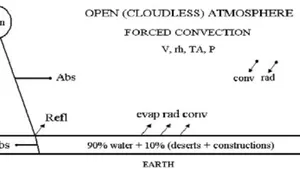
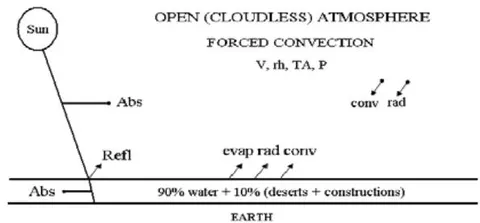
Being the planet a big water box with a small part of land it can be represented by Figure 1
When the sky is cloudy, the planet can be represented by Figure 2.
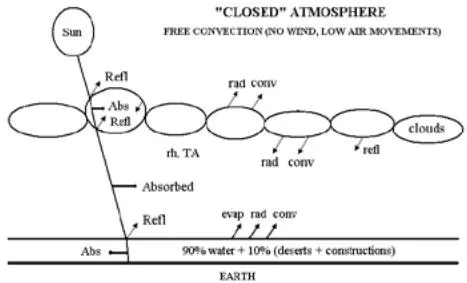
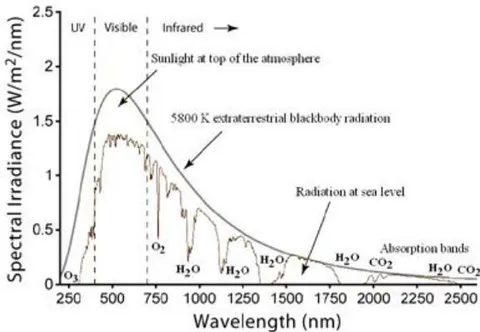
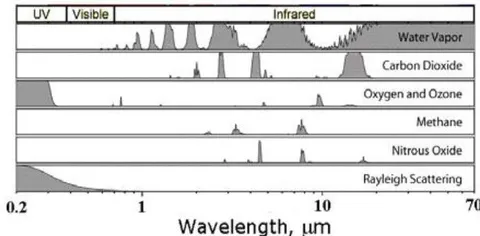
Both systems are very similar to an open evaporator and to a closed evaporator, respectively. The physical and mathematical demonstrations and comparisons of both systems are shown in Sartori (1996; 2019a). The land part do not appear in Figures 1 and 2. Figure 3 presents the well-known graph of the solar radiation wavelength spectrum with the absorption bands by different atmospheric gases. Figure 4 is an equivalent representation of Figure 3, but clearer and more didactic
All of us know that the global warming literature attributes the air temperature mainly to a greenhouse effect caused by the CO2 and its radiation absorption. Such literature and corresponding verbal statements blame theCO2 for the planet's temperature. However, this is equivocated because the air temperature is a consequence of many factors and not only of a gas, which participation in the atmosphere is of only , as well as the levels of CO2 are not identical around the globe. The air temperature is a consequence of the heat and mass balances between the Earth's surface and the air where the Sun's heat, the heat and mass by evaporation, the heat and mass by sublimation from the glaciers, the heat by convection, conduction and radiation, the heat and mass by some human activities, greenhouse effect by cloud covers, the greenhouse effect by some gases included the water vapor should be considered. This is complex and cannot be reduced to a single gas. It is necessary to identify the processes. Such knowledge, among others, lead this author to discover the New Water Cycle in a few seconds, to discover new laws of evaporation, to create the general law of evaporation by Dalton-Sartori (see Sartori 2019b), to create an entire theory for the planet already confirmed by many experimental data from around the world, to create many important and accurate equations such as for evaporation and convection coefficient etc. There are more things between the sky and the Earth's surface than the vane philosophy and "science" can imagine.
We can verify mathematically which is the contribution of the greenhouse effects by the four gases (water vapor, carbon dioxide, methane and nitrous oxide) considered by the literature on global warming. The physical properties that make a substance (glass, plastic, gases etc) to be or not to be of greenhouse effect is its concentration and its radiation absorption. So, Figures 3 and 4 show that the absorption of radiation by the water vapor is much greater than that of the CO2. It is known that its concentration is about 100 times greater than that of the CO2. In these graphs, we also see that the absorptions of radiation by the methane and nitrous oxide are negligible. We also know that the concentrations of the methane and nitrous oxide are insignificant. From these data, we verify that the water vapor is the gas of highest greenhouse effect and much higher than that of theCO2, but the literature on global warming neglect it due to its erroneous concept "feedback", which one also eliminates the water vapor from the atmosphere. Absurdity! The water vapor is always present in the atmosphere causing greenhouse effect, strong heat and mass transfer processes, floods, droughts and participates strongly in storms, tornadoes and hurricanes.
Admitting that the concentrations of the 4 gases that generate the highest greenhouse effects are, respectively, 45,000; 400; 1.8; 0.32 ppm and that they have the same radiation absorption, the greenhouse effect becomes dependent only on each gas concentration and thus a rule of three can be established to verify the influences that each gas would have on the air temperature of . The law of Beer-Lambert says that the radiation absorption per substance is directly proportional to the length L through which the ray crosses the substance and to its concentration c, i. e., AαLc. Therefore, considering L constant, this law also justifies the application of the rule of three. In this way we have
That is, the percentage influence that each gas would have on the temperature is
As we can see, the influence of the CO2 is less than one percent on the air temperature. At the same time, we observe the high contribution of the water vapor for the formation of the air temperature. Moreover, the influences of the methane and nitrous oxide are still much lower, that is, nothing. Furthermore, as in reality the radiation absorption of the other 3 gases are much lower than that of the water vapor, the percentages to be obtained are even much lower than those found above. Less than nothing! Additionally, as described above, it is not only a gas or 4 gases that compose or command the air temperature and then the participation of the greenhouse effect by the CO2 in the air temperature is still more negligible. Less than lessof nothing!
b) The New Water Cycle
All of us know that the planet has about of water and of land, but people should also to know that the land part is mostly covered by vegetation and that water also exists at the vegetation, humid soils, animals and glaciers. Therefore, we can consider that about of the planet emit water by evaporation, because we can neglect only the constructions and deserts from this process (Sartori 2019b). Besides this, the vegetation and the animals evaporate through their leaves, trunks, branches and sides, which increase the area of evaporation in comparison to the flat area of the planet. This is a planet of evaporation.
The IPCC says that of the water vapor in the air have natural origin and thus no deindustrialization could change the amount of this gas in the atmosphere. Problem misunderstanding! Such misunderstanding clearly demonstrates the total lack of knowledge about the mass and heat behaviors of the atmosphere as well as about the nature of human activities. The atmosphere is not a monolithic block where only one factor at one side can cause all phenomena and consequences at the other side. On the contrary, the atmosphere is gaseous whose physical processes have multiple causes, variations and consequences. Such human activities humidify the planet, produce more clouds (or fewer clouds when the saturation limits of clouds for aerosols are reached, see Sartori 2012, 2015, 2019b), more precipitation (or less precipitation) and more floods in irregular amounts, times and places.
For example, the emissions of water vapor by nuclear and fossil fuel power plants, industries, vehicles, wildfires, burnings etc change the local or regional conditions of the atmosphere, directly. Moreover, the "science" on global warming considers the atmosphere as having only the role of warming and in its global panorama. As demonstrated in Sartori (2012, 2015, 2019a, 2019b) the H2O in the air also has human causes. In these publications, it is shown, among other things, that the water vapor in the air due to some human activities increases clouds, humidity, rain, floods etc., and modifies the natural cycles because they do this in higher amount, more rapid and more irregularly than the natural cycles can do. The traditional or natural water cycle and the new water cycles are mass balances! As the new water cycle clearly shows, it is not a matter of changing completely the atmosphere, but to modify partially locally or regionally something in the atmosphere. The IPCC sees only the CO2, its greenhouse effect, its radiation and a global temperature, and thinks that all of this is everything and homogeneous or uniform globally.
The natural water cycle became known as Precipitation = Evaporation, but this equation needs a correction to include the sublimation from glaciers, and thus we have Precipitation = Evaporation + Sublimation. The new water cycle is not related to this correction; instead, it is related to the interference of certain human activities on the climate as seen below.
If I throw a drop of water into the atmosphere, one drop of water will come back and this equation must be modified to
Of course, one drop does not matter, but only one fossil fuel power plant of 600 MW emits to the air more than 50 million liters per day of water in form of vapor. Imagine the billions of fossil fuel and nuclear power plants, industries, vehicles, burnings, wildfires etc., that throw into the atmosphere at least millions of tons of water and aerosols, and much heat in every instant around the world and faster and more irregularly than the natural cycles can do. These are just the factors that form clouds and affect hydrological and other natural cycles and thus the climate. A nuclear power plant throws into the atmosphere about more water than a fossil fuel power plant.
The new water cycle also shows that the issue is not to change completely, but to modify something partially. Such human actions humidify the planet, produce more clouds (or fewer clouds when the saturation limits of clouds for aerosols are reached, see Sartori 2012; 2015, 2019a, 2019b), more precipitation (or less precipitation) and more floods in irregular amounts, times and places. The strong heats and masses emitted by such human sources also cause atmospheric instability, being that storms, tornadoes and hurricanes happen only when the atmosphere is unstable.
We can make the water mass balance for the new water cycle as follows. For a control volume of the Earth's surface we have
which means
Variation of accumulation of water mass (in the bodies of water, soils, vegetation and animl) = variation of water mass in (precipitation) - variation of water mass out (evaporation) - variation of water mass out (sublimation) - variation of water mass out (human activities).
where water mass emitted by human activities
The water mass balance of the new water cycle is completed when we make the mass balance for a selected layer (control volume) of the atmosphere
which means
Variation of accumulation of water mass (clouds + water vapor) = variation of the water mass in (evaporation) + variation of the water mass in (sublimation) + variation of the water mass in (human activities) - variation of the water mass out (precipitation), is time.
As we can see, everything is a matter of variation. The "science" on global warming would never discover the new water cycle because it considers the atmosphere as a warming and a monolithic body only as well as eliminates the water from the atmosphere.
c) The global temperature
The global temperature has been used for many purposes such as to make alarmism about the warming of the planet due to a negligible temperature of for 2100, to try to explain climatic events, to try to justify the greenhouse effect of the CO2 etc. However, we should reason.
In a world that grows in population and in services it is obvious that with the current technology, it needs more industrialization including power plants, and consequently more emissions of gases and heat, thus warming the places locally or regionally, directly. That is, before to activate a greenhouse effect, the emissions heat the air around and thermometers in the vicinity record such new temperature of the air.
An air temperature obtained globally does not serve to explain climatic events, because these happen locally or regionally. A man with the head into a freezer and the feet into an oven has an average temperature of , normal, therefore. If statistics were physics. That is, a global temperature does not explain local conditions. Moreover, it must be known that what generates atmospheric events is the temperature difference, not the temperature itself.
In the nature, the events happen from the less probable situation to the most probable situation, i. e., from the high pressure to the lower pressure. The special fact is that pressure is function of temperature, thus a pressure difference (P1 - P2) is equivalent to the temperature difference . The temperature difference is the driving force for the evaporation, wind, rain, convection, conduction, radiation exchange, storms, tornadoes, hurricanes etc. These events happen locally or regionally. A global temperature difference makes no sense and a global temperature has a limited importance.
An excellent example that explains the high influence of local temperature differences on climate events is the following, explained for the first time in the world. Always when there is a great wildfire, we see the reporters invariably saying something like this: "The strong winds prevent or make difficult the fire combat". It is not because appeared a fire and due to a bad luck appeared the strong winds, too. No! The explanation is that the fire heats strongly the air, this creates a great temperature difference in relation to the air of the vicinity and this generates strong air streams, that is, strong winds. This also shows that the atmospheric events are local or regional.
Calculations performed by this author show that for the wind speed is , for the wind speed is and for the wind speed is . While the first and second cases correspond to speeds of hurricanes, the third one only moves the leaves of small trees.
The wind results from a horizontal air pressure difference, and since the pressure is function of the temperature, the wind is function of temperature differences. Since the Sun heats different parts of the Earth differently, this causes pressure differences and then the Sun is the force that generates the local winds. Fossil fuel power plants emit gases at and we can understand that this affects the local or regional winds.
In view of this, global temperatures of 1.0, 1.5 or by 2100 or lower global temperatures than these ones for the current days do not cause floods, droughts, hot air at one side of the planet and a terribly cold at the opposite one, storms, tornadoes, hurricanes etc. Each one of these events has its own causes and consequences. For example, the heat waves that reach Europe are due to African winds, not due to a greenhouse effect of the CO2.
d) Erroneous understanding about evaporation
The "science" on global warming makes lots of scientific insanities, being another one the absurd belief that increasing the air temperature the evaporation increases.
The fact that a nonprofessional person believes that higher air temperatures produce higher evaporation is acceptable, but that an entire science believes the same and as one of its most relevant and fundamental principles is unacceptable. In summer, the evaporation is higher because the Sun heats more the water being that evaporation is an exponential function of the water temperature while increasing the air temperature decreases the relative humidity, thus increasing the evaporation. However, the increase of the air temperature alone decreases the evaporation.
We can see in almost all corresponding equations that the evaporation is directly proportional to the pressure difference and thus to the temperature difference between the water surface and the air. See, for example, the Sartori equation for evaporation (Sartori, 2019a; 2019b)
where evaporation, . wind speed, m/s; L length of water surface in the wind direction, m; partial pressures of the water vapor at the dew point temperature, at the water surface temperature, respectively, Pascal; atmospheric pressure, Pascal.
However, many important institutions and followers repeat the referred error and blame the carbon dioxide. See, for example, the NOAA (2017) statement: "the warmer air caused by the global warming increases the evaporation". Still, (NASA 2017a, b): "When the concentration of carbon dioxide increases, more water evaporates, which then amplifies the greenhouse warming and then the CO2is the gas that forms the temperature and the size of the greenhouse effect". Moreover, "The amount of water vapor in the atmosphere exists in the direct relation of the temperature. If you increase the air temperature, more water evaporates and this one becomes vapor and vice-versa. Thus, when some extra thing causes an increase of the temperature (such as extra CO2) more water evaporates. Then, as the water vapor is a greenhouse gas, this additional water vapor makes the temperature to increase still more, a positive feedback. (Skeptical Science). If the water vapor in the atmosphere existed in the direct relation with the temperature, the Sahara would be the most humid place on Earth! When the premise is wrong, the conclusions are also wrong, that is, the CO2 is not the gas that forms the temperature and the size of the greenhouse effect. This "science" makes confusion between the capacity of the warm air to contain more humidity with the capacity of evaporation, due to lack of knowledge on evaporation. See Sartori (2019b) for a more complete analysis about the subject.
Also, see Sartori (2019b) for a demonstration on how hurricanes form with extremely high pressures and extremely high amounts of water vapor, together with high temperatures, which ones are reached only by direct human actions on the air, becoming evident the influence of these human activities on the generation of these phenomena. Meanwhile, such literature thinks that the CO2 and a negligible temperature of indirectly and for 2100 not having the proper physical properties are the guilty of everything nowadays.
III. CONCLUSION
In this paper, we see how the planet and its atmosphere really work regarding climate events. Also shown are the calculations and physical demonstrations that the CO2 has a participation in the air temperature of much less than one percent, negligible, therefore. It is also shown the new water cycle, discovered by this author, who demonstrates it physically and mathematically. This new cycle evidences the influence of certain human activities on the natural cycles and thus on the climate, that is, not as such influence has been said to us up to now. The "science" on global warming would never discover the new water cycle because such "science" considers the atmosphere as a warming and monolithic body only as well as eliminates the water from this gaseous layer. Also shown is the fact that climate events depend on temperature differences, not on a temperature itself. Global temperature differences make no sense. Global temperatures do not serve to explain climatic events, because these happen locally or regionally. In view of this, global temperatures of 1.0, 1.5 or by 2100 or lower global temperatures than these ones for the current days do not cause floods, droughts, hot air at one side of the planet and a terribly cold at the opposite one, storms, tornadoes, hurricanes etc. Each one of these events has its own causes and consequences. Temperature differences are the driving force for the atmospheric events. If the water vapor in the atmosphere existed in the direct relation with the air temperature, the Sahara would be the most humid place on Earth.