Introduction-Aimed at boosting connectivity and cargo transportation between Central Asia and South Caucasus, Kazakhstan Government on June 23 rd 2023 announced establishment of a jointly owned logistics company along with Azerbaijan and Georgia. A bilateral agreement was signed during Kazakhstan Prime Minister Alikhan Smailov’s visit to Baku with his Azerbaijani counterpart Ali Asadov. Georgia, is expected to sign the agreement soon. The company’s primary goal is to transfer freight between China and Europe using the Trans-Caspian International Transport Route (TITR), which is also called as the Middle Corridor. It also aims to reduce transportation tariffs and increase connectivity efficiency by streamlining procedures with digital means. This route seeks to reduce delivery time between Chinese territory and Europe from current 18-23 days to 10-15 days. 1 A large part of the rail traffic from China and Central Asia to Europe passes through Russia.
## I. INTRODUCTION
Aimed at boosting connectivity and cargo transportation between Central Asia and South Caucasus, Kazakhstan Government on June $23^{\mathrm{rd}}$ 2023 announced establishment of a jointly owned logistics company along with Azerbaijan and Georgia. A bilateral agreement was signed during Kazakhstan Prime Minister Alikhan Smailov's visit to Baku with his Azerbaijani counterpart Ali Asadov. Georgia, is expected to sign the agreement soon. The company's primary goal is to transfer freight between China and Europe using the Trans-Caspian International Transport Route
(TITR), which is also called as the Middle Corridor. It also aims to reduce transportation tariffs and increase connectivity efficiency by streamlining procedures with digital means. This route seeks to reduce delivery time between Chinese territory and Europe from current 18-23 days to 10-15 days. $^{1}$ A large part of the rail traffic from China and Central Asia to Europe passes through Russia.[^1] However, due to sanctions imposed on Russia following the Ukraine crisis, Central Asian and South Caucasian countries seeking for alternative routes. The TITR, or Middle Corridor is therefore gaining popularity as a key East-West link and holds immense potential to boost economic growth across the regions.[^2] $^{2}$
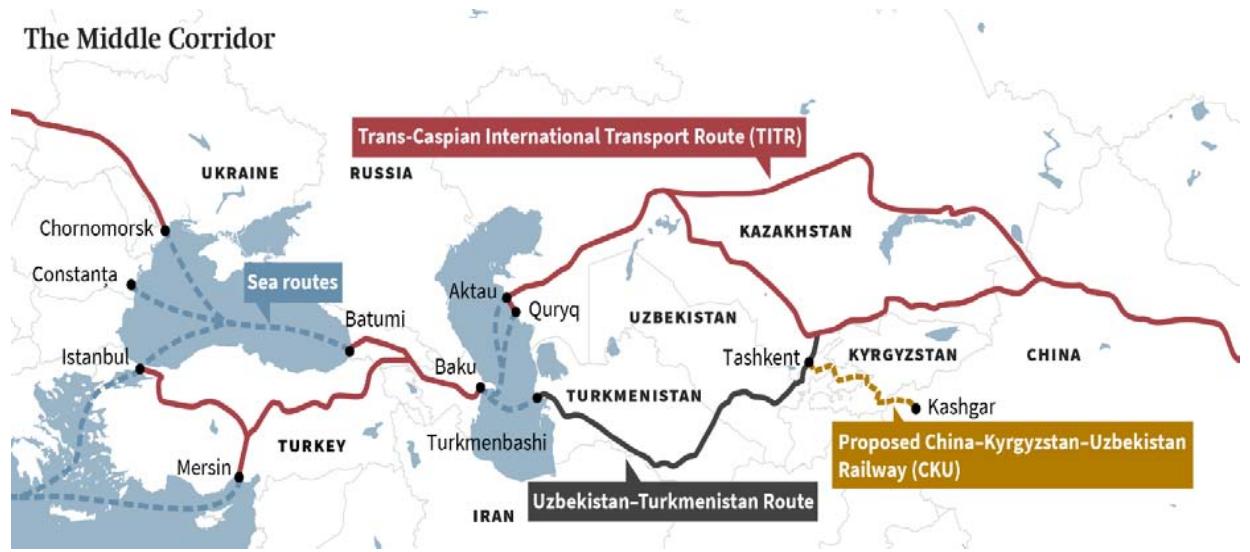 II. MIDDLE CORRIDOR AND CHANGING REGIONAL DYNAMICS Source: www.middlercorridor.com
The Middle Corridor is a multimodal transportation corridor that runs from China through Kazakhstan, partially through Uzbekistan and Turkmenistan, and across the Caspian Sea to the Black Sea via Azerbaijan and Georgia. From there, two routes reach Europe via Turkey and Black Sea. It consists mainly of around 4,250 km of rail lines and approximately 500 kilometers of waterway. Since the Ukraine crisis, cargo volumes via the Middle Corridor has more than doubled as compared to 2021, reaching 1.5 million tons in 2022, while shipping volume along the conventional Northern Route via Russia decreased by
34%. According to analyses by German Economic Team, the transit volume might increase to between 15 and 18 million tonnes by 2030.[^3]4
The Middle Corridor has become an appealing economic route for Central Asian and South Caucasian countries not just because it provides a direct link to Europe via Kazakhstan, Azerbaijan and Georgia, but also because it reduces the reliance on Russia and Iran. For that reason, several countries in Central Asia and Caucasus regions such as Kazakhstan, Azerbaijan and Georgia, have expressed support for the Middle Corridor, leading to collaboration among various business consortia focused on improving speed and ease of transportation across these regions.
Kazakhstan and Azerbaijan, which are mainly involved in the Middle Corridor transit, are also strengthening their connectivity through the development of various ports including Aktau Seaport of Kazakhstan and Alyat Seaport of Azerbaijan.5
Similarly, Uzbekistan is also interested in engaging with Azerbaijan in efforts to expand connectivity in the Caspian Sea region for developing linkages with Europe through the "Middle Corridor".[6]
The government of Kazakhstan has taken steps to further improve ties with Turkey, the European Union, and China to diversify its trade routes.[^7][^4]7 Earlier in March 2023, the 'Kazpost' Kazakhstan's national postal service, 'WEA Transport GmbH' a German rail company, and 'Huapengfei Company Limited' a Chinese domestic logistics provider signed a memorandum on March 2023 to address the logistical issues on the Middle Corridor.[^8]8
China has also been seeking new routes to Europe, alternative to the China-Europe Railway Express, which uses Russian lines such as the Northern Corridor that connects Russia and China's Pacific ports to Europe. In February 2023, representatives from the Chinese and Kazakh railway industries signed a bilateral agreement regarding cargo[^9] transportation via rail through the Middle Corridor. $^{9}$ The agreement focuses on exchanging information about freight movements utilizing advanced technology, coordinating activities at container ports, improving physical connections, and enhancing transcontinental travel capacity across the Middle Corridor.
## III. WHY MIDDLE CORRIDOR IS IMPORTANT FOR KAZAKHSTAN?
The development of the TITR, or the Middle Corridor and Central Asian regional cooperation are most important agenda for Kazakhstan. Kazakhstan believes that the TITR route holds significant potential for the involved countries as this corridor links the Central Asian and Caucasus's key economic hubs to each other and connects Central Asian landlocked countries to other Eurasian and global markets. As the biggest economy in the region, Kazakhstan is turning towards the Caucasus not only to further strengthen partnerships but also to seek support for the TITR, along with Azerbaijan and Georgia.
From a Kazakhstan's perspective, the Middle Corridor presents an opportunity to boost energy exports to Europe. After the Russian-Ukraine crisis, there is a clear demand in Europe for alternatives to Russian energy, the EU is looking for more energy imports from Central Asia. Kazakhstan, along with other Central Asian countries and even Caucasian countries like Azerbaijan, want to expand its energy export.[10] In 2022, German crude oil imports from Kazakhstan was at 8.2 million tons, which was $10\%$ higher than the previous year, and likely to increase in 2023. Kazakhstan supplied 90,000 tons of crude oil to Germany through the sanctions-exempt Russian pipeline Druzhba's southern branch during February-April 2023, replacing Russian supplies.[11] Kazakhstan also reached an agreement with Azerbaijan in early 2023 to annually ship up to 1.5 million tons of Kazakh oil through the South Caucasus, most of it bound for Europe. Kazakhstan hopes to transfer 1.5 million tons of oil (Approx $2 - 3\%$ of Kazakhstan's total oil exports) to Europe by 2023 via the Middle Corridor, as part of its attempts to diversify transport routes.[12] For
Kazakhstan, the Middle Corridor can bring foreign investments, profits, create jobs, improve country's international image, and give an opportunity to diversify its economy.
Additionally, cultural ties between Kazakhstan and the Caucasian countries are strong, particularly between Azerbaijan and Kazakhstan, given their shared Turkish heritage. Kazakhstan and some Caucasian states also share membership of several organizations, including the Organization of Turkic States, the Eurasian Economic Union, and the Commonwealth of Independent States.
Turkey, also interested in the development and usage of the Middle Corridor. On May 10th 2022, Turkish President Recep Tayyip Erdoğan during his meeting with Kazakh President Kassym-Jomart Tokayev in Turkey, both the president discussed the importance of the Middle Corridor and said both the country is willing to enhance cooperation and implement joint infrastructure projects to capitalize the potential of this transport corridor.[13] For the EU the Middle Corridor is a potential trade route to reach expanding markets of Central Asia and the Caucasus region. Countries like Kazakhstan, Uzbekistan, Azerbaijan and Georgia can help to mitigate the Europe's energy needs by supplying Oil and Gas through the Middle Corridor. German President Frank-Walter Steinmeier during his visit to Kazakhstan in June 2023 described the Middle Corridor as an alternative transport route for goods between Asia and Europe that is geared to the future.[14]
## IV. CHALLENGES
There are several challenges around the Middle Corridor that needs to be addressed to make the route popular among freight transporters. The underdeveloped infrastructure and transfer services, border-crossing delays are among the bottlenecks. The Middle Corridor has played a relatively minor role in world commerce so far compared to the Northern Route due to limited capacity and higher costs. Despite the significant increase in trade volumes, currently the Middle Corridor's capacity can only cover less than $10\%$
of the transport traffic between the EU and China, and it is more expensive as compared to the Northern Corridor. China is one of the biggest investor in the Central Asian region, it is investing heavily in infrastructure and connectivity projects including the TITR. For developing the TITR to its full potential Chinese investments and cooperation might play an important role, but taking in to account China's current economic slowdown there is a possibility that it can impact the developments of the new trade route if Chinese economic growth continues to reduce.[15]
## V. CONCLUSION
The geopolitical and geo-economic attractiveness of the Middle Corridor is that, it is a short and secure route, approximately 2,000 kilometers shorter than the Northern Corridor, which passes through Russia.[16] The Middle Corridor helps in mitigating the risks, uncertainties, and sanctions connected with transit through Russia. Several multinational logistics companies are already using the Middle Corridor.[17] Both Western Countries and China view the establishment of alternative routes through the Middle Corridor as an opportunity to expand their influence. Due to recent changes in political conditions following the Russian-Ukrainian crisis, it appears that the Middle Corridor is getting attention, and its usage may increase because of current regional dynamics.
Generating HTML Viewer...
Funding
No external funding was declared for this work.
Conflict of Interest
The authors declare no conflict of interest.
Ethical Approval
No ethics committee approval was required for this article type.
Data Availability
Not applicable for this article.
How to Cite This Article
Biswarup Baidya. 2026. \u201cCaspian Sea Route Gains Traction in Changing Regional Dynamics\u201d. Global Journal of Human-Social Science - F: Political Science GJHSS-F Volume 23 (GJHSS Volume 23 Issue F4): .
Explore published articles in an immersive Augmented Reality environment. Our platform converts research papers into interactive 3D books, allowing readers to view and interact with content using AR and VR compatible devices.
Your published article is automatically converted into a realistic 3D book. Flip through pages and read research papers in a more engaging and interactive format.
Introduction-Aimed at boosting connectivity and cargo transportation between Central Asia and South Caucasus, Kazakhstan Government on June 23 rd 2023 announced establishment of a jointly owned logistics company along with Azerbaijan and Georgia. A bilateral agreement was signed during Kazakhstan Prime Minister Alikhan Smailov’s visit to Baku with his Azerbaijani counterpart Ali Asadov. Georgia, is expected to sign the agreement soon. The company’s primary goal is to transfer freight between China and Europe using the Trans-Caspian International Transport Route (TITR), which is also called as the Middle Corridor. It also aims to reduce transportation tariffs and increase connectivity efficiency by streamlining procedures with digital means. This route seeks to reduce delivery time between Chinese territory and Europe from current 18-23 days to 10-15 days. 1 A large part of the rail traffic from China and Central Asia to Europe passes through Russia.
Our website is actively being updated, and changes may occur frequently. Please clear your browser cache if needed. For feedback or error reporting, please email [email protected]
Thank you for connecting with us. We will respond to you shortly.