Loading menu…

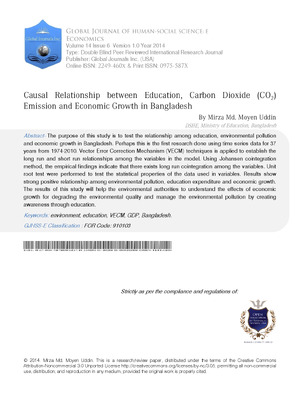
Causal Relationship between Education, Carbon Dioxide ( ) Emission and Economic Growth in Bangladesh

§ DSHE, Ministry of Education, Bangladesh

Send Message

To: Author

Causal Relationship between Education, Carbon Dioxide ( ) Emission and Economic Growth in Bangladesh

Article Fingerprint

ReserarchID

Q62Y3

Causal Relationship between Education, Carbon Dioxide ( ) Emission and Economic Growth in Bangladesh Banner

Key Research Insights

Synthesized scholarly intelligence & interactive research assistant
  • English
  • Afrikaans
  • Albanian
  • Amharic
  • Arabic
  • Armenian
  • Azerbaijani
  • Basque
  • Belarusian
  • Bengali
  • Bosnian
  • Bulgarian
  • Catalan
  • Cebuano
  • Chichewa
  • Chinese (Simplified)
  • Chinese (Traditional)
  • Corsican
  • Croatian
  • Czech
  • Danish
  • Dutch
  • Esperanto
  • Estonian
  • Filipino
  • Finnish
  • French
  • Frisian
  • Galician
  • Georgian
  • German
  • Greek
  • Gujarati
  • Haitian Creole
  • Hausa
  • Hawaiian
  • Hebrew
  • Hindi
  • Hmong
  • Hungarian
  • Icelandic
  • Igbo
  • Indonesian
  • Irish
  • Italian
  • Japanese
  • Javanese
  • Kannada
  • Kazakh
  • Khmer
  • Korean
  • Kurdish (Kurmanji)
  • Kyrgyz
  • Lao
  • Latin
  • Latvian
  • Lithuanian
  • Luxembourgish
  • Macedonian
  • Malagasy
  • Malay
  • Malayalam
  • Maltese
  • Maori
  • Marathi
  • Mongolian
  • Myanmar (Burmese)
  • Nepali
  • Norwegian
  • Pashto
  • Persian
  • Polish
  • Portuguese
  • Punjabi
  • Romanian
  • Russian
  • Samoan
  • Scots Gaelic
  • Serbian
  • Sesotho
  • Shona
  • Sindhi
  • Sinhala
  • Slovak
  • Slovenian
  • Somali
  • Spanish
  • Sundanese
  • Swahili
  • Swedish
  • Tajik
  • Tamil
  • Telugu
  • Thai
  • Turkish
  • Ukrainian
  • Urdu
  • Uzbek
  • Vietnamese
  • Welsh
  • Xhosa
  • Yiddish
  • Yoruba
  • Zulu
Reading Preferences
Font Size
Line Spacing
Background
This converted HTML version may contain rendering inconsistencies. Please refer to the PDF for the authoritative version, or click here to provide feedback.

Abstract

The purpose of this study is to test the relationship among education, environmental pollution and economic growth in Bangladesh. Perhaps this is the first research done using time series data for 37 years from 1974-2010. Vector Error Correction Mechanism (VECM) techniques is applied to establish the long run and short run relationships among the variables in the model. Using Johansen cointegration method, the empirical findings indicate that there exists long run cointegration among the variables. Unit root test were performed to test the statistical properties of the data used in variables. Results show strong positive relationship among environmental pollution, education expenditure and economic growth. The results of this study will help the environmental authorities to understand the effects of economic growth for degrading the environmental quality and manage the environmental pollution by creating awareness through education.

References

18 Cites in Article
  1. 1. Amzath Ahmed,Drama Herve,Laijun Zhao (2012). Empirical Study on Relationship between Environmental Pollution and Economic Growth of Maldives Using Environmental Kuznets Curve and OLS Method. International Journal of Business and Management, 7(21)
  2. 2. K. Alkhathlan,M. Alam (2012). Carbon Dioxide Emission, Energy Consumption and Economic Growth in Saudi Arabia: A Multivariate Co integration Analysis. British Journal of Economics, Management and Trade, 2(4), 327-339.
  3. 3. Harry Bloch,Shuddhasattwa Rafiq,Ruhul Salim (2012). Coal consumption, CO2 emission and economic growth in China: Empirical evidence and policy responses. Energy Economics, 34(2), 518-528.
  4. 4. D. Dickey,W.A (1981). Fuller, 1981, Distribution of the estimators for the autoregressive time series with a unit root, Econometrica. Econometrica, 49, 1057.
  5. 5. R. Engle (1987). Co-Integration and Error Correction: Representation, Estimation, and Testing. Econometrica, 55, 251.
  6. 6. L. Lau (2009). A comparative study on the energy policies in Japan and Malaysia in fulfilling their nations’ obligations towards the Kyoto Protocol. Energy Policy, 37, 4771-4780.
  7. 7. B. Gunter (2010). The Impact of Development on Emission: A case study for Bangladesh until 2050. Bangladesh Development Research Working Paper Series
  8. 8. G. Grossman,A. Krueger (1991). environmental impacts of a North American Free Trade Agreement.
  9. 9. D. Gujarati (2011). Basic Econometrics.
  10. 10. R. Cheng,Y. Rajib,S. (2012). International Trade and Carbon Emissions ( CO ): The case of Bangladesh. Journal of Economics and Sustainable Development, 3, 18-26.
  11. 11. S. Kuznets (1955). Kuznets, S., 1955, Economic growth and income inequality, American Economic Review. American Economic Review, 49, 1-28.
  12. 12. McKinsey Company,sustaining growth (2008). The McKinsey Quarterly. The McKinsey Quarterly, 7, 2-33.
  13. 13. N. Odhiambo (2011). Economic growth and carbon emission in South Africa: An empirical investigation. International Business and Economics Research Journal, 10(7), 75-82.
  14. 14. Phillips-Perron (1988). Phillips-Perron, 1988), Testing for Unit root in Time Series Regression, Biometrica. Biometrica, 75, 335-346.
  15. 15. Xingjun Ru,Shaofeng Chen,Hongxiang Dong (2012). A Study on Relationship between CO2 Emissions and Economic Development in China Based on Dematerialization Theory. Energy and Environment Research, 2(2), 37-44.
  16. 16. B. Saboori,J. Sulaiman (2012). An Empirical Analysis of the Environmental Kuznets Curve for CO2 Emissions in Indonesia: The Role of Energy Consumption and Foreign Trade. International Journal of Economics and Finance, 4, 243-251.
  17. 17. M. Salequzzaman (2003). J.K. Davis, 2003, Environmental Education and Environmental Management in Bangladesh and their Sustainability, Environmental Informatics Archives, 2, 70-82.
  18. 18. S. Ong (2012). Interactions between economic growth and environmental quality: panel and non-panel analyses. Applied Mathematical Sciences, 7, 687-700.

Funding

No external funding was declared for this work.

Conflict of Interest

The authors declare no conflict of interest.

Ethical Approval

No ethics committee approval was required for this article type.

Data Availability

Not applicable for this article.

How to Cite This Article

Mirza Md. Moyen Uddin. 2014. "Causal Relationship between Education, Carbon Dioxide ( ) Emission and Economic Growth in Bangladesh". Global Journal of Human-Social Science - E: Economics GJHSS-E Volume 14 (GJHSS Volume 14 Issue 43 (E6)).

More Citation Formats

Download Citation

Journal Specifications

Crossref Journal DOI 10.17406/GJHSS

Print ISSN 0975-587X

e-ISSN 2249-460X

Keywords
Classification
GJHSS-E Classification FOR Code: 910103
Version of record
v1.2

Issue date
August 22, 2014

Language
English
Order Article Reprint
Experience in AR

Explore published articles in an immersive Augmented Reality environment. Our platform converts research papers into interactive 3D books, allowing readers to view and interact with content using AR and VR compatible devices.

Read in 3D

Your published article is automatically converted into a realistic 3D book. Flip through pages and read research papers in a more engaging and interactive format.

Article Matrices
Total Views: 1.2K
Total Downloads: 74
All Trends

Request Access

Please fill out the form below to request access to this research paper. Your request will be reviewed by the editorial or author team.
X

This is the heading

Lorem ipsum dolor sit amet, consectetur adipiscing elit. Ut elit tellus, luctus nec ullamcorper mattis, pulvinar dapibus leo.

High-quality academic research articles on global topics and journals.

Causal Relationship between Education, Carbon Dioxide ( ) Emission and Economic Growth in Bangladesh

Mirza Uddin
Mirza Uddin DSHE, Ministry of Education, Bangladesh