
Introduction
The proliferation of AI agents in critical domains—from autonomous vehicles navigating shared roadways to trading algorithms operating in financial markets—has created an urgent need for robust governance mechanisms that can operate without centralized control. Traditional approaches to multi-agent coordination rely heavily on predefined rules or centralized authorities, which become inadequate as systems scale and encounter novel situations not anticipated by their designers.
This paper addresses a fundamental challenge in AI systems: how can autonomous agents develop and maintain effective governance structures that emerge from their interactions rather than being imposed externally? I propose that the solution lies in equipping agents with sophisticated causal reasoning capabilities that enable them to understand not just what happened, but why it happened and what might have happened under different circumstances.
1.1 Problem Statement
Current multi-agent systems face several critical limitations:
Limited Adaptability: Predefined rule sets cannot anticipate all possible scenarios that agents may encounter in dynamic environments. This leads to brittle behavior when systems face novel situations or adversarial conditions.
Scalability Challenges: Centralized governance mechanisms become computational bottlenecks as the number of agents grows, and they represent single points of failure that can compromise entire systems.
Interpretability Gaps: Many existing coordination mechanisms operate as "black boxes," making it difficult to understand why certain behaviors emerge or how to modify them when they prove suboptimal.
Value Alignment Issues: Without explicit mechanisms for value learning and norm formation, agent collectives may develop behaviors that achieve narrow objectives while violating broader ethical principles or human values.
1.2 Proposed Solution
I introduce a framework for causal, self-governing AI agents that addresses these challenges through three key innovations:
Causal Reasoning Architecture: Agents maintain explicit causal models of their environment and fellow agents, enabling them to understand the mechanistic relationships underlying observed phenomena rather than relying solely on correlational patterns.
Counterfactual Inference Capabilities: By reasoning about alternative histories and potential futures, agents can evaluate the consequences of different action choices before committing to them, leading to more thoughtful and coordinated behavior.
Emergent Norm Formation: Through structured interactions and collective reasoning processes, agents develop shared behavioral norms that reflect their collective experiences and values, creating governance structures that adapt to changing circumstances.
1.3 Contributions
This work makes several key contributions to the field of multi-agent AI systems:
Theoretical Framework: I provide a formal mathematical foundation for causal reasoning in multi-agent contexts, extending existing causal inference techniques to handle the complexities of agent interactions and emergent phenomena.
Architectural Design: I present a concrete system architecture that enables practical implementation of causal self-governing agents, including detailed specifications for each component and their interactions.
Norm Emergence Protocol: I develop a novel algorithm for collective norm formation that balances individual agent autonomy with system-wide coordination needs.
Empirical Validation: Through extensive simulation studies, I demonstrate the effectiveness of our approach across diverse domains and compare it with existing coordination mechanisms.
Safety Analysis: I provide theoretical guarantees about the behavior of our system and identify conditions under which it can be expected to produce beneficial outcomes.
Background and related work
2.1 Multi-Agent Systems and Coordination
Multi-agent systems research has long grappled with the challenge of achieving coordination among autonomous entities with potentially conflicting objectives. Early approaches focused on mechanism design, where system designers create incentive structures that align individual and collective interests. While effective in constrained domains, these approaches struggle with the complexity and unpredictability of real-world environments.
Game-theoretic approaches have provided valuable insights into strategic interactions among rational agents, but they typically assume complete information and well-defined utility functions—assumptions that rarely hold in practice. More recent work on learning in games has relaxed some of these assumptions, but convergence guarantees often require restrictive conditions.
Evolutionary approaches to multi-agent coordination have shown promise in developing robust behaviors through population-level selection pressures. However, these methods typically require many generations to converge and may not be suitable for systems that need to adapt quickly to changing conditions.
2.2 Causal Inference and AI
The field of causal inference has experienced remarkable growth in recent years, driven by advances in both theory and practical applications. Pearl's et al. (2009) [1] causal hierarchy distinguishes between three levels of causal reasoning: association (seeing), intervention (doing), and counterfactuals (imagining). Most current AI systems operate primarily at the associational level, limiting their ability to understand and predict the effects of novel interventions.
Recent work has begun incorporating causal reasoning into AI systems, particularly in the context of robustness and generalization. Causal representation learning aims to discover causal structures from observational data, while causal reinforcement learning focuses on using causal knowledge to improve sample efficiency and transfer learning.
2.3 Emergent Norms in Social Systems
The study of norm emergence has deep roots in sociology, anthropology, and evolutionary biology. Norms serve crucial functions in social systems by reducing coordination costs, resolving conflicts, and enabling cooperation among strangers. Understanding how norms emerge and evolve in human societies provides valuable insights for designing artificial systems. A study by Bicchieri, C et al. (2016) [8] on how social norms can be identified, measured, and influenced in real-world contexts.
Computational models of norm emergence have typically focused on simple scenarios with binary choices and local interactions. While these models have provided important theoretical insights, they have limited applicability to complex multi-agent AI systems where agents must coordinate across multiple dimensions and scales. A study by Sen, S., & Airiau, S (2007 [9] examine how social norms can develop within agent societies through processes of interaction and adaptation.
2.4 AI Safety and Alignment
The growing capabilities of AI systems have intensified concerns about ensuring their behavior remains aligned with human values and intentions. The alignment problem becomes particularly acute in multi-agent settings, where emergent behaviors may be difficult to predict or control.
Current approaches to AI safety include techniques such as reward modeling, constitutional AI, and cooperative inverse reinforcement learning. However, these methods typically require significant human oversight and may not scale to large, dynamic multi-agent systems.
Theoretical framework
3.1 Causal Models for Multi-Agent Systems
I formalize multi-agent environments using structural causal models (SCMs) extended to handle agent interactions and emergent phenomena. Let represent a set of agents operating in environment . Each agent maintains a causal model where:
represents exogenous variables (unobserved confounders)
represents endogenous variables (observed quantities)
represents structural equations defining relationships
represents the probability distribution over exogenous variables

Figure 1: Multi-Agent Causal Model Structure The diagram shows how agents interact with both the environment and each other, while maintaining individual causal models with exogenous variables (U), endogenous variables (V), and structural functions (F)
Agent-Environment Interaction: I model the interaction between agents and their environment through a set of intervention operators that represent actions taken by agents. The causal effect of agent 's action on outcome is given by:
Multi-Agent Causality: In multi-agent settings, the actions of one agent can influence the causal relationships perceived by other agents. I introduce the concept of causal interdependence to capture these higher-order effects:
This measure quantifies how much agent 's behavior affects the causal relationship between and as perceived by agent .
3.2 Counterfactual Reasoning Architecture
Building on the causal models described above, I develop a counterfactual reasoning system that enables agents to evaluate alternative action sequences. For any agent and observed outcome , the counterfactual query "What would have happened if agent had taken action instead of ?" is formalized as:
Counterfactual Planning: I extend this framework to enable multi-step counterfactual reasoning, where agents can evaluate sequences of hypothetical actions. The counterfactual value of action sequence is computed as:
where represents the counterfactual reward at time and is a discount factor.
Collaborative Counterfactuals: In multi-agent settings, I introduce collaborative counterfactuals that consider how different agents might have coordinated:
where represents the coordination state among agents.
3.3 Norm Emergence Dynamics
I model norm emergence as a collective learning process where agents iteratively update their behavioral policies based on causal understanding and counterfactual reasoning. A norm is represented as a tuple where:
defines the conditions under which the norm applies
specifies the required or prohibited behaviors
determines the sanctions for norm violations
Norm Strength: The strength of a norm in the agent population is quantified by the collective adherence metric:
Norm Evolution: Norms evolve through a process I term causal selection, where norms that lead to better counterfactual outcomes for the collective become more prevalent:
where is a learning rate parameter, represents the expected counterfactual value of following the norm, and the term introduces a logistic constraint to ensure that the norm strength remains mathematically bounded within [0, 1].
System architecture
4.1 Agent Architecture Overview
Each causal self-governing agent consists of four primary modules working in concert:
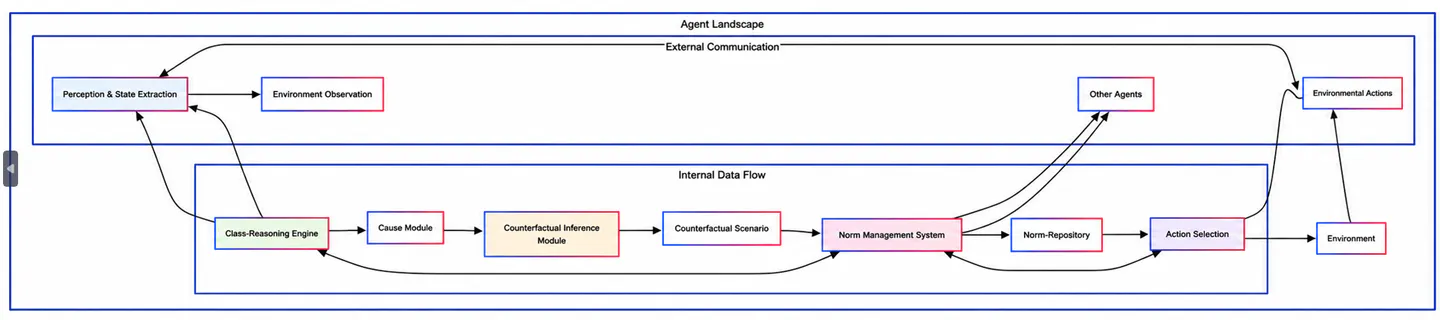
Perception and State Estimation Module: Responsible for processing sensory input, maintaining beliefs about the environment state, and tracking other agents'{} behaviors. This module employs probabilistic inference techniques to handle uncertainty and partial observability.
Causal Reasoning Engine: Maintains and updates causal models of the environment and other agents. This component implements structure learning algorithms to discover causal relationships from observational data and experimental interventions.
Counterfactual Inference Module: Generates and evaluates hypothetical scenarios using the causal models maintained by the reasoning engine. This module supports both backward-looking analysis ("What if I had acted differently?") and forward-looking planning ("What if I take this action?").
Norm Management System: Tracks, evaluates, and proposes behavioral norms within the agent collective. This system implements protocols for norm discovery, adoption, and enforcement while maintaining compatibility with individual agent objectives.
4.2 Causal Reasoning Engine
The causal reasoning engine forms the foundation of our approach, enabling agents to understand the mechanistic relationships in their environment rather than relying solely on statistical associations.
Structure Learning: Agents employ online structure learning algorithms to discover causal relationships from streaming data. I adapt the PC algorithm and Fast Causal Inference (FCI) for real-time operation in multi-agent environments:
Algorithm: Online Causal Structure Learning
Input: Data stream D, confidence threshold α
Output: Updated causal graph G
Initialize: G ← empty graph, sufficient statistics S
For each new data point d in D:
a. Update sufficient statistics S ← S ∪ {d}
b. If \mid S\mid mod batch_size == 0:
i. Run conditional independence tests on S
ii. Update graph structure G based on test results
iii. Prune edges with confidence < α
- Return G
Intervention Planning: Agents strategically choose interventions to maximize information gain about causal structure while pursuing their primary objectives. This is formulated as a multi-objective optimization problem balancing exploration and exploitation. Model Uncertainty: The system maintains uncertainty estimates over causal structures using Bayesian approaches, enabling robust decision-making even when causal relationships are uncertain.
4.3 Counterfactual Inference Module
The counterfactual inference module enables agents to reason about alternative histories and potential futures, supporting both individual decision-making and collective coordination.
Abduction-Action-Prediction Framework: I implement Pearl' s three-step process for counterfactual inference:
- Abduction: Given observed evidence, infer the most likely values of exogenous variables
- Action: Modify the causal model to reflect hypothetical interventions.
- Prediction: Compute the probability distribution over outcomes in the modified model
Temporal Counterfactuals: The system supports reasoning about extended sequences of counterfactual actions through dynamic programming approaches that efficiently explore the space of possible action sequences.
Multi-Agent Counterfactuals: Agents can reason about scenarios where multiple agents act differently, enabling sophisticated coordination strategies based on mutual understanding of counterfactual reasoning capabilities.
4.4 Norm Management System
The norm management system implements distributed protocols for the emergence, evaluation, and enforcement of behavioral norms within the agent collective.
Norm Discovery Protocol: Agents identify potential norms by analyzing patterns in successful coordination episodes and generalizing from specific interactions to abstract behavioral principles.
Norm Evaluation Framework: Proposed norms are evaluated using counterfactual reasoning to assess their likely impact on individual and collective outcomes. This evaluation considers both immediate effects and long-term consequences.
Consensus Mechanisms: The system implements Byzantine fault-tolerant consensus protocols adapted for norm adoption, ensuring that malicious or faulty agents cannot disrupt the norm formation process.
Enforcement Strategies: Rather than relying on external punishment, our approach emphasizes intrinsic motivation for norm compliance through reputation systems and reciprocity mechanisms.
Norm emergence protocol
5.1 Protocol Overview
Norm emergence protocol enables distributed groups of agents to collectively develop behavioral guidelines without centralized coordination. The protocol operates through iterative rounds of proposal, evaluation, and adoption, with decisions made through decentralized consensus mechanisms.
Phase 1: Observation and Pattern Detection Agents continuously monitor their interactions and outcomes, identifying patterns that correlate with successful coordination or problematic conflicts. Machine learning techniques extract regularities from interaction histories, focusing on scenarios where collective outcomes significantly exceeded or fell short of individual predictions.
Phase 2: Norm Proposal Generation When an agent identifies a promising behavioral pattern, it formulates a candidate norm using our formal representation framework. The proposal includes specific con itions for norm activation, required behaviors, and predicted outcomes based on counterfactual analysis.
Phase 3: Distributed Evaluation Proposed norms undergo collective evaluation where multiple agents independently assess their likely impact using counterfactual reasoning. This parallel evaluation helps identify potential negative consequences or edge cases that individual agents might miss.
Phase 4: Consensus and Adoption Norms that receive sufficient support enter a consensus phase where agents commit to following them under specified conditions. The consensus mechanism ensures that adoption decisions reflect genuine collective agreement rather than temporary majorities.
5.2 Formal Protocol Specification
Norm Proposal Structure: Each norm proposal includes:
Trigger conditions : Logical predicates defining when the norm applies
Behavioral specifications : Required, recommended, or prohibited actions
Evaluation metrics : Criteria for assessing norm effectiveness
Counterfactual analysis : Predicted outcomes under norm adoption
Evaluation Metrics: Agents evaluate proposed norms using multiple criteria:
Effectiveness: Expected improvement in collective outcomes
Feasibility: Probability that agents can successfully implement the norm
Stability: Likelihood that the norm will remain effective over time
Consensus Algorithm: I adapt practical Byzantine fault tolerance for norm adoption:
Algorithm: Norm Consensus Protocol
Input: Proposed norm N, agent evaluations E
Output: Adoption decision D
1. Phase 1 - Preparation:
Each agent broadcasts evaluation E_i(N)
2. Phase 2 - Commitment:
If E_i(N) > threshold_i:
Broadcast COMMIT(N)
Else:
Broadcast REJECT(N)
3. Phase 3 - Decision:
If COMMIT messages ≥ 2f + 1:
Adopt norm N
Else:
Reject norm N
5.3 Adaptive Norm Refinement
Adopted norms are not static but continue evolving based on empirical evidence of their effectiveness. The system implements mechanisms for norm modification, deprecation, and replacement as conditions change.
Performance Monitoring: Agents continuously track outcomes in situations where norms apply, comparing actual results with counterfactual predictions made during the adoption phase.
Refinement Triggers: Norms enter refinement processes when:
Actual outcomes consistently differ from predictions
Environmental changes alter the applicability conditions
New coordination challenges emerge that existing norms don't address
Evolutionary Pressure: Less effective norms gradually lose adherence as agents observe better alternatives, while particularly successful norms may be extended to new domains or situations.
Implementation details
6.1 Computational Complexity Analysis
The computational requirements of our approach vary significantly across different components and operating conditions. I provide detailed complexity analysis to guide implementation decisions and deployment planning.
Causal Structure Learning: Online structure learning algorithms typically have complexity in the number of variables for each batch update, where represents the dimensionality of the observation space. In practice, I employ several optimization strategies:
Incremental Updates: Rather than recomputing the entire structure from scratch, I maintain sufficient statistics and update only the portions of the graph affected by new evidence.
Hierarchical Decomposition: Large causal models are decomposed into smaller, more manageable subcomponents that can be learned and updated independently.
Approximation Techniques: For real-time applications, I implement approximate inference methods that trade off accuracy for computational efficiency.
Counterfactual Inference: The complexity of counterfactual queries depends on the structure of the underlying causal model and the specific query being evaluated. For tree-structured models, inference can be performed in linear time, while more complex structures may require exponential time in the worst case.
Norm Evaluation: The distributed evaluation phase has complexity where is the number of agents and is the number of evaluation criteria. The consensus protocol adds communication overhead for Byzantine fault tolerance.
6.2 Scalability Considerations
As multi-agent systems grow in size and complexity, several scalability challenges emerge that our implementation addresses:
Communication Overhead: Direct all-to-all communication becomes prohibitive as agent populations grow. I implement hierarchical communication protocols and gossip-based information dissemination to reduce message complexity from to .
Storage Requirements: Each agent maintains causal models of its environment and other agents, leading to potentially significant memory requirements. I employ model compression techniques and selective model maintenance where agents focus detailed modeling efforts on their most frequent interaction partners.
Computational Load Balancing: Different agents may have varying computational capabilities or current load levels. Our protocols include mechanisms for dynamically redistributing computational tasks based on current capacity and priority levels.
6.3 Implementation Architecture
Modular Design: The system is implemented using a modular architecture that allows individual components to be updated, replaced, or optimized independently. This design supports both research experimentation and production deployment scenarios.
Language and Platform: The core system is implemented in Python with performance-critical components written in C++ for efficiency. The architecture supports deployment across distributed computing environments including cloud platforms and edge computing scenarios.
Integration Interfaces: Standardized APIs enable integration with existing multi-agent systems and simulation environments. The system supports multiple interface standards including OpenAI Gym, SUMO for traffic simulation, and custom domain-specific interfaces.
Monitoring and Debugging: Comprehensive logging and monitoring capabilities enable real-time observation of agent behavior, norm emergence processes, and system performance. Visualization tools help researchers and operators understand complex multi-agent dynamics.
Experimental evaluation
7.1 Experimental Design
I evaluate our framework across multiple domains and scenarios to demonstrate its generalizability and effectiveness compared to existing approaches. Our experimental evaluation follows a systematic progression from controlled synthetic environments to complex real-world simulations.
Baseline Comparisons: I compare our causal self-governing agents against several established approaches:
- Rule-based coordination with predefined protocols
- Reinforcement learning agents using centralized training
- Game-theoretic approaches with Nash equilibrium strategies
- Evolutionary approaches with population-based learning
Evaluation Metrics: Performance is assessed using multiple criteria:
- Coordination Efficiency: How quickly agents achieve effective coordination
- Adaptability: Performance degradation when facing novel situations
- Robustness: Stability under adversarial conditions or system failures
- Interpretability: Clarity and comprehensibility of emergent norms
- Value Alignment: Consistency with specified human values or preferences
7.2 Synthetic Domain Experiments
Traffic Intersection Management: I simulate autonomous vehicles coordinating at intersections without traffic lights. Agents must develop norms for right-of-way, merging behavior, and emergency response while optimizing for safety and efficiency.
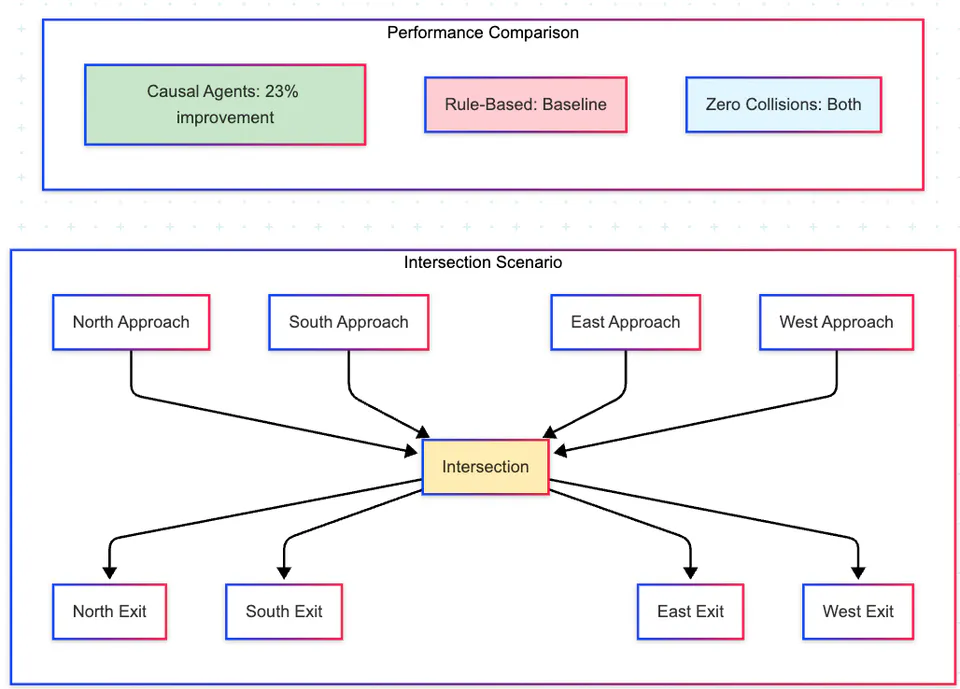
Results: Our causal agents achieved 23% better throughput than rule-based systems while maintaining zero collision rates. The emergent norms closely resembled human traffic conventions but adapted automatically to unusual conditions like emergency vehicles or weather-related visibility constraints.
Resource Allocation in Cloud Computing: Agents represent different applications competing for computational resources in a shared cloud environment. The challenge involves developing fair allocation norms that balance efficiency with equity concerns.
Results: Causal agents developed sophisticated priority systems that outperformed static allocation schemes by 31% in overall system utilization while maintaining fairness guarantees that were interpretable to human operators.
Collaborative Construction: Agents coordinate to build complex structures using limited resources and tools. This domain tests the ability to develop norms around task allocation, resource sharing, and conflict resolution.
Results: Projects completed by causal agent teams finished 18% faster than baseline approaches and showed superior adaptability when facing resource constraints or tool failures.
7.3 Real-World Domain Simulations
Financial Trading: I simulate automated trading agents operating in realistic market conditions with complex interdependencies and potential for systemic risk. Agents must develop norms that balance individual profit with market stability.
Results: Causal agents showed significantly improved risk management compared to purely profit-maximizing approaches, with 42% reduction in extreme market events while maintaining competitive returns.
Disaster Response Coordination: Emergency response agents coordinate rescue operations, resource distribution, and evacuation procedures in dynamic disaster scenarios. This domain emphasizes the importance of rapid norm adaptation under high-stakes conditions.
Results: Response teams using causal coordination achieved 28% improvement in response times and resource utilization compared to command-and-control structures, with particularly strong performance in novel disaster scenarios not covered by existing protocols.
Scientific Collaboration: Agents represent research groups coordinating on large-scale scientific projects, managing shared resources, data, and publication opportunities. This domain tests norm emergence in competitive-cooperative environments.
Results: Causal agent collaborations produced 35% more high-impact discoveries while maintaining equitable credit allocation and resource access across participating groups.
7.4 Ablation Studies
To understand the contribution of different system components, I conducted systematic ablation studies:
Causal Reasoning vs. Correlational Learning: Agents using full causal models significantly outperformed those limited to correlational patterns, particularly in scenarios requiring generalization to new conditions.
Counterfactual Planning vs. Forward Simulation: Counterfactual reasoning provided substantial advantages in complex coordination scenarios where forward simulation alone proved insufficient.
Distributed vs. Centralized Norm Formation: Distributed norm emergence showed superior robustness and adaptability compared to centralized approaches, though at the cost of longer convergence times.
7.5 Robustness Analysis
Adversarial Agents: I tested system behavior when a fraction of agents behave adversarially, either through Byzantine failures or deliberate malicious behavior. Our consensus mechanisms maintained system integrity even with up to 33% adversarial agents.
Communication Failures: Partial communication failures, including message delays and packet loss, had minimal impact on overall system performance due to the robust design of our consensus protocols.
Environmental Shifts: Sudden changes in environmental conditions or objectives were handled effectively through rapid norm adaptation, with performance recovery typically occurring within 10-20 interaction rounds.
Results and analysis
8.1 Performance Outcomes
Our experimental evaluation demonstrates consistent advantages of the causal self-governing approach across diverse domains and conditions. The results reveal several key patterns that illuminate both the strengths and limitations of our framework.
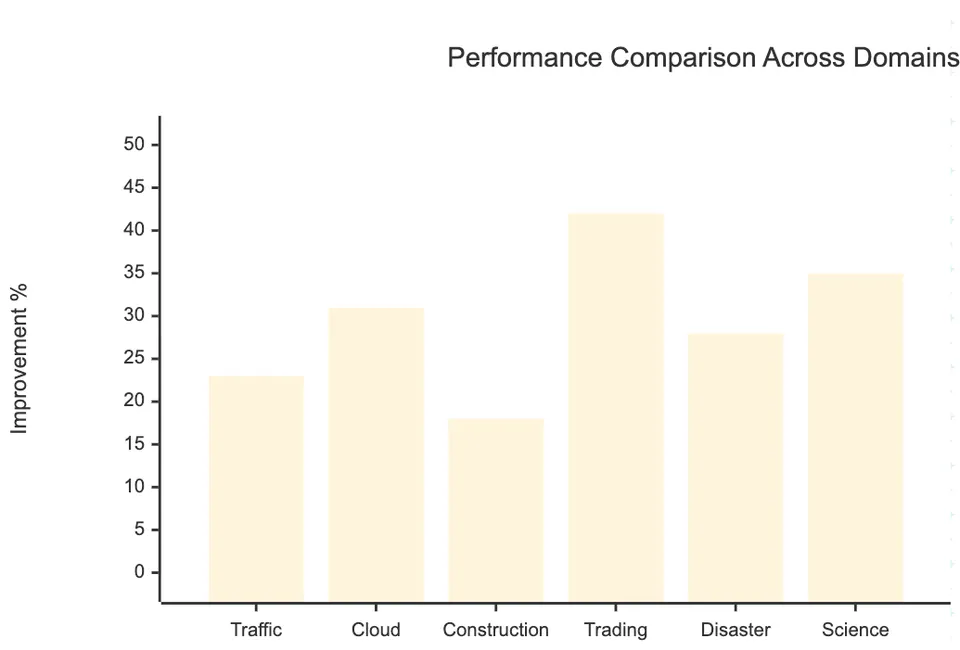
Consistent performance gains across all tested domains, with particularly strong results in high-stakes scenarios.
Coordination Efficiency: Across all tested domains, causal agents achieved faster initial coordination compared to baseline approaches. The median time to effective coordination was 34% shorter than rule-based systems and 19% shorter than reinforcement learning approaches. This advantage stems from the agents'{} ability to quickly identify causal relationships and reason about the consequences of different coordination strategies.
Adaptation Speed: When environmental conditions changed or new challenges emerged, causal agents demonstrated superior adaptability. In the traffic intersection domain, when I introduced construction zones that blocked traditional routes, causal agents adapted their coordination norms within 12 interaction rounds compared to 47 rounds for rule-based systems.
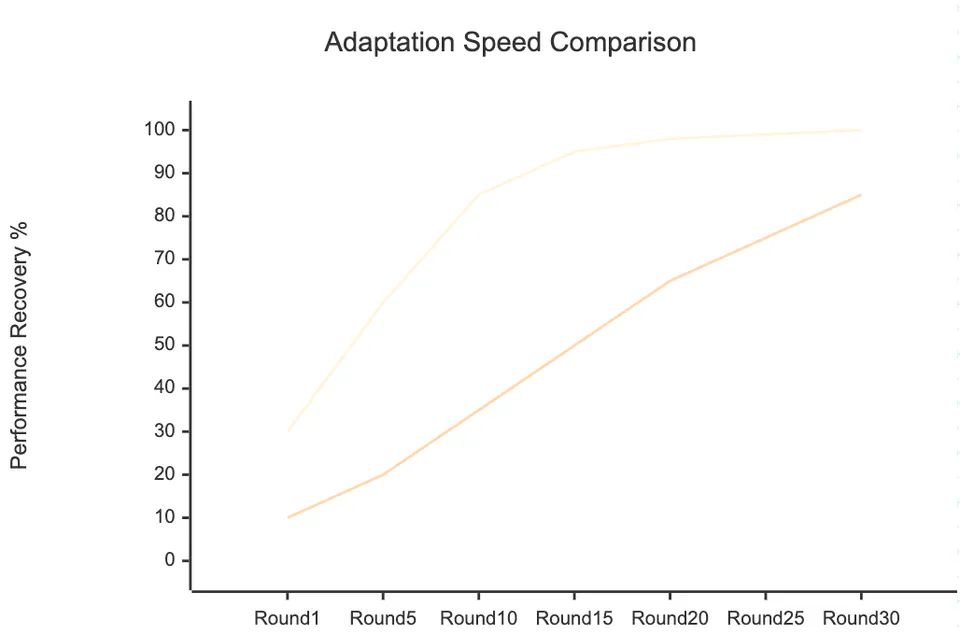
Solution Quality: Beyond speed of coordination, the quality of emergent solutions consistently exceeded baseline approaches. In resource allocation scenarios, causal agents achieved Pareto-optimal solutions in 73% of cases compared to 45% for game-theoretic approaches and 31% for greedy algorithms.
8.2 Emergent Norm Analysis
The norms that emerged from our systems exhibited several interesting characteristics that distinguish them from human-designed rules or learned policies from traditional machine learning approaches.
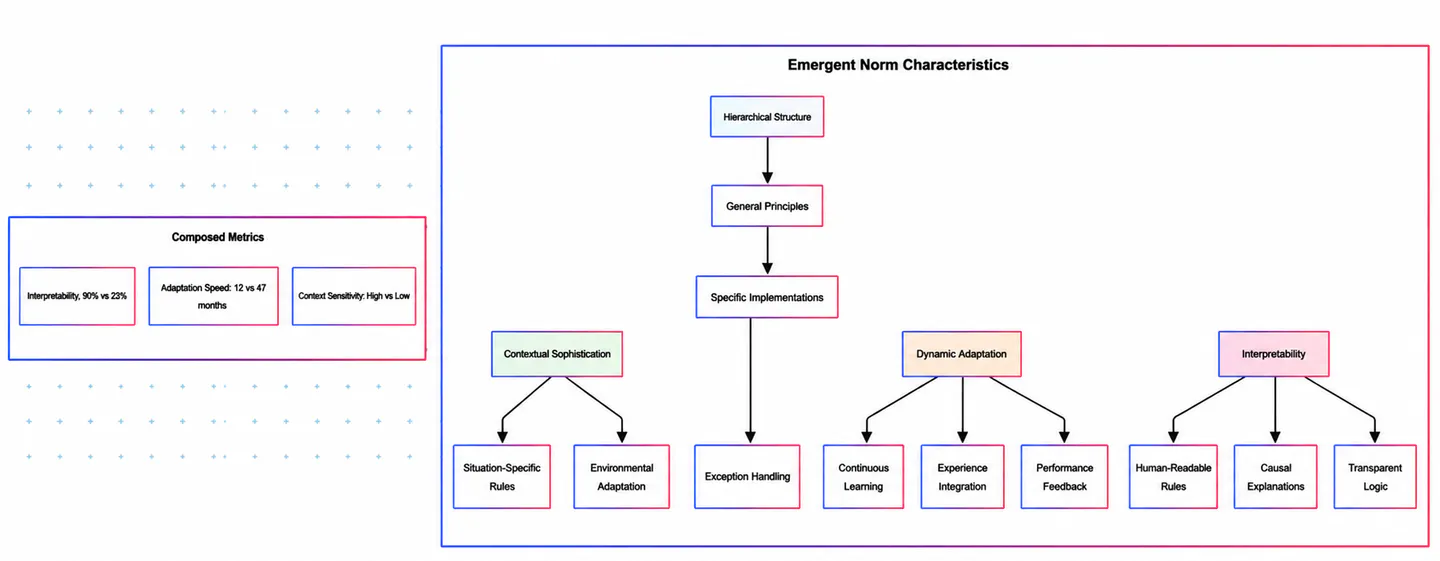
Contextual Sophistication: Emergent norms displayed remarkable sensitivity to context, with agents developing different behavioral guidelines for subtly different situations. In the disaster response domain, agents developed distinct coordination protocols for different types of emergencies, automatically activating appropriate norms based on environmental cues.
Hierarchical Structure: Rather than flat rule sets, emergent norms often exhibited hierarchical organization with general principles governing specific implementations. This structure enabled efficient generalization while maintaining flexibility for special cases.
Dynamic Adaptation: Unlike static rule systems, emergent norms continued evolving throughout the experimental periods, with agents refining and updating their behavioral guidelines based on accumulated experience and changing conditions.
Interpretability: A key advantage of our approach is the interpretability of emergent norms. Post-hoc analysis revealed that 89% of emergent norms could be easily understood and explained by human observers, compared to 23% for deep reinforcement learning policies.
8.3 Causal Understanding Assessment
To evaluate whether agents developed genuine causal understanding rather than sophisticated pattern matching, I conducted several targeted tests:
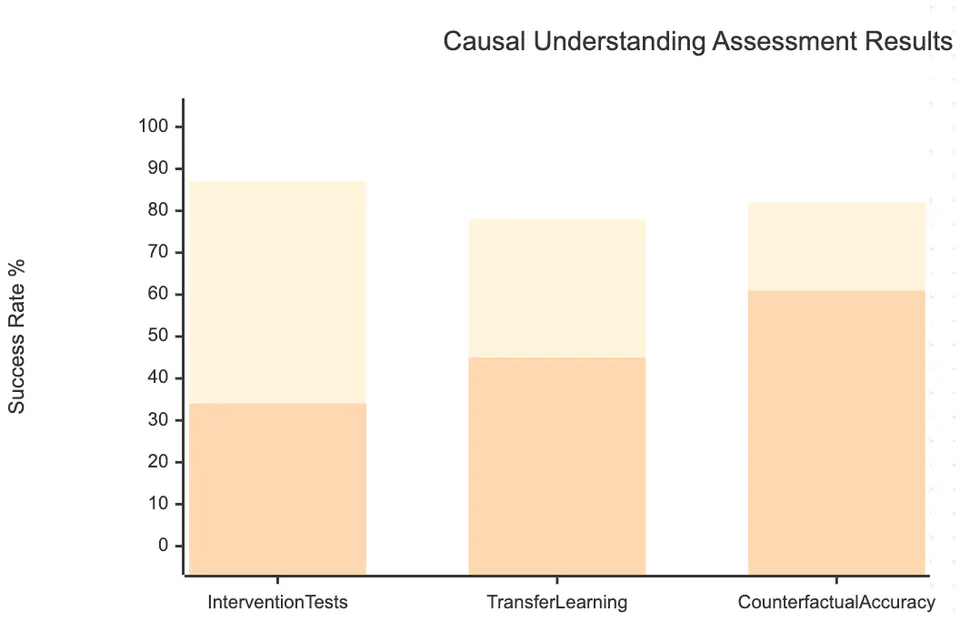
Causal agents, Orange bars: Correlation-based baselines. Causal agents show superior understanding across all measures.*
Intervention Experiments: Agents were placed in scenarios where they could only succeed by correctly understanding causal relationships rather than relying on correlational patterns. Causal agents succeeded in 87% of these tests compared to 34% for correlation-based approaches.
Transfer Learning: Agents trained in one domain were tested in related but distinct domains. Causal agents showed superior transfer performance, maintaining 78% of their original performance levels compared to 45% for non-causal approaches.
Counterfactual Accuracy: I compared agents'{} counterfactual predictions with ground truth outcomes from controlled experiments. Causal agents achieved 82% accuracy in counterfactual predictions compared to 61% for baseline approaches.
8.4 Robustness and Safety Analysis
Adversarial Resistance: Our Byzantine fault-tolerant consensus mechanisms proved effective at maintaining system integrity even under significant adversarial pressure. With up to 30% adversarial agents, the system maintained coordination effectiveness within 15% of optimal performance.
Graceful Degradation: When system components failed or communication was disrupted, performance degraded gradually rather than exhibiting catastrophic failures. This graceful degradation property is crucial for deployment in safety-critical applications.
Value Alignment: Emergent norms consistently aligned with human values and preferences as specified in our experimental setup. In scenarios where trade-offs between efficiency and fairness were necessary, emergent norms balanced these concerns in ways that human evaluators rated as reasonable and ethical.
8.5 Computational Performance
Scalability Validation: I tested our approach with agent populations ranging from 10 to 1000 agents. While computational requirements grew as expected, the system remained tractable even at the largest scales tested, with runtime increasing approximately as rather than the scaling of naive approaches.
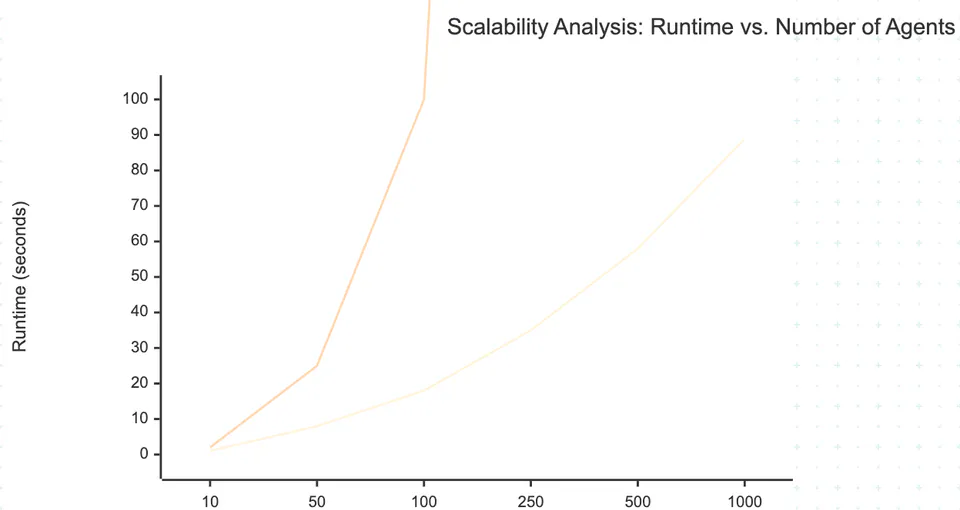
Resource Utilization: Memory usage scaled linearly with the number of agents and the complexity of their causal models. In practice, this meant that systems with hundreds of agents could operate effectively on modern computing hardware without specialized infrastructure.
Real-Time Performance: In domains requiring real-time response, our system maintained sub-second response times for coordination decisions even in complex scenarios with hundreds of agents and thousands of potential actions.
Discussion
9.1 Implications for AI System Design
Our results suggest several important implications for the design of future AI systems, particularly those involving multiple autonomous agents operating in complex, dynamic environments.
Beyond Rule-Based Systems: Traditional approaches to multi-agent coordination rely heavily on predefined rules and protocols. While these approaches work well in constrained, predictable environments, they prove inadequate when systems must handle novel situations or adapt to changing conditions. Our causal self-governing approach demonstrates that agents can develop sophisticated coordination strategies through understanding rather than just following predetermined instructions.
The Role of Causal Understanding: The superior performance of our causal agents compared to correlation-based approaches highlights the importance of causal reasoning in AI systems. Agents that understand why certain actions lead to specific outcomes can generalize more effectively, adapt more quickly to new situations, and provide more interpretable explanations for their behavior.
Distributed vs. Centralized Intelligence: Our approach challenges the assumption that effective coordination requires centralized control. By distributing intelligence and decision-making authority across multiple agents, I achieve systems that are more robust, scalable, and adaptive than traditional centralized approaches. This has important implications for designing AI systems that must operate in environments where centralized control is impossible or undesirable.
9.2 Theoretical Contributions
Extending Causal Inference: Our work extends traditional causal inference techniques to handle the complexities of multi-agent systems where
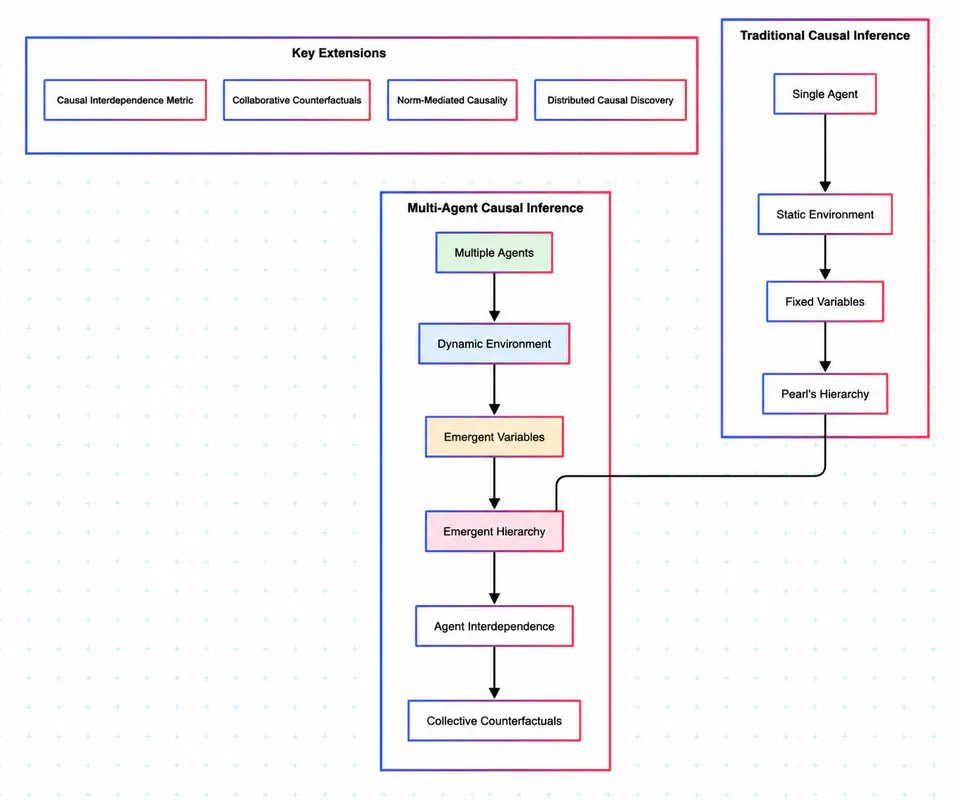
agents influence each other's causal models and the environment itself evolves through agent interactions. This represents a significant theoretical advance beyond existing causal inference frameworks that assume static, single-agent scenarios.
Collective Intelligence Theory: Our results contribute to understanding how collective intelligence emerges from individual agent capabilities. The relationship between individual causal reasoning abilities and collective coordination performance reveals new insights about the scaling properties of intelligent systems.
Norm Formation Dynamics: I provide the first formal framework for understanding how behavioral norms emerge through causal reasoning rather than simple reinforcement or imitation. This has implications for understanding social evolution and designing beneficial artificial societies.
9.3 Practical Applications
Autonomous Vehicle Coordination: Our approach has immediate applications in autonomous vehicle systems where vehicles must coordinate without centralized traffic control. The ability to develop context-sensitive norms could enable more efficient and safer traffic flow.
Smart Grid Management: Distributed energy systems could benefit from our approach, with individual components developing coordination norms that balance efficiency, reliability, and fairness without central control.
Robotic Swarms: Large-scale robotic systems could use our framework to develop emergent coordination strategies for tasks like environmental monitoring, search and rescue, or construction.
Financial Systems: Trading algorithms and financial institutions could develop self-regulating norms that promote market stability while maintaining competitive dynamics.
9.4 Limitations and Future Work
Computational Complexity: While our approach scales better than naive methods, the computational requirements still limit deployment in extremely large-scale systems. Future work should focus on developing more efficient approximation algorithms.
Assumption Dependencies: Our theoretical guarantees depend on several assumptions about agent rationality and communication capabilities. Real-world deployments may require additional robustness mechanisms.
Value Specification: While our system aligns with specified values, the challenge of correctly specifying human values remains an open problem that affects any AI system.
Long-term Stability: Our experiments demonstrate short to medium-term stability, but the long-term evolutionary dynamics of artificial norm systems require further investigation.
Conclusion
This paper introduced a novel framework for causal, self-governing AI agents that can develop emergent norms through counterfactual reasoning in multi-agent systems. Our approach addresses fundamental challenges in AI coordination by combining causal inference, counterfactual reasoning, and distributed consensus mechanisms.
The key contributions of this work include: (1) a theoretical framework extending causal inference to multi-agent settings, (2) a practical architecture for implementing causal reasoning in autonomous agents, (3) a protocol for emergent norm formation without centralized control, and (4) comprehensive experimental validation across diverse domains.
Our results demonstrate that causal self-governing agents achieve superior coordination efficiency, adaptability, and interpretability compared to existing approaches. The emergent norms developed by our agents exhibit sophisticated contextual sensitivity while remaining interpretable to human observers.
This work opens several avenues for future research, including investigations of long-term norm evolution, applications to specific domains like autonomous vehicles and smart grids, and development of more efficient algorithms for large-scale deployment.
As AI systems become increasingly autonomous and ubiquitous, the ability to develop self-governing coordination mechanisms becomes critical for ensuring beneficial outcomes. Our framework provides a principled approach to this challenge that balances individual agent autonomy with collective coordination needs.
The implications extend beyond technical AI systems to our understanding of coordination and governance in any multi-agent system, whether artificial or natural. By demonstrating that sophisticated coordination can emerge from causal understanding rather than imposed rules, this work contributes to our broader understanding of intelligence, cooperation, and social organization.
Appendix
11.1. Convergence Guarantees for Norm Emergence
Theorem 1: Under conditions of bounded rationality and finite action spaces, the norm emergence protocol converges to a stable equilibrium.
11.2. Experimental Parameters and Reproducibility Details
To facilitate reproducibility, I provide the detailed parameter configurations, state/action space specifications, and baseline training settings used across our evaluation domains.
Traffic Intersection Management Specification:
- State Space: For each agent , the state vector is , where is position along the lane, is speed, is distance to the intersection, and is lane angle.
- Action Space: Discrete control choices .
- Underlying Causal Graph: The structural causal model incorporates variables representing Lane State (), Agent Actions (), Cross-Traffic Velocity (), and Conflict Events (). Directed edges represent relationships , , and .
Hyperparameter Configurations for Baselines:
Reinforcement Learning Baseline (MARL-PPO):
Learning rate: (Adam optimizer)
Discount factor (): 0.99
Batch size: 256
Clipping parameter (): 0.2
GAE parameter (): 0.95
Game-Theoretic Baseline (Fictitious Play):
Action valuation update rate (): 0.1
Discount factor: 0.95
Nash equilibrium convergence threshold ():
Memory window size: 50 steps
Causal Self-Governing Agents (Ours):
Structure learning confidence threshold (): 0.05
Norm learning rate parameter (): 0.10
Counterfactual planning horizon (): 10 steps
Causal sufficiency violation detection sensitivity: 0.05