
I. INTRODUCTION
Despite advances in understanding the world, the structure of the Earth's core is still a subject of research and discussion. The traditional geotectonic theory is the Goldschmidt hypothesis of a metallic nucleus, an intermediate sulfide zone, and a silicate mantle. There is a difference of views on the nature of geological phenomena and the evolution of the Earth. This applies to issues such as the Earth's heat source, the rock cycle, and the expansion of the Earth. A supplement to Goldschmidt's theory is the rock cycle, assuming the origin of basalt magma from the remelting of existing rocks. Regarding the structure of the Zemi nucleus, it is believed that the inner part of the nucleus is made of an alloy of iron and nickel, with an admixture of lighter elements: oxygen, sulfur, potassium and carbon (Zelaźniewicz & Grad, 2009). According to the prevailing views, basalt magma is formed from the remelting of old rocks and the cause of volcanism is continental drift. The phenomenon of lithospheric plate subduction and the transport of rock matter in convective cells are suggested. However, the existence of a heat source in the Earth's core is excluded and the hypothesis of "relict heat" is introduced in its place. The matter is important from the point of view of objectivism in science that despite the obvious argument in the form of the geothermal profile (Fig. 12), the facts are denied and the conclusion is accepted that is contrary to the principles of thermodynamics. Such views are expressed in the theory of plate tectonics.
An alternative geotectonic theory that interprets these phenomena differently is the theory of global expansion. The authors of the theory of global expansion that explain the effects of this phenomenon are: S.W. Carey (1958, 1976, 1996) and Hilgenberg (1933, 1974). Among the continuators of the research on the phenomenon of expansion are James Maxwell (1995, 2000, 2018) and Jan Koziar (1980, 1985, 2018). The researchers' attention is focused on tectonic forms of expansion, leaving aside the cause-and-effect analysis of the expansion phenomenon.
The cause of the expansion of the Earth was taken up by Hilgenberg, who asked the rhetorical question: "expansion yes, but with or without an increase in the mass of the Earth?". The question had a deep meaning because it was inspired by Kuhn and Rittmann's [1941] statement about solar matter in the Earth's core. These researchers found that there is no metallic Earth's core, but that the interior of the Earth is filled with undifferentiated solar matter. According to Kuhn and Rittmann, in addition to elements such as silicon, iron and magnesium, hydrogen is present in large amounts in the Earth's core. The author of the article continues his work on the cause of the expansion of the Earth: Pawula (2000, 2021a, b, c, 2022).
II. EXPANSION OF THE EARTH - STUDY OF THE PHENOMENON
The phenomenon of the Earth's expansion is the result of thermonuclear processes taking place in the Earth's core. The creation of a georeactor begins with the production of low-temperature plasma, which generates a magnetic field and creates a magnetic trap of this plasma. A magnetically stiffened insulating layer is created, a cover for the future reactor. After exceeding the critical mass of an aggregate of matter, thermonuclear reactions appear spontaneously. It is a common phenomenon in the Cosmos, but requires deeper reflection and associations. We know that there is a relationship between matter and energy in nature, described by the Einstein equation and termed "mass deficit" in nuclide synthesis reactions. We associate gravity with matter. Gravity depends on the mass of this matter, and at the same time we notice that by exerting pressure we destroy its structure. The importance of the forces related to the structure of matter particles was revealed by studies on the structure of the proton [https://phys.orgnews/2018-05-subatomic-particle-mechanical-property-reveals.html]. It has been found that the inside of a proton has a huge pressure, 10 times the pressure inside a neutron star.
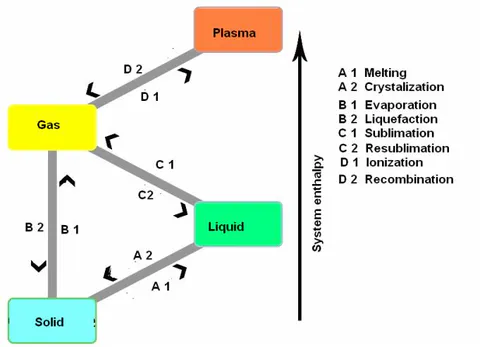
The phenomenon of Eart's expansion is associated with the destruction of the structure of the atom in the process of ionization of matter and with the nuclide synthesis reactions, with the dominant participation of protons. The enthalpy of the plasma recombination process decreases and the structure of the protons is not compromised (Fig. 1). As a result of the action of gravity, compressive forces appear, the potential energy of gravitational pressure turns into kinetic energy, into heat. The constant increase in the mass of the globe, incl. by gravitational accretion, it causes a constant increase in temperature and ionization energy. By adding energy to the system, the enthalpy increases.
Basalt magma is a hot alloy with a temperature of , a mixture of minerals, liquids and gases, with an elemental composition corresponding to that of the plasma. Basalt magma is created by the recombination of plasma, which gushes out of the Earth's core. The recombination of protons into
hydrogen atoms is expressed by an increase in the particle diameter 100,000 times. The change in structure causes a sharp increase in pressure and stress in the Earth's mantle. Fissures are formed, reaching the surface of the earth, from which an oceanic spouts. In crevices not reaching the surface, igneous intrusion occurs. Under the deep sea conditions, magma differentiation and crystallization of igneous rocks occur. Plasma, on the other hand, is ionized matter with special electromagnetic properties. Low-temperature plasma is the initial medium that meets the Lawson criterion for the initiation of nuclide synthesis reactions. High-temperature plasma is a product of thermonuclear reactions and constitutes of the mass of the universe.
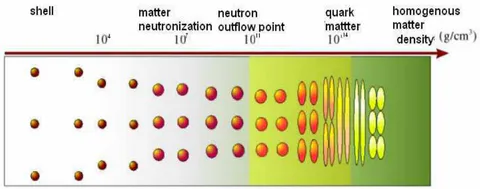
The phenomenon of the Earth's expansion, expressed in the accelerated growth of the radius of the globe, appeared only when the pressure of hot plasma in the thermonuclear reactor exceeded the gravitational pressure and the magnetic field strength of the reactor's cover. This moment can be defined as 500 million years ago. All the time, in the process of gravitational accretion, the mass and temperature of the globe increased. Structural changes in matter are the effect of the increase in temperature and density of the medium (Fig. 2). In certain critical states of this continuous process, nuclear forces are revealed.
Plasma is a good conductor of electric current and, through the eddy currents, it generates a magnetic field and becomes magnetized at the same time. Based on the theory of primal forces of nature, the probability of spontaneous formation of thermonuclear fusion reactors and the determination of the Earth's core as an endogenous heat source has been demonstrated (Pawula, 2021a).
Hydrogen and its alter ego - proton play a significant role in geological processes.
The main factor facilitating the collision of ions is the formation of a low-temperature layer of liquid plasma as a result of ionization. Liquid plasma has electromagnetic properties, produces a magnetic field and becomes magnetized. The layer of low-temperature plasma forms the shell of the reactor and ensures that the thermonuclear reaction chamber is sealed to the Lawson tightness criterion.
(16 g/cm3) and in the Sun (160 g/cm3). Contrary to the idea that the Sun is burning off hydrogen and helium, the theory of the primordial forces of nature treats the evolution of planets as an open sequence that ends with a maximum concentration of matter and a star collapse.
In the universe, hydrogen makes up about of the plasma volume (Figure 3). An explanation of this phenomenon can be found in the following set of equations. Protons, hydrogen nucleons, are excessively formed in heavy ion collision reactions. In the proton-proton hydrogen cycle, apart from positrons, electron neutrinos and gamma rays, nuclear energy is emitted, resulting from the mass transformation (the so-called mass deficit).
In the collision of two protons, a deuterium nucleus is formed, which in reaction with the next proton produces a helium isotope nucleus. Eventually, the collision of two helium nucleons produces a 4He helium nucleus and two protons. Protons are ejected at high speed, have high kinetic energy and are the main source of heat. The emitted energy corresponds to the mass deficit:
The total mass of the two helium nuclei is 10.0122E-24 g.
The total mass of the nucleus and both protons is 9.98928E-24 g.
Weight difference 0.0229E-24 g,
Equivalent energy
The difference in mass is emitted as energy of electromagnetic radiation.
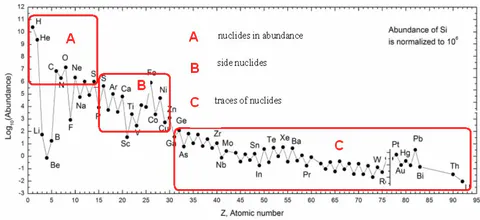
The phenomenon of ion collisions, apparently impossible to be induced in terrestrial conditions, in fact appears in space as a common and spontaneous phenomenon. Light nuclides, mainly nuclei of hydrogen and helium atoms, most often take part in the collision reactions.
A characteristic feature of the Earth's expansion process is the increase in the volume of the globe, without any increase in mass. The explanation for this phenomenon is the plasma recombination process, including, in particular, structural changes in proton/ hydrogen. The importance of hydrogen lies in its small size and abundance in hot plasma.
Basalt magma has special properties, it is homogeneous, identical regardless of the age and place of discharge, and its elemental composition is similar to solar plasma. Hot plasma contains a broad spectrum of rare elements and a small but constant amount of uranium and thorium. Basalt magma lacks the light elements, hydrogen, nitrogen and carbon, which dominated the plasma.
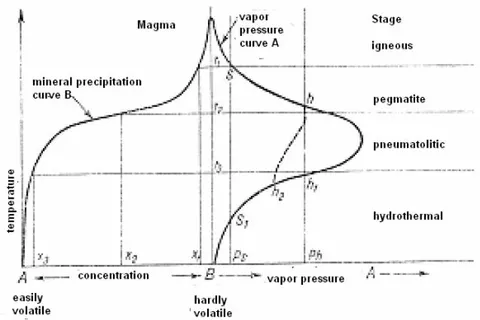
Basalt magma, which does not flow out through volcano chimneys and is slowly cooling down, is subject to a differentiation process. Under characteristic temperature conditions, elements and mineral compounds precipitate. In the temperature range of , the pneumatolytic stage takes place, when gases are released from the magma (Fig. 7).
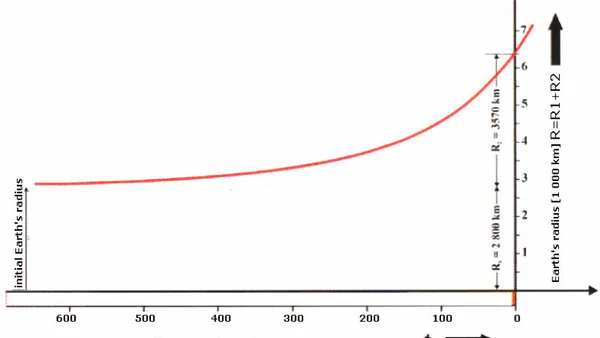
Hydrogen plays a special role in the expansion phenomenon. During the transformation from a proton, as a component of an igneous alloy, it increases in volume and causes the uplift of the Earth's mantle. The effect of the uplift is the crevices into which the magma is pressed. Magma intrusion, batolitas and global rifts are formed. The phenomenon of expansion is expressed by the production of basalt magma and an accelerated increase in the volume of the Earth. The growth curve of the radius of the Earth takes the form of an exponential function (Fig. 4).
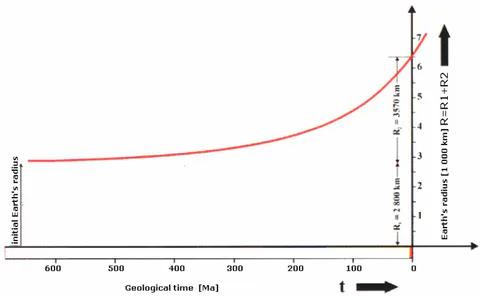
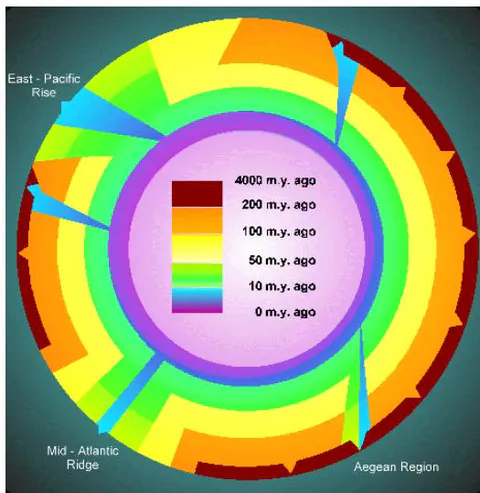
According to Koziar's (1980) calculations, the contemporary annual increase in the radius of the Earth is / year. Calculations show that in the last 280 million years the volume of the Earth has increased tenfold without increasing the mass of the globe. There is only a shift of dense matter from the Earth's core to the transformation zone D". In the expanding Earth model (Fig.5), contemporary matter dated 0 -10 thousand years BP occurs in the D" layer and in the ocean rift zone. Moving away from the rift line and the D "zone, there are older layers, up to the Jurassic.
Volcanic eruption is caused by magma pressure, and under certain conditions, there is also an eruption of igneous gases. This has to do with the mineral composition and temperature of the magma. Primary basalt lava in the exuberant volcanoes of Hawaii has a temperature in the range of , it is liquid and rich in dark minerals. In explosive volcanoes, lava has a rhyolite mineral composition, it is enriched with silica and has a lower temperature, in the range of
. As a result of temperature drop , mafic minerals (Mg - Fe) precipitate from the magma and form rhyolite magma enriched with silica. Gases are released, mainly hydrogen, which reacts with carbon, carbon oxides and sulfur to form methane, water and hydrogen sulphide (Fig. 6).
Under certain conditions, the accumulated hydrogen and methane will explode, causing severe earthquakes (explosive volcanoes). Hot magma remaining in zone D "presses on the mantle of the globe, causing magma intrusion and metasomatosis of the rocks encountered. In the temperature range of
400-600°C, the magma degassing process takes place. Due to the fact that hydrogen constitutes 90% of the elemental composition of magma in the recombination process, the degassing effect is felt in the ground as strong seismic shocks.
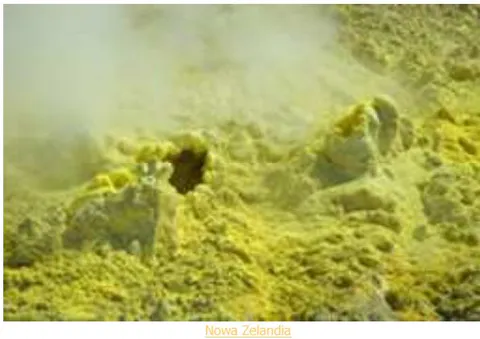
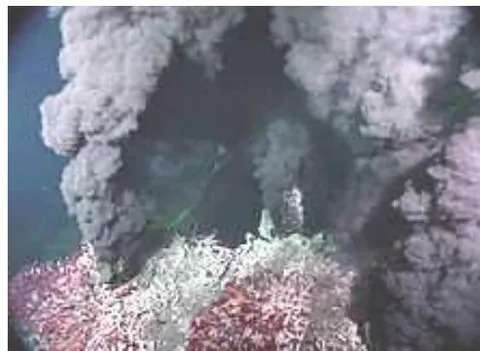
The released igneous gases react with each other. The photo shows the source of igneous solutions at (Fig. 8). The presence of hydrogen gas and its reaction products with carbon (methane ) and sulfur . The mineral compounds of silicon, titanium, aluminum, iron, manganese, calcium, sodium, potassium and phosphorus crystallize in the basalt rock, as well as numerous trace elements: basalt magma is an evident evidence of the existence of a thermonuclear georeactor in the Earth's core. The hydrogen gas reacts violently with carbon to form dry methane and reacts with carbon monoxide to form juvenile water and methane. Under high pressure, methane squeezes through the rocks of the Earth's mantle and explodes during a volcanic eruption.
Ocean plates, formed by basalt magma, cover more than of the globe. During 280 million years, the volume of the Earth's globe has increased tenfold: it has increased from (Earth's radius ), to the present (Earth's radius ). Thus, there was an increase in the volume of the Earth by and this is the volume of basalt magma that was produced in the process of plasma recombination.
The global cross-section shows the proportion of the small Earth globe, before the expansion (outline of continents) and the ten times larger growth zone, created in the process of matter transformation (Fig. 9).
![Fig. 9: Global structural section [Zhang, Y.S., Tanimoto, T., 1993]](https://doc.globaljournals.org/wujh53_52724/ocr/images/derivatives/75/75e4a97c229b14ea27ba730fa6ea8b58f5cf4a8b2c3e7e9cbf66351c61ef9e39.webp)
It can therefore be concluded that during this period the georeactor produced plasma, which formed of basalt magma (3.53E+3 km3/year). If magma is trapped in the Earth's mantle, it will differentiate and degass. As it cools, the hydrogen accumulates in gas traps and reacts with elemental carbon or carbon oxides to form flammable methane and water .
Volcanic eruptions and earthquakes are then irregular, separated by periods of calm, but violent. Hydrogen which does not react with carbon or carbon monoxide to form methane and water is released into the atmosphere. Since it is over 14 times lighter than air, it escapes to the exosphere (Fig. 10).
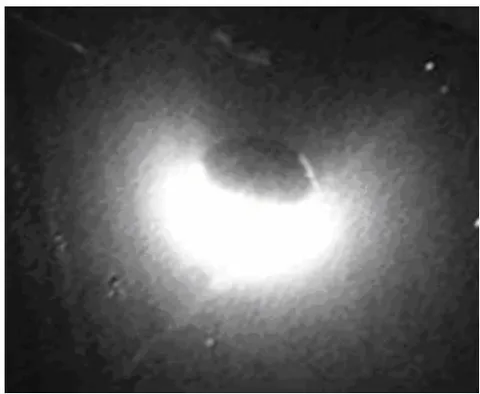
The photo on the moon was taken by astronaut John Young as part of the Apollo 16 space mission (1972). https://malagabay.wordpress.com/2013/04/11/terrestrial-degassing-of-hydrogen-and-helium/.
Evidence of the correct interpretation of the Earth's expansion phenomenon is the detection of the missing hydrogen in the Earth's exosphere.
| Components | Kilauea (Hawaii) | Nyiragongo (Congo) | Mont Pélé, */ (Martinique) |
| CO2 | 21,4 | 40,9 | 10,2 |
| CO | 0,8 | 2,4 | 2,0 |
| H2 | 0,9 | 0,8 | 0,2 |
| SO2 | 11,5 | 4,4 | |
| S2 | 0,7 | - | 0,5 |
| SO3 | 1,8 | - | - |
| Cl2 | 0,1 | - | 0,4 |
| N + rare gases | 10,1 | 8,3 | 0,9 |
| H2O | 52,7 | 43,2 | 82,5 |
III. GEOTHERMAL ENERGY
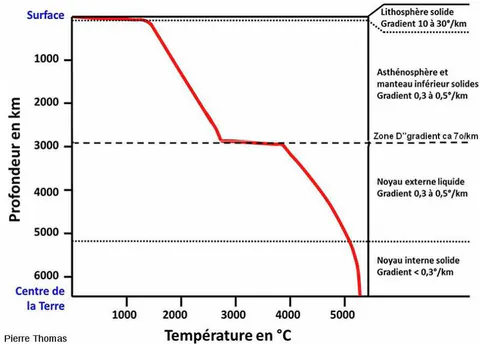
The author argues with the view of the generally accepted theory of lithospheric plate tectonics that the endogenous heat of the Earth is the relict heat of the globe and the cause of geological activity is the drift of lithospheric plates. The dispute is about the fundamental issue, the source of heat in the Earth's core, which the theory of plate tectonics does not take into account. According to the theory of the primal forces of nature, the source of endogenous heat is a thermonuclear reactor in the core of the Earth, analogous to a reactor operating in the core of the sun. Evidence of the existence of a heat source in the Earth's core is the geothermal profile (Fig. 11). According to the laws of thermodynamics, the temperature increases as we approach a heat source.
[La chaleur de la Terre et la géothermie — Planet-Terre planet-terre.ens-lyon.fr]
So the source of heat is the core of the Earth, and its energy potential tends to increase. So you can refer to geothermal energy as natural nuclear energy.
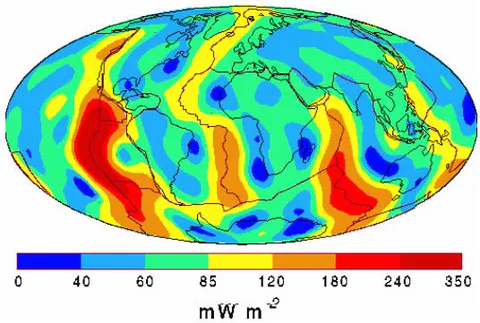
The map of the geothermal flux density (Fig. 12) shows the zoning of the activity of geological processes and is a picture of the globe's expansion.
[Pollack et al., 1993: http://www.geo.lsa.umich.edu/ IHFC/heatflow.htm]
The lowest heat flux densities, below 0.07 W/m2, are found in the area of continental plates. In the rift zone, the heat flux density increases several times, to 0.35 W/m2, and the global thermal power of the Earth is Q = 35 742 448 MW. The map of the geothermal flux density (Fig. 12) shows the zoning of the activity of geological processes and is a picture of the globe's expansion. The fundamental conclusion emerges from the Earth's evolution scenario. Thermal changes are increasing in nature. There is a general trend of climate warming, periods with a downward trend in average temperatures, it occurs incidentally due to factors such as the dustiness of the atmosphere with volcanic ash.
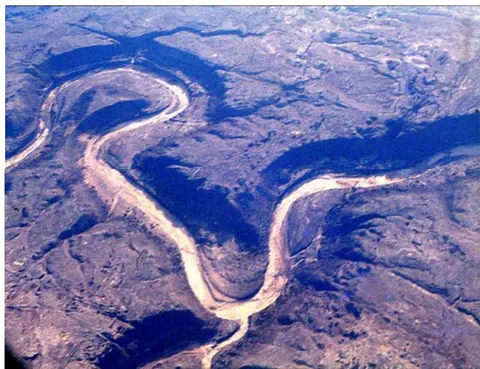
Several thousand years ago, the Sahara was green. The climate was warm and humid. In the area of the present desert, there are deep river valleys (Fig. 13), traces of settlement by people of different cultures and civilizations have been preserved.
At that time, northern Europe was covered with Arctic glacial ice. Over these several thousand years, the climate has warmed significantly. The direction of climate change is obvious, one should recognize the inevitability of these changes. Information about climate warming in Antarctica refers to the same phenomenon, because the phenomenon has a global dimension. The problem of global warming is best presented on the example of Antarctica (Fig. 14).
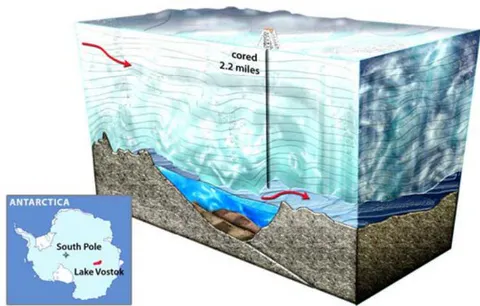
Geophysical surveys have detected a huge water reservoir under the ice sheet - Lake Vostok. In the research zone, a stream of gases from the deep ground, dominated by hydrogen, was detected. To explain this phenomenon of nature, one should take into account the fact that there are numerous volcanoes under the Antarctic ice. The research report explains the global warming in Antarctica by the degassing of the ground caused by continental drift. (Rejetun, 2021). Such an interpretation of the soil degassing phenomenon under the Antarctic ice sheet is not convincing. Continental drift does not cause processes such as plasma recombination.
Taking into account the accelerated process of the Earth's expansion, one should predict an increase in the geothermal flux density and its increasing influence on climate warming. There are several hundred active volcanoes from which volcanic ashes and gases are discharged, incl. carbon dioxide, hydrogen, hydrogen chloride, sulfur dioxide, hydrogen sulfide, methane, ammonia. The fundamental conclusion emerges from the Earth's evolution scenario. Thermal changes are increasing in nature. There is a general trend of climate warming, periods with a downward trend in average temperatures, it occurs incidentally due to factors such as the dustiness of the atmosphere with volcanic ash.
The picture of climate change in the evolutionary aspect of the theory of the primal forces of nature looks as follows: "In the Precambrian about 3.8 billion years ago, the first geothermal symptoms appeared, emanations of igneous gases, including water vapor. In the absence of an atmosphere, water vapor appeared. It froze, forming first the polar ice sheet, and then the global glaciation. Traces of the Precambrian glaciation, which lasted until the beginning of the Palaeozoic, were preserved in the form of tilites, among others in the Moorish Sahara (Adrar Plateau). Geological activity was present under the ice sheet, as it is now, under the ice of Antarctica. The conclusion is that the Antarctic ice sheet has lasted continuously since the Precambrian. When considering hard coal deposits, Spitzbergen has the answer - carbon deposits were formed from igneous coal with the help of bacteria - methanotrophs., there is an organic life based on the energy of hydrocarbons (chemosynthesis) s global warming is irreversible!
There are various methods and techniques for managing geothermal energy, by taking hot groundwater or hot reservoir brine, or by injecting water to heat it, or by direct heat extraction. The main differences between individual systems relate to the contact with the environment, through the intake of water or brine, and discharges of sewage. In the case of deep drilling, capturing hot water from crystalline rocks, crushing the rocks and treating them with chemicals is a troublesome procedure.
The choice of the type of intake depends on the resources and energy demand. Designing should take into account the local geological conditions, especially the local geothermal gradient. Geothermal gradient - extreme values:
The figure (Fig. 15) shows three geothermal systems:
Low-temperature geothermal energy, also known as "heat pump", uses a heat exchanger similar to domestic refrigerators, but in the reverse order. Thermal energy is recovered by lowering the temperature of the circulating medium. Theoretically, they can extract heat from water or atmospheric air at a temperature close to zero degrees. In this type of installation, the "heaters" are placed at a depth of about .
The second installation is used for hot water abstraction (balneology) in an area with the above geothermal gradient. Generally, geothermal gradients are in the range of . In the nearsurface zone of the lithosphere, the geothermal gradient is rectilinear. Medium-temperature geothermal energy refers to the extraction of heat from hot mineral water or reservoir brine.
The third hot rock geothermal model concerns forced flow through a crushed crystalline rock. This system, called "deep", is used in the energy sector. The depth of the holes used was , however, it turned out to be too small. Water with a temperature of 100 degrees Celsius was too low for energy needs. It was decided to go to a depth of , but the problems of rock crushing, water injection and environmental impact remained.
![Figure 15: Geothermal systems [Gasiewicz et al.]](https://doc.globaljournals.org/wujh53_52724/ocr/images/derivatives/5b/5b104df8520ac5956357f908939047a7d7eba052f8f0f9c205e015aa3f24f4d3.webp)
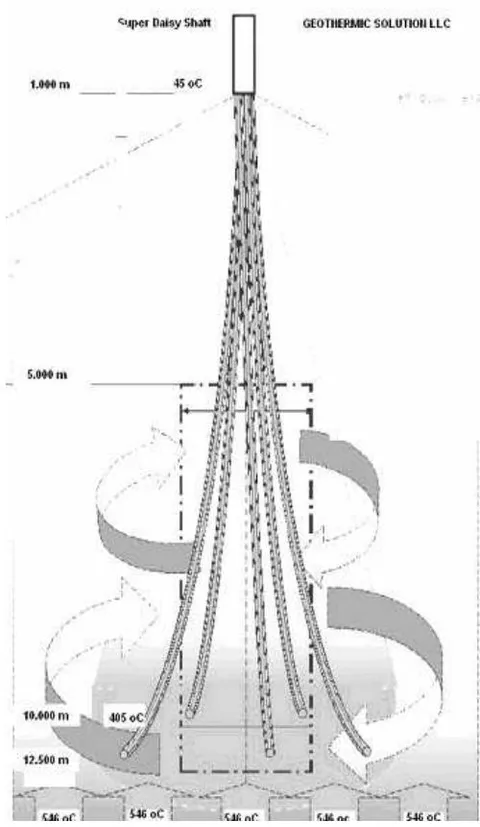
The fourth model is a modified deep model (Fig. 16). The modification consists in eliminating crushing of rocks and chemical preparations and contact with the natural environment. An important detail of the drilling technology is the increase in the depth of the boreholes to more than and the introduction of a closed circuit of the working fluid. This solution is optimal for the power industry. The first implementations of such geothermal installations were successful The geothermal model, called "deep-sea CHP plants" has been tested on several sites (Oklahoma (1979), depth over 10 km; Qatar (2008) depth 12.3 km, implementation time 35 days; Sakhalin (2011), depth 12.3 km, delivery time 60 days). The drilling rigs are adapted to drilling to a depth of 10,000 meters. The heat source is guaranteed in the high depth zone. Based on data obtained from existing deepwater power plants, the cost of kWh of electricity produced is cheaper than any other electricity generation technology currently available.
IV. CONCLUSIONS
The most important conclusion concerns geothermal energy and the outlook for its management. The problem of choosing a geothermal installation is related to the determination of the heat source. Proving the thesis that there is an unlimited heat source in the Earth's core gives an argument to promote the concept of building deep-sea CHP plants. The prospect of satisfying the energy needs on a global scale is emerging!
In scientific views, the dispute over truth has its material dimension. Staying with the view that there is no heat source in the middle of the globe is because the thermonuclear georeactor is an alternative view. And such a view is ruled out by physicists, supporters of the Big Bang theory.
In this article, the author explains why the Earth is expanding. In order to comment on this, it is necessary to explain what this phenomenon is and what are the traces of its operation.
The reason for the expansion of the Earth is the increase of basalt magma in the mantle of the globe and oceanic plates. The expansion phenomenon is caused by the operation of a thermonuclear reactor in the Earth's core. The direct cause of the expansion is the eruption of plasma from the Earth's core into zone D". From the point of view of physico-chemical processes, it is the process of plasma recombination into basalt magma.
The expansion began on Earth in an initial (latent) form of 500 million. BP years, and in the developed (explicit) form, BP 280 million years. During this time, the volume of the Earth has increased tenfold. All growth is basalt magma. The globe radius growth curve is an exponential function, which indicates the acceleration of the phenomenon.
The plasma recombination process causes a sharp increase in pressure, the appearance of tectonic stresses, seismic tremors and volcanic eruptions. The resulting elements form basalt magma, the characteristic feature of which is the stability of the chemical composition.
Basalt rock (oceanite) is devoid of hydrogen, which is degassed. The process of plasma recombination causes a rapid increase in pressure, the appearance of tectonic stresses, seismic shocks and volcanic eruptions.
The resulting elements form basalt magma, the characteristic feature of which is the stability of the chemical composition. Basalt magma contains all natural elements, but at the temperature of it loses gaseous components, mainly hydrogen. High concentrations of hydrogen have been detected near the Antarctic ice sheet, in the zone of volcanic activity and in the Earth's exosphere.
The management of geothermal energy is a rationally justified direction of exploration. Among the analyzed types of installations, preference is given to heat pumps, low-temperature individual users, and deep-sea CHP plants, 10 km deep and 30-40 MW, for municipal purposes.