
I. INTRODUCTION
Globalization has led to, beyond being economic entities, organizations also being responsible and sensitive to the circumstances of consumers, based on competitiveness, environmental impact and comprehensive care of collaborators.
To this extent, the Mining and Construction company seeks to implement a model based on the international standards defined by the International Organization for Standardization (ISO), in particular ISO 9001:2015, of quality management systems; ISO 14001:2015, environmental management system; ISO 45001:2018, occupational health and safety system (OSH) (International Organization for Standardization [ISO], 2015a; 2015b; 2018). This in order to strengthen business management, that is, the development and positioning of the company from respect for the client, environmental preservation and the well-being of both the community and its collaborators. In this sense, the diagnosis of the company and the definition of the axes of the implementation plan aligned with the quality principles and standards of the integrated management system mentioned above are proposed as research results.
a) Description of Mining and construction
The Mining and Construction company is part of the stone material extraction sector, whose economic growth has been significant due to the development of various construction and road infrastructure projects in the southwestern region of Colombia. However, after analyzing its competitive environment, it was found that there are companies dedicated to similar activities, which is why it is necessary to implement improvements that meet the needs of both internal and external clients, with a view to creating lasting competitive advantages.
Therefore, it is considered essential to standardize your processes with a focus on planning, implementation, verification and decision-making, with the guidance of the aforementioned standards. Sustainable development, the health and safety of employees, as well as the optimal quality of its products, are primary criteria, since the company's primary activity affects the environment, the surrounding communities and the workers. Thus, the high occupational risk that this implies requires strengthening prevention, comprehensive safety and quality programs.
II. THEORETICAL FOUNDATION
The National Competitiveness Report 2018-2019 (Private Competitiveness Council, 2018) highlights the need to strengthen the development of science, innovation and technology to increase productivity, an effort that must come from private and public companies. To achieve this, strategic plans based on integrated quality management systems are required, in particular, the ISO 9001:2015, ISO 14001:2015 and ISO 45001:2015 standards already mentioned.
a) Brief history of ISO standards
The International Organization for Standardization (ISO) is the product of the alliance of two associations dedicated to developing standards: the International Federation of National Standards Associations (ISA) and the newly created United Nations Standards Coordinating Committee. The first had been closed in 1939, due to the Second World War, as international communication was interrupted. Although the ISO was created in 1946, with delegates from twenty-five countries, the official date for the start of its activities is February 27 of the following year. Currently, the ISO is made up of 167 countries.
b) Principles for using ISO standards
The principles described in the ISO 9000 and ISO 9001 standards present a framework of reference that guides companies to improve their performance; These in turn will be taken into account for the design of actions in the business implementation plan.
Customer focus: Companies depend directly on customers, so they must meet their needs and requirements, as well as exceed their expectations, thus achieving their loyalty and loyalty.
Leadership: Which requires senior management to encourage the participation of everyone and the alignment of efforts with a view to achieving institutional goals in addition to recognizing performance at the individual and team level.
Commitment of people: This aspect aims to facilitate the participation of all members of the work teams, promoting motivation and commitment; Therefore, employees use their skills to achieve the organization's objectives, in this way, resources, staff performance and time will be optimized.
Process-based approach: It involves relating the different processes, in order to achieve efficiency, effectiveness and, consequently, greater productivity under standardized procedures that are continually subject to monitoring and evaluation.
Improvement: This principle promotes organizational learning with a view to business sustainability and satisfaction of the needs and expectations of interested parties, preparing to face changes, quickly and flexibly.
Decision-making based on evidence: Refers to the need to capture and process the necessary information to carry out an objective analysis of it and proceed to execute actions based on the results obtained in order to comply with the strategic direction.
Relationship Management: Stakeholders and companies are interdependent; Therefore, a link that benefits both adds value and can even contribute to optimizing resources and costs.
c) Key concepts
System: It is a set of elements that fulfills a specific mission or purpose and that functions as a whole, thanks to the interaction of its components.
Integrated Management System: A system that contains quality, environmental, and occupational health and safety management whose elements are interrelated to meet customer requirements, with minimal environmental impact and the lowest risk for workers. It brings together compliance with ISO 9001, 14001 and 45001 standards in a single model, and replaces any other quality, environmental and SST system (ESG Innova Group, 2017).
ISO 9001:2015 Standard: Is an international standard that aims to ensure that a company improves its performance, based on the "plan-do-control-act" principle and continuous improvement (Betilloch-Mas et al., 2019).
ISO 14001:2015 Standard: Establishes the requirements for the adequate implementation of an environmental management system to improve the performance of a company in that area (European School of Excellence, 2015).
ISO 45001:2018 Standard: Defines the OSH management system as one that is used to comply with OSH policies aimed both at preventing injuries and deterioration in the health of workers, and at providing safe and healthy work environments (European School of Excellence, 2018).
d) Quality management: periods of evolution
Industrialization: Corresponds to the 19th century, particularly the Industrial Revolution. Then, manual labor was gradually replaced by mechanical work. Already in the First World War, because the complexity of the production chain increased, the role of the inspector became necessary to supervise the effectiveness of the operator's performance (ESG Innova Group, 2016).
Statistical quality control (1930-1949): This period, in which the Second World War permeated all spheres of social relations, focused on proving that statistics could control production scenarios, with a view to raising the productivity and reduce errors (Shewhart, 1997). Furthermore, Shewhart, one of the most important theorists of the time in that field, designed the PHVA cycle: plan, do, check, act, which is the basis of current quality management systems.
Quality assurance (1950-1979). First systems: Characterized by the requirement to identify needs and expectations, in order to produce quality goods and services. Programs and systems for the quality areas of companies emerged from Shewhart's proposals and, in addition to measurement, quality planning was incorporated, from the postulate: "Quality is built from within" (Cubillos Rodríguez and Rozo Rodríguez, 2009, p. Here it is no longer enough to carry out statistical control, since the processes must be carried out in stages, susceptible to correction in case of failure (ESG Innova Group, 2016).
Strategy: From the early 1980s to the mid-1990s, quality was seen as a strategic process, that is, subject to continuous improvement that can represent a competitive advantage. Now, the focus is on the client's needs, management systems are consolidated and staff are involved with greater intensity (ESG Innova Group, 2016).
Total quality: It began in the mid-1990s and is still in force. There is no longer a distinction between service and product, nor between the article and its manufacturing stages, since the process as a whole is now taken into account. Quality control even extends to after-sales (ESG Innova Group, 2016).
Competition is strengthened, markets are globalized and the hegemony of Western industry is broken. Cost reduction is a constant purpose; Likewise, companies recognize the relevance of producing their own knowledge, systematically (Cubillos Rodríguez and Rozo Rodríguez, 2009).
Thus, quality went from identifying defective products to being the common thread of organizations that, within the framework of the GIS led by senior management, institute tools aimed at general improvement.
environment, in order to find the correlation between the situations and their context. To that extent, data were collected through observation, interview, and record review.
Furthermore, this research applied a quantitative approach that allowed, after applying an instrument called a checklist, to capture, process the information and obtain a diagnosis of the degree of implementation of the three standards mentioned above.
The documentary review was also carried out, because the purpose of the research is to propose the axes of the implementation plan under the quality principles and the ISO 9001:2015, ISO 14001:2015 and ISO 45001 of 2018 standards.
b) Participants
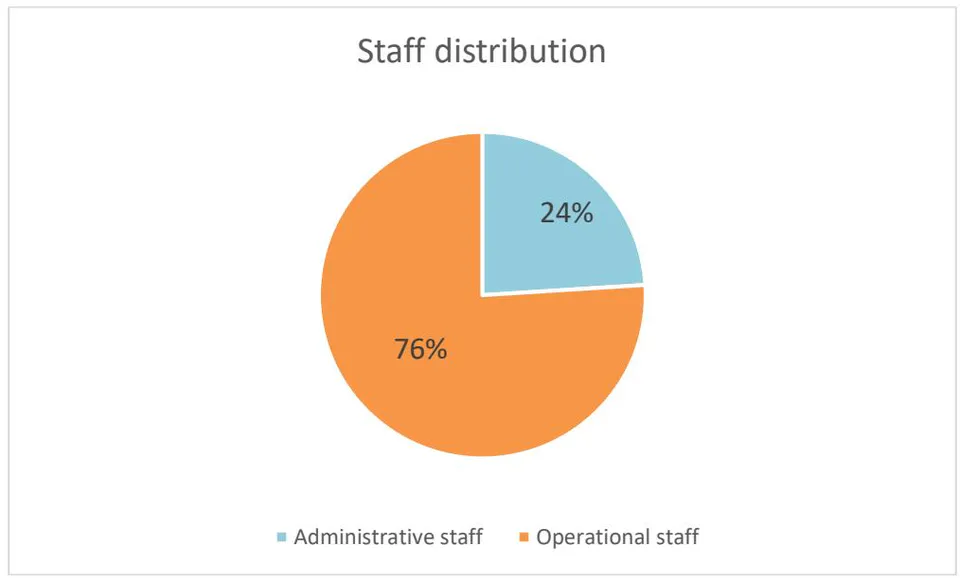
Of the company's 42 employees, (10 employees) correspond to administrative personnel and (32 employees) to operational positions that perform tasks in the quarry and crushing plant.
III. METHOD
a) Design
The type of study was descriptive since the information was collected without altering the
Source: own elaboration (2023)
Taking into account the objective of the investigation and the knowledge of the operation of the organizational processes, it was defined that the personnel to be interviewed during the first phase of the investigation should be focused on eight (8) leaders of administrative and missional processes.
c) Instruments
The research techniques applied to collect information included a face-to-face interview, which was carried out with the defined leaders, in which the strategic planning in the short and medium term was investigated, as well as the strengths and opportunities for improvement of the company.
Likewise, taking into account the need to verify the degree of implementation of the requirements of the three standards mentioned above, the checklist was prepared which contains fifty (50) items, based on the standards.
This instrument made it possible to collect quantitative and qualitative information provided by the process leaders, as well as the review of existing documentation and field visits to the company's operating facilities where the extraction and transformation of the stone material is carried out, facilitating this process. verification and provide the tools to obtain a diagnosis adjusted to business reality.
d) Procedures
The activities aimed at determining the current status of the company in relation to the Integrated Management System require the execution of activities in group and individual sessions described below:
Senior Management Awareness Process about the Integrated Management System.
Socialization to staff about the importance of quality, environmental management and health and safety at work.
Conducting interviews and applying checklists.
Processing of collected information.
- 5.Diagnosis and formulation of implementation plan.
Source: own elaboration (2023)
Figure 2: Summary of research stages
IV. RESULTS
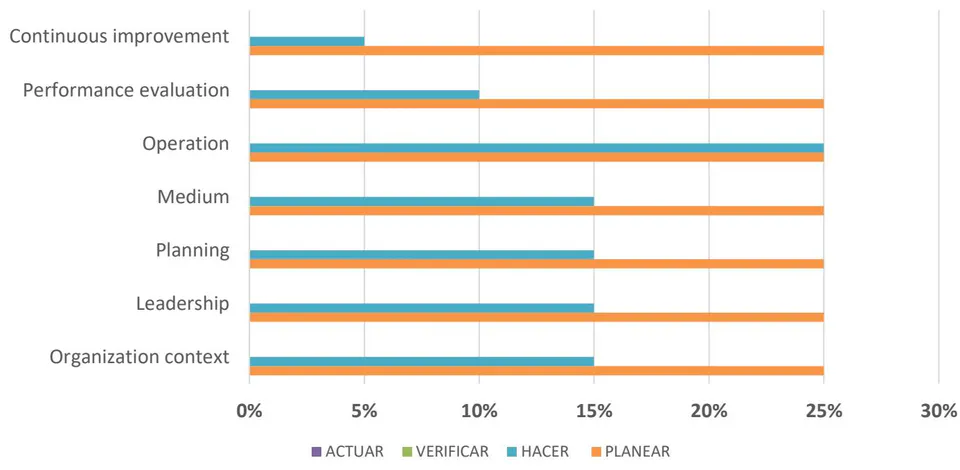
After reviewing the standards that were taken as the axis for this investigative process and considering the nature of the company, the instruments were applied to the staff and during field visits based on the requirements of the standards and under the concept of improvement cycle Plan – Do – Check – Act (PHVA).
The obtained results are showed next:
DIAGNOSIS OF THE INTEGRATED MANAGEMENT SYSTEM
Source: own elaboration (2023)
Carrying out the analysis, it is observed that although procedures and formats have been established that respond to the ISO 9001:2015, ISO 14001:2015 and ISO 45001:2018 standards, the application of these is not frequent in the different institutional processes, therefore The improvement cycle and decision making based on real information are interrupted, this explains why a high degree of compliance is observed in the planning phase, a percentage that is significantly affected when the implementation, verification and taking of actions are investigated. against the detected deviations.
a) Company context
Mining and Construction does not have a standardized process to identify the needs and expectations of all interested parties in a systematic manner, however, during customer service and to generate the necessary input for production processes, the needs are recorded and consolidated in a contract which is monitored by some leaders.
Also due to the nature of the company, it must abide and comply with regulations applicable to the mining sector, this also includes carrying out responsibility actions in which actions to benefit the community are carried out according to the needs raised in the meetings held in set, but in addition to the mechanisms for detecting the parties' requirements, the monitoring method to evaluate the satisfaction of all interested parties must necessarily be established.
b) Leadership
The project was presented and endorsed by Senior Management due to the relevance of adopting integrated quality management systems, however, the limited availability of resources necessary for the implementation of the three standards is a prevailing factor in the implementation of the proposed plan.
In addition to the aforementioned, the lack of knowledge of the members of the Board about the challenges of this type of companies in this regional context and the importance of standardizing processes to promote continuous improvement within the framework of an integrated management system is an aspect which must be addressed through a process of continuous training and active participation.
c) Management of planning, support and operation processes
Evaluated this aspect, although it is true that the implementation shows a high percentage in relation to the operation of the processes, it is a priority to ensure that the company institutes an organizational dynamic based on well-structured processes that meet the needs of its clients and other parties. interested.
These also require improving the resource planning process in the financial, technological and human talent fields with a view to increasing business productivity and competitiveness.
The aforementioned requires executing measurable daily activities, as well as setting objectives for each process that allow it to achieve its strategic goals.
The nonexistence of these processes and objectives prevents traceability, statistical control and the detection of deficient services and products, which is why it is necessary to standardize effective communication models and documentation of procedures.
d) Performance evaluation and improvement
Regarding performance evaluation, audits and accountability, only those carried out by Occupational Health and Safety and those attended to at the request of external actors (National Mining Agency, Autonomous Corporation and ARL Occupational Risk Administrator) are recorded.
These activities focused on a few processes, but did not take into account the strengths and opportunities for improvement around customer satisfaction and compliance of all processes.
The improvement component is touched upon only tangentially when answering for the results of the audits.
All of the above demonstrates the imperative need for Senior Management to become aware of the relevance of instituting a strategic plan—short, medium and long term—based on the integrated policy of the quality management system aimed at guaranteeing organizational sustainability.
Challenges in the implementation of the integrated management system based on ISO 9001:2015, ISO 14001:2015 and ISO 45001:2018 standards and quality principles
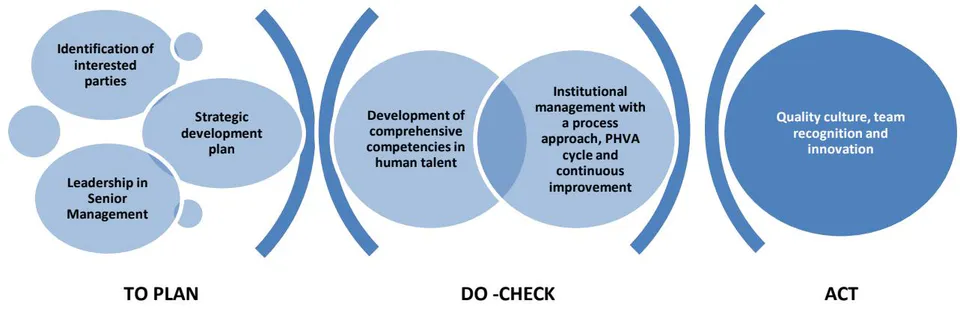
The adoption of the integrated management system in companies independent of the sector requires that the principles of quality be the foundation of this and therefore must be the basis for developing the tracing themes of the implementation plan, which are set out below:
Source: own elaboration 2023
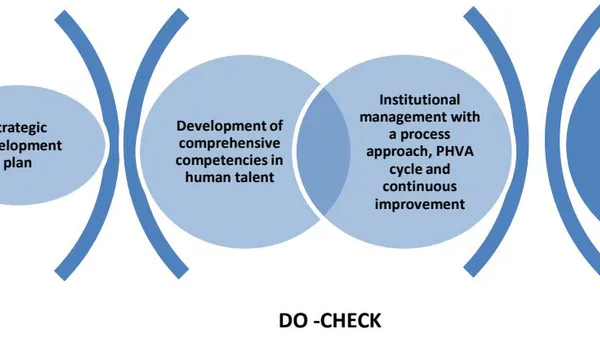
The figure shows the axes on which the implementation of the standards in the company under study must be based, whose implementation becomes an institutional retrofit since extremely important actions that are described below must be executed:
e) Commitment and leadership of Senior Management
Being clear that productivity, competitiveness and sustainability are necessary in companies independent of the sector, it is mandatory that those who manage be continuously trained in this case in integrated quality management systems, disruptive thinking and coaching since they are responsible for convening and combining everyone's efforts to build the strategic platform.
They must lead by example to motivate everyone to fulfill the promise of value established within the framework of the principles and values that underpin the organization and constitute the business DNA, in this way the principle of leadership becomes palpable in the process of implementation.
f) Identification and systematic management of the needs and expectations of interested parties
In companies, it is essential to adequately identify interested parties which can positively or negatively affect their operations; this justifies the inclusion of "Relationship Management" as a principle of the integrated quality system.
Therefore, it is necessary to establish a systematic methodology to detect its needs and expectations because this is the fundamental input information for strategic planning in the short, medium and long term. It is worth highlighting the importance of carrying out a continuous evaluation of the satisfaction of interested parties to proceed with taking the relevant actions in case of deviations.
g) Systematic and participatory strategic planning
Taking into account the challenges of the global economy, it is necessary to anticipate the scenarios and prepare to respond effectively to them, which requires promoting the active participation of all collaborators to establish objectives and goals in different horizons.
Once this stage has been completed, it is necessary to define the operational plans in which the activities are cited to carry out adequate resource management and be able to respond to clients, collaborators and other interested parties. This process must be in charge of Strategic Management (principle of "Leadership") and focused on the satisfaction of internal and external customers (principle of "Customer Focus").
The fundamental complement to this planning process is related to the establishment of tracer indicators to measure progress from financial perspectives, customer focus, internal processes, and learning and growth.
h) Development of comprehensive competencies in human talent
Once the management, mission, support and evaluation processes have been established, the specific and differentiating competencies necessary in the personnel must be established. This step is essential to carry out the recruitment, selection and continuous training processes.
The competencies must be strengthened during the life cycle of the collaborator, the aforementioned will allow the evaluation and improvement of organizational and individual performance, in this way the principle "commitment of people" will be a reality since human talent will be motivated and trained, becoming a main actor that generates added value to the company and also contributes to creating an environment of respect and trust.
i) Institutional management with a process approach, PHVA cycle and continuous improvement
Undoubtedly, quality based on ISO standards requires a focus on processes as established in their principles; this implies the standardization of processes and document management under the Plan-Do-Check-Act (PHVA) structure.
In this sense, objectives must be established for each process in coherence with the strategic ones and the resources necessary for the effective operation of the processes must be defined.
It is also necessary to identify and prioritize risks to carry out proactive management focused on eliminating, transferring or minimizing them; This activity must be executed by the process leader and the work team who have in-depth knowledge of the process operations.
As previously stated, during strategic planning, tracer indicators must be established that allow the effectiveness of the processes through a comprehensive control panel. This implies that each process must measure its operation through metrics whose monitoring allows for the traceability of this process. and carry out statistical control regarding the conformity of the products/services delivered to internal/ external clients.
j) Quality culture, team recognition and innovation
The quality principles related to "Improvement" and "Evidence-based decision making" constitute a fundamental pillar in the creation of a quality culture based on continuous progress.
This new cultural conception also requires establishing an assertive and effective communication plan that facilitates the process of feedback and recognition of work; It is also expected that through this it will be possible to socialize the lessons learned and promote innovation to solve the gaps, opportunities for improvement and/or deviations detected during the monitoring stage.
It is important to highlight the importance of training staff to develop internal audits and prepare to receive external audits carried out by control and/or certifying entities, in this way the quality culture will promote accountability, self-management and heteroevaluation in organizational processes.
V. CONCLUSIONS
Organizations that have permanence in the market and enjoy a certain "stability" consider the adoption of integrated management systems is not a mandatory decision, however after carrying out a self-assessment process against their requirements they realize the need to adopt international standards that, through activity planning processes, execution of operational plans, process monitoring and promotion of continuous improvement, prepare an accurate path for the company's competitiveness.
In this way, in the participating company, a diagnosis was obtained in which the prevailing need to engage Senior Management in the organizational strategic direction under the principles of quality under a process approach within the framework of the Plan-Do-Check cycle was evident. -Act, structuring processes that meet the requirements of the ISO 9001:2015, ISO 14001:2015 and ISO 45001:2018 standards in order to comprehensively respond to the needs and expectations of the various interested parties.
Although this company has managed to remain in the market and can choose to maintain its basic operation if it wants to remain in the market, retain customers and be more productive and competitive, I detect the need to execute actions based on the principles of quality, that is, leading a quality culture with a focus on internal and external customers, promoting people's commitment through efficient processes that continually improve by making decisions based on facts and data.
In this sense, the axes of the implementation plan aim to build a competitive, safe and sustainable strategy, supported by the PHVA cycle, through a set of actions that are based on the three ISO standards already mentioned, which seek to empower collaborators under a transformative leadership; reduce rework; optimize organizational processes; provide compliance, satisfaction and attention to customer requirements and expectations; stimulate sustainable and environmentally friendly development, and act against all types of risks—including labor risks—to maintain the health of all its collaborators and thus guarantee a successful path for the company with the purpose of fulfilling the strategic plan. which must be focused on improving competitiveness, productivity and business sustainability.