
Sh. A. Topchiyeva
I. INTRODUCTION
One of the important factors determining the degree of spread and intensity of invasions is the time of year and the climatic conditions of farms. Parasite numbers rise with time when conditions are suitable and internal parasite burdens impact on the health and well-being of the animal when their numbers grow beyond what the animal can tolerate. Nematodes are pathogenic parasites, causing disease in the host. Usually they live in the digestive system of the host. Haemonchus contortus attaches to the wall of the abomasums in sheep and goats, feeding on the host's blood, causing anemia. Other nematodes usurp the nutrients eaten by the host, causing weight loss (Hale, 2006) [1.2] In the literature, data has been given on the extent of the invasion, depending on climatic conditions. The difference in invasiveness is explained by unequal conditions of keeping, the degree of contamination of keeping and feeding areas of animals. The isolation of invasive elements in their opinion depends on the condition of the host organism, feeding, habitat conditions and abiotic factors. All these factors affect the viability of helminths in the external environment and the host organism .
Serum enzyme activities of sorbitol dehydrogenase, glutamate dehydrogenase, gamma glutamyltransferase, alkaline phosphatase, aspartic aminotransferase, and creatine kinase, were measured in five clinically normal mixed-breed goats. Tissue activities of these enzymes were also measured in two goats. These basal serum values were then used to determine the response to treatment with carbon tetrachloride (CCl4). The basal value for serum and hepatic tissue sorbitol dehydrogenase were appreciably greater for goats than previously reported for sheep and cattle. The change in the above serum enzymes after CCl4 treatment resembled change in sheep, but the amount of sorbitol dehydrogenase increase was less than that in sheep.
This study established basal tissue and serum enzyme activity values and demonstrated the efficacy of the use of changes in serum S.D.H. and G.D.H. activity as indicators of acute hepatopathy in goats [5].
The blood, being the internal environment of the organism, has a relative constancy of its composition; nevertheless, it is a system that reflects in a varying degree all the changes that occur in the body. At the same time, its morphofunctional indicators are individual values (A.N. Kvochko, 2002). Blood content of red blood cells, hemoglobin and other hematological parameters, according to A.N. Kvochko (2001) varies with age, sex, level of feeding, content, productivity, and season of the year. Hematological parameters are interrelated with animal productivity. In this regard, for the early evaluation of the economically useful traits of animals, biochemical blood parameters are increasingly used.
Transamination processes are important in the developmental period of an organism, when it builds proteins of its tissues and organs from protein digestion products in the digestive tract, in which the full set of amino acids necessary for synthesis is not always present (SE Vasilyeva, 1987). In this regard, the activity of serum transamination enzymes, aspartate aminotransferase (AST) and alanine aminotransferase (ALT), whose concentration reflects the level of protein metabolism in the body, was studied.
The highest enzymatic activity of transaminases ALT (alanine aminotransferase) and AST (aspartate aminotransferase) was observed in animals obtained in the first two decades of kazleniya (group I and II), which was higher compared with group III animals, respectively, by 30.0.22.5% and 11.7% [6, 7].
Alanine aminotransferase is an enzyme that catalyzes transamination processes. Indicators of activity of alanine transferase have differences in blood by sex, and also differ in the period of physiological development in young [8]
The synthetic function of the liver can be assessed by studying the activity of the transaminating enzymes AlAT and AsAT, the main function of which is the synthesis and breakdown of certain amino acids in the body. A significant increase in these indicators in the blood of animals of the experimental group is consistent with the data on the content of total protein, serum urea, and indicates a violation of liver function and intensity of protein metabolism.
The content of total protein in serum is an important indicator characterizing the level of metabolism in the body of an animal. Proteins are a building material for the cells of body tissues, they are actively involved in the formation of various types of products. A significant decrease in the total protein content in the blood of the experimental group when exposed to a negative temperature of below the physiological norm (70-80 g/l) can be associated with stress adaptation processes, in particular, with a decrease in the level of protein metabolism. Causes of hypoproteinemia can be protein starvation or poor absorption of proteins from the feed due to disorders of the gastrointestinal tract, as well as mobilization of proteins as energy sources [9, 10].
Protein metabolism is a complex of transformations of proteins and amino acids in the body. It is known that serum proteins play a leading role in metabolic processes in animals and are functionally related to the development of their main economically valuable traits. These heterogeneous complexes contribute to the preservation of homeostasis, the transmission of hereditary information, provide the natural resistance of the organism .
Based on the above, the purpose of the research was to study the dynamics of total protein and enzymatic activity in healthy and parasite-infected goats.
II. MATERIAL AND RESEARCH METHODS
Experimental studies of the detection of aspartate transaminase activity in the blood of goats of Khizi-Khachmaz zone of Azerbaijan in different seasons of the year for the period from December 2017 to January 2018, depending on the degree of invasion by parasites of animals were held. Determination of the enzymatic activity and the dynamics of total protein in the blood was carried out spectrophotometrically using a Folin reagent on a Specol 1500 spectrophotometer (Analitik Jena). The assessment of the reliability of differences of compared samples was performed by Student's criterion.
III. RESEARCH RESULTS AND DISCUSSION
We determined the dynamics of the activity of the enzyme aspartate aminotransferase (AcAT) in samples of serum of goats invaded by parasites, depending on the degree of parasite invasion at different times of the year.
It was found that in goats infested by parasites, the activity of AsAT in the blood in the winter in February is 2.14 times lower (p <0.05) than in the first half of spring. The activity of AIAT in the serum of goats in September was 1.04 times (p <0.01) higher than in February. In addition, in the blood of goats in the summer in June, there was a decrease in the activity of ALT by 1.38 times (p <0.05), compared with the activity of the enzyme in the spring period (in March).
Analysis of the data obtained shows that the activity of enzymes that regulate the conjugation of protein and carbohydrate metabolism in the blood of goats during the period of invasion by parasites may be associated with their subsequent ability to survive of animals and their reproductive performance.
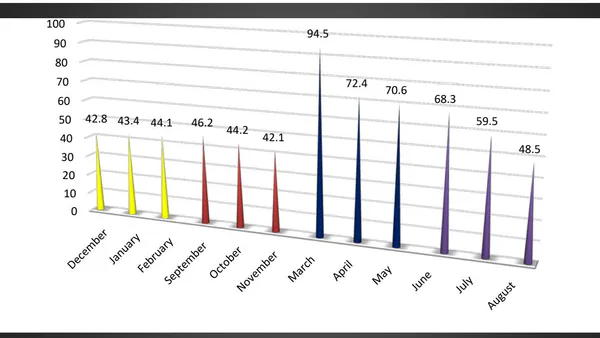
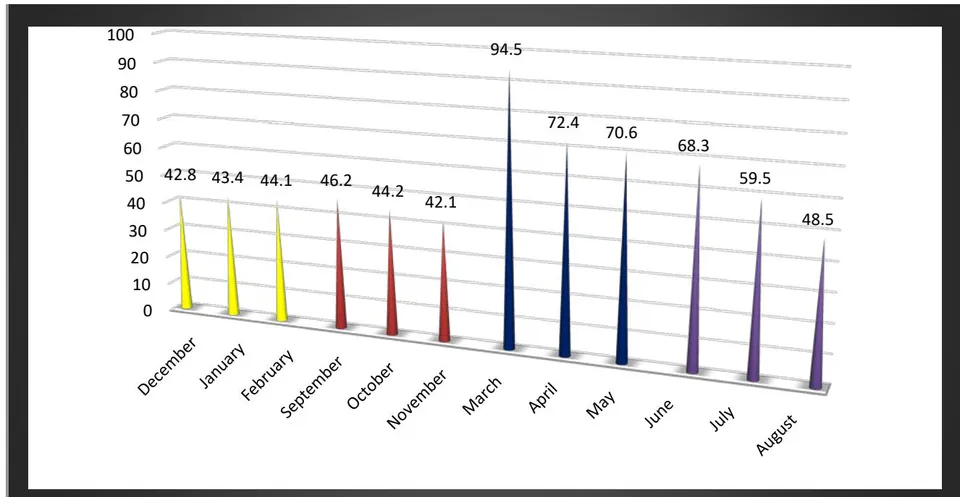
The maximum peak of intensity of aspartate transaminase enzymatic activity of blood of goats was revealed. The maximum value of the enzyme activity was reached in March equal to U/L of the blood, and the minimum in June reaching 72 U/L of the blood (tabl.1, fig.1).
Thus, experimental studies were conducted to identify aspartate transaminase activity of blood in goats infested by parasites in different seasons of the year. Proceeding from the obtained data, it can be stated that the season of the year and the climatic conditions of their maintenance on farms significantly influences the aspartate transaminase enzymatic activity of goat homogenates. (tabl.1, fig.1)
The amount of activity of the enzyme aspartate aminotransferase (AST) in the blood of healthy goats was determined, which ranged from to .
It was experimentally revealed that in goats an increase in the enzymatic activity of AsAT in the blood during parasite invasion is detected. At the same time, the activity of AsAT in the blood at all seasons is significantly lower in healthy goats than in infected ones. The activity of AST in the blood of healthy goats is 1.39 times lower (p < 0.05) than in the winter period. The activity of AIAT in the serum of animals increased 2.97 times (p < 0.02) compared with the control group of animals.
| Aspartate-transaminase activity of goat's blood enzymes, U/L | |||||||
| Months | |||||||
| Winter season | Autumn season | Spring season | Summer season | ||||
| December | 42.8±2.3 | September | 46.2±2.1 | March | 94.5±3.5 | June | 68.3±3.4 |
| January | 43.4±1.6 | October | 44.2±1.3 | April | 72.4±2.1 | July | 59.5±2.2 |
| February | 44.1±2.4 | November | 42.1±1.1 | May | 70.6±1.8 | August | 48.5±2.5 |
The dynamics of changes in the content of total protein in serum is an important indicator characterizing the level of metabolism in the animal. With the invasion of animals by parasites, there is a change in the total blood protein of the experimental animals. A significant decrease in the total protein content in the blood of the experimental group was noted, depending on the degree of infection of goats. При исследовании общего белка методом Фолина у контрольных групп коз общий белок колебался в пределах 80.6±1.3-92.3±1.8 г/л соответственно. In the study of total protein by the folin method in the control groups of goats, the total protein ranged from 80.6 ± 1.3-92.3 ± 1.8 g/l, respectively. However, depending on the degree of parasite invasion, which affects the activity of the enzyme AsAT, a decrease in the total protein content was observed at the same time (Table 2), which is most likely due to the stress of adaptation processes, in particular, to a decrease in the level of protein metabolism during parasite invasion.
So, with an increase in enzymatic activity, there is a decrease in total protein in the blood of infested goats, which is associated with the degree of infection of experimental animals.
In conclusion, the change in the activity of the enzyme AsAT in the blood, depending on the degree of invasion and the season should be noted.
Analysis of the data also shows that the activity of enzymes that regulate the conjugation of protein and carbohydrate metabolism in the blood of goats during invasion by parasites may be associated with their subsequent ability to survive and reproduce. The indicators of total blood protein allow us to assess the physiological state of the body of goats, the functions of its organs and systems in the work of maintaining protein metabolism and are one of the main indicators for diagnosing various pathologies of animals.
| Total protein, g/l | |||||||
| Months | |||||||
| Winter season | Autum season | Spring season | Summer season | ||||
| December | 70.8±1.3 | September | 76.2±2.0 | March | 64.2±1.5 | June | 68.3±1.4 |
| January | 71.4±1.9 | October | 74.2±1.2 | April | 62.1±1.3 | July | 69.5±1.1 |
| February | 71.1±1.5 | November | 72.1±1.5 | May | 60.5±0.9 | August | 68.5±0.9 |
Monitoring on the biochemical parameters of the blood of goats will allow for effective breeding activities to form the gene pool of an animal population with a high metabolic rate in order to improve the high productivity of small ruminants.
IV. FINDINGS
The activity of the enzyme aspartate aminotransferase (AST) in the blood of healthy goats was detected, which ranged from to U/L.
The activity of AsAT in the blood at all times of the year is significantly lower in healthy goats than in infected ones.
The maximum peak of intensity of aspartate transaminase enzymatic activity in blood of goats was revealed. The maximum value of the enzyme activity was reached in March equal to , and the minimum in November reaching U/L blood.
Decrease in total protein in the blood of goats, depending on the degree of invasion by parasites was revealed. In the control groups of goats, the total protein corresponded to g/l., While in the experimental groups of goats it was within g/l.