Changes in Total Protein Level in Human Female Saliva during Ovulatory Functions and Metabolic Disorders

α
Shweta
Shweta
σ
Navi Ranjan
Navi Ranjan
α Veer Kunwar Singh University

Send Message

To: Author

Changes in Total Protein Level in Human Female Saliva during Ovulatory Functions and Metabolic Disorders

Article Fingerprint

ReserarchID

8CZ6A

Changes in Total Protein Level in Human Female Saliva during Ovulatory Functions and Metabolic Disorders Banner

AI TAKEAWAY

Connecting with the Eternal Ground
  • English
  • Afrikaans
  • Albanian
  • Amharic
  • Arabic
  • Armenian
  • Azerbaijani
  • Basque
  • Belarusian
  • Bengali
  • Bosnian
  • Bulgarian
  • Catalan
  • Cebuano
  • Chichewa
  • Chinese (Simplified)
  • Chinese (Traditional)
  • Corsican
  • Croatian
  • Czech
  • Danish
  • Dutch
  • Esperanto
  • Estonian
  • Filipino
  • Finnish
  • French
  • Frisian
  • Galician
  • Georgian
  • German
  • Greek
  • Gujarati
  • Haitian Creole
  • Hausa
  • Hawaiian
  • Hebrew
  • Hindi
  • Hmong
  • Hungarian
  • Icelandic
  • Igbo
  • Indonesian
  • Irish
  • Italian
  • Japanese
  • Javanese
  • Kannada
  • Kazakh
  • Khmer
  • Korean
  • Kurdish (Kurmanji)
  • Kyrgyz
  • Lao
  • Latin
  • Latvian
  • Lithuanian
  • Luxembourgish
  • Macedonian
  • Malagasy
  • Malay
  • Malayalam
  • Maltese
  • Maori
  • Marathi
  • Mongolian
  • Myanmar (Burmese)
  • Nepali
  • Norwegian
  • Pashto
  • Persian
  • Polish
  • Portuguese
  • Punjabi
  • Romanian
  • Russian
  • Samoan
  • Scots Gaelic
  • Serbian
  • Sesotho
  • Shona
  • Sindhi
  • Sinhala
  • Slovak
  • Slovenian
  • Somali
  • Spanish
  • Sundanese
  • Swahili
  • Swedish
  • Tajik
  • Tamil
  • Telugu
  • Thai
  • Turkish
  • Ukrainian
  • Urdu
  • Uzbek
  • Vietnamese
  • Welsh
  • Xhosa
  • Yiddish
  • Yoruba
  • Zulu

Abstract

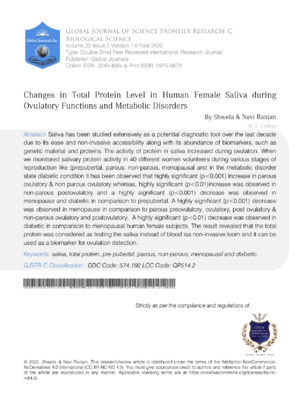
Saliva has been studied extensively as a potential diagnostic tool over the last decade due to its ease and non-invasive accessibility along with its abundance of biomarkers, such as genetic material and proteins. The activity of protein in saliva increased during ovulation. When we monitored salivary protein activity in 40 different women volunteers during various stages of reproduction like (prepubertal, parous, non-parous, menopausal and in the metabolic disorder state diabetic condition it has been observed that highly significant (p

References

24 Cites in Article
  1. S Alagendran,S Saibaba,R Muthukumar,Rajkumar,G Guzman,Archunan (2013). Characterization of salivary protein during ovulatory phase of menstrual cycle through MALDI-TOF/MS.
  2. Kiran Ambatipudi,Bingwen Lu,Fred Hagen,James Melvin,John Yates (2009). Quantitative Analysis of Age Specific Variation in the Abundance of Human Female Parotid Salivary Proteins.
  3. Antonio Mata,Duarte Marques,Sara Rocha,Helena Francisco,Carolina Santos,Maria Mesquita,Jaipaul Singh (2004). Effects of diabetes mellitus on salivary secretion and its composition in the human.
  4. E Arranz,S O'mahony,J Barton,A Ferguson (1992). Immunosenescence and mucosal immunity: significant effects of old age on secretory IgA concentrations and intraepithelial lymphocyte counts..
  5. H Ben-Aryeh,A Shalev,R Szargel,A Laor,D Laufer,D Gutman (1986). The salivary flow rate and composition of whole and parotid resting and stimulated saliva in young and old healthy subjects.
  6. José Chicharro,Alejandro Lucía,Margarita Pérez,Almudena Vaquero,Rosario Ureña (1998). Saliva Composition and Exercise.
  7. Chun-Ming Huang (2004). Comparative proteomic analysis of human whole saliva.
  8. Paul Denny (2008). The proteomes of human parotid and submandibular/sublingual gland saliva collected as the ductal secretions.
  9. Anne Dodds,Dodds (1997). Effects of glycemic control on saliva flow rates and protein composition in noninsulin-dependent diabetes mellitus.
  10. C Ferreiro,M,M Hermida,S Prieto,R Rodriguez,A Vazquez,Castro,P Iglesias,Diz Dios (2002). Whole stimulated salivary flow in patients with chronic hepatitis C virus Journal of oral pathology & medicine.
  11. Lawrence Tabak (2001). A Revolution in Biomedical Assessment: The Development of Salivary Diagnostics.
  12. P Lakshmi,E Sridevi,A Sankar,M Kumar,M Sridhar,B Sujatha (2015). Diagnostic perspective of saliva in insulin dependent diabetes mellitus children: an in vivo study.
  13. N J O H Lowry,A L Rosebrough,R J Farr,Randall (1951). Protein measurement with the Folin phenol reagent.
  14. M Navazesh,C Christensen (1982). A Comparison of Whole Mouth Resting and Stimulated Salivary Measurement Procedures.
  15. A Nieuw Amerongen,Eci Veerman (2002). Saliva -the defender of the oral cavity.
  16. Arati Panchbhai,Shirish Degwekar,Rahul Bhowte (2010). Estimation of salivary glucose, salivary amylase, salivary total protein and salivary flow rate in diabetics in India.
  17. H Perinpanayagam,B Vanwuyckhuyse,Z Ji,L Tabak (1995). Characterization of Low-molecular-weight Peptides in Human Parotid Saliva.
  18. P Sanjay,K Hallikeri,A Shivashankara (2008). Evaluation of salivary sialic acid, total protein, and total sugar in oral cancer: A preliminary report.
  19. Shen Hu,Patricia Denny,Paul Denny,Yongming Xie,Joseph Loo,Lawrence Wolinsky,Yang Li,Jim Mcbride,Rachel Ogorzalek Loo,Mavash Navazesh,David Wong (2004). Differentially expressed protein markers in human submandibular and sublingual secretions.
  20. J Simpson,L Wood,P Gibson (2005). Inflammatory mediators in exhaled breath, induced sputum and saliva.
  21. S Twetman,I Johansson,D Birkhed,T Nederfors (2002). Caries Incidence in Young Type 1 Diabetes mellitus Patients in Relation to Metabolic Control and Caries-Associated Risk Factors.
  22. M Villiger,R Stoop,T Vetsch,E Hohenauer,M Pini,P Clarys,F Pereira,R Clijsen (2018). Evaluation and review of body fluids saliva, sweat and tear compared to biochemical hydration assessment markers within blood and urine.
  23. Weihong Yan (2009). Systematic comparison of the human saliva and plasma proteomes.
  24. R D Zachariasen (1993). The Effect of Elevated Ovarian Hormones on Periodontal Health.

Funding

No external funding was declared for this work.

Conflict of Interest

The authors declare no conflict of interest.

Ethical Approval

No ethics committee approval was required for this article type.

Data Availability

Not applicable for this article.

How to Cite This Article

Shweta. 2026. \u201cChanges in Total Protein Level in Human Female Saliva during Ovulatory Functions and Metabolic Disorders\u201d. Global Journal of Science Frontier Research - C: Biological Science GJSFR-C Volume 22 (GJSFR Volume 22 Issue C3): .

Download Citation

High protein levels in human saliva linked to oral and systemic health disorders. Study explores implications for dental and medical research.
Issue Cover
GJSFR Volume 22 Issue C3
Pg. 15- 18
Journal Specifications

Crossref Journal DOI 10.17406/GJSFR

Print ISSN 0975-5896

e-ISSN 2249-4626

Keywords
Classification
GJSFR-C Classification: DDC Code: 574.192 LCC Code: QP514.2
Version of record

v1.2

Issue date

January 30, 2023

Language
en
Experiance in AR

Explore published articles in an immersive Augmented Reality environment. Our platform converts research papers into interactive 3D books, allowing readers to view and interact with content using AR and VR compatible devices.

Read in 3D

Your published article is automatically converted into a realistic 3D book. Flip through pages and read research papers in a more engaging and interactive format.

Article Matrices
Total Views: 1358
Total Downloads: 54
2026 Trends
Related Research

Published Article

Saliva has been studied extensively as a potential diagnostic tool over the last decade due to its ease and non-invasive accessibility along with its abundance of biomarkers, such as genetic material and proteins. The activity of protein in saliva increased during ovulation. When we monitored salivary protein activity in 40 different women volunteers during various stages of reproduction like (prepubertal, parous, non-parous, menopausal and in the metabolic disorder state diabetic condition it has been observed that highly significant (p

Our website is actively being updated, and changes may occur frequently. Please clear your browser cache if needed. For feedback or error reporting, please email [email protected]

Request Access

Please fill out the form below to request access to this research paper. Your request will be reviewed by the editorial or author team.
X

Quote and Order Details

Contact Person

Invoice Address

Notes or Comments

This is the heading

Lorem ipsum dolor sit amet, consectetur adipiscing elit. Ut elit tellus, luctus nec ullamcorper mattis, pulvinar dapibus leo.

High-quality academic research articles on global topics and journals.

Changes in Total Protein Level in Human Female Saliva during Ovulatory Functions and Metabolic Disorders

Shweta
Shweta Veer Kunwar Singh University
Navi Ranjan
Navi Ranjan

Research Journals