I. INTRODUCTION
As a diagnostic fluids Body fluids like blood, saliva, tears, sweat and urine are a source of pathological biochemical markers in which saliva is an excellent biological fluid that is useful for noninvasive exploration of the human diseases and physiological conditions (Villiger et al., 2018). Salivary protein concentration is dependent on gland production at time of day, diet, age, gender and presence of disease (Ferreiro et al., 2002). Saliva consists mainly of water, enzymes, ions and amino acids and performs several important functions in oral health. It contains various biomolecules such as proteins, enzymes and hormones. Saliva contains a large number of proteins that participate in the protection of the oral tissues, for instance lysozyme, lactoferrin, lactoperoxidase, immunoglobulins, ag-glutinin and mucins. Nieuw Amerongen and Veer-man 2002, Denny et al., 2008 and Yan et al., 2008 reported about two thousand proteins in human saliva using mass spectrometry. Sanjay et al., 2008 reported significant high total salivary protein in the saliva of cancer patient. In the beginning of menstruation and during ovulation, the protein content of saliva increases considerably, which turns out to be a rich source of nutrient to bacteria, the count of which may increase during menstruation and ovulation. Protein in the serum is made up of albumin and globulin. Albumin is made mainly in the liver which helps tissue growth and healing. Globulins is made up of different proteins called alpha, beta and gamma. Some globulins are made by liver while others are made by immune systems. Salivary proteins, such as mucins, -amylase, lysozyme, and peroxidase are synthesized and packed into secretory granules in acinar cells. Salivary protein secretion is strongly enhanced by the sympathetic nerve stimulation. Perinpanayagam et al., 1995 reported that small peptide in saliva showed proteolytic activity. Chicharro et al., 1998 indicated that the salivary level of total protein increases also through -sympathetic activity in salivary glandssince saliva secretion is mainly evoked by the action of androgenic mediators. Hu et al., 2004 and Huang, 2004 studied the structure and function of a large number of proteins in human saliva with traditional biochemical techniques including chromatography, gel electrophoresis, mass spectrometry, immunoassay. Tabak, 2001 and Simpson et al., 2005 also detected various enzymes, enzyme inhibitors, hormones (growth factor) and cytokines (Interlukin-8) in the saliva. Van Nieum Amerongen & Veerman 2002 studied the functional aspect of important proteins in saliva which act as mineralization of the enamel, taste, perception, digestion, inhibition, cell proliferation, chemotaxis, and cell motility. Zachariasen, 1992 also indicated that changes in ovarian hormone levels during puberty, parous pregnancy menstrual cycle and after oral contraceptive use appear to co-relate with decrease in various proteins. Ben-Aryeh et al., 1986 and Arranz et al., 1992 also reported increase in total protein and reduction in amylase activity with age in parotid saliva. Lakshmi et al., 2015 showed a higher level of salivary total proteins and -amylase in patients with DM. Panchbhai et al., 2010 studied on salivary total proteins, and -amylase of well-controlled and poorly-controlled DM patients compared with healthy individuals and showed a significantly lower level of salivary -amylase in patients with well-controlled DM compared to healthy subjects.
II. MATERIALS AND METHODS
The studies were performed in 63 different human female volunteers of age group (7 to 45 yrs.) categorized as prepubertal, parous, non-parous, menopausal and diabetogenic. The human female unstimulated whole saliva was collected during various periods of parous and non-parous volunteers, viz. preovulatory, ovulatory and post ovulatory phases and also from pre-pubertal, menopausal and diabetogenic stages and were stored at for further use (Navazesh and Christensen, 1982). Subjects were asked not to swallow any saliva during the collection period. Saliva volume was measured with the tube sealed and then frozen in dry ice until taken back to the laboratory for processing. All the saliva samples of different category of female subjects were placed into salivate tube using a natural cotton swab insert and centrifuged at for 10 minutes at . The Total protein was measured as per method of Lowry et al., 1951 by Folin-ciocalteau phenol reagent.
III. RESULTS & DISCUSSION
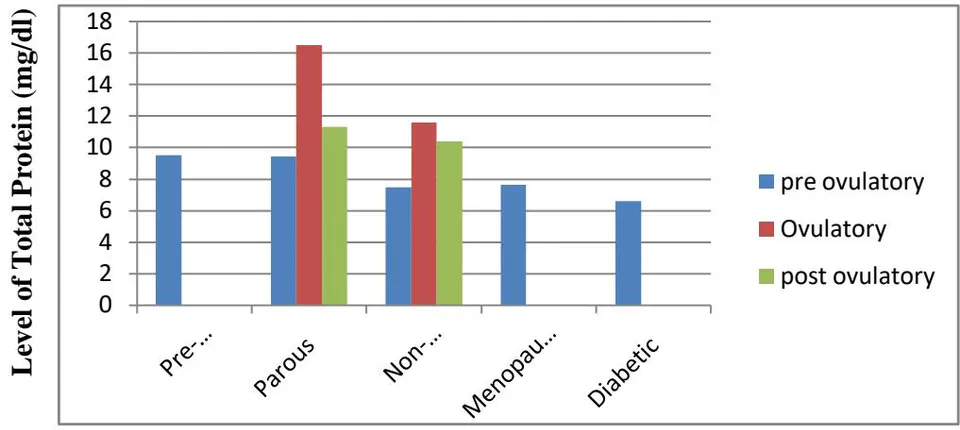
| SI No. | Name of different conditions with symbols | Level of Total Protein(mg/dl), Mean and SE of 6 samples | P-Value |
| 1 | Pre-pubertal-(a) | 9.51 ± 0.153 | |
| 2 | Parous | a to c - (p<0.001) HS | |
| Pre-ovulatory-(b) | 9.40 ± 0.184 | a to e - (p<0.001) HS | |
| Ovulatory - (c) | 16.50 ± 0.149 | a to f - (p<0.001) HS | |
| Post ovulatory-(d) | 11.28 ± 0.181 | a to g - (p<0.01) HS | |
| 3 | Non-Parous | ||
| Pre-ovulatory-(e) | 7.47 ± 0.264 | b to e - (p<0.001) HS | |
| Ovulatory - (f) | 11.58 ± 0.147 | c to f - (p<0.001) HS | |
| Post ovulatory-(g) | 10.38 ± 0.153 | d to g - (p<0.01) S | |
| 4 | Menopausal-(h) | 7.61 ± 0.150 | a to h - (p<0.001) HS |
| b to h - (p<0.001) HS | |||
| c to h - (p<0.001) HS | |||
| d to h - (p<0.001) HS | |||
| f to h - (p<0.001) HS | |||
| g to h - (p<0.001) HS | |||
| 5 | Diabetogenic-(i) | 6.58± 0.164 | a to i - (p<0.001) HS |
| b to i - (p<0.001) HS | |||
| c to i - (p<0.001) HS | |||
| d to i - (p<0.001) HS | |||
| e to i - (p<0.02) S | |||
| f to i - (p<0.001) HS | |||
| g to i - (p<0.001) HS | |||
| h to i - (p<0.01) HS |