
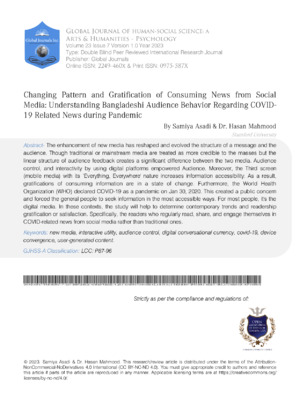

Changing Pattern and Gratification of Consuming News from Social Media: Understanding Bangladeshi Audience Behavior Regarding COVID-19 Related News during Pandemic

1
Samiya Asadi
Samiya Asadi
2
Dr. Hasan Mahmood
Dr. Hasan Mahmood

Send Message

To: Author

GJHSS Volume 23 Issue A7

Article Fingerprint

ReserarchID

0176K

Changing Pattern and Gratification of Consuming News from Social Media: Understanding Bangladeshi Audience Behavior Regarding COVID-19 Related News during Pandemic Banner
  • English
  • Afrikaans
  • Albanian
  • Amharic
  • Arabic
  • Armenian
  • Azerbaijani
  • Basque
  • Belarusian
  • Bengali
  • Bosnian
  • Bulgarian
  • Catalan
  • Cebuano
  • Chichewa
  • Chinese (Simplified)
  • Chinese (Traditional)
  • Corsican
  • Croatian
  • Czech
  • Danish
  • Dutch
  • Esperanto
  • Estonian
  • Filipino
  • Finnish
  • French
  • Frisian
  • Galician
  • Georgian
  • German
  • Greek
  • Gujarati
  • Haitian Creole
  • Hausa
  • Hawaiian
  • Hebrew
  • Hindi
  • Hmong
  • Hungarian
  • Icelandic
  • Igbo
  • Indonesian
  • Irish
  • Italian
  • Japanese
  • Javanese
  • Kannada
  • Kazakh
  • Khmer
  • Korean
  • Kurdish (Kurmanji)
  • Kyrgyz
  • Lao
  • Latin
  • Latvian
  • Lithuanian
  • Luxembourgish
  • Macedonian
  • Malagasy
  • Malay
  • Malayalam
  • Maltese
  • Maori
  • Marathi
  • Mongolian
  • Myanmar (Burmese)
  • Nepali
  • Norwegian
  • Pashto
  • Persian
  • Polish
  • Portuguese
  • Punjabi
  • Romanian
  • Russian
  • Samoan
  • Scots Gaelic
  • Serbian
  • Sesotho
  • Shona
  • Sindhi
  • Sinhala
  • Slovak
  • Slovenian
  • Somali
  • Spanish
  • Sundanese
  • Swahili
  • Swedish
  • Tajik
  • Tamil
  • Telugu
  • Thai
  • Turkish
  • Ukrainian
  • Urdu
  • Uzbek
  • Vietnamese
  • Welsh
  • Xhosa
  • Yiddish
  • Yoruba
  • Zulu

The enhancement of new media has reshaped and evolved the structure of a message and the audience. Though traditional or mainstream media are treated as more credible to the masses but the linear structure of audience feedback creates a significant difference between the two media. Audience control, and interactivity by using digital platforms empowered Audience. Moreover, the Third screen (mobile media) with its ‘Everything, Everywhere’ nature increases information accessibility. As a result, gratifications of consuming information are in a state of change. Furthermore, the World Health Organization (WHO) declared COVID-19 as a pandemic on Jan 30, 2020. This created a public concern and forced the general people to seek information in the most accessible ways. For most people, it’s the digital media. In these contexts, the study will help to determine contemporary trends and readership gratification or satisfaction. Specifically, the readers who regularly read, share, and engage themselves in COVID-related news from social media rather than traditional ones.

Funding

No external funding was declared for this work.

Conflict of Interest

The authors declare no conflict of interest.

Ethical Approval

No ethics committee approval was required for this article type.

Data Availability

Not applicable for this article.

Samiya Asadi. 2026. \u201cChanging Pattern and Gratification of Consuming News from Social Media: Understanding Bangladeshi Audience Behavior Regarding COVID-19 Related News during Pandemic\u201d. Global Journal of Human-Social Science - A: Arts & Humanities GJHSS-A Volume 23 (GJHSS Volume 23 Issue A7): .

Download Citation

Amended title: Social News Patterns.
Journal Specifications

Crossref Journal DOI 10.17406/GJHSS

Print ISSN 0975-587X

e-ISSN 2249-460X

Keywords
Classification
GJHSS-A Classification: (LCC): P87-96
Version of record

v1.2

Issue date

December 18, 2023

Language

English

Experiance in AR

The methods for personal identification and authentication are no exception.

Read in 3D

The methods for personal identification and authentication are no exception.

Article Matrices
Total Views: 1061
Total Downloads: 30
2026 Trends
Research Identity (RIN)
Related Research

Published Article

The enhancement of new media has reshaped and evolved the structure of a message and the audience. Though traditional or mainstream media are treated as more credible to the masses but the linear structure of audience feedback creates a significant difference between the two media. Audience control, and interactivity by using digital platforms empowered Audience. Moreover, the Third screen (mobile media) with its ‘Everything, Everywhere’ nature increases information accessibility. As a result, gratifications of consuming information are in a state of change. Furthermore, the World Health Organization (WHO) declared COVID-19 as a pandemic on Jan 30, 2020. This created a public concern and forced the general people to seek information in the most accessible ways. For most people, it’s the digital media. In these contexts, the study will help to determine contemporary trends and readership gratification or satisfaction. Specifically, the readers who regularly read, share, and engage themselves in COVID-related news from social media rather than traditional ones.

Our website is actively being updated, and changes may occur frequently. Please clear your browser cache if needed. For feedback or error reporting, please email [email protected]
×

This Page is Under Development

We are currently updating this article page for a better experience.

Request Access

Please fill out the form below to request access to this research paper. Your request will be reviewed by the editorial or author team.
X

Quote and Order Details

Contact Person

Invoice Address

Notes or Comments

This is the heading

Lorem ipsum dolor sit amet, consectetur adipiscing elit. Ut elit tellus, luctus nec ullamcorper mattis, pulvinar dapibus leo.


High-quality academic research articles on global topics and journals.

Changing Pattern and Gratification of Consuming News from Social Media: Understanding Bangladeshi Audience Behavior Regarding COVID-19 Related News during Pandemic

Samiya Asadi
Samiya Asadi
Dr. Hasan Mahmood
Dr. Hasan Mahmood

Research Journals





























































