





I. INTRODUCTION
With the introduction of information technology, it has changed the business. It allows to communicate people with each other and interact from different regions and make it very easy and it also make marketing of services and products cheaper.
In the past years, the internal organization system which connect organization with each other was very popular during that time. As the high costs, many organizations cannot afford to use it.
Digitalization of services is a way to attract tech-savvy guests. The main purpose of digitalization is to provide a digital business by pushing hospitality on guests touch point. Digital platform allows guest to have something on their own convenience that provide seamless travel to experience.
Booking websites, social media, are the best example of digital services. There are many third-party agents which provides rooms to the guest and even guests are all aware of them. Commission is the source of revenue for the third-party agents, to earn this revenue hotel should have their own hotel application so that they can provide best services to guests offline and online as well. There should be some loyalty programs to attract the guests like points on bookings or stays so that guests can be attracted to use hotel websites instead of third-party agents. Providing digital services requires a technological infrastructure with computation and communication skills.
Personalized experience is the main motive of the hospitality from a very long time. Industry which relies on services requires to change and improve them to make them better that a guest looking for. From simple things like notes and flowers, digitalization has been taken to new level of advancements of technology. The expectations of the guests are always high and this is the responsibility of the hotel to improve the systems and services to meet these demands and a software than can record all guest's data.
A guest visits a hotel and during checkout gives small feedback about the rose-based toiletries that he is allergic to roses. The guest again visits the hotel and get surprised after looking that the toiletries has been replaced with new set and a letter with apologies was there for the inconveniences he has faced in his last stay to the hotel, this only can be possible with the right use of technology.
II. OBJECTIVE
To know how the work done with the help of software is more effective efficient and faster.
To know how it help in getting more loyal guests.
To analyse how technology help in getting more guest reservations with regards to profitability.
III. METHODOLOGY
Primary data source: the primary data is been collected through structured questionnaire method. Primary data includes the type of personal (individual) and its type of thinking, experience, findings and suggestions.
Secondary data source: secondary data were collected through various source such as websites, reports, hotels broachers and some is from the following sources:
Internet
Observation
IV. LITERATURE REVIEW
Ahmad T., et al. (2012) Based on the findings of statistical research, which demonstrate the impact of Customer Relations Management on client happiness, confidence, and retention at the State Hotel of India, it is apparent that no firm in the world is free of flaws and imperfections. Without a doubt, regardless of its success, every company should examine and upgrade its plans to discover new strategies that are relevant to the developed management environment and that specify the demands and aspirations of existing and new customers.
Thryambakam P. (2013) Community-based, long-term sustainability Rural tourism has proven to be an effective mechanism for connecting rural stakeholders with the tourism industry in order to increase employment. To make this more relevant, it is critical to discuss sustainability concerns with the community prior to the commencement of the project, as well as aggressive destination marketing with local and international tour operators. Rural areas require both short- and long-term planning, implementation, and monitoring to avoid damage. Community-based sustainable rural tourism requires environmental management, local participation, strong laws, sustainable marketing, and realistic planning.
Srinivasa R. (2014) Despite the industry's scale and complexity, technology has connected many of its components. People may now book airline tickets, rental cars, hotel rooms, and tours all at the same time using computer systems. Computer reservation systems or worldwide distribution systems are the names given to these computer systems. Although many people in the sector labour behind the scenes, those who operate on the front lines—travel agents, front desk clerks, tour guides, and so on—must be passionate and articulate. You'll also need a great sense of service and attention to detail in almost any position.
V. TECHNOLOGY USED IN HOSPITALITY INDUSTRY
PMS
CRS
Global Distribution System
POS
Yield Management
Call Accounting System
Guest History
In Room System
Locking System
Accounting System
VI. FEATURES OF HOTEL SOFTWARE
The current trend of the Hotel Industry indicates the needs for a more technology towards enhanced guest experience. Resorting to complex spreadsheets is definitely not a favourable idea in this case. The implementation of the effective Software can help to elevate the business standards of the industry. The use of this software will definitely provide a boost to the performance levels and financial profits in any Hotel.
The software is equipped with an exquisite range of features targeted towards improving the business performance levels in any given hotel organization. List below are some prominent features of a Hospitality Software.
Availability of real-time financial status to authorized users.
Easy management solutions across hotel properties.
Affordable pricing schemes.
Centralized rate management module with flexible discounts
Reservation management module for streamlined offline and online booking
Documentation and monthly report generation for seeing of the performance.
Error-free accounting services in terms of the accounts payable.
User-friendly interface for easy navigations.
Extensive cloud support for easy data backup.
Excellent automation features with good reliability.
VII. BENEFITS OF USING HOSPITALITY SOFTWARE
The implementation of a Hospitality Software in your Hotel Business will cause the subsequent mind-blowing benefits:
a) Easy Setup and Operational Flexibility
Implementation of cloud-based hospitality software requires no additional maintenance. The updates and therefore the latest features are often easily installed from the web. The software brings in seamless integration of all the features, and this may boost the performance level in your hotel business.
b) Multiple Payment Methods
Incorporation of hotel management software enables easy booking and payment solutions. The user can have access to a spread of payment methods in offline also as online mode. The software will automate your hotel business to an excellent extent, and this may subsequently improve the workflow and productivity in your business.
c) Customized Booking Solutions
The installation of this software in your hotel business will provide the utmost transparency to Users, such he/she can select the space of his/her choice. In other words, the software offers easy and customised booking solutions consistent with the user's requirements. This may then convince be highly beneficial for greater customer satisfaction and customer retention in your business.
d) Responsive Designs for all Devices
The responsive design of this software provides for greater scalability of installation over various devices. This is often highly beneficial considering the superb simple use facilitated through modular implementation techniques.
The multi-platform and cross-platform feature of this software will assist you gain an extended client base.
e) Automatic Data Backup Solutions
The excellent cloud support feature of the software establishes greater security standards through the facilitation of an automatic data backup and network. The hospitality software comes along side 24-hour monitoring services and electrical backup solutions. This may assist you protect confidential data and your clients' information from theft, physical damage and even malware!
f) Affordable Pricing Solutions
The implementation of the hospitality software in your hotel business will reduce the upfront costs and also a hospitality management software possesses very affordable pricing solutions counting on the features you would like. The installation of this software is reasonable and requires no manual overhead.
g) Excellent Automation Features
One of the advantages of employing a hotel software in your business is that it'll facilitate a big level of automation in any given task or business procedure. This may essentially reduce all the manual labour. So, the implementation of hotel software in your hotel business will bring-in process automation, auto-documentation, and smooth transactions.
h) Highly Secure Systems with Detailed Report Generation
The hospitality or hotel management software renders detailed documentation of the varied transactions. This is often done by the software privacy. The software also will provide you the detailed performance of your hotel business. Real-time report generation is an advantage of implementing the software.
The analysis of the reports will present you an image of what all you would like to try to extend your hotel business. This may ultimately have greater standards for your hotel business.
VIII. ROLE OF PMS IN INCREASING HOTEL REVENUE
Smart phones and mobile gadgets are changing the ways how we communicate and do business. Here are 3 mobile technologies for hotels and which increases revenue.
a) Via guest satisfaction + loyalty
Positive guest experience and their satisfaction is profitable. Guests who had more good experience at the hotel spend 140% more than who had bad experience. Research says that customer experience and satisfaction is linked to royalty. Studies says that improving guest experience can increase the annual revenue. if we put all the information together in today's time it's the technology that is critical in hotel guest satisfaction. They want more personalized services and satisfaction.
The power of self-check in gives more satisfaction to the guests. Providing self-check in and check out option to the guest gives relief to them as now they don't have to stand in long queues and wait for their turn to come and then check in or check out.
And also, nobody wants to stand in the lines anymore.
b) Boost Ancillary Revenue
The guests had limited option and products. Services were rarely brought or sold by the guests or the staff. With the rise of technology there is more availability of products and services which can be provided to the guests. hotels with their own mobile application can bring in ancillary product packages.
The hoteliers are more advanced in their offerings or anything which they think that guests might want and is usually sold as ancillary product or service.
The services which are provided by the mobile not only makes decisions making easy but also more personalized to the guests.
c) Streamline Operations
The technology conversations are focused on the guests. New applications give more efficient communication between the system and departments.
Housekeeping department Can see which all rooms are occupied or which are vacant and thereby respond to the requests or the guest with the help of mobile device.
They can directly be in contact with the front office department for room status, check in or check out increased room attendant productivity and also eliminate 80% of the calls made to front office department.
IX. HOTEL INDUSTRY OVER A PERIOD OF TIME
If there is one constant in the lodging business it's that everything changes. For example, transportation technology has brought up rise in offer (number of rooms accessible to rent) and demands.
The people began traveling even more with the increase in demand the hotels came In and used to serve guests. There has been higher occupancy rate in the year 2005-06 and 2006-07 which resulted in higher average area rate (AAR). The Indian hotels were charging higher rates more than the rates charged by alternative countries huge rise in the area rates resulted in corporates exploring for alternate lodging potentials. To satisfy this new company guest houses and repair residences were made in the cities which were more cost effective than the building rooms. As the economy declined in the coming years the needs and demands also declined.
Due to Mumbai terrorist attack in the TajMahal palace and the Oberoi the occupancy rate suddenly came down in 2009-2010 and also reduction in foreign travellers. In the year 2008 there were around 28 million foreign arrivals which came down to only 17 million in the year 2009. But there was one positive side also that during this era there was increase in number of domestic travellers. The average rate remains low but the occupancy rate rose due to the movement of domestic travellers in India. There was positive development in the year 2010-2011 because of domestic tourists and also foreign arrivals. The rise in the number of young populations have resulted in more expenditure on leisure services. As per ministry of tourism the government of India there were 57,75,692 foreign arrivals in the year 2010. That rose to 63,09,222 in 2011. The quantity of interchange in Indian rupees was rs 64,889 crore in 2010 77,591 in 2011 and at the end of 2012 it was 94,487 crores.
X. FOCAL POINT TECH-SAVVY GUESTS ON SOCIAL MEDIA
Hotels developed themselves to attract tech-savvy guests like from Wi-Fi in rooms to touch screens in lobbies but to make it more successful there is need for hotel to be on social media like posting amazing food photos, guest moments, views from room windows on social media platforms like Facebook, Instagram, twitter, etc. This creates a reputation on social media about hotel that make it attractive and make an indirect communication between guests and hotels as social media is the part of day-to-day life nowadays. Guest who are involved in technologies like to be on social media platforms, they like to share their travel experiences, foods on social media and this also helps in attracting other guests who may be the follower, friend, or someone else of him/her. Nowadays youth are travelling a lot and they have grown with technology and social is in their daily routine life so hotels have to be there on such platforms to attract them and use them also to fulfil guests need.
a) Embracing Google, Amazon and Trip Advisor
As per Trading Economics statistics, there is increase in annual income every year so it simply means that the number of travellers is also increasing every year. In addition, hotel services are different to each other with the brands. To attract the more room reservation, we have to offer lower room rates. Even
Google also provide ads to promote hotels online that help in running business locally as well.
Google has its own rating feature like if you visit a hotel, google will automatically ask for the ratings and experience and there are also other platforms for this review system like trip advisor. These systems are making hotel brands popular as well as creating a new platform for hotel search. Google provide different sources like hotel finder and other websites for searching hotels that are very popular on social media as well as among travellers too. Trip Advisor also provide two features one is Trip Connect and second is Instant Booking. Both allows users to make a room reservation on Trip Advisor's website itself.
b) Adopting Mobile Technology
Nowadays a lot of guests are using their tablets/smart phones for making hotel room bookings. Now it's time for hospitality to take Mobile technology in their operations with the assistance of hotel software and take it with the aspects of functioning of hotel.
Take an example of Starwood Hotels and Resorts, they are making the room door key less mean to say that they are providing a feature from that a guest can open his/her room with the mobile app. In this process, hotel register the guest mobile with software and then they will receive the hotel room number and other details and with the use of app guest can enter in his/her room without a key.
c) Cloud System
In this era of technology, investing in cloud technology is become the norm that integrates different hotel operations and increase profits. Cloud technology improve hotel operational efficiency especially in chain hotels. It allows user to look different properties from one location. It provides automation of many tasks, with this help staff can now focus more on guests and can improve their experience. Hotel software like CRM, PMS, POS, allows staff to do their main responsibilities.
d) Improve data security
With the rise of cybercrime and stricter privacy restrictions, it's become even more important to protect guest information. To protect against cyber-attacks, the cloud-based system receives periodic security updates.
Each system has its own set of security guidelines. Several of them include two-factor authentication for added user verification, automatic deletion of guest master card data after 14 days, and more. As a result, hoteliers can rest assured that their guests' data is secure.
e) Increases the rate of return on investment
In layman's terms, cloud-based hotel software helps properties save costs, resulting in more revenue.
In fact, if the programme is properly implemented, you can slash your IT costs in half. It eliminates the usual costs. Consider the cost of purchasing and maintaining a server, as well as various applications to support the most complex system.
f) Adaptability to Changes
One of the advantages of cloud-based software is that it is simple to integrate with emerging trends. As a result, it is the ability to adapt and expand.
The hospitality sector is always changing and requires adaptability. Changes made across several properties can be handled quickly and easily with scalable and robust software.
g) Focus on Health and Wellbeing
Hotels must constantly reinvent themselves in terms of product and service offerings in order to stay relevant. Because today's travellers are more health-conscious, it's critical to accommodate their new lifestyle choices by providing innovative hotel products and services.
This could include vegan cuisine, all-natural products, and so on. There is a rising market for travellers who follow these healthy lifestyles.
XI. STEPS BY THE GOVERNMENT OF INDIA TO PROMOTE THIS INDUSTRY
Safety concerns are like crime against tourists especially women need to be dealt with in very vary strictly. cities are being developed by the government of India under certain schemes which has helped in attracting tourists. The development of the infrastructure in smart cities helps in creating necessary infrastructure and connectivity.
As it is well aware fact that tourism sector has immense potential for development and if it is fully tapped then it will help in creating employment and will help in build forex reserves, and India image globally as well as spread the unique Indian way of life throughout or all over all world.
A cordial reception Development and Promotion Board has additionally been established to observe and expedite building project approvals. The Ministry of business has been creating efforts to develop quality business infrastructure at holidaymaker destinations and circuits within the country. As per the eleventh set up, Ministry of business Statistics (2013), it's sanctioned Rs four, 090.31 large integer (US$ 652.42 million) for business comes, which incorporates comes associated with Product/ Infrastructure Development for Destination and Circuits (PIDDC), Human Resource Development (HRD), Fairs and Festivals and journey & Rural business for infrastructure augmentation. within the year 2002, there have been two.38 million foreign holidaymaker arrivals in Asian nation that went up to six.58 million within the year 2012, over a span of ten years, as per the Ministry of business, Government of Asian nation (2012) Statistics.
XII. TRENDS AND THE TECHNOLOGY THAT ARE RESHAPING THE INDUSTRY
a) Mobile Technology
One of the foremost vital cordial reception trends that showing no sign of slowdown in the mobile technology integration.
Technology continues to start within edifice and cordial reception business. Innovations like remote arrival, area reservations, and mobile area keys lead the manner. And there's a lot of Small, dress shop hotels currently supply guest-facing apps that can permit the ordering of area service, or drinks at the poolside area of the hotel.
b) Wi-Fi all over and information measure on Demand
Now as the need, demands and desires of the guest are changing they want seem less and digital technology. In the coming years the technology will take a path in which in the hotels the guest will be offered app which will be earned by hotel. The guest can write or request their demands, their needs and their requests on the app and it will be completed by the hotel personal.
c) A Connected Guest expertise
Now-a-days websites and chatbots have been developed by the hotel with the help of those the guest can ask about their queries. This has been possible only because of digitalisation which is taking a very good growth in terms of liking. Now-a-days guests want technology more than they are using at their place.
d) Dynamic client information
With the help of technology now the paper work is very less everything is jot down on software which are being purchased by the company. More and more database and the data which is collected can be saved for longer years to come. One can see past 2 years back data in today's date only with full and correct information.
e) Increases Return on Investment
In layman's terms, cloud-based hotel software helps properties save costs, resulting in increased revenue.
Hoteliers should face the additional expense of licence and hardware when deploying on-premise software. This is not the case with cloud-based solutions. Instead, it's offered as a service, allowing clients to personalise the tools and capabilities PRN provides. As a result, it enables for easy interaction with other third-party apps, resulting in cost and energy savings.
XIII. TRANSFORMATION
TREND IN INDIA, in 2011 there is 8.7% contribution of travel and tourism sector in India's growth of GDP, it is moderate in 2009 but increased to its peak in 2010. As per WITTC predictions the direct and indirect contribution of Hospitality sector in GDP is to be expected to increase by 8.1% to 8.8% respectively in next five years. India has started a new program under Incredible India Campaign that is called TVAS (Tourist Visa on Arrival Scheme), in this a traveller can get visa on arrival and the main motive of this scheme to establishing an image of India as Tourist-friendly nation.
In starting, it was extended to five countries which are Finland, Japan, New Zealand, Singapore and Luxembourg. The program was extended to six more countries in January 2011. Now this list also includes Vietnam, Philippines, Indonesia, Myanmar, Laos and Cambodia.
Government has also adopted the code of conduct for safe and honourable tourism in July 2011 to make India as a safe destination for tourism. These initiatives have helped India to make it as a tourist destination and there is growth of 8.1% noticed in 2010-2011 as compared to 2009-10 in terms of Foreign Tourist Arrivals. As per Global Hotel and Hospitality Consulting Firm, HVS international, in 2011 the major growth in tourist arrivals can be attributed to strengthening ties with developed countries.
Strong GDP performance.
Opening of economic sectors to private sector or foreign sector.
The efforts made by Ministry of Tourism and culture had a great impact on India's Tourism factory that increases the confidence of Indian Tourism
XIV. THE KEY TO GUEST ENGAGEMENT: PERSONALISATION
Digitalisation is coming up to a great extent the importance of digital transformation and the mobile technologies is increasing in the hospitality industry the hotel industry concentrates on online channel more lies in two topics personalisation and guest engagement.
The hotels guests who use digital channels are receiving more personalized services which creates good customer experience.
75% of consumers uses brands which know them by name those services which support past purchases and also know past purchase history
XV. DIGITALISATION AND HOSPITALITY INDUSTRY
a) Wi-Fi users pay models
In the past years hotel charged guests for fast wifi in their rooms. A recent survey shows that 1 guest out of 5 want to have free Wi-Fi with complimentary breakfast. As the technology changes and digitalization is on top, now a single guest carries many gadgets as 2 mobiles and a laptop are very common nowadays.
As the internet is very basic requirement of everyone nowadays so if a hotel will not provide wifi for its guest it can be a drawback for itself. While it's require a greater up front investment for hotels to put in facility-wide wireless network. It's a forward-facing decision which will boost costumer satisfaction. A high-density network, including in-house mobile coverage, accommodates both the casual, leisure traveller also as professional group who are staying for conferences or other function.
A/V, VIP and VTC conference as the business travellers are increasing day by day the hotels starts to design their rooms to full fill their needs. Rooms are equipped with WiFi and nowadays there are smart TVs as well in their that can be connected to TV or laptop easily can turn tv into a computer or a presentation display. For business travellers, meetings can be happen very often and sometimes they have to present during their stay. Hotels are making rooms equipped with WiFi, smart TVs and other technology to give a experience that is beyond expectations. Yet even amid such a lot digitisation, studies show that fashionable consumers still craves personalisation, to the present end. While an electronic kiosk can be preferred over an in-person interaction with receptionist, visitors still want to ascertain their own name on the screen along side with welcome message.
Along those self same lines, some chains also are investing in technology that remembers and recalls customers past room service orders, so the hotel can recommend related dishes within the future and make ordering simpler or that recommends nearby destinations and tourist locales supported a customer's stated performances.
b) Field communication
whenever a guest take his/her phone near to POS to do a transaction, NFC starts to work. NFC is a technology used to share information between devices. It is a high frequency with short range technology that is used to transfer payments or money. Hospital is using it broadly nowadays.
With a maximum data transfer of 424k bit/sec. NFC is enabled and activated when two smart devices, like Master card and POS machine, inherit contact with each other. The transaction is secure and instant, which are two features consumers are increasingly gravitating toward when it involves their preferred hotel technology.
While check-ins are the primary place, NFC is being implemented. It can also be integrated into various aspects of the stay experience, including a sensible room key. The technology can also be used to help facilities cater to their guests through more targeted and direct advertising techniques.
For instance, NFC usage must be programmed to vary from a generic advertising to kid friendly when a toddler walks by alongside with other personalisation.
c) Smart Keys, Robotics and other futuristic elements
We like to have fun till last, in order to create user stay more personalized. Some hotels use technology to make it more amazing and technology-friendly as well. As above we have discussed about NFC that making opening room gate easier and smarter. In addition there are some high technological end like in California, hotels are using robotic butlers to bring requested or ordered items, and they are working from providing room service meals to replacement of toothbrushes for the users even they can move from one floor to another easily.
Even in housekeeping, there is a infrared scanner that can detect body heat in a particular area mainly used for room so that they can know there is someone in the room or not. Over a time, this application can be used in the place present Do Not Disturb (DND).
d) Social media and customer care
Whether you are social media user or not but surely you have heard about the someone looking for the hotel online using google and even Google suggests itself a wide range of hotels by searching a single word HOTEL and within a single click you will get a long list of hotels with the ratings and reviews bohot positive and negative.
The best thing about social media is if you want to say about your stay or having lunch or something you tag your location as well as that provide the name and location of that place that may be a chance to exchange information and people also get to know about it.
Now it hotels are even having their Facebook Instagram pages and Twitter handles on social media, this is the simplest way to promote a hotel as a owner you can post good pictures of hotels and offers to attract more guests.
Google is a big platform for rating a hotel this is place where you can create a positive impact on that person who is looking for hotel by getting good responses and positive feedbacks. Nowadays people use to judge a hotel on its reviews, even Google also provide rating on the basis stars you are getting in your feedbacks. Social media as usual plays a significant role in our daily life, same happening in hospitality. Now guest are more technology friendly they believe on public reviews because these are real experience shared there.
There are also negative feedback but it is on management how they deal with it. Everyone also looks for the suggestions or how the negative feedback has been sorted out if you are resolving them this is a good sign for the guest but it is left lightly then it is bad. As sometimes you cannot say to person on reception as you may feel shy but on social media everyone can express everything easily But there is always a solution there are many things to sort out these things there are features like management response, chat bots, talk back and so on.
e) Technology that integrates
Technology is not just using Facebook WhatsApp or something else, technology is all about making experiences more amazing and fantasising. For example compare a apple watch with a old wrist watch nowadays watches have become smart as they are not just showing time they are also showing notifications of messages, notes, etc even you can make a phone call from a watch, you can how many steps you have walked, your heart beat, calories burned everything.
As per Travel Trends Today, Hilton is offering guests to choose their rooms as per the choices with the help of digital floorplans they provide and also digital check-in service. Hilton providing this service in 4300 hotels globally including 14 hotels that are operating in India as well. In India the number is low but it will be more soon as technology is becoming more familiar and getting into our lifes In Hilton they show you a digital floor plan from which you can choose your room by your choices and you make changes and can even tell to send something in your room. Hilton is using this technology so that they can provide better experience to their loyal guests by providing what they want.
Mobile technology is meant to be source of talking with each other and Sharing information but the truth is that we are using this technology more than that. We have are not just using it for communication but we are also make our lives easier.
The one thing remains the same and that is everything changes. Take an example of change in technology in transportation give people chance to travel globally. Individuals are traveling so often as per their needs whether it's regarding business, tourism or something else as compare it is done before.
With the increase in travel of people, demand of hotel start increasing as they to want to stay somewhere where they can have food and other necessities. Vardhrajan, Goel and Karulkar discovers that Indian hotels recorded a healthy growth within the half of millennium from 2000-2005 and they have also noticed the high occupancy rates during 2005-2007. Average Daily Rates(ADR) has increased significantly for hotels in
India. The discrepancy between the available rooms in the hotel and the rooms that are needed is increased.
As it is noticed that hotel demands are increasing, hotels start to charge good money from the guest as they discovered it a good source of money making. Variety in India either Indian or international brand create a intrude on the market.
Now India started to reworked in such a way to attract the good investments that increases the area rates of the place which have the potential for construction and running of a hotel. To satisfy the needs companies start to repair guesthouses and building in major cities to make them operational and that was really cost effective as compare to constructing a new hotel. But because of economic retardation worldwide, the demand start decreasing. Most importantly Taj attacks as well, attack of Taj Hotel Mumbai and Oberois put a question mark on indian hospitality that results in decrease of revenue in 2009 and 2010. Number of visitors start decreasing in these years. As per the statistics of Indian Tourism and Ministry, there was 5.28 million foreign travellers in 2008 then goes down to 5.17 millions in 2009.
But because of Indian travellers who are travelling in the country, occupancy rates was stable but it doesn't increase the Average Daily Rates (ADR), it continues to at lower position. The hotel business has currently experience a positive rise from 2010 onwards because of increase of domestic and foreign travellers in India because of that the strong per capita financial gain was discovered in that put a positive impact on Indian commercial market.
The young youth apart from their dynamic life style, they like to spend on luxuries, they are more spending on leisure services. As per the Ministry of To statistics, there were 57,65,692 foreign travellers in 2010 that changes to 63,09,222 in 2011, and in December 2012 it is 65,77,745 foreign travellers that are coming to India. Similarly there was a great increase in foreign currency exchange as well that 64,889 crores INR in 2010 that changes to 77,581 crores INR in 2011 and till December 2012 it is 94,487 crore.
The hoteliers are overwhelmed by technology, data, and digital marketing silos. The standard of hotel use myriad of vendors that don't ask each other and don't even know one another. Each property team whether it is revenue management team or guest service work in separate. Every team has its own vendors, database which don't communicate with the other teams.
There are some main impediments to the industry becoming a digital technology driven and technology savvy driven Reluctance to take position in digital technology - this reluctance comes because of shortage of understanding that we are serving to technology obsessed consumers. The hospitality industry goes beyond the TV or the pms and specialises in guest facing digital and technology applications and decides like mobile first property website, voice assistants etc..
Antiquated accounting on hospitality - most of the new technologies are not being amortized like capital or neither they are considered as cogs due to which many owners and managers are hesitating to take position in digital technology applications
Generally different teams at the property use different set of knowledge for their operations which creates data integrity mess which affects the guest acquisition and retention efforts.
The goal is to bridge the guest data and technology in hospitality and make solution to empower hotels to bring new guests engage the current guests and retain past guests by combining digital marketing, websites into one cohesive marketing platform.
Technology like Wi-Fi in the rooms and touch screen in suites attract tech savvy guest. Hotels have to use so
f) Embracing Google, Amazon and Trip Advisor
As per Trading Economics statistics, there is increase in annual income every year so it simply means that the number of travellers are also increasing every year. In addition hotel services are different to each other with the brands. To attract the more room reservation we have to offer lower room rates. Even Google also provide ads to promote hotels online that help in running business locally as well.
Google has its own rating feature like if you visit a hotel, google will automatically ask for the ratings and experience and there are also other platforms for this review system like trip advisor. These systems are making hotel brands popular as well as creating a new platform for hotel search.
Google provide different sources like hotel finder and other websites for searching hotels that are very popular on social media as well as among travellers too. Trip Advisor also provide two features one is Trip Connect and second is Instant Booking. Both allows users to make a room reservation on Trip Advisor's website itself.
g) Adopting Mobile Technology
Nowadays a lot of guests are using their tablets/smart phones for making hotel room bookings. Now it's time for hospitality to take Mobile technology in their operations with the assistance of hotel software and take it with the aspects of functioning of hotel.
h) Cloud System
In this era of technology, investing in cloud technology is become the norm that integrates different hotel operations and increase profits. Cloud technology improve hotel operational efficiency especially in chain hotels. It allows user to look different properties from one location. It provide automation of many tasks, with this help staff can now focus more on guests and can improve their experience. Hotel software like CRM, PMS, POS, allows staff to do their main responsibilities media to a full extent.
i) Enhances Data Security
With the rise of cybercrime and stricter privacy restrictions, it's become even more important to protect guest information. To protect against cyber assault, the cloud-based system receives periodic security updates.
Each system has its own set of security guidelines. Two-factor authentication for added user verification, automated removal of guest mastercard data after 14 days, and other features are included in a number of them. As a result, hoteliers can rest comfortable that their guests' data is secure.
j) Increases Return on Investment
In layman's terms, cloud-based hotel software helps properties save costs, resulting in more revenue.
Hoteliers should face the additional costs of licence and hardware when deploying on-premise software. With cloud-based, this is not the case. Instead, it's offered as a service, allowing customers to tailor the tools and capabilities PRN offers. As a result, it enables for easy connection with other third-party programmes, saving time and money.
In fact, if the programme is properly implemented, you can slash your IT costs in half. It eliminates the usual costs. Consider the cost of purchasing and maintaining a server, as well as various applications to support the most complex system.
k) Ability to Adapt to Changes
One of the advantages of cloud-based software is that it is simple to integrate with emerging trends. As a result, it is the ability to adapt and expand.
The hospitality sector is always changing and requires adaptability. Changes made across several properties can be handled quickly and easily with scalable and robust software.
i) Focus on Health and Wellbeing
Hotels must constantly reinvent themselves in terms of product and service offerings in order to stay relevant. Because today's travellers are more health-conscious, it's critical to accommodate their new lifestyle choices by providing innovative hotel products and services.
This could include vegan cuisine, all-natural products, and so on. There is a rising market for travellers who are living healthier lifestyles.
Regardless of the size of the hotel, hoteliers can make simple improvements to accommodate this lifestyle shift. They'll start by adding yoga mats, vegetarian vending machines, vegan milk options for breakfast, and so on.
XVI. DATA ANALYSIS AND INTERPRETATION
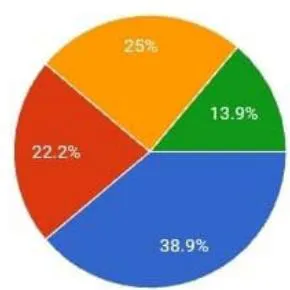
I have surveyed among the 50 people and the employees which i have considered are from hotel (Radisson blu greater noida, Radisson kaushambi, Radisson Faridabad, country inn and suites by Radisson, crowne plaza greater noida, crowne plaza today new delhiohkla, the lalit,jp greens golf spa and resorts)
I have several questions in my questionnaire which is to be filled by the hoteliers. So those questions are mentioned below and also the data analysis and the result which has came out from this survey which i have done.
I have surveyed among 50 employees out of which their are 32.7% are female and the rest 67.3% are males professionals.

XVII. CONCLUSION
As with digitalisation there are many software comes in hotel industry and with this hotel industry has also become digitalised. now there are not only the phone calls for the reservation but also there are many hotel websites online booking websites like make my trip, booking.com, yatra.com and hotel started adopting software and gradually it has changed their number of guests, number of locations, from which the guest is coming. Now a hotel can be seen anywhere on any booking website or else one can check hotel website from sitting anywhere.
This will improve guest experience and can make it a regular guest that means a single guest will give revenue for many times and words of mouth is also one of another best way of promotion.
As with the help of digitalisation you can store data with the help of this you will recognise the coming guest on reception that will also be a great experience form which the guest will be happy.
some of the good 5-star hotels are using the old property management system that is like Fidelio, showman which is not same as the upgraded property management systems like the opera as opera is more effective and efficient with regards to profitability.
Hotels are also now linked with online booking website so there are lot of platforms for the hotel to get its booking that also increase revenue as the number of locations from which booking are done are more now-a-days.
Advance booking is more popular as it is very cost effective for guest and helps hotel in selling their rooms and now hotel also knows how many rooms are sold and how many will be empty and this data will help in making future plans for better revenue. information of guest is filled through reservation so it will also increase staff productivity as now one can take more check in with the help of software as compared to that of when the digitalisation was not that much advanced
This is how development in hotel software is increasing hotel revenue directly or indirectly.


