
I. INTRODUCTION
The organizational change process is a critical issue, it has a huge drawback on employee performance (Kavanagh and Ashkanasy, 2006). Companies are observed to rely on their leaders to control these changes to minimize the risk and to restrain the resistance of the employees (Melhem and Ibrahim, 2008). Failing in managing the consequences of the change process may harm the company's performance and interrupt the consistency of the brand promise (Bateh et al., 2013).
A charismatic leader is an effective person with superior forms and characteristics in influencing followers and individuals (Mhatre and Riggio, 2014). A leader is followed by people who see him/her as an extraordinary person, supernatural or superhuman, or at an extraordinary minimum (Weber, 1976). Thies and Nadler (2001) put it that there is not enough qualitative analysis carried out on the role of leadership in the application process of organizational change for long-term success. Walter and Bruch (2009) argued that previous research lacks input on charismatic leadership characteristics and has gaps in its development and investigations. There is also insufficient interest in previous studies in studying the role of charismatic leadership in looking for and managing organizational change (Abbasiyannejad et al., 2015).
Employees' resistance to change is a personally constructed phenomenon that is created and interpreted by interaction, where the employees' use of self-promotion strategies in reaction to a menace to them makes company identity stronger (Van Dijk and Van Dick, 2009). The success of employee resistance to change and maintaining the status quo is due to managers' failure to guide change (Paais & Pattiruhu, 2020). The leader has to consider the relevance of the organization to fit the goals of change and to achieve them through a successful leader seeking for change based on the beliefs of the organization arising by education and training (Pardo et al., 2003).
Previous studies on charismatic leadership style and employee resistance to organizational change process have targeted companies in developed countries (Abbasiyannejad et al., 2015). Such results may not be generalized for third-world countries because of cultural, economic, social, political, and religious differences (Wanasida et al., 2021). This study is a source of subsequent studies on the role of charismatic leadership style in overcoming "employee resistance" in the management of organizational change processes in the context of a developing country's business environment. Thus, the problem addressed in this study is to determine whether charismatic leadership might be an effective factor in overcoming employees' resistance to change and defending the sustainability and success of any institution in this context an environment (Saleh et al., 2022). Based on the above argument, the questions of the study could be framed as:
Does a charismatic leader enhance or impede the organizational change process?
Does a charismatic leader enhance or impede "employee resistance" to organizational change?
Does a charismatic leader enhance or impede followers to the organizational change process?
How does a charismatic leader augment the organizational change process and the two jointly have a positive effect, to enhance the ability to influence followers then increase control over
"employee resistance" to achieve organizational change desired?
This study proposes a theoretical model to explore how a charismatic leadership style can overcome employee resistance to the organizational change process. Accordingly, the case study approach has been conducted. The data was collected by the fieldwork observation at Queen Alia International Airport in Jordan for one year.
II. LITERATURE REVIEW AND HYPOTHESES
The leader must be qualified and trained enough to make changes in an organization to ensure that the employees accept the changes applied by the change process (Kavanagh and Ashkanasy, 2006). Leaders, who aim for organizational change, seek to overcome the difficult challenges they face to gain the consent of the employees (Michela and Burke, 2000). The interfaced between successful leaders arises in identifying many propositions that find solutions that support their goals within the organization by understanding the problems and challenges that stand as a solid barrier in the way of change (Awamleh & Ertugan, 2021). In previous studies, the "great person" theory of successful leadership skills has been adopted and has had a significant impact on success in many organizations (Judge et al., 2002).
Every leader moves organizational members from the present to the future to achieve the desired vision and change where charismatic leaders can classify lack in current circumstances and express an idea that represents the power of exiting current circumstances and making their idea a source of inspiring insights to the achieve desired change (Kavanagh and Ashkanasy, 2006). These trends of charisma are explored on an equal footing with the change of society in the individual but this model provides an insight into the behavior of perceived leaders who are often passionate about adhering to charismatic qualities effective leadership and the role of the charismatic leader in generating a vision and personal emotional support will influence their followers to facilitate the change process, as leadership intensifies training skills for employees that generate a positive sense of change (Oreg and Berson, 2011). To formulate this into a testable proposition, we need to take into account all the possible types of charismatic leadership discussed in this paper:
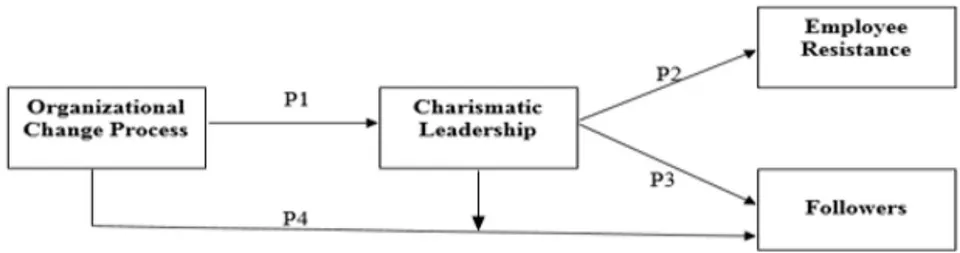
Proposition1: If a charismatic leader is chosen in the stage of change, then the role of the leader to motivate the organizational change process will lead to positive outcomes for the organizational interests as a whole.
Many studies conclude that resistance to change is one of the most important problems faced by those involved in the change process. However, it can be noted that there is no consensus on clarifying the resistance to change as past researchers studied the concept from diverse perspectives. The phenomenon of employee resistance to change, defined as a measure to protect the individuals from the effects of change like actual or supposed action, identifies resistance as an act to maintain the current situation (Senge, 2006). Leaders are advised to distinguish between the causes of resistance and the resulting symptoms of it (Melhem and Ibrahim, 2008). Among the most prominent symptoms of the resistance of the employees include complaints about a particular method or procedures followed in the organization, attacking new proposals and ideas. They can be frequent criticisms, spreading rumors, non-compliance with work rules and procedures, high turnover, absenteeism rates or low rates output, also individuals' insistence that change is not fair or that many questions are asked of employees and some indifferent to change, in addition to some individuals trying to influence others by convincing them that staying on the status quo is better than change (Petrini and Hultman, 1995). This leads to a second proposition:
Proposition 2: If there is strong employee resistance to organizational change threatening the interests and values of the organization then the role of the charismatic leader will be to defend, change and manage that situation.
Change processes in organizations face employee resistance for personal reasons or fear of change. Successful management is needed to overcome such resistance. This can be achieved by managing the actions of individuals through controlling their emotions and behavior (Erwin and Garman, 2010). The charismatic leader rejects traditional attitudes in seeking the status quo and doesn't search for new commitments in the workplace. The task of the leader is to change and strive for the best whilst working in the most charismatic way. He/she doesn't hesitate in breaking tradition or negative habits to keep up with the present and achieve future growth. Charisma is a supernatural power as it is the ability to control the minds of people, changing their thoughts and beliefs from fear of the unknown; by redirecting them in the right way.
This simple idea of charisma has been developed and revised in many ways. To illustrate this, it has been suggested that charismatic leaders transfer and reorganize the standards of their followers using their influential characteristics (Seyranian and Bligh, 2008). It has also been suggested that charisma is a common vision and which best illustrates how its followers succeed by overlapping interactions with unrepresented characters (Ladkin, 2006). This leads to a third proposition:
Proposition 3: If there is a talented leader with a convincing vision on the benefits of organizational change then there will be no fundamental difference in the relationship between the leader and his followers to defend the organizational change process.
The employee assessments and the effectiveness of change will affect the employees themselves in the context of the organization they work for. A good assessment procedure will provide opportunities for the employees, while a poor assessment will make the employees feel their position at risk and often suffer from depression and abuse (Van Dijk and Van Dick 2009). Both Cartwright and Cooper (2014) point out that during periods of change in an organization the rapid development or change in operations is will tighten control systems imposing restrictions and pressure on employees. Leaders face resistance to change in different ways while restructuring the organization. The details of employee resistance to change and its consequences must be understood well to develop effective strategies against any resistance (Senge, 2006).
The application of loyalty performance measuring tools has different effects on employee performance. This is due to the possessiveness in conservative practices of some companies with management perspectives that resist change. Such practices lead to a defensive state in organizations which may result in low confidence and a cultural shock. Employee interactions can be analyzed by four stages: Discomfort; chaos and then boredom; trying to bargain, and approval (Van Dijk and Van Di, 2009). Galvin et al. (2010) argued that the use of charismatic leadership style helps to understand, or at least benefit from, social networks and flow of information in organizations. This perceptive may provide an insight into how large relationships are linked between individuals and leaders.
Seyranian and Bligh (2008) underlined the compatibility of the relationship between the leader and his followers. Charismatic leadership can also be inspired by the influence of society and its orientation towards change. Effective leadership strategy is observed when vision and personal emotional support of followers facilitate the change process. The characteristics of the charismatic leader are innovation, cooperation, and participation in new decisions (Paulsen, et. al., 2009). Trust is created via influential innovations coming from the followers. The results of this study also show that the exploitation of the emotion of the followers creates an effective change in their behavior to follow the charismatic leader on new strategies (Michaelis, et. al., 2009). Bateh et al. (2013) underlined the importance of leadership effectiveness suggesting that creating employee participation through training and creating awareness of change enables managers to reduce conflict and increase collaboration to overcome employee resistance to change.
It can be underlined that the reasons for internal integration and acceptance of processes and procedures of change are until the "leader" begins to change himself shaping out the needed steps for leading the change and his power and his will to possess and apply the chosen strategies that are going to differentiate the organizational through the chosen change process (Pardo et al., 2003; Wikangas and Okumura, 1997). As Van Knippenberg and Hogg (2003) argued, it is important to acknowledge that change begins with the leader himself by setting an example for change, which motivates the employee to follow the leader. There are a lot of causes to encourage the expectation that shift and change through charismatic leadership style. This will enhance the employee's ability to accept change. The charismatic leadership style has gone beyond normative exchange to accept those who wish to, by establishing systems of unique importance to representatives (Gardner and Avolio, 1998). Moreover, successful leaders have become a change model and encouraged followers to think about current methods in a variety of ways; to motivate them; to outweigh their principles, behavior, and thinking (Van Dijk and Van Dick, 2009; Oreg and Berson, 2011; Seyranian and Bligh, 2008).
Charisma is an essential social style that influences and strengthens employee thinking, in a period of strategic change. The interdependence amongst individuals and their leaders will affect the inevitable ability to lead and the success of the chosen change process and its application (Paais & Pattiruhu, 2020). The unnatural style of a charismatic leader is built on manipulation of disbelief; thus, the resistance of the employee is expected to be overcome by perceiving the employee's attitude on the process, implementing different strategies on a perceptual basis (Saleh et al., 2022). Thus, have a successful positive outcome of the process. This leads to a final proposition:
Proposition 4: If a leader has an influential personality and ability to influence "followers" then it is likely to increase control over "employee resistance" who see it as a threat to their value and personal interests to achieve organizational change desired.
a) Conceptual framework
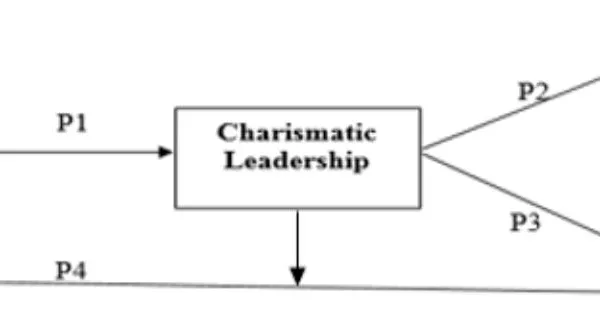
In formulating its propositions, this study has taken into account all that supported the organizational change process, charismatic leader, followers, and employee resistance as in the conceptual model in "Figure 1" below.
III. METHODOLOGY
The epistemological perspective is an interpretive perspective based on beliefs in multiple realities of the social world. Data collection methods have led to collect rich details of phenomena that have been studied. Data were collected over a year of observation and a set of qualitative in-depth telephone interviews with the organization. In addition, to investigate the participants' subjectivity of the study propositions have been constituted.
Both primary and secondary data were used in this study. The primary data were collected from "Queen Alia International Airport" by personal observation of the researcher during the work period of one full year, conducting several telephone interviews and using data via the Internet for the official airport sites. Whereas the secondary data is collected from a theoretical framework based on available information and documented in books, references, and published articles, as well as studies in different periodicals. International electronic databases such as Ebsco, Emerald, and ProQuest were also used.
a) Case Study Description
Queen Alia International Airport belonged to a traditional Jordanian family. The structure of the airport organization was also developed traditionally. In years, the family owning the organization decided to sell half of the shares to a private French company. The reason to share the company was that the traditional management facilities drove the family business to complex problems and financial conflicts. The management responsibility was given to the French partner; who decided to change the management style of the airport. The aim was to widen the location, have more international and internal flights and increase the capacity for profit. The change process was activated after hiring a French CEO who investigated one year the situation and the structure of the company. After one year, the change process was activated officially and faced resistance where the buy-in was located; the resistance came from the employees who were used to be managed by the traditional Jordanian organizational culture.
The CEO of Queen Alia International Airport seemed to be a prominent and distinguished figure who built a good reputation and a convincing personality in his field. He was the founder of the change process. More specifically, the chosen change process included the expansion of an organizational structure, transformation from traditional work programs to electronic and online work programs, conversion of the scope of work of the organization's employees to outsource companies on annual contracts, shifting the scope of employees from employees with different tasks in the workplace to one function or quality control and monitoring the commitment of the outsource companies with whom they had contracts. Also, new restrictions were imposed on employees not familiar with employees' previous management style as a fingerprint device to monitor employees during working hours and intensifying surveillance cameras to monitor the work procedures in the right way and took the old job of the account of contracted companies, which lost the employee the right to dispose of the scope of his old work. In addition, the employees of the outsourcing companies did not allow the airport employees to interfere in their work procedures which resulted in skirmishes, problems, chaos, and negative expression and have been shaped like a "non-acceptance, resistance to the change process".
To overcome the situation a positive intervention from the senior management was carried out on the order of the Chief Executive Director (CEO); to hold educational sessions and absorb the anger of the employees in a manner that is desirable by motivating and persuading employees to work promising the employees a better future through change and improvement. It has been explained clearly that traditional work generates boredom, problems and reduces profits, and attracts fewer passengers, which results in low salaries and the risk of loss of work for many employees.
The chosen process of change has achieved positive results which improved the physical and social status of the employees and the organization in general. The CEO served as a father to the employees and convinced them as he was coming down on the field of work and helping the employees in their formal work, which enticed passion and instilled awareness and will to work.
b) Case Study Analysis
The case was analyzed based on seven core viewpoints. These viewpoints comprise our understanding of how a charismatic leadership style can defend an organization's position in overcoming "employee resistance against the chosen organizational change style" and supports the interests and objectives of the organization they work for. The importance of the change and who is responsible in addition to what motivates them. These viewpoints draw a crystal clear image about the subject on who is doing the change. While the on other hand, the responsibilities, who to deploy the change, the role of senior management, and the actual change will draw the missing puzzle of the conscience of the change process on the organization. Finally, the study sought another alternative to deal with such changes.
First core viewpoint, why the change was necessary: Queen Alia International Airport belonged to a traditional Jordanian family. The organizational structure was thus developed traditionally. In years, the family owning the organization decided to sell half of the shares to a private company. The reason to share the company was that the traditional management facilities drove the family business to become too complex to solve problems and financial conflicts.
The second core viewpoint, who initiated the change: The change process was started by the French company, by the French CEO. The CEO of Queen Alia International Airport seemed to be a prominent and distinguished figure who built a good reputation and who was a convincing personality in his field.
The third core viewpoint, how it was introduced and by whom: the change process was activated after hiring a French CEO who investigated the situation and the structure of the company for one year. After one year the change process was activated officially and faced resistance when the buy-in was located; the resistance was from employees who were used to be managed by traditional Jordanian organizational culture.
The fourth core viewpoint, how the responsibilities for implementation were allocated: the management responsibility was given to the French partner who decided to change the management style of the airport. The aim was to widen the location, have more international and internal flights and increase the capacity for profit.
The fifth core viewpoint, how "buy-in" to new ways of working were achieved: the chosen change process included the expansion of an organizational structure, transformation from traditional work programs to electronic and online work programs, conversion of the scope of work of the organization's employees to outsource companies on annual contracts, shifting the scope of employees from employees with different functions in the fields to multi to one function or quality control and monitoring the commitment of the outsource companies with whom they had contracts. To overcome resistance to change, a positive intervention from the senior management was carried out on the instructions of the Chief Executive Director (CEO); to hold educational sessions and absorb the anger of the employees in a manner that is desirable by motivating and persuading employees to work promising the employees a better future through change and improvement. It has been explained clearly that traditional work generates boredom, problems and reduces profits, and attracts fewer passengers, which results in low salaries and the risk of loss of work for many employees.
The sixth core viewpoint, the level of "buy-in" achieved: The chosen process of change has achieved positive results which improved the physical and social status of the employees and the organization in general. The CEO served as a father to the employees and convinced them as he was coming down on the field of work and helping the employees in their formal work, which enticed passion and instilled awareness and will to work.
The seventh core viewpoint, how the whole process may have been handled differently: The Chief Executive Officer and his followers used to provide influential phrases and future offers to the employees that benefit their position, and training courses were also intensified to raise awareness among employees. Therefore, the employees' opposition to change was overcome using the preferred leadership style or the charismatic leadership to defend the change to achieve the interests and objectives of the company.
IV. DISCUSSION
The case study above and the literature review carried out on the previous studies analyzed leadership. Choosing a charismatic leadership style on organizational change processes and overcoming employee resistance to change can be considered as an effective decision for maintaining the sustainability, and success of the company.
The change process was started by the French company, by positioning the French CEO. As shown above, the charismatic leader is a catalyst for change. It has been shown in Proposition 1: that choosing a charismatic leader in the stage of change is motivational and defends the organization's goals in general. This is in agreement with Weber (1976) and Mhatre and Riggio (2014). Effective charisma is an influential basis for social change, and also corresponds to a concept of charismatic leadership style that corresponds as a power for change and is adopted by most of the researchers in the field (eg. Shamir and Howell, 1999; Waldman and Javidan, 2013; and Beyer, 1999). It differs from Levay (2010). The character of the charismatic leader in maintaining the status quo has been emphasized as distinct by most of them.
Proposition 2: the consequences of the charismatic leader have an effective role in confronting resistance and persuading employees about the benefits of the change and the company as a whole. The leader had a strong diplomatic orientation and effective rhetoric in negotiating with employees and enticing their passion in a sufficiently effective manner to defend the organization's goals and overcome employees' opposition to change and convince them that this change was beneficial to the organization as a whole. This is in agreement with Van Dijk and Van Dick (2009) who mentioned a leader's interactions with the employee through four stages. They are considered as discomfort that begins with disapproval and fear; Chaos and then boredom; Trying to bargain; then Approval. As Bateh et al. (2013), argued about leadership effectiveness by creating employee participation as an initiator of change through training and creating awareness of change enables managers the management to reduce conflict and increase collaboration around employees. The results of a study conducted by Oreg (2006), show that the reason for the domination of employees on the organization by creating negative feelings of resistance, generated as a result of a collective intention to leave the job, can be summarized as the lack of strong leaders capable to defend and motivate the desired change.
Proposition 3: It turns out that the processes of influencing acts of the leader individually and the exercise of his activities that haven't been done before affected the emotional status of the followers and also affected the values and their perceptions about their company identity. This was the work of guidance and job description of the new system adopted. This provides an opportunity to develop in future cases an example to reduce the shock and vision of the employees of organizations that suffer cases of resistance by creating objections before the occurrence. Therefore, the study carried out needs a proposition for a solution: A leader attracts the group, which tends to the leaders of the commander through his decision to provide a convincing vision. This point is in agreement with the finding of Wikangas and Okumura (1997) and Pardo et al. (2003), who found that the lack of skill of the leader in motivating followers to change their behavior will lead to failure in the procedure of change as an outcome of resistance of individuals to this change. They underlined the reasons for internal integration and acceptance of processes and procedures of change that are dependent on the leader. The leader begins to change his behavior and the power of the leader then his will to possess high charismatic perceptive features on employee' develops the change. Several studies have also shown the power of the charismatic leader to influence his followers to help him in the organizational change process, creating a common relationship to seek the desired change. (Eg. Michaelis, et al. 2009; Oreg and Berson, 2011; Seyranian and Bligh, 2008). Van Knippenberg and Hogg (2003) argued and stated that change begins with the leaders themselves first by setting an example for change, which is going to motivate the employee to follow their leader's charismatic characteristics. The consequences of the study proved that the leader enjoys characteristics such as the innovative, imaginative, visionary, inspiring, and personal power that affects all members of the firm and that successful and satisfactory results can be visible to the company. The perception of employees on the process and their emotional commitment will switch the entire organization to a positive outcome.
Proposition 4: Through the above-mentioned case of the Queen Alia International Airport, the leader, and his followers had a strong enough position in the organization to overcome the employee's resistance to change convincing them in a gracious and sophisticated manner that this change was beneficial to the organization as a whole and was making them successful. This is in agreement with Erwin and Garman (2010) who mentioned the procedures of change developed under the control of a charismatic leader. According to the Charisma theory (Weber, 1978; Abbasiyannejad, et. al., 2015), charismatic leaders have a better power level and understand better the ideas and expectations of the employee due to emotional capability and close relations (less power distance). Paulsen and his colleagues (2009) showed that one of the characteristics of a charismatic leader is innovation, where he seeks successful change and creates opportunities for his support to change and dominate the organization and control followers to achieve successful results of the change.
There are some limitations and opportunities for future studies. Consequently, this phenomenon should be studied in future research, and proposals that summarize the results of this study should be developed as a guide. In addition, similar studies in different environments should be carried out to test the propositions developed by this study under different circumstances. This study was a single leadership style that did not take into account other leadership styles to compare results and analyze leadership roles and their impact on change processes and the need to intensify studies and create gaps in organizations that are a barrier to change processes in business organizations.
V. CONCLUSION
Understanding the role of charismatic characteristics and features of leadership style gives us important insights into the role of the charismatic leader as well as his influence on his followers and their perceptions. Perhaps more importantly, it helps us understand how leaders can use, or at least take advantage of, organizational change processes and control of individuals and groups. Specifically, looking at the characteristics and behaviors of the leader provides insights into how to identify the employee reasons for resistance to change and how to control them by the ability of the leader to influence the organization by creating awareness and training to can get sustainability and keep up with the development of social change. The charismatic characteristics here are more subtle and pluralistic than the homogenous strategy described by previous researchers, and they support in influencing "devote followers and employee resistance to accepting the desired change". However, this study has described potentially strong influences on organizations and perceptions of followers. This understanding may provide greater clarity for individuals who have no direct interaction with the leader may develop with the same strength and consistency of the leader's perceptions as those individuals who have a great interaction. At the macro level, this understanding may provide insights into how large-scale movements are associated with charismatic leaders to achieve desired change process and control over individuals and groups across organizations, communities, and cultures.