## I. INTRODUCTION
Over the last few years, the educational sector has experienced a massive transformation due to the rapid implementation of Artificial Intelligence (AI) technologies, especially ChatGPT (Nasir and Javed, 2023). These technologies have introduced strong progressive and interactive learning methods that vary from traditional patterns. This study aims to understand the relationship between Moroccan University students and the use of ChatGPT, examining students' attitudes and behavioral goals within their educational journey.
The dominance of such technology and its ongoing growth in the education sector worldwide has been taken into consideration in this research. This study was initiated due to the significant changes AI has brought to the educational sectors, necessitating an understanding of its impact on students. ChatGPT provides an innovative approach and an exclusive experience to enhance students' learning process in their educational journey, offering automated interactive conversation, personalized and engaged discussions where they can immediately ask questions and receive feedback (Wu, 2023; Rasul et al., 2023). Existing literature highlights both the benefits and concerns of AI in education, providing a foundation for this study exploration. Despite these benefits, the implementation of ChatGPT has also raised concerns regarding the impact it has on the students' ability to establish critical thinking and academic honesty as it may lead students to become strongly dependent over its use for academic assistance, potentially compromising their academic integrity (Wu, 2023; Rasul et al., 2023). While some argue in favor of integrating ChatGPT in educational use as it strengthens students' learning and academic comprehension, others claim it may weaken students fundamental academic skills such as critical thinking (Qawqzeh, 2024). Considering the complex relationships and conflicted opinions over the use of AI in educational purposes, this study explores several elements that impact Moroccan students' adoption, aims, and perceptions towards the application of ChatGPT. These elements include Attitude towards using ChatGPT, Behavioral Intention, ChatGPT Resistance, Ethical Values/Morals/Integrity, Perceived Academic Integrity, Perceived Bias/Inaccuracies, Perceived Credibility, Perceived Instructor AI Competency, Perceived Usefulness, Religiosity, and Student Digital Literacy Social Norms. Moreover, this research attempts to study models/theories: Technology Acceptance Model (TAM) (Davis, 1989), Unified Theory of Acceptance and Use of Technology (UTAUT) (Venkatesh et al., 2003), and Fraud Triangle theory's usefulness to form an actual influence over user behavior in Morocco's cultural and educational context. This method aims to offer a thorough understanding of the reception and implementation of AI in education and valuable insights within socio-cultural settings. Morocco was chosen for this study because its cultural and educational context is unique. The relevance of this study highlights Moroccan education as it is poorly present in existing literature. This study is not only investigating a critical gap in the application of AI as ChatGPT in Morocco among University students, but it is also providing feasible insights for educational sectors looking to improve its use effectively into their programs.
For what has been addressed, this research answers important questions:
- RQ1: How do Moroccan university students perceive the utility and credibility of AI tools like ChatGPT in their academic activities?
- RQ2: What are the primary concerns and barriers that Moroccan students face when integrating AI technologies like ChatGPT into their learning processes?
- RQ3: In what ways do instructors' AI competencies influence students' attitudes and behavioral intentions towards using ChatGPT?
- $RQ4$: Does religiosity significantly moderate the relationship between attitudes towards using Al tools and the behavioral intentions of Moroccan students?
This paper is structured as the following: In Section 2, the paper will introduce the theoretical framework and the foundational principles of the study. Section 3 will focus on discussing the conceptual model and formulating hypotheses. Following that, Section 4 and Section 5 will delve into the research methods employed and the data analysis conducted. Section 6 will serve as the conclusion of the paper, summarizing the key findings and implications of the study.
## II. THEORETICAL BACKGROUND
### a) The Concept of ChatGPT
ChatGPT is a new form of artificial intelligence designed to interact with users in a way that feels natural, almost like talking to another person. It learns from a vast amount of data to understand different aspects of human language, such as speech and writing. Božić and Poola (2023) discuss how ChatGPT works and its potential applications in education. Unlike earlier AI models, which could only handle basic conversations, ChatGPT is capable of creating dialogues that seem very realistic (Roumeliotis & Tselikas, 2023). Whether it's providing assistance in customer service or acting as a virtual assistant, ChatGPT aims to offer experiences that closely resemble human interaction, understanding and responding to text in a way that feels human-like. Additionally, ChatGPT is constantly learning and improving. With each interaction, it gets better at understanding language, adapting to changes, and becoming more accurate over time (Haleem, Javaid, & Singh, 2022). By adapting to users needs, ChatGPT ensures its conversations remain relevant and effective. It also adds empathy to its interactions, understanding emotions and context to engage users in friendly, personalized chats. This approach builds trust and connection, changing how we perceive AI from a tool to a companion that actively listens and understands.
### b) Theoretical Foundation
## i. The Theory of Acceptance and Use of Technology (UTAUT)
The Theory of Acceptance and Use of Technology (UTAUT) provides a framework for explaining reasons behind people's choice of specific technologies over others and how they interact with them in action. UTAUT was developed by Venkatesh. It investigates several technological aspects among them social norms/effects, their efficacy and accessibility, and the factors behind promoting its adoption worldwide (Venkatesh et al., 2003). Additionally, this model regards age, gender, technological learning experience, and freedom to use technology.
## ii. The Technology Acceptance Model (TAM)elaborate
One of the frequently used models to study user acceptance with technology is The Technology Acceptance Model (TAM) elaborated by (Davis, 1986). It is based on social psychology theory and the Theory of Reasoned Action (TRA) by (Fishbein and Ajzen, 1975). TRA theory indicates attributes that affect people's beliefs and attitudes, which then influence their behavior and aims. In the same way as TAM theory, (Davis, 1986) elaborates several important aspects consisting of perceived usefulness (PU), perceived ease of use (PEOU), attitude, and intention to use. Among these, PU and PEOU investigate user perceptiveness about technology consumption and how it impacts their attitude, determining whether users will embrace it or reject it.
## iii. Fraud Triangle Theory
Donald Cressey's Fraud Triangle theory, emphasises a radical structure to comprehend the psychological, social and environmental circumstances that lead individuals to commit fraud. The theory implies three main aspects resulting in fraud behavior: Pressure, Opportunity and Rationalization. In accordance with Cressey ideology, people are motivated to engage in fraudulent activities when they are experiencing either financial or personal pressures. Eventually, pressure motivates individuals to perceive their deceitful actions acceptable when they are given a chance to take advantage of vulnerability or weakness within a strict setting. Students tend to use ChatGPT when they are experiencing overwhelmness and immense pressure to meet up all their multiple academic tasks as deadlines, assignments or projects in a short period of time with limited resources (Devlin & Gray, 2023). This technology helps them manage their workload, save time and quickly generate answers for them. Therefore, the theoretical elements are connected which makes it important for organizations to enhance preventive measures. However, comprehending these factors is challenging for institutions to stay vigilant, to detect possible threats to prevent fraud activities (Cressey, 1953). Mostly, people justify fraud when they often experience pressure and see a way out by doing so. Here comes the Fraud Triangle Theory with a progressive philosophy to understand the reasons behind fraud. The Fraud Triangle theory has made significant progress in developing a philosophical foundation for understanding fraud occurrence (Ma, Qingxiong & Liu, Liping, 2005).
## III. CONCEPTUAL MODEL AND HYPOTHESIS DEVELOPMENT
### a) Conceptual Model
In figure 1, The framework suggested below, is based on reconciling the theories of TAM, proposed by Davis (1989), focuses on two primary determinants of technology adoption: Perceived Usefulness (PU) and Perceived Ease of Use (PEOU) and UTAT Venkatesh et al. (2003) theories in addition to research conducted by relevant scholars in the field.
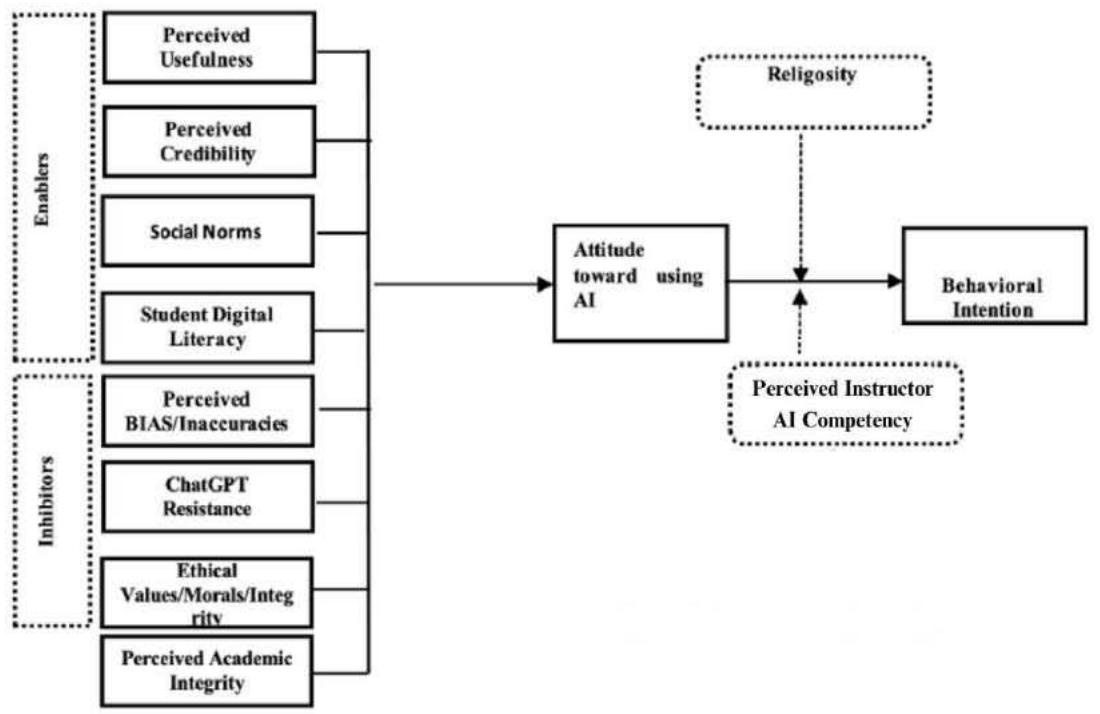 Figure 1: Hypothesized Model
### b) Hypotheses Development
Perceived Usefulness refers to how much students believe that using ChatGPT will help them do better in their studies, includes making studying easier, improving understanding of course materials, and overall enhancing their academic performance. Based on the theory of technology acceptance model (TAM) of (Davis, 1986), perceived usefulness (PU) significantly predicts users attitude and behavioral intention to adopt the use of a technology. Similarly, Albayati (2024) found that when people have good experiences with such technologie like ChatGPT, they tend to feel more positive about using it. For example, if a student find that ChatGPT consistently gives them accurate and helpful responses to their academic questions, they are more likely will use it regularly to improve their studies. Additionally, a research conducted by Iqbal, Ahmed, and Azhar (2022) highlights that if the instructors perception of ChatGPT as a valuable tool in their teaching methodologies it positively impacts their attitude to use it. This finding where the perceived usefulness of ChatGPT is likely to influence students attitudes in a similar manner. Given that both instructors and students engage with ChatGPT within educational settings, their positive results with the technology can contribute to their overall acceptance and ongoing utilization of it. Accordingly, it is hypothesized that:
H1: Perceived Usefulness Positively Impacts Students' Attitude towards using ChatGPT.
Perceived Credibility refers to the degree to which students believe that ChatGPT provides reliable, accurate, and trustworthy information. Students are convinced that ChatGPT provides accurate and reliable information; therefore, they develop positive beliefs regarding its usage to attain their academic objectives (Tiwari et al., 2023). Its effective everyday usage results in making students believe it could do more, leading them to adopt a positive attitude in terms of its utility and boost their self-esteem. This is exactly what a student experience with AI feels like. It becomes a trustworthy source that is frequently used due to its provision of reliable and accurate information. Research by Iqbal (2023) supports this notion, showing that students who trust ChatGPT's responses are more inclined to use it for learning, leading to improved academic engagement and outcomes. Additionally, findings from Sallam et al. (2023) confirm that perceived credibility is crucial in validating the acceptance of ChatGPT, demonstrating that students who viewed ChatGPT as credible showed positive attitudes towards use in it into their studies. These studies underscore the significance of perceived credibility in shaping students' acceptance and continued use of ChatGPT in educational settings. Accordingly, the study proposed that:
H2: Perceived Credibility Positively Impacts Students' Attitude towards using Chatgpt.
Social Norms refer to the shared expectations and rules that guide the behavior of people within social groups. Based on the Theory of Acceptance and Use of Technology (UTAUT) (Venkatesh et al., 2003) and the Technology Acceptance Model (TAM) (Davis, 1986), UTAUT demonstrates that social norms are a driver towards technology adoption and implies that ChatGPT is to show positive acceptance in case it gets taken up by the community of students (Mahmud et al., 2024). TAM reinforces this by highlighting the influence of social pressures on technology adoption. With these combined, students are more likely to view ChatGPT positively if it is seen as a norm within their social circles. In addition, Sallam et al. (2023) found that students who get attracted by their colleagues using ChatGPT, they have better attitudes towards it. Similarly to a study conducted by Fabella (2023) who discovered that first-year college students are more likely to accept ChatGPT if they believe others view it positively. This finding underscores the impact of peer opinions and social norms on students attitudes towards new technology like ChatGPT which is the case in this study. These mentioned findings collectively emphasize the importance of considering peer influence and prevailing social norms when understanding students' acceptance of innovative technologies. Accordingly, the study proposed that:
H3: Social Norms Positively Impact Students' Attitude towards using ChatGPT.
Digital Literacy refers to the ability to effectively use digital tools and technologies to find, evaluate, create, and communicate information. According to a study conducted by Annamalai and Naghmeh-Abbaspour (2023), digital literacy plays a significant role in how students perceive and adopt new technologies like ChatGPT. Those with strong digital skills tend to appreciate ChatGPT's capabilities more, leading to better academic performance and a positive attitude towards its use. As students become more proficient with digital tools, they can maximize ChatGPT potential to enhance their learning experiences. Further research by First (2023) supports that students with higher digital literacy are more favorably towards using ChatGPT, recognizing its potential to support diverse learning activities effectively. Learners do not have to put extra effort into learning how to use ChatGPT as it is similar to searching for information on the Internet. If the use of ChatGPT is easy, clear, and simple, students would intend to use it for learning purposes in the future. Accordingly, the study proposed that:
H4: Students' Digital Literacy Positively Impacts Students' Attitude towards using Chatgpt.
Perceived Bias/Inaccuracies refer to the extent to which students believe that the information provided by ChatGPT is biased, incorrect, or misleading. Based on Barakat, Salim, and Sallam (2024) findings, students perception of bias or inaccuracies in ChatGPT responses significantly impacts their attitude toward using the technology. These perceptions can highlight trust and reliance on ChatGPT for academic purposes, causing students to question the AI tool reliability and accuracy. Hidayat-ur-Rehman and Ibrahim (2023) support this finding by indicating that perceived bias and inaccuracies not only discourage educators but also significantly influence students willingness to adopt ChatGPT. The study highlights that these negative perceptions resulted the resistance to use ChatGPT. Accordingly, it is hypothesized that:
H5: Perceived Bias/Inaccuracies Negatively Impact Students' Attitude towards using ChatGPT.
ChatGPT Resistance refers to the reluctance or refusal of students to use ChatGPT due to various concerns such as discomfort, distrust, or preference for human interaction. According to Yilmaz research, students attitude changes as a consequence of ChatGPT resistance. The findings showcase that if students feel discomfort, distrust, or prefer human interaction instead of AI technologies, it influences their attitude towards using ChatGPT and it evolves into an unfavorable tool. ChatGPT resistance may develop for several reasons, including laziness, concerns about trustworthiness, or the fear of being caught using AI tools. Hence, these motives negatively impact students' willingness to accept ChatGPT as a facilitator in their learning process and discourage them from forming a positive attitude towards it (Yilmaz, 2023). Another research conducted by Famaye, Bailey, and Adisa (2024) found that students are worried if using AI tools like ChatGPT might make them lazy and harm their writing skills, leading to negative attitudes toward such technology. Similarly, Sevnarayan's (2023) study showed that both students and instructors have concerns beyond just reliability and ethics when it comes to using ChatGPT, affecting how they feel about it overall. These studies highlight how various worries can combine to make people hesitant about using AI in education. Accordingly, it is hypothesized that:
H6: Students' Resistance to ChatGPT Negatively Impacts their Attitude towards using ChatGPT.
Moral Values refer to the principles and standards of behavior that students consider to be important and right, guiding their actions and decisions. Based on a study conducted by Fahri (2023) students moral values play a crucial role in determining the attitude regarding the integration of ChatGPT (Farhi et al. 2023). This casts doubts to students on how ChatGPT usage goes against their moral values. For one thing, ChatGPT resistance could imply ethical concerns, data privacy problems or any misconduct resulting from AI technologies leading to a disadvantageous approach about its acceptance. From a student perspective, the employment of AI tools in academic learning is considered unjust if it appears a category is benefiting from its usage in contrast to others (Farhi et al. 2023). In addition, Iqbal (2023) study mentioned that students worry about the truthfulness and correctness of AI generated responses, fearing that using such tools might go against their own moral principles. These worries lead to negative feelings about ChatGPT when students think it might harm their honesty or academic principles. Accordingly, the study proposed that:
H7: Students' Moral Values Negatively Impact their Attitude towards using ChatGPT.
Perceived Academic Integrity refers to students' beliefs about maintaining honesty and originality in their academic work while using technological tools like ChatGPT. Bin-Nashwan et al. (2023) found that how students think ChatGPT affects academic honesty greatly influences in their attitudes. If students believe using ChatGPT for their studies might make their work less authentic or original, they're more likely to see it in a negative light. This might stop them from using ChatGPT because they are worried about being not honest and keeping their work not credible. Other study by Iqbal (2023) points out that students are concerned that using these tools could make it easier to cheat, which could harm their academic reputation or lead them to bad consequences. The potential for plagiarism or undermining one's own learning process has been identified as significant barriers to the acceptance of ChatGPT in educational settings.. Hence, the following hypothesis is proposed.
H8: Perceived Academic Integrity Negatively Impacts the Students' Attitude towards using ChatGPT.
Intention to use refers to the likelihood that students will use ChatGPT for their academic activities based on their attitudes towards the technology. According to Artur Strzelecki (2023) having a positive attitude towards ChatGPT leads to a stronger intention to use the system. When students have positive opinions about ChatGPT, it motivates them to use the technology more in their academic pursuits. Another study by Abdaljaleel et al. (2024) shows that when students feel comfortable with such a technology like ChatGPT, they're more likely to use it. Likewise, Albayati (2024) found that if students think ChatGPT is easy to use and helpful, they're more willing to use it often. These studies highlight how important it is for students to have positive experiences with AI tools like ChatGPT to want to use them more. therefore:
H9: Students' Attitude toward using ChatGPT Positively Impacts their Intent to use it.
Perceived Instructors' AI Competency refers to the extent to which students believe that their instructors are skilled and knowledgeable in using AI technologies in educational settings. According to the research by Sanusi et al. (2022), perceived competency of instructors in artificial intelligence plays a crucial moderating role in shaping students attitudes toward AI use in educational sectors. Effective instructors is a key role in shaping how students perceive AI technologies like ChatGPT. By integrating AI into their teaching methods, they can clarify how AI works, link its use to their educational goals. This approach creates a supportive learning environment where students feel comfortable with AI technologies. Additionally, the systematic review by Salas-Pilco, Xiao, and Hu (2022) highlight the importance of instructors' AI competencies in moderating students' attitudes. It highlights that instructor confidence and capability in using AI directly impact how students perceive the reliability and effectiveness of AI applications in education. Moreover, The relationship between instructors' perceived competency in AI and students' attitudes towards its use aligns with established theories like the Technology Acceptance Model (TAM) and the Unified Theory of Acceptance and Use of Technology (UTAUT). According to TAM, users who are more proficient in AI can enhance students' perception of its usefulness and ease of use, thus promoting greater acceptance of AI among students. Similarly, UTAUT suggests that users with high AI competency can create conditions that facilitate positive attitudes towards AI, leading to increased performance and effort expectancy between instructors and students.
H10: Perceived Instructors' AI Competency Moderate the Relationship between Attitude towards AI use.
Student Religiosity refers to the extent to which students religious beliefs and practices influence their attitudes and behaviors. In the ChatGPT context, the more religiously inclined students are less likely to give in to the use of AI tools like ChatGPT, as noted by Reed (2021). Islam is the largest religion in Morocco, with more than $99\%$ of the population adhering to it. The country follows only one religion which is Islam, and Islamic teachings play a crucial role in shaping cultural and societal norms (Islam Web, 2023). Supporting this, a study conducted by Zhang et al. (2024) delve into the impact of personal ethics, particularly those influenced by religiosity, on behavioral intentions towards technology. Their research indicates that moral evaluations strongly affect the acceptance and usage of technology. Therefore, religious students may fear that embracing AI technologies like ChatGPT which is the case for this study, could lead to unethical practices, such as spreading misinformation or cheating, which is considered 'haram' or forbidden in Islam. Accordingly, it is hypothesized that:
H11: Student Religiosity Moderates the Relationship between Attitude towards using ChatGPT and Behavioral Intent to use it.
## IV. METHODS
### a) Procedures
We collected data using a questionnaire by asking people to rate their agreement and disagreement with various statements on a scale of 1 to 5 ("Strongly Disagree" to "Strongly Agree"). The questionnaires were delivered in French, the primary language used in Morocco (Chetioui et al., 2020). Also, the survey was translated from French to English by using back-translation technique (Tian et al., 2022) to ensure the english version accurately reflected the original French questions. This ensured clear communication with all participants. By providing the questionnaire in both French and English, we aimed to facilitate participation and understanding among all respondents. This approach helped minimize any potential misinterpretations of the questions and ensured consistency in responses across participants.
The survey was for the most part distributed through DMs on social media like facebook, instagram, linkdin and emails to the participants. This has been a very convenient and effective method, bearing in mind the time factor we had, sampling the amount of information required in the study. Appendices are provided for reference.
### b) Sample and Data Collection
ChatGPT is becoming increasingly used in various industries, including universities. Choudhury and Shamszare (2023) point out that many occupations within academic institutions are using ChatGPT. Given the rapid growth of ChatGPT use among students, we have selected to study a sample consisting of Moroccan students to test the above model. We have adopted a nonprobability sampling method that integrated both self-selecting and snowball sampling. Based off the previously cited work, respondents were self-selected and participated of their own accord. Additionally, all questions on the survey were mandatory to answer to ensure that our data remained free of any inconsistencies. The sample size of our study consisted of Moroccans currently residing in Morocco. The results are as follow: For the Demographics part, The survey included a total of 286 respondents, with a gender distribution nearly even at $51.4\%$ female and $48.6\%$ male. In the study, most participants are students in higher education. Among them, $43.4\%$ are undergraduates, $52.1\%$ are graduates, and $4.5\%$ are PhD candidates. The majority of participants, $57\%$, are between 18-24 years old, while $40.2\%$ are aged 25-34, indicating a young participant base. When it comes to attitudes towards ChatGPT, a large number of participants, 130, strongly agree with its use for learning, and 129 agree. However, there are some who are neutral (13), disagree (10), or strongly disagree (4) with its use. Concerning addiction to ChatGPT, 120 strongly agree and 99 agree that they feel addicted, while 25 strongly disagree and 10 disagree. Regarding integration into activities, 118 find it very likely, and 139 think it's likely, while a few are neutral (15), unlikely (11), or very unlikely (3). In terms of usage, 143 participants frequently use ChatGPT, 108 use it occasionally, 32 rarely use it, and only 3 have never used it. Lastly, on accessibility, 135 find ChatGPT absolutely accessible, 142 say it's accessible in some cases, and only 9 find it not accessible.
Table 1: Respondent Profile Survey Respondent $(n = 286)$
<table><tr><td>Measure</td><td>Item</td><td>N</td><td>(%)</td><td>Measure</td><td>Item</td><td>N</td><td>(%)</td></tr><tr><td rowspan="3">Gender</td><td>Female</td><td>147</td><td>51,4</td><td rowspan="3">Level of Studies</td><td>Undergraduate</td><td>124</td><td>43,4</td></tr><tr><td rowspan="2">Male</td><td rowspan="2">139</td><td rowspan="2">48,6</td><td>Graduate</td><td>149</td><td>52,1</td></tr><tr><td>Phd Candidate</td><td>13</td><td>4,5</td></tr><tr><td rowspan="3">Age</td><td>18-24</td><td>163</td><td>57,0</td><td></td><td></td><td></td><td></td></tr><tr><td>25-34</td><td>115</td><td>40,2</td><td></td><td></td><td></td><td></td></tr><tr><td>35-44</td><td>8</td><td>2,8</td><td></td><td></td><td></td><td></td></tr><tr><td rowspan="6">CHATGPT Learning</td><td>Strongly Agree</td><td>130</td><td>45,5</td><td rowspan="6">ChatGPT Addiction</td><td>Strongly Agree</td><td>120</td><td>41,96</td></tr><tr><td>Agree</td><td>129</td><td>45,1</td><td>Agree</td><td>99</td><td>34,62</td></tr><tr><td>Neutral</td><td>13</td><td>4,5</td><td>Neutral</td><td>32</td><td>11,19</td></tr><tr><td>Disagree</td><td>10</td><td>3,5</td><td>Disagree</td><td>25</td><td>8,74</td></tr><tr><td>Stronlgy</td><td></td><td></td><td></td><td></td><td></td></tr><tr><td>Disagree</td><td>4</td><td>1,4</td><td>Strongly Disagree</td><td>10</td><td>3,50</td></tr><tr><td rowspan="5">ChatGPT Integrations</td><td>Very Likely</td><td>118</td><td>41,3</td><td rowspan="5">ChatGPT USE</td><td>Never</td><td>3</td><td>1,05</td></tr><tr><td>Likely</td><td>139</td><td>48,6</td><td>Rarely</td><td>32</td><td>11,19</td></tr><tr><td>Neutral</td><td>15</td><td>5,2</td><td>Occasionally</td><td>108</td><td>37,76</td></tr><tr><td>Unlikely</td><td>11</td><td>3,8</td><td>Frequently</td><td>143</td><td>50,00</td></tr><tr><td>Very Unlikely</td><td>3</td><td>1,0</td><td></td><td></td><td></td></tr><tr><td rowspan="3">ChatGPT Accessibility</td><td>Absolutely</td><td>135</td><td>47,2</td><td></td><td></td><td></td><td></td></tr><tr><td>In some cases</td><td>142</td><td>49,7</td><td></td><td></td><td></td><td></td></tr><tr><td>No</td><td>9</td><td>3,1</td><td></td><td></td><td></td><td></td></tr></table>
## V. RESULTS
The analysis of the data in our study was conducted using a statistical method called structural equation modeling (SEM). This approach helps us understand the relationships and causal links within the conceptual model we presented earlier. It involves analyzing numerical data using techniques like multiple regression and factor analysis. Given the complexity of our model, we opted to use the partial least squares method, as recommended by Chetiou et al. (2022), to ensure accurate analysis. To assess the quality and accuracy of our research, we'll be looking at several factors, including indicator reliability, construct reliability, convergent validity, and discriminant validity. These measures help ensure that our data is reliable and valid for drawing conclusions. Once we've established the reliability and validity of our measurements, we'll proceed with the structural modeling test using SMART-PLS 4.
### a) Assessment of the Measurement Model
The results obtained from Table 2, The Cronbach's Alpha values obtained in this research indicate how reliable our measurements are. According to Pallant (2001), if the Cronbach's Alpha value is above 0.6, it means our measurements are quite reliable and acceptable (Nunnally and Bernstein, 1994). Conversely, if the value is below 0.6, it suggests lower reliability. Our study found that all variables had Cronbach's Alpha values higher than 0.6, meaning they are reliable and suitable for analysis.
Composite Reliability (CR) measures how consistent and dependable our constructs are. To be considered acceptable for our study, CR values should be higher than 0.7 according to Hair, Hult, Ringle, and Sarstedt (2014). Our analysis revealed that all variables had CR values exceeding 0.7, indicating that they are reliable and suitable for our study.
To ensure the reliability of our measurements, we need the Average Variance Extracted (AVE) value for each variable to be greater than 0.5 (Hair et al., 2010). After conducting our analysis, we found that all variables exceeded this value. This indicates confirming the reliability of our measurements.
In this study a method by Fornell and Lacker (2018) is used. They suggest that the average root square of the average variance extracted (VAVE) for each aspect should be higher than its correlation with any other aspect. We checked this using Table 3, and it seems that each aspect is indeed different enough from the others.
Table 2: Factor Loadings, Composite Relabilities, Cronbach Alpha and Average Variance Extracted (n=286)
<table><tr><td>Constructs</td><td>Loadings</td><td>CA</td><td>CR</td><td>AVE</td><td>Constructs</td><td>Loadings</td><td>CA</td><td>CR</td><td>AVE</td></tr><tr><td>Perceived Usefulness</td><td></td><td>0,807</td><td>0,812</td><td>0,721</td><td>Ethical Values/Morals/Integrity</td><td></td><td>0,885</td><td>0,956</td><td>0,737</td></tr><tr><td>PU1</td><td>0,831</td><td></td><td></td><td></td><td>EVI1</td><td>0,720</td><td></td><td></td><td></td></tr><tr><td>PU2</td><td>0,904</td><td></td><td></td><td></td><td>EVI2</td><td>0,875</td><td></td><td></td><td></td></tr><tr><td>PU3</td><td>0,809</td><td></td><td></td><td></td><td>EVI3</td><td>0,909</td><td></td><td></td><td></td></tr><tr><td>Perceived Credibility</td><td></td><td>0,776</td><td>0,777</td><td>0,690</td><td>EVI4</td><td>0,914</td><td></td><td></td><td></td></tr><tr><td>PC1</td><td>0,822</td><td></td><td></td><td></td><td>Perceived Academic Integrity</td><td></td><td>0,828</td><td>0,828</td><td>0,746</td></tr><tr><td>PC2</td><td>0,849</td><td></td><td></td><td></td><td>PAI1</td><td>0,824</td><td></td><td></td><td></td></tr><tr><td>PC3</td><td>0,821</td><td></td><td></td><td></td><td>PAI2</td><td>0,913</td><td></td><td></td><td></td></tr><tr><td>Social Norms</td><td></td><td>0,895</td><td>0,916</td><td>0,758</td><td>PAI3</td><td>0,852</td><td></td><td></td><td></td></tr><tr><td>SN1</td><td>0,845</td><td></td><td></td><td></td><td>Attitude towards using ChatGPT</td><td></td><td>0,813</td><td>0,818</td><td>0,728</td></tr><tr><td>SN2</td><td>0,905</td><td></td><td></td><td></td><td>AT1</td><td>0,868</td><td></td><td></td><td></td></tr><tr><td>SN3</td><td>0,853</td><td></td><td></td><td></td><td>AT2</td><td>0,836</td><td></td><td></td><td></td></tr><tr><td>SN4</td><td>0,879</td><td></td><td></td><td></td><td>AT3</td><td>0,856</td><td></td><td></td><td></td></tr><tr><td>Student Digital Literacy</td><td></td><td>0,850</td><td>0,858</td><td>0,769</td><td>Perceived Instructor AI Competency</td><td></td><td>0,864</td><td>0,872</td><td>0,786</td></tr><tr><td>SDL1</td><td>0,850</td><td></td><td></td><td></td><td>PIAC1</td><td>0,868</td><td></td><td></td><td></td></tr><tr><td>SDL2</td><td>0,913</td><td></td><td></td><td></td><td>PIAC2</td><td>0,926</td><td></td><td></td><td></td></tr><tr><td>SDL3</td><td>0,867</td><td></td><td></td><td></td><td>PIAC3</td><td>0,864</td><td></td><td></td><td></td></tr><tr><td>Perceived Bias/Inaccuracies</td><td></td><td>0,872</td><td>0,900</td><td>0,710</td><td>Riligosity</td><td></td><td>0,729</td><td>0,771</td><td>0,642</td></tr><tr><td>PBI1</td><td>0,768</td><td></td><td></td><td></td><td>R1</td><td>0,768</td><td></td><td></td><td></td></tr><tr><td>PBI2</td><td>0,807</td><td></td><td></td><td></td><td>R2</td><td>0,884</td><td></td><td></td><td></td></tr><tr><td>PBI3</td><td>0,901</td><td></td><td></td><td></td><td>R3</td><td>0,745</td><td></td><td></td><td></td></tr><tr><td>PBI4</td><td>0,887</td><td></td><td></td><td></td><td>Behavioral Intention</td><td></td><td>0,830</td><td>0,832</td><td>0,747</td></tr><tr><td>ChatGPT Resistance</td><td></td><td>0,876</td><td>1,157</td><td>0,693</td><td>BI1</td><td>0,844</td><td></td><td></td><td></td></tr><tr><td>CGR1</td><td>0,759</td><td></td><td></td><td></td><td>BI2</td><td>0,916</td><td></td><td></td><td></td></tr><tr><td>CGR2</td><td>0,824</td><td></td><td></td><td></td><td>BI3</td><td>0,831</td><td></td><td></td><td></td></tr><tr><td>CGR3</td><td>0,859</td><td></td><td></td><td></td><td></td><td></td><td></td><td></td><td></td></tr><tr><td>CGR4</td><td>0,882</td><td></td><td></td><td></td><td></td><td></td><td></td><td></td><td></td></tr></table>
Table 3: Discriminant Validity (Heterotrait-Monotrait Ratios-HTMT)
<table><tr><td></td><td></td><td>1</td><td>2</td><td>3</td><td>4</td><td>5</td><td>6</td><td>7</td><td>8</td><td>9</td><td>10</td><td>11</td><td>12</td></tr><tr><td>1.</td><td>Attitude towards using ChatGPT</td><td></td><td></td><td></td><td></td><td></td><td></td><td></td><td></td><td></td><td></td><td></td><td></td></tr><tr><td>2.</td><td>Behavioral Intention</td><td>0,705</td><td></td><td></td><td></td><td></td><td></td><td></td><td></td><td></td><td></td><td></td><td></td></tr><tr><td>3.</td><td>ChatGPT Resistance</td><td>0,197</td><td>0,218</td><td></td><td></td><td></td><td></td><td></td><td></td><td></td><td></td><td></td><td></td></tr><tr><td>4.</td><td>Ethical Values/Morals/Integrity</td><td>0,225</td><td>0,364</td><td>0,114</td><td></td><td></td><td></td><td></td><td></td><td></td><td></td><td></td><td></td></tr><tr><td>5.</td><td>Perceived Academic Integrity</td><td>0,697</td><td>0,457</td><td>0,074</td><td>0,282</td><td></td><td></td><td></td><td></td><td></td><td></td><td></td><td></td></tr><tr><td>6.</td><td>Perceived Bias/Inaccuracies</td><td>0,172</td><td>0,144</td><td>0,330</td><td>0,111</td><td>0,091</td><td></td><td></td><td></td><td></td><td></td><td></td><td></td></tr><tr><td>7.</td><td>Perceived Credibility</td><td>0,716</td><td>0,704</td><td>0,205</td><td>0,207</td><td>0,519</td><td>0,170</td><td></td><td></td><td></td><td></td><td></td><td></td></tr><tr><td>8.</td><td>Perceived Instructor AI Competency</td><td>0,257</td><td>0,301</td><td>0,108</td><td>0,429</td><td>0,345</td><td>0,175</td><td>0,319</td><td></td><td></td><td></td><td></td><td></td></tr><tr><td>9.</td><td>Perceived Usefulness</td><td>0,682</td><td>0,735</td><td>0,269</td><td>0,349</td><td>0,425</td><td>0,086</td><td>0,554</td><td>0,267</td><td></td><td></td><td></td><td></td></tr><tr><td>10.</td><td>Riligosity</td><td>0,306</td><td>0,269</td><td>0,088</td><td>0,270</td><td>0,113</td><td>0,202</td><td>0,224</td><td>0,201</td><td>0,243</td><td></td><td></td><td></td></tr><tr><td>11.</td><td>Student Digital Literacy</td><td>0,498</td><td>0,659</td><td>0,241</td><td>0,555</td><td>0,459</td><td>0,083</td><td>0,427</td><td>0,530</td><td>0,588</td><td>0,224</td><td></td><td></td></tr><tr><td>12.</td><td>Social Norms</td><td>0,327</td><td>0,477</td><td>0,070</td><td>0,571</td><td>0,271</td><td>0,185</td><td>0,306</td><td>0,356</td><td>0,377</td><td>0,284</td><td>0,408</td><td></td></tr></table>
### b) Assessment of the Structural Model
Given the fact that the measurement model has been proven to be correct, it is now possible to move on to the structural model portion of the study. According to Cohen (1992) r-square value.12 or below indicate low, between.13 to.25 values indicate medium,.26 or above and above values are considered high. Table 4 highlights the $(\mathsf{R}^2)$ for all endogenous variables in the study, highlighting the fact that they exceed 0.26 and above.
Table 4: Coefficient of Determination
<table><tr><td></td><td>R Square</td><td>Cohen (1992)</td></tr><tr><td>Attitude towards using ChatGPT</td><td>0.554</td><td>High</td></tr><tr><td>Behavioral Intention</td><td>0.364</td><td>High</td></tr></table>
### c) Direct Relationships
From the results obtained in Table 5, this study explores the factors influencing the adoption and usage of ChatGPT among students in universities. The analysis for Hypothesis 1 (H1), it finds that if students think ChatGPT is useful (beta = 0.270, p-value = 0.000), they will have a more positive attitude towards it. This agrees with other research showing that AI tools can improve learning quality and offer practical benefits in learning environments. For Hypothesis 2 (H2), if students think ChatGPT is trustworthy (beta = 0.255, p-value = 0.000), they will also have a positive attitude. Trust is important for adopting new educational technologies. Hypothesis 3 (H3) is not supported since the P value is higher than 0.05 (p-value = 0.286, beta = 0.052), meaning what peers think doesn't really affect student attitudes towards ChatGPT. Students care more about their own experiences and preferences than about social influences. This could be because students personal experiences and preferences are more important than what their peers think. Hypothesis 4 (H4) is also not supported (p-value = 0.268, beta = 0.061), showing that knowing how to use digital tools doesn't make students more likely to like ChatGPT. Familiarity with digital tools doesn't necessarily predict favorable attitudes towards specific technologies. Hypothesis 5 (H5) is supported since the p value is lower than 0.05 (beta = 0.092, p-value = 0.046). Even if students think ChatGPT might have some bias or inaccuracies, they still tend to like it. This indicates that concerns about biases can actually engage students to use ChatGPT. Hypothesis 6 (H6) is supported (beta = -0.098, p-value = 0.014), showing that resistance to new technology makes students less likely to like ChatGPT. This reflects the challenges in technology adoption where resistance can stem from various user concerns. Hypothesis 7 (H7) is not supported because the p value is higher than 0.05 (beta = -0.077, p-value = 0.143), meaning ethical concerns don't really affect student attitudes towards ChatGPT. Other factors, like how useful or easy ChatGPT is to use, might be more important to students than ethical considerations. Hypothesis 8 (H8) is strongly supported (beta = 0.343, p-value = 0.000), showing that if students think ChatGPT helps with
academic integrity, they will like it more. Highlighting perceived academic integrity can greatly enhance positive attitudes. Finally, Hypothesis 9 (H9) is very strongly supported (beta = 0.529, p-value = 0.000), showing that if students have a positive attitude towards ChatGPT, they are very likely to use it. This confirms that positive attitudes significantly predict the behavioral intention to use ChatGPT.
Table 5: Path Coefficients
<table><tr><td></td><td>Relationships</td><td>Beta</td><td>STDEV</td><td>T-statistics</td><td>P-values</td></tr><tr><td>H1</td><td>Perceived Usefulness -> Attitude towards ChatGPT</td><td>0.270</td><td>0.065</td><td>4.152</td><td>0.000</td></tr><tr><td>H2</td><td>Perceived Credibility -> Attitude towards using ChatGPT</td><td>0.255</td><td>0.067</td><td>3.792</td><td>0.000</td></tr><tr><td>H3</td><td>Social Norms -> Attitude towards ChatGPT</td><td>0.052</td><td>0.049</td><td>1.068</td><td>0.286</td></tr><tr><td>H4</td><td>Student Digital Literacy -> Attitude towards ChatGPT</td><td>0.061</td><td>0.055</td><td>1.109</td><td>0.268</td></tr><tr><td>H5</td><td>Perceived Bias/Inaccuracies -> Attitude towards using ChatGPT</td><td>0.092</td><td>0.046</td><td>1.998</td><td>0.046</td></tr><tr><td>H6</td><td>ChatGPT Resistance -> Attitude towards using ChatGPT</td><td>-0.098</td><td>0.040</td><td>2.459</td><td>0.014</td></tr><tr><td>H7</td><td>Ethical Values/Morals/Integrity -> Attitude towards using ChatGPT</td><td>-0.077</td><td>0.052</td><td>1.466</td><td>0.143</td></tr><tr><td>H8</td><td>Perceived Academic Integrity -> Attitude towards using ChatGPT</td><td>0.343</td><td>0.085</td><td>4.042</td><td>0.000</td></tr><tr><td>H9</td><td>Attitude towards using ChatGPT -> Behavioral Intention</td><td>0.529</td><td>0.071</td><td>7.435</td><td>0.000</td></tr></table>
### d) The Moderating Effect
From the results obtained (Table 5.1. Moderating effects) The moderators of the model are, Hypothesis H10 and Hypothesis 11. H10 suggests that the perception of instructors competency in AI might affect how students positive attitudes towards AI translate into their intentions to use AI technologies. The beta value obtained is 0.127 which is positive, implying that as students perceive their instructors to be more skilled in AI. However, the p-value obtained is 0.056 which is higher than the conventional value of 0.05 for statistical significance. This means we can't conclude that perceived instructor AI competency moderate student behavioral intention to use AI technologies.
In Hypothesis H11, it's proposed that religiosity among students moderate their intentions to use it. The beta value obtained is 0.087, the p-value of 0.092 shows that this effect is not significant. This means that although there might be a trend where religiosity impacts how attitudes translate into behavioral intentions, the evidence doesn't strongly support a significant moderating effect of religiosity in this context. This could be because other factors, like how useful or easy to use ChatGPT is, matter more to students than their religious beliefs.
Table 5.1: Moderating effects
<table><tr><td>Hypotheses</td><td colspan="4">Relationship</td><td>Beta</td><td>STDEV</td><td>T Statistics</td><td>P Values</td></tr><tr><td></td><td colspan="4">Moderating Effects</td><td></td><td></td><td></td><td></td></tr><tr><td>H10</td><td colspan="4">Perceived Instructor AI Competency -> Behavioral Intention</td><td>0.127</td><td>0.067</td><td>1.912</td><td>0.056</td></tr><tr><td>H11</td><td colspan="4">Religiosity -> Behavioral Intention</td><td>0.087</td><td>0.052</td><td>1.687</td><td>0.092</td></tr></table>
## VI. DISCUSSION
### a) Theoretical Implications
This study provides insights into ChatGPT's acceptance in Moroccan education. First, the significant relationship between perceived usefulness and students attitudes towards using ChatGPT aligns with the findings of Davis (1986), who emphasizes that the importance of perceived usefulness in the Theory of Technology Acceptance Model (TAM). This confirms our assumption
that perceived usefulness is a critical factor influencing students behavioral intentions to adopt AI tools, supported by recent works that highlight its role in shaping technology acceptance behaviors (Venkatesh et al., 2003; Albayati, 2024). Also, the findings indicate that perceived credibility significantly impacts students attitudes towards ChatGPT. This confirms previous research by Tiwari et al. (2023), highlighting the importance of credibility in technology adoption. Our findings highlight that trust and reliability in ChatGPT are essential for its acceptance among students, highlighting the critical role of perceived credibility in technology adoption within educational settings. Contrary to expectations, our study indicates that social norms, which is often significant in influencing technology adoption as mentioned in the Unified Theory of Acceptance and Use of Technology (Venkatesh et al., 2003), do not have a strong impact in this research. In the Moroccan educational sector (Universites), is seems to be different. our study found that social norms do not significantly influence attitudes towards ChatGPT, which differs from findings by Mahmud et al. (2024) which suggested that social norms play a crucial role in adopting new technology. Moroccan students have a more individualistic way of deciding whether to use new technology. They care more about their own thoughts and preferences than what others thinks. Additionally, our study found that digital literacy has little impact on attitudes toward ChatGPT, which contradicts expectations based on prior research suggesting that digital literacy should promote technology adoption (Nagaletchimee Annamalai & Bita Naghmeh-Abbaspour, 2023). This suggests that students may already possess a strong understanding of digital tools, causing their technological proficiency less influential in their willingness to use ChatGPT. Essentially, because students who belong to Generation Z, which is known for being digital natives, could explain why their level of digital literacy doesn't significantly impact their attitudes toward ChatGPT. Supporting this idea by a recent work, Generation Z individuals have grown up surrounded by technology, so they may already possess a high level of digital literacy compared to previous generations (Latkovikj & Popovska, 2020). For perceived bias and inaccuracies in ChatGPT responses, the results indicates that it negatively impact students' attitudes, aligning with findings by Barakat Salim and Sallam (2024). This highlights ongoing concerns about the reliability of AI outputs and highbithing the need for improvements in AI technologies to reduce biases and inaccuracies, which are crucial for gaining student trust and wider acceptance in educational contexts. Moreover, we found that resistance to ChatGPT negatively influences attitudes towards its use, supporting the notion presented by Yilmaz (2023) that fear of AI and discomfort with technology can hinder adoption. This suggests that resistance based on a lack of familiarity or fear of becoming overly dependent on AI could be significant barriers to the integration of AI technologies such as ChatGPT in education. For the Ethicals and Valus, our results did not find a significant impact of them on attitudes towards ChatGPT. This is different from what other studies done by Farhi et al. (2023) and Bin-Nashwan et al. (2023). They found that students concerns about privacy and academic honesty strongly influence how they feel about AI tools like ChatGPT. The difference between these studies and ours may indicate a unique cultural or educational perspective in Morocco, where ethical concerns might be acknowledged but are less noticeable by factors like perceived usefulness or credibility in determining the acceptance of ChatGPT. The study suggests that having a positive attitude toward ChatGPT strongly affects the intention to use it, which supports the idea that attitude plays a crucial role in determining usage intentions. This finding is consistent with previous research by Artur Strzelecki (2023), which showed that favorable attitudes toward educational technologies are a strong predictor of their continued use. This highlight how positive user experiences are vital for encouraging the adoption of technology. While our study didn't find significant evidence supporting the idea that perceived instructor AI competency affects the intention to use ChatGPT, this differs from the findings of Ball and Levy (2008). They proposed that instructors proficiency with AI tools can influence students attitudes and intentions to use them. This difference in findings could be due to variations in how extensively AI is used in teaching practices or differences in educational environments. Moving to Religiosity, Our results indicate that religiosity doesn't significantly change the relationship between attitudes toward ChatGPT and the intention to use it. This differs from previous ideas suggesting that religiosity could affect technology adoption (Reed, 2021). It means that, in our study's context, religious beliefs don't notably students inteions for using AI. This suggests that personal beliefs might not be as important as previously thought in determining technology acceptance in this aspect. These theoretical insights not only deepen our understanding of how AI technologies like ChatGPT are perceived within the Moroccan educational universities but also offer a framework for predicting and enhancing technology acceptance among students.
### b) Practical Implications
This study found that students willingness to use ChatGPT in Moroccan educational universities is influenced by their attitudes towards the technology. This means that how students feel about ChatGPT play a big role in whether they decide to use it. The universities need to critically focus on improving the perception of students toward ChatGPT and the way people feel about it for such technology to be effectively used.
Based on the findings, which show the strong influence of perceived usefulness and credibility on students' attitudes, this research suggests that educational institutions should highlight the educational benefits of ChatGPT. These efforts should focus on how ChatGPT can support learning activities like giving feedback and tutoring. By emphasizing these benefits, universities can help students develop a positive attitude towards using ChatGPT.
Another finding of this study is that perceived academic integrity affects students attitudes toward using ChatGPT. Educational institutions should create strategies to showcase the ethical use of AI technologies. This can be done by developing clear guidelines to ensure that using ChatGPT supports, rather than harms, academic honesty which can lead to bad consequences such as dimiss of failing the subject. Universities should also encourage instructors to integrate ChatGPT into their teaching and provide them with the necessary training. Regular checking on the impact of ChatGPT on learning and collecting student feedback will be a gradual process in making improvements. The discussion group where students share experiences and ideas may also involve great contribution. These measures taken by universities would facilitate their positive attitudes as well as usage in an effective and ethical manner, thus enhancing total educational experiences.
### c) Limitations
The number of students we studied was sufficient for doing our analysis, but the results were from only universities in morocco. This might make it harder to apply our findings to other groups, like students in high schools. Those students might have different opinions about using ChatGPT. If we also included high school students, we could learn more about what younger people think, those from the Alpha Generation. This could give us a better idea about how different generations use technology. So, including high school students in future studies could help us understand ChatGPT acceptance better across different ages and education levels.
APPENDIX A
<table><tr><td>Constructs</td><td>Items</td><td>Measuarment Items</td><td>References</td></tr><tr><td rowspan="3">Perceived Usefulness (PU)</td><td>PU1</td><td>I believe that perceived usefulness can influence my attitude towards using ChatGPT for educational purposes.</td><td>Albayati, H. (2024)</td></tr><tr><td>PU2</td><td>The specific features or functionalities of ChatGPT are particularly useful for my educational needs.</td><td></td></tr><tr><td>PU3</td><td>I consider ChatGPT to be a valuable resource for accessing educational materials or obtaining learning assistance.</td><td></td></tr><tr><td rowspan="3">Perceived Credibility (PC)</td><td>PC1</td><td>I perceive ChatGPT as a trustworthy tool for educational purposes.</td><td>Tiwari, C. K., Bhat, Mohd. A., Khan, S. T., Subramaniam, R., & Khan, M. A. (2023).</td></tr><tr><td>PC2</td><td>The perceived credibility will significantly contribute to my intention to adopt ChatGPT.</td><td></td></tr><tr><td>PC3</td><td>ChatGPT can facilitate my learning process and help me achieve my educational objectives.</td><td></td></tr><tr><td rowspan="4">Social Norms (SN)</td><td>SN1</td><td>My friends/Classmates approve my decision to use ChatGPT.</td><td>Mahmud, A., Sarower, A. H., Sohel, A., Assaduzzaman, M., & Bhuiyan, T. (2024).</td></tr><tr><td>SN2</td><td>My friends/Classmates also use ChatGPT.</td><td></td></tr><tr><td>SN3</td><td>My friends/Classmates think that I should use ChatGPT in my studies.</td><td></td></tr><tr><td>SN4</td><td>My friends/Classmates can consider using ChatGPT for studies.</td><td></td></tr><tr><td rowspan="3">Student Digital Literacy (SDL)</td><td>SDL1</td><td>I am confident in browsing, searching, filtering data, and information & digital content.</td><td>Behzad Foroughi, Madugoda Gunaratnege Senali, Mohammad Irnanamesh, Ahmad Khanfar, Morteza Ghobakhloo, Nagaletchimee Annamalai & Bita Naghmeh-Abbaspour (2023)</td></tr><tr><td>SDL2</td><td>I actively use a wide range of online communication tools.</td><td></td></tr><tr><td>SDL3</td><td>I have already used ChatGPT in the past.</td><td></td></tr><tr><td rowspan="4">Perceived Bias/Inaccuracies (PBI)</td><td>PBI1</td><td>Using ChatGPT, students produce biased objects.</td><td>Barakat, M., Salim, N.A. and Sallam, M. (2024)</td></tr><tr><td>PBI2</td><td>Using ChatGPT, students produce inaccurate objects.</td><td></td></tr><tr><td>PBI3</td><td>Using ChatGPT, students produce objects that do not conform to standards.</td><td></td></tr><tr><td>PBI4</td><td>Using ChatGPT, students produce prejudiced objects.</td><td></td></tr></table>
<table><tr><td rowspan="4">ChatGPT Resistance (CGR)</td><td>CGR1</td><td>Overreliance of students on ChatGPT decreases students' interest in books.</td><td rowspan="4">Yilmaz, H., Maxutov, S., Baitekov, A., & Balta, N. (2023).</td></tr><tr><td>CGR2</td><td>Overreliance of students on ChatGPT decreases students' interest in the classroom.</td></tr><tr><td>CGR3</td><td>Overreliance of students on ChatGPT decreases students' interest in lectures.</td></tr><tr><td>CGR4</td><td>Overreliance of students on ChatGPT impairs their logical reasoning.</td></tr><tr><td rowspan="4">Ethical Values/Morals/Integrity (EVI)</td><td>EVI1</td><td>I consider honesty an important quality for one's character.</td><td rowspan="4">Farhi, F., Jeljeli, R., Aburezeq, I. M., Dweikat, F. F. I., Al-shami, S. A., & Slamene, R. (2023)</td></tr><tr><td>EVI2</td><td>I consider it very important that people be ethical.</td></tr><tr><td>EVI3</td><td>I admire responsible people.</td></tr><tr><td>EVI4</td><td>I like people who are disciplined.</td></tr><tr><td rowspan="3">Perceived Academic Integrity (PAI)</td><td>PAI1</td><td>I believe that using ChatGPT ethically aligns with academic integrity standards.</td><td rowspan="3">Bin-Nashwan, S. A., Sadallah, M., & Bouteraa, M. (2023).</td></tr><tr><td>PAI2</td><td>I am conscious of the need to use ChatGPT with moderation to avoid plagiarism.</td></tr><tr><td>PAI3</td><td>I value the importance of upholding academic integrity while utilizing ChatGPT for educational tasks.</td></tr><tr><td rowspan="3">Attitude towards using ChatGPT (AT)</td><td>AT1</td><td>I value the role of ChatGPT in facilitating interactive and engaging learning experiences.</td><td rowspan="3">Artur Strzelecki (2023)</td></tr><tr><td>AT2</td><td>I perceive ChatGPT as a reliable resource for accessing educational materials.</td></tr><tr><td>AT3</td><td>I believe that ChatGPT can positively impact my learning outcomes and academic performance.</td></tr><tr><td rowspan="3">Perceived Instructor AI Competency (PIAC)</td><td>PIAC1</td><td>I believe my instructors are familiar with AI use.</td><td rowspan="3">Ball, D. & Levy, Yair. (2008)</td></tr><tr><td>PIAC2</td><td>I believe my instructors can detect it if I use ChatGPT for assignments/projects.</td></tr><tr><td>PIAC3</td><td>I believe my instructors have the tools to detect the use of ChatGPT in assignments/projects.</td></tr><tr><td rowspan="3">Riligosity (R)</td><td>R1</td><td>Belief in the Islamic religion makes people good citizens.</td><td rowspan="3">Reed, Randall. (2021)</td></tr><tr><td>R2</td><td>I believe I am a good Muslim.</td></tr><tr><td>R3</td><td>I Follow Islamic commands in all life affairs.</td></tr></table>
Generating HTML Viewer...
References
41 Cites in Article
A Nasir,T Javed (2023). Enriching the Quality of Education Through Implementation of Generative Artificial Intelligence.
Yousef Qawqzeh (2024). Exploring the Influence of Student Interaction with ChatGPT on Critical Thinking, Problem Solving, and Creativity.
A Albayati (2024). Understanding user experience and attitude towards ChatGPT.
F Davis,V Venkatesh (1986). Toward Preprototype User Acceptance Testing of New Information Systems: Implications for Software Project Management.
Viswanath Venkatesh,Michael Morris,Gordon Davis,Fred Davis (2003). User Acceptance of Information Technology: Toward A Unified View1.
I Mahmud,R Kabir,M Rahman,R Mustafa (2024). Influence of social norms on students' adoption of AI technologies in higher education.
M Devlin,R Gray (2023). Is it harmful or helpful? Examining the causes and consequences of generative AI usage among university students.
F Fabella (2023). Attitudes toward the positive and negative features of Chat GPT by selected firstyear college students.
Nayab Iqbal,Hassaan Ahmed,Kaukab Azhar (2022). EXPLORING TEACHERS’ ATTITUDES TOWARDS USING CHATGPT.
Malik Sallam,Nesreen Salim,Muna Barakat,Kholoud Al-Mahzoum,Ala'a Al-Tammemi,Diana Malaeb,Rabih Hallit,Souheil Hallit (2023). Assessing Health Students' Attitudes and Usage of ChatGPT in Jordan: Validation Study (Preprint).
Taoling Tian,Chai Song,Jin Ting,Hongyang Huang (2022). A French-to-English Machine Translation Model Using Transformer Network.
Topuzovska Latkovikj,Borota Marija,Mirjana Popovska (2020). How Millennials, GEN Z, AND Technology are Changing the Workplace Design?.
Avishek Choudhury,Hamid Shamszare (2023). Investigating the Impact of User Trust on Adoption and Use of ChatGPT: A Survey Analysis.
Yi Wu (2023). Integrating Generative AI in Education: How ChatGPT Brings Challenges for Future Learning and Teaching.
T Rasul,S Nair,D Kalendra,M Robin (2023). The role of ChatGPT in higher education: Benefits, challenges, and future research directions.
V Božić,I Poola (2023). Chat GPT and education.
Konstantinos Roumeliotis,Nikolaos Tselikas (2023). ChatGPT and Open-AI Models: A Preliminary Review.
A Haleem,M Javaid,R Singh (2022). An era of ChatGPT as a significant futuristic support tool: A study on features, abilities, and challenges.
Muna Barakat,Nesreen Salim,Malik Sallam (2024). Perspectives of University Educators Regarding ChatGPT: A Validation Study Based on the Technology Acceptance Model.
Imdadullah Hidayat-Ur-Rehman,Yasser Ibrahim (2023). Exploring factors influencing educators’ adoption of ChatGPT: a mixed method approach.
Tolulope Famaye,Cinamon Bailey,Ibrahim Adisa,Golnaz Irgens (2024). “What Makes ChatGPT Dangerous is Also What Makes It Special”: High-School Student Perspectives on the Integration or Ban of Artificial Intelligence in Educational Contexts.
Kershnee Sevnarayan (2023). Exploring the dynamics of ChatGPT: Students and lecturers perspectives at an open distance e-learning university.
Ramazan Yilmaz,Fatma Karaoglan Yilmaz (2023). Augmented intelligence in programming learning: Examining student views on the use of ChatGPT for programming learning.
Faycal Farhi,Riadh Jeljeli,Ibtehal Aburezeq,Fawzi Dweikat,Samer Al-Shami,Radouane Slamene (2023). Analyzing the students' views, concerns, and perceived ethics about chat GPT usage.
F Iqbal (2023). Knowledge, Attitude, and Perception Towards ChatGPT Among University Students and Faculty: A Preliminary Exploration.
Hao Yu (2023). Reflection on whether Chat GPT should be banned by academia from the perspective of education and teaching.
Artur Strzelecki (2024). Students’ Acceptance of ChatGPT in Higher Education: An Extended Unified Theory of Acceptance and Use of Technology.
Y Chetioui,H Lebdaoui,H Chetioui (2020). Factors influencing consumer attitudes toward online shopping: the mediating effect of trust.
Maram Abdaljaleel,Muna Barakat,Mariam Alsanafi,Nesreen Salim,Husam Abazid,Diana Malaeb,Ali Mohammed,Bassam Hassan,Abdulrasool Wayyes,Sinan Farhan,Sami Khatib,Mohamad Rahal,Ali Sahban,Doaa Abdelaziz,Noha Mansour,Reem Alzayer,Roaa Khalil,Feten Fekih-Romdhane,Rabih Hallit,Souheil Hallit,Malik Sallam (2024). A multinational study on the factors influencing university students’ attitudes and usage of ChatGPT.
Hayder Albayati (2024). Investigating undergraduate students' perceptions and awareness of using ChatGPT as a regular assistance tool: A user acceptance perspective study.
Ismaila Sanusi,Sunday Olaleye,Solomon Oyelere,Raymond Dixon (2022). Investigating learners’ competencies for artificial intelligence education in an African K-12 setting.
Chih-Hung Wu,Chih-Hsing Liu,Yueh-Min Huang (2022). The exploration of continuous learning intention in STEAM education through attitude, motivation, and cognitive load.
Sdenka Salas-Pilco,Kejiang Xiao,Xinyun Hu (2022). Artificial Intelligence and Learning Analytics in Teacher Education: A Systematic Review.
J Henseler,C Ringle,R Sinkovics (2009). The use of partial least squares path modeling in international marketing.
J Hair,Jr,W Black,B Babin,R Anderson (2010). Multivariate Data Analysis.
Joseph Hair,G Hult,Christian Ringle,Marko Sarstedt,Nicholas Danks,Soumya Ray (2017). Partial Least Squares Structural Equation Modeling (PLS-SEM) Using R.
Joseph Hair,Jeffrey Risher,Marko Sarstedt,Christian Ringle (2019). When to use and how to report the results of PLS-SEM.
Ahmad Fatwa (2023). The Urgency of Socio-Legislation in Providing Legal Responsibilities of Marital Cheating.
(2023). Islam in Morocco.
A Reed (2021). AI in religion, AI for religion, AI and religion: Towards a theory of religious studies and artificial intelligence.
Lixuan Zhang,Clinton Amos,Iryna Pentina (2024). Interplay of rationality and morality in using ChatGPT for academic misconduct.
Explore published articles in an immersive Augmented Reality environment. Our platform converts research papers into interactive 3D books, allowing readers to view and interact with content using AR and VR compatible devices.
Your published article is automatically converted into a realistic 3D book. Flip through pages and read research papers in a more engaging and interactive format.
Our website is actively being updated, and changes may occur frequently. Please clear your browser cache if needed. For feedback or error reporting, please email [email protected]
Thank you for connecting with us. We will respond to you shortly.