
I. INTRODUCTION
A concept inventory (CI) can be defined as a test, usually in multiple-choice form, designed to determine how well students have assimilated the basic concepts of a discipline they have been taught for the first time. Historically the first CI to appear was the Force Concept Inventory (FCI). The FCI covers the basic physics syllabus: kinematics, Newton's First, Second and Third Laws, superposition principle and kinds of forces with special attention to gravitation. There followed CIs for several other disciplines and subdisciplines. In chemistry several CIs have been developed, each one reflecting the relevant syllabus taught.
Being a questionnaire, every CI evidently entails its own psychometric properties, especially with regards to reliability and validity. Beyond this, every concept taught invariably invokes specific reactions from the recipient, who will eventually form his own attitudes towards the concept whether they be conscious or subconscious. These attitudes can be evaluated by using semantic differential techniques. It has been argued that, in contrast to Likert-based response formats, "in measuring positive psychological constructs, a semantic differential format may effectively reduce acquiescence bias without lowering psychometric quality".
In fact, a 20-item semantic differential instrument to measure student attitudes toward the subject of chemistry (ASCI) has already been developed and tested. Subsequently a shortened version (ASCIv2) was developed and validated, which substantiated a two-factor structure of the instrument measuring intellectual and emotional attitudes.
There remains the question whether the attitudes towards the concept would be correlated to the scores obtained in the inventory. In a meta-analysis regarding public understanding of science the authors found a "small positive correlation between general attitudes towards science and general knowledge of scientific facts". However, the same approach has not been applied with regards to concept inventories.
In view of the above the current study focused on the following three goals: First, to develop and test a structured Chemical Concepts Inventory, to evaluate the level of understanding of 15-year old Greek students of chemical ideas focused around the central concept of the periodic system of chemical elements. Second, using a Semantic Differential Scale Questionnaire, to appraise the students' attitude toward the periodic system. Third, to test the hypothesis of the existence of a strong link between a subject's positive attitude towards a concept and his/her comprehension of its main ideas
II. METHODS
Questionnaires
The current study utilizes two questionnaires. The first is the Chemistry Concept Inventory (CCI) and the second is the Semantic Differential Scale Questionnaire (SDSQ). The CCI (see Supporting Information, Part A) contains 21 multiple choice questions that cover the chemistry syllabus taught during the first semester of the first year in Greek Public Lyceums, supervised by the Greek Ministry of Education. The 45-minute classes cover the span of weeks with 2 lessons per week. The syllabus and accordingly the inventory are centered on the fundamental concept of the periodic system of elements and are divided into four units, taught in the order: structure of the atom (5), electronic orbitals (4), periodic table (7) and chemical bonds (5). In parentheses are the numbers of questions in the inventory that refer to each section. The questions that pertain to each section and the correct answers are shown in Supporting Information Part A.
The second instrument was the Semantic Differential Scale Questionnaire (SDSQ) containing twelve dipoles, aiming at measuring the students' attitude towards the Periodic System. The wording of the questionnaire and the dipoles used are included in Supporting Information, Part B.
Both the semantic questionnaire and the Chemistry Concept Inventory (CCI) were given upon the completion of the syllabus during the last week of January 2015. One important nuance of the experimental procedure is that the Semantic differential scale questionnaire and the Chemistry Concept Inventory (CCI) were given in this order, so that the subject's conception of his/her performance in the inventory might not interfere with his/her attitude towards the concept.
The sample of 103 students came from two Greek public schools (lyceums), one in Athens and one in Piraeus. One school was an experimental school. The School X Gender cross tabulation is shown in table 1.
| School | Gender | Total | |
| Male | Female | ||
| Athens | 25 | 28 | 53 |
| Piraeus | 34 | 16 | 50 |
| Total | 59 | 44 | 103 |
III. STATISTICAL ANALYSIS
The CCI was subjected to rigorous analysis, reporting the basic characteristics of the distribution, central tendency and dispersion of the total scores, which were further subjected to two-factor analysis of variance (ANOVA) with gender and school (and their interaction) as the between subjects factors. The four section scores were subjected to ANOVA with repeated measures followed by post-hoc pairwise comparisons with Bonferroni corrections. The twelve semantic differential scores were tested if they differed significantly from zero with the one-sample t-test, as well as with ANOVA with repeated measures. Subsequently the twelve scores were subjected to factor analysis and the results were compared to the results of the above ANOVA procedure. Finally, the associations between the scores from the two questionnaires were established with the use Pearson's correlation coefficients. The level of significance was set at 0.05.
IV. RESULTS
a) Chemistry Concepts Inventory (CCI)
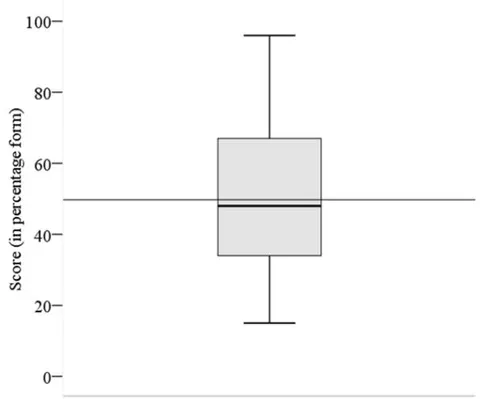
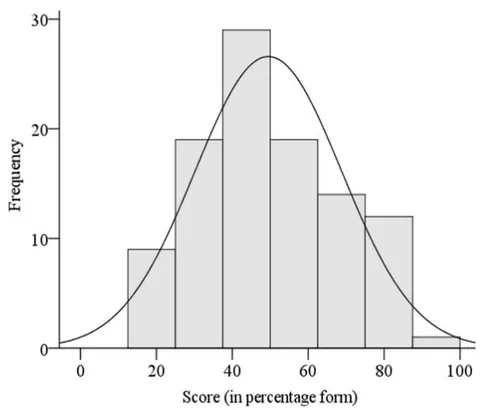
The box plot and histogram of the frequency distribution of the students' score in CCI (Figure 2) summarize the basic characteristics of the distribution, central tendency and dispersion of the scores in CCI. The fact that the mean of 49.7 (SD=18.8) is very close to the median of 48 is indicative of a normal distribution. This is corroborated by the likeness of the distribution to the normal curve and confirmed by Kolmogorov-Smirnov test (p=0.126).
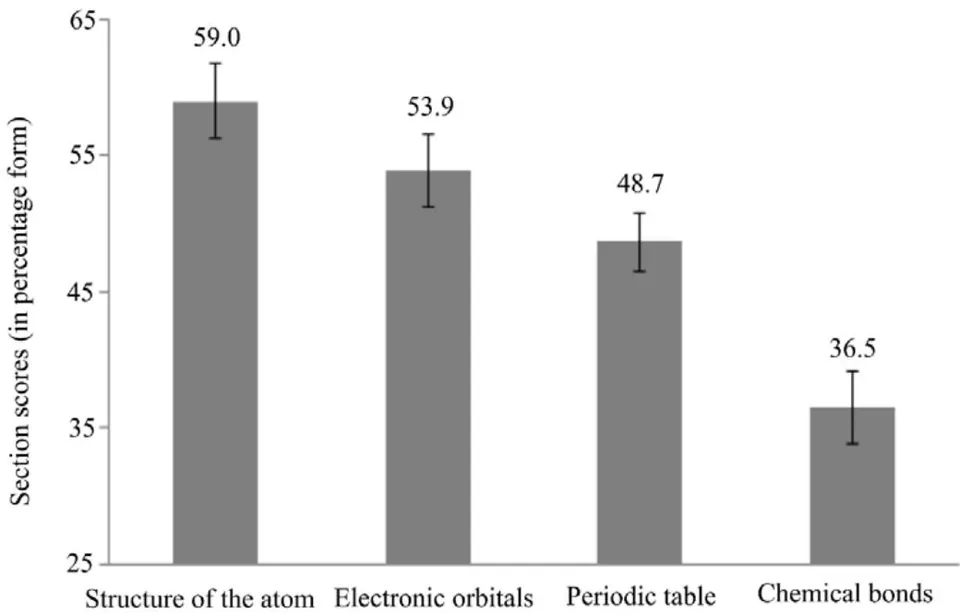
The ANOVA model proved that the CCI score is independent from gender (p=0.222), school (p=0.482) and their interaction (p=0.257). However the repeated measures ANOVA revealed that the average section scores in percentage form (Figure 3) differed significantly (F(3,306)=23,3, p<0.01). Post-hoc pairwise comparisons with Bonferroni corrections proved that the average score in the chemical bonds section was significantly lower (p<0.01) than in the three other sections. Significantly lower (p<0.01) was also the average score in the periodic table section in comparison to the structure of the atom section.
b) Semantic Differential Scale Questionnaire (SDSQ)
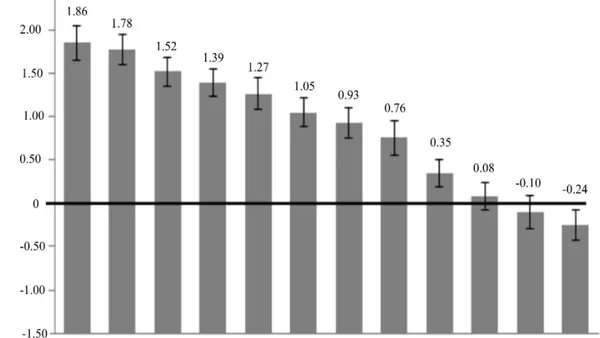
Figure 4 shows the mean values and standard errors of the scores in the twelve semantics used in the current questionnaire. Overall the students gave a positive score to the notion of the Periodic Table. For nine out of the twelve concepts the score was significantly greater than zero (p<0.05). The scores for two concepts (sweet and young) did not differ from zero, while for the concept of noisy it was significantly less than zero. Probably for this concept it is better to reverse the scores.
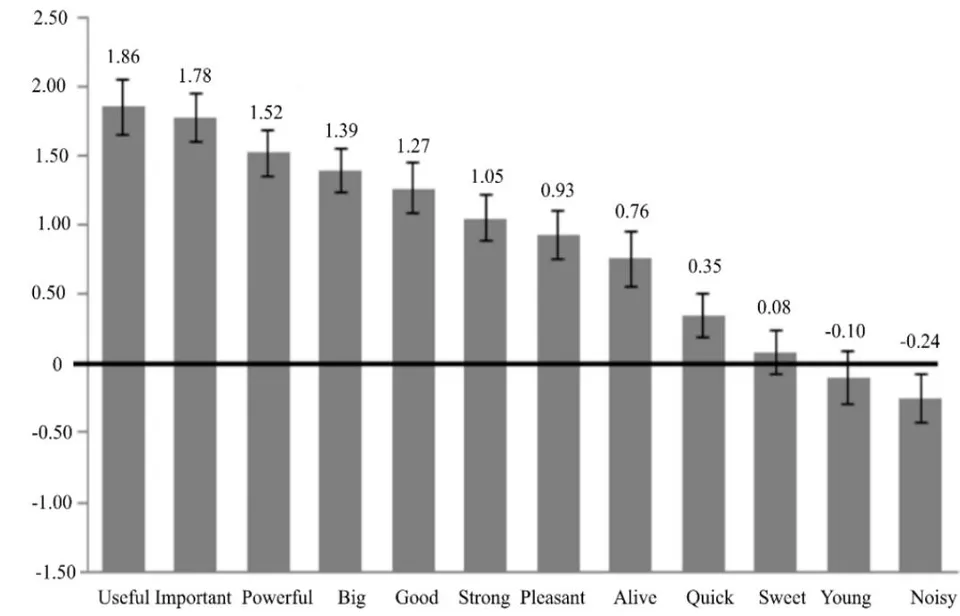
It is obvious that there were significant differences between the mean scores in the twelve concepts . As figure 3 shows, there was a group of six concepts from useful to strong, where the mean score was greater than one.
Table 2 shows the results of the application of exploratory factor analysis on the scores of the twelve concepts. There were three factors extracted with eigenvalues greater than one, explaining 65.3% of the total variability. Most interesting is the first factor with an eigenvalue of 3.7 that explains 30.6% of the total variability. The factor is composed of the six concepts that received the highest mean score, as shown above. Moreover, the loadings of the concepts follow the same patterns with their mean scores.
| Concept | Factor | ||
| 1 | 2 | 3 | |
| Useful | 0.857 | ||
| Important | 0.833 | ||
| Powerful | 0.794 | ||
| Strong | 0.681 | ||
| Big | 0.675 | ||
| Good | 0.627 | ||
| Sweet | 0.824 | ||
| Alive | 0.705 | ||
| Pleasant | 0.674 | ||
| Young | 0.570 | ||
| Noisy | 0.867 | ||
| Quick | 0.619 | ||
| Eigenvalue | 3.7 | 2.7 | 1.4 |
| % of variance | 30.6% | 22.8% | 12.0% |
Consequently, both approaches point to the same conclusion that from the total of the twelve semantic (conceptual) dipoles, six of them imprint the positive attitude of the students towards the notion of the Periodic Table. Therefore, the first factor conceptualizes the positive attitudes to the construct of the Periodic Table, while the second and third factors respectively encompass the neutral and negative attitudes.
c) Correlation between scores in Chemistry Concept Inventory and Semantic Differential Scale Questionnaire
Table 3 shows the Pearson's correlation coefficients between the twelve scores in the Semantic
Differential Scale Questionnaire and the total score and the scores in the four sections of the Chemistry Concept Inventory. The total score is significantly correlated with six out of the twelve semantic dipoles. The interesting detail is that five out of the six significant correlations are with the concepts with the highest score that are constituents of the first factor. The only differentiation is the absence of significant correlation with the semantic dipole big-small and the presence of significant correlation with the dipole sweet-sour.
| Concept | Total score | Structure of the atom | CCI scores Electronic orbitals | Periodic table | Chemical bonds |
| Important | 0.358** | 0.355** | 0.319** | 0.254* | 0.148 |
| Useful | 0.300** | 0.261** | 0.252* | 0.209* | 0.176 |
| Strong | 0.292** | 0.316** | 0.230* | 0.193 | 0.132 |
| Powerful | 0.244* | 0.279** | 0.064 | 0.217* | 0.137 |
| Good | 0.231* | 0.315** | 0.183 | 0.126 | 0.069 |
| Sweet | 0.202* | 0.251** | 0.217* | 0.172 | -0.035 |
| Young | 0.185 | 0.326** | 0.226 | 0.050 | -0.039 |
| Alive | 0.174 | 0.306** | 0.188 | 0.069 | -0.037 |
| Pleasant | 0.172 | 0.280** | 0.092 | 0.111 | 0.019 |
| Quick | 0.150 | 0.238* | 0.045 | 0.113 | 0.030 |
| Big | 0.139 | 0.150 | 0.069 | 0.075 | 0.119 |
| Noisy | 0.105 | 0.145 | 0.036 | 0.077 | 0.054 |
Moreover, as table 3 shows, semantic relevance is significantly associated with the scores in the section of the structure of the atom, where there were ten significant correlations. The number of significant correlations drops in subsequent sections concomitantly with the drop in the scores of corresponding sections. Thus there were only four significant correlations of semantic concepts with the score in the section of electronic orbitals, two with the score in the section of the periodic table and none with the score in the section of chemical bonds.
V. DISCUSSION
The current study undertakes, with the use of a Chemical Concepts Inventory, to evaluate the level of knowledge and understanding of the basic concepts built around the Periodic System of Chemical Elements attained by 15-year old Greek students who are taught the discipline for the first time. At the same time, using a Semantic Differential Scale Questionnaire, the study appraises the students' attitude toward the concept of the Periodic Table. The most notable finding hereof is that the level of understanding is concomitant with more positive attitude towards the concept.
The scores in the Chemical Concepts Inventory largely follow the same distribution, central tendency and dispersion as school tests and exams. The fact that there is a significant decrease of the students' score as the syllabus moves through the four units (structure of the atom, electronic orbitals, periodic table and chemical bonds) could be explained by two pivotal points. Firstly, the underlying concepts of the units gradually increase in complexity, requiring at the same time the basic understanding of the concepts of the previous units. Secondly, as the teacher is well aware of the above fact, he will probably try to teach the lesson without leaving any gaps, which may in the end result that the later more difficult units will be taught in a disproportionately less time than the one required. As a consequence, the student's understanding of the very important concepts of chemical bonds, as reflected by their corresponding scores in the inventory, leaves much to be desired.
The results of the semantic differential scale questionnaire showed that, overall the students had a positive attitude towards the concept of the Periodic Table. In point of fact the semantics that did not receive a significant positive score are represented by dipoles that bear practically no relevance of an attitude towards a scientific concept.
The most interesting finding is the presence of significant positive correlation between the scores in the Chemical Concepts Inventory and the scores in the Semantic Differential Scale Questionnaire. Even more fascinating is that this association is stronger with concepts that the students had higher scores, i.e. concepts that are more understandable to the students. This means that the semantic importance attributed to the concept of the Periodic System is directly related with the level of knowledge acquired by the student in chemistry. This finding is in agreement with previously published research evidencing that attitude and achievement are related.
The above conclusion can be reworded in a more generalized context: The conceptual importance attributed to a science discipline is related to the level of cognition attained in the specific discipline. In other words, "the more I understand it, the more I like it". Perhaps, even this relationship is bidirectional.
VI. LIMITATIONS
The scores of the CCI presently presented clearly reflect the knowledge level attained by the students in Greek public schools as per the syllabus taught and its time limits according to the guidelines of the Greek Ministry of Education.
VII. IMPLICATIONS
This pilot study has pointed to the potential of building and fine-tuning the teaching of the chemical discipline with critical awareness about the curriculum terminology in ways based on interactive support which draws on the principle of "guidance through interaction in context of shared experience".
Our conjectures remain tentative and our findings more promising than decisive. However, using the perspective of semantic meaning in classroom pedagogies appears to offer not only ways of understanding, but, just as importantly, to demystify the structuring of knowledge in chemical discipline in ways that may enable more students to succeed.
Furthermore, the use of semantic meaning methodology provides a tool for studying intangible knowledge regarding the learner's understanding that are often hard to discern with other methods. This approach also allows better control of intervening variables than classroom-based research.
VIII. ASSOCIATED CONTENT
a) Supporting Information
It includes the content of the two questionnaires: the Chemistry Concept Inventory (CCI) and the second is the Semantic Differential Scale Questionnaire (SDSQ).
i. The Chemistry Concepts Inventory (CCI)
a. Questions For each question circle the letter that you believe corresponds to the right answer.
Choose only one answer for each question.
Please do not leave unanswered questions.
Try to avoid guessing. Your answers should be indicative of your own personal way of thinking. Try to complete the test within 20 minutes.
Your performance in this inventory will have no consequences in your final grade in the chemistry lesson.
Thank you for your cooperation.
1. In the nucleus of an atom there are:
A. Only electrons and protons
B. Only neutrons
C. Only electrons and neutrons
D. Electrons, protons and neutrons
E. Only neutrons and protons
2. In a neutral atom always:
A. The number of electrons is equal to the number of neutrons
B. The number of electrons, protons and neutrons is equal
C. The number of electrons is equal to the number of protons
D. The number of neutrons is equal to the number of protons
E. None of the above
3. The identity of an atom is:
A. Its mass number
B. Its atomic number
C. Its number of neutrons
D. Its number of electrons and neutrons
E. None of the above
4. Isotopes are elements that have:
A. The same mass number and the same atomic number
B. The same mass number
C. Different mass numbers and the same atomic number
D. Different atomic numbers and the same mass number
E. None of the above
- In an atom of an element there are 20 neutrons and there is one neutron more than there are protons. Its mass number is:
A. 1
B. 19
C. 20
D. 21
E. 39
- When an electron of a neutral atom jumps from an inner to an outer orbital:
A. The atom converts into a cation
B. The atom converts into an anion
C. Energy is released
D. Energy is absorbed
E. The atom remains at the same energy state
7. The atom of a neutral atom loses an electron. The atom:
A. Converts into a cation
B. Converts into an anion
C. Remains as it is
D. Changes its mass number
E. Changes its atomic number
- The atom of calcium has the atomic number 20. In its fundamental state on the outer orbital the atom has:
A. No electrons
B. 1 electron
C. 2 electrons
D. 8 electrons
E. 10 electrons
- Chlorine has the electron configuration (2, 8, 7). In order to attain the structure of a noble gas it must:
A. Gain a proton
B. Lose a proton
C. Lose an electron
D. Gain an electron
E. Gain a neutron
10. Two elements have similar chemical properties. These two elements:
A. Belong to the same group of the periodic table
B. Belong to the same period of the periodic table
C. Have the same number of neutrons
D. Have the same mass number
E. Have the same atomic number
The chemical elements in a period of the periodic table have the same number of: A. Protons in the nucleus B. Electron orbitals C. Electrons in the nucleus D. Electrons in the outer orbital E. Neutrons in the nucleus
In an aqueous solution of sodium chloride there are:
Sodium chloride molecules
Sodium and chlorine atoms
Sodium cations and chlorine anions
Sodium anions and chlorine cations
Sodium cations and chlorine atoms
The bond in the oxygen molecule is: A. Ionic B. Nonpolar simple covalent C. Polar double covalent D. Nonpolar double covalent E. Nonpolar triple covalent
The chemical elements and form an ionic compound with the chemical formula: A. AB B. C. D. E.
The chemical elements , and have in the order they are given: A. Increasing atomic radius and increasing electropositivity B. Decreasing atomic radius and increasing electropositivity C. Increasing atomic radius and decreasing electropositivity D. Decreasing atomic radius and decreasing electropositivity
Across the same period the atomic radius: A. Increases B. Decreases C. remains the same D. at first increases and then decreases E. at first decreases and then increases
The oxidation number of the atom of Nin the molecule of is A.-1 B.0 C.+1 D.-3 E.+3
The oxidation number of S in is: A. -6 B. -2 C. 0 D. +2 E. +6
In which part of the periodic table are the nonmetals? A. In the middle B. In the right part Γ. In the left part Δ. In the upper part E. In the lower part
Which category comprises the majority in the periodic table? A. The metals B. The metalloids C. The nonmetals D. The noble elements E. The lanthanides
The atom of element A has two electrons at the outer orbital of element B has 7. In which groups do these elements belong? A. Alkali metals and alkaline earths B. Halogens and noble gases C. Halogens and alkali metals D. Alkaline earths and halogens E. Alkali metals and noble gases
b. Correct
| Question | 1 | 2 | 3 | 4 | 5 | 6 | 7 | 8 | 9 | 10 | 11 |
| Answer | E | C | B | C | E | D | A | C | D | A | B |
| Question | 12 | 13 | 14 | 15 | 16 | 17 | 18 | 19 | 20 | 21 | |
| Answer | C | D | E | A | B | B | E | B | A | D |
c. Sections
| Structure of the atom (5) | 1, 2, 3, 4, 5 |
| Electronic orbitals (4) | 6, 7, 8, 9 |
| Periodic table (7) | 10, 11, 15, 16, 19, 20, 21 |
| Chemical bonds (5) | 12, 13, 14, 17, 18 |
i. Semantic Differential Questionnaire
The perception of the significance of a concept is accompanied by its agreement or disagreement (relative or absolute) with other concepts. In this context we would like you to try to imprint the degree of your agreement (or disagreement) in reference to the importance of the concept of the PERIODIC SYSTEM of elements in Chemistry in relation to the semantic dipoles that follow.
For each dipole circle the number that best suits your attitude. If you are not certain give the most probable answer.
The present grading refers to the relation that you a scribe, of the importance of the concept of the PERIODIC SYSTEM with the semantic dipoles that follow, at present after the completion of the educational program.
| Pleasant | 3 | 2 | 1 | 0 | 1 | 2 | 3 | Unpleasant |
| Big | 3 | 2 | 1 | 0 | 1 | 2 | 3 | Small |
| Fast | 3 | 2 | 1 | 0 | 1 | 2 | 3 | Slow |
| Good | 3 | 2 | 1 | 0 | 1 | 2 | 3 | Bad |
| Strong | 3 | 2 | 1 | 0 | 1 | 2 | 3 | Weak |
| Alive | 3 | 2 | 1 | 0 | 1 | 2 | 3 | Dead |
| Sweet | 3 | 2 | 1 | 0 | 1 | 2 | 3 | Sour |
| Powerful | 3 | 2 | 1 | 0 | 1 | 2 | 3 | Powerless |
| Noisy | 3 | 2 | 1 | 0 | 1 | 2 | 3 | Calm |
| Useful | 3 | 2 | 1 | 0 | 1 | 2 | 3 | Useless |
| Important | 3 | 2 | 1 | 0 | 1 | 2 | 3 | Trivial |
| Young | 3 | 2 | 1 | 0 | 1 | 2 | 3 | Old |