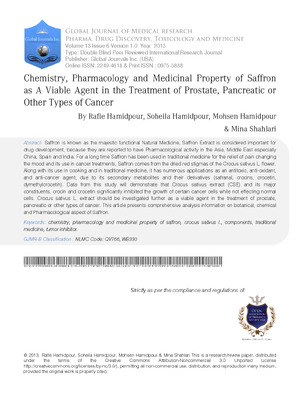
Chemistry, Pharmacology and Medicinal Property of Sage as a Viable Agent in the Treatment of Prostate, Pancreatic or other Types of Cancer

§ University of Central Missouri

Send Message

To: Author

Chemistry, Pharmacology and Medicinal Property of Sage as a Viable Agent in the Treatment of Prostate, Pancreatic or other Types of Cancer

Article Fingerprint

ReserarchID

MRR5J8P

Chemistry, Pharmacology and Medicinal Property of Sage as a Viable Agent in the Treatment of Prostate, Pancreatic or other Types of Cancer Banner

AI TAKEAWAY

Connecting with the Eternal Ground
  • English
  • Afrikaans
  • Albanian
  • Amharic
  • Arabic
  • Armenian
  • Azerbaijani
  • Basque
  • Belarusian
  • Bengali
  • Bosnian
  • Bulgarian
  • Catalan
  • Cebuano
  • Chichewa
  • Chinese (Simplified)
  • Chinese (Traditional)
  • Corsican
  • Croatian
  • Czech
  • Danish
  • Dutch
  • Esperanto
  • Estonian
  • Filipino
  • Finnish
  • French
  • Frisian
  • Galician
  • Georgian
  • German
  • Greek
  • Gujarati
  • Haitian Creole
  • Hausa
  • Hawaiian
  • Hebrew
  • Hindi
  • Hmong
  • Hungarian
  • Icelandic
  • Igbo
  • Indonesian
  • Irish
  • Italian
  • Japanese
  • Javanese
  • Kannada
  • Kazakh
  • Khmer
  • Korean
  • Kurdish (Kurmanji)
  • Kyrgyz
  • Lao
  • Latin
  • Latvian
  • Lithuanian
  • Luxembourgish
  • Macedonian
  • Malagasy
  • Malay
  • Malayalam
  • Maltese
  • Maori
  • Marathi
  • Mongolian
  • Myanmar (Burmese)
  • Nepali
  • Norwegian
  • Pashto
  • Persian
  • Polish
  • Portuguese
  • Punjabi
  • Romanian
  • Russian
  • Samoan
  • Scots Gaelic
  • Serbian
  • Sesotho
  • Shona
  • Sindhi
  • Sinhala
  • Slovak
  • Slovenian
  • Somali
  • Spanish
  • Sundanese
  • Swahili
  • Swedish
  • Tajik
  • Tamil
  • Telugu
  • Thai
  • Turkish
  • Ukrainian
  • Urdu
  • Uzbek
  • Vietnamese
  • Welsh
  • Xhosa
  • Yiddish
  • Yoruba
  • Zulu
Font Type
Font Size
Font Size
Bedground

Abstract

Saffron is known as the majestic functional Natural Medicine, Saffron Extract is considered important for drug development, because they are reported to have Pharmacological activity in the Asia, Middle East especially China, Spain and India. For a long time Saffron has been used in traditional medicine for the relief of pain changing the mood and its use in cancer treatments, Saffron comes from the dried red stigmas of the Crocus sativus L. flower. Along with its use in cooking and in traditional medicine, it has numerous applications as an antitoxic, anti-oxidant, and anti-cancer agent, due to its secondary metabolites and their derivatives (safranal, crocins, crocetin, dymethylcrocetin). Data from this study will demonstrate that Crocus sativus extract (CSE) and its major constituents, crocin and crocetin significantly inhibited the growth of certain cancer cells while not effecting normal cells. Crocus sativus L. extract should be investigated further as a viable agent in the treatment of prostate, pancreatic or other types of cancer. This article presents comprehensive analysis information on botanical, chemical and Pharmacological aspect of Saffron.

References

25 Cites in Article
  1. M Afshari,S Bathaie,M Taghikhani,A Moosavi-Movahedi,F Abdullaev (2002). Cancer Chemopreventive and Tumoricidal Properties of Saffron (Crocus sativus L.).
  2. F Abdullaev,J Espinosa-Aguirre (2004). Biomedical Properties of Saffron and its Potential Use in Cancer Therapy and Chemoprevention Trials.
  3. Fikrat Abdullaev,Christina Macvicar,Gerald Frenkel (1992). Inhibition by selenium of DNA and RNA synthesis in normal and malignant human cells in vitro.
  4. A Assimopoulou,Z Sinakos,V Papageorgiou (2005). Radical scavenging activity ofCrocus sativus L. extract and its bioactive constituents.
  5. H Aung,C Wang,M Ni,A Fishbein,S Mehendale,J Xie (2007). Crocin from Crocus sativus Processes Significant Antiproliferation Effects on Human Colorectal Cancer Cells.
  6. Heriberto Caballero-Ortega,Rogelio Pereda-Miranda,Fikrat Abdullaev (2007). HPLC quantification of major active components from 11 different saffron (Crocus sativus L.) sources.
  7. D Chryssanthi,F Lamari,G Iatrou,A Pylara,N Karamanos (2007). Cordopatis P. Inhibition of Breast Cancer Cell Proliferation by Style Constituents of Different Crocus Species.
  8. Julio Escribano,Gonzalo-Luis Alonso,Miguel Coca-Prados,José-Antonio Fernández (1996). Crocin, safranal and picrocrocin from saffron (Crocus sativus L.) inhibit the growth of human cancer cells in vitro.
  9. J Gainer,D Wallis,J Jones (1976). The Effect of Crocetin on Skin Papillomas and Rous Sarcoma.
  10. H Hosseinzadeh,H Sadeghnia (2007). Effect of Safranal, A Constituent of Crocus sativus (Saffron), on Methyl Methanesulfonate (MMS)-Induced DNA Damage in Mouse Organs: An Alkaline Single-Cell Gel Electrophoresis (Comet) Assay.
  11. F Jafarova,H Caballero-Ortega,L Riveron-Negrete,R Pereda-Miranda,R Rivera-Luna,J Hernandez (2002). Evaluation In Vitro of Chemopreventive Potential of Saffron.
  12. Charalabos Kanakis,Petros Tarantilis,Heidar-Ali Tajmir-Riahi,Moschos Polissiou (2007). DNA Interaction with Saffron's Secondary Metabolites Safranal, Crocetin, and Dimethylcrocetin.
  13. Charalabos Kanakis,Petros Tarantilis,Heidar-Ali Tajmir-Riahi,Moschos Polissiou (2007). Interaction of tRNA with Safranal, Crocetin, and Dimethylcrocetin.
  14. T Konoshima,M Takasaki,H Tokuda,S Morimoto,H Tanaka,E Kawata,L Xuan,H Saito,M Sugiura,J Molnar,Y Shoyama (1998). Crocin and crocetin derivatives inhibit skin tumour promotion in mice.
  15. Na Li,Ge Lin,Yiu-Wa Kwan,Zhi-Da Min (1999). Simultaneous quantification of five major biologically active ingredients of saffron by high-performance liquid chromatography.
  16. Venkatraman Magesh,Jayapal Singh,Karupaya Selvendiran,Ganapathy Ekambaram,Dhanapal Sakthisekaran (2006). Antitumour activity of crocetin in accordance to tumor incidence, antioxidant status, drug metabolizing enzymes and histopathological studies.
  17. S Nair,B Pannikar,K Panikkar (1991). Antitumour activity of saffron (Crocus sativus).
  18. K Peter (2000). Saffron. Handbook of Herbs and Spices.
  19. K Premkumar,C Thirunavukkarasu,S Abraham,S Santhiya,A Ramesh (2006). Protective Effect of Saffron (Crocus sativus L.) Aqueous Extract against Genetic Damage Induced by Anti-tumor Agents in Mice.
  20. M Salomi,S Nair,K Panikkar (1991). Inhibitory Effects of Nigella sativa and Saffron (Crocus sativus) on Chemical Carcinogenesis in Mice.
  21. Ana Sánchez,Manuel Carmona,Amaya Zalacain,José Carot,José Jabaloyes,Gonzalo Alonso (2008). Rapid Determination of Crocetin Esters and Picrocrocin from Saffron Spice (Crocus sativus L.) Using UV–Visible Spectrophotometry for Quality Control.
  22. M Schmidt,G Betti,A Hensel (2007). Saffron in Phytotherapy: Pharmacology and Clinical Uses.
  23. Y Surh,H Na,H Lee (2005). Chemopreventive Effects of Selected Spice Ingredients.
  24. Petros Tarantilis,Moschos Polissiou,Michel Manfait (1994). Separation of picrocrocin, cis-trans-crocins and safranal of saffron using high-performance liquid chromatography with photodiode-array detection.
  25. S Verma,A Bordia (1998). Antioxidant Property of Saffron in Man.

Funding

No external funding was declared for this work.

Conflict of Interest

The authors declare no conflict of interest.

Ethical Approval

No ethics committee approval was required for this article type.

Data Availability

Not applicable for this article.

How to Cite This Article

Rafie Hamidpour, Soheila Hamidpour, Mohsen Hamidpour. 2014. "Chemistry, Pharmacology and Medicinal Property of Sage as a Viable Agent in the Treatment of Prostate, Pancreatic or other Types of Cancer". Global Journal of Medical Research, Global Journal of Medical Research - B: Pharma, Drug Discovery, Toxicology & Medicine GJMR-B Volume 13 (GJMR Volume 13 Issue B6).
Download Citation

Journal Specifications

Crossref Journal DOI 10.17406/gjmr

Print ISSN 0975-5888

e-ISSN 2249-4618

Keywords
Classification
GJMR-B Classification NLMC Code: QV766
WB330
Version of record

v1.2

Issue date
January 3, 2014

Language
German
Experiance in AR

Explore published articles in an immersive Augmented Reality environment. Our platform converts research papers into interactive 3D books, allowing readers to view and interact with content using AR and VR compatible devices.

Read in 3D

Your published article is automatically converted into a realistic 3D book. Flip through pages and read research papers in a more engaging and interactive format.

Article Matrices
Total Views: 1.4K
Total Downloads: 132
All Trends

Request Access

Please fill out the form below to request access to this research paper. Your request will be reviewed by the editorial or author team.
X

This is the heading

Lorem ipsum dolor sit amet, consectetur adipiscing elit. Ut elit tellus, luctus nec ullamcorper mattis, pulvinar dapibus leo.


High-quality academic research articles on global topics and journals.

Chemistry, Pharmacology and Medicinal Property of Sage as a Viable Agent in the Treatment of Prostate, Pancreatic or other Types of Cancer

Rafie Hamidpour
Rafie Hamidpour <p>University of Central Missouri</p>
Soheila Hamidpour
Soheila Hamidpour
Mohsen Hamidpour
Mohsen Hamidpour