


1. Introduction
Violence against children and adolescents is defined as any form of emotional and/or physical mistreatment, sexual abuse, neglect, commercial exploitation, or other forms of exploitation that may cause actual or potential harm to their health, survival, development, or dignity [1]. Child abuse can occur both in their home environment and in institutions, schools, or communities with which they have contact [2].
In this article, child abuse is defined according to the World Health Organization [3] as interpersonal acts of violence against individuals under 18 years of age, including any form of maltreatment inflicted by a parent or caregiver at home (whether physical, emotional, or sexual abuse, neglect, or exposure to domestic violence), intimate partner (or dating) violence during childhood and adolescence, as well as community violence occurring between individuals who are not connected as family members, such as peers, acquaintances, or strangers [3, 4].
Child abuse represents a significant public health challenge with severe impacts. Despite advances in scientific production and awareness-raising in society over the past ten years, infant mortality rates associated with reported cases of abuse have increased [5]. The study by Hillis et al. [6] points out that, in just one year, more than 1 billion children aged 2 to 17 experienced some form of violence.
In Brazil, the fight against child abuse began in the 1980s, with a focus on preventing risk factors and providing specialized treatment [7]. However, a report published by the United Nations Children’s Fund (Unicef) identified 34,918 intentional violent deaths of children and adolescents in the country between 2016 and 2020, an average of 6,970 deaths per year. Among the victims, at least 1,070 were children up to 9 years of age [8].
Cases of child abuse reported in Brazil revealed higher prevalence in children aged 0-4 years (63.5%) compared to those aged 5-9 years (36.5%). Reporting rates for different forms of violence, such as physical, psychological, neglect, and sexual, varied between boys and girls in different age groups [9]. The largest number of notifications occurs among girls, most of whom are black or brown, and in most cases the abuser is identified among friends, acquaintances or family members [10].
Under current health policies, primary health care teams play a crucial role in identifying and responding to violence against children and adolescents. As they are close to families and involved in individual and collective health actions, they are more likely to detect cases of violence and offer support, diagnosis, treatment, care and reporting, referring cases to the social protection network.
In addition, collaboration among professionals, services, and sectors is essential to ensure the comprehensive protection of children and adolescents, with health services playing a crucial role in this practice and participation in protection networks [11].
Despite their strategic position, many professionals working in the Family Health Strategy (FHS) have not received adequate training to identify and support victims of domestic violence. The predominance of practices based on the biomedical model tends to hinder the appropriate management of cases involving children and adolescents who have experienced violence. International studies emphasize the importance of investing in training programs that develop the pedagogical competencies needed to address domestic violence. These studies highlight collective reflection, team communication, and the sharing of beliefs and experiences as essential components of group learning [12].
Furthermore, in cases of intrafamilial violence against children, it is necessary to consider the dynamic relationship of power and affection, in which subordination and domination are present. In these relationships, parents and children, across different generations, occupy opposite and asymmetrical positions. In this context, violence represents an abuse of power that objectifies children and adolescents and violates their fundamental rights [13].
However, challenges in addressing violence remain rooted in cultural beliefs and practices that hinder changes in the way child maltreatment is perceived and addressed, for example, by accepting corporal punishment as a legitimate form of education and discipline [14].
Therefore, this study aimed to investigate the knowledge, attitudes, and practices of physicians and nurses working in primary health care in Campina Grande, Paraíba, Brazil, regarding suspected cases of child physical abuse and maltreatment.
2. Material and methods
2.1. Study Characterization and Setting
This was a cross-sectional, quantitative, analytical study of knowledge, attitudes, and practices (KAP). KAP studies assess a specific population’s knowledge, beliefs, and behaviors regarding a particular topic, thereby identifying potential gaps, cultural influences, and behavioral patterns that may affect how the topic is understood and addressed [15].
The study was conducted in Campina Grande, Paraíba, Brazil, the state’s second-largest city in terms of population. The Human Development Index (HDI) of Campina Grande is among the highest in Paraíba, with education being the dimension that evolved the most from 2000 to 2010, followed by longevity and income. Furthermore, the state of Paraíba has the tenth largest economy in Brazil, with Campina Grande being one of the municipalities that stands out in this topic based on livestock, tourism, agriculture, among others [16].
According to the Human Development Atlas of Brazil [17], social inequality in Campina Grande changed over the period, with the Gini index increasing from 0.61 in 1991 to 0.62 in 2000 before decreasing to 0.58 in 2010.
2.2. Study population and Sampling
The study included physicians and nurses working in primary health care (PHC) services within the Family Health Strategy in Campina Grande, Paraíba, Brazil. According to information from the Municipal Health Department, the municipality currently has 204 family health teams, which accounts for a total of 408 physicians and nurses. In addition, nurses working in Basic Health Units enrolled in multidisciplinary residency (five) were included, totaling a population of 413 individuals [18].
The sample size was calculated using Epi Info for Windows, considering a 95% confidence level and a 5% margin of error. The resulting sample consisted of 155 professionals. The sample was divided into two groups, comprising 78 physicians and 77 nurses.
2.3. Eligibility criteria
All physicians and nurses working in the Primary Health Care (PHC) within the scope of the family health strategy during the research period were included.
Professionals who refused to sign the Free and Informed Consent Form (FICF) or were absent from work due to leave or medical reasons during data collection were excluded. Those who could not be reached after three attempts on different days and at different times were considered losses.
2.4. Questionnaire and data Collection
The data collection instrument was based on a questionnaire previously developed and tested by Silva-Oliveira et al. [19]. The questionnaire underwent cross-cultural adaptation into Brazilian Portuguese and demonstrated excellent reproducibility. Response stability was assessed using simple and weighted kappa coefficients, which were predominantly above 0.80, indicating excellent test–retest agreement. The authors concluded that the Brazilian version of the instrument is a reliable tool for assessing the knowledge and attitudes of primary healthcare professionals regarding child physical abuse [19].
The seven health districts were divided between two researchers, who visited the Basic Health Units on different days and at different times to locate the professionals. To avoid potential embarrassment while completing the self-administered questionnaire, printed copies were distributed to the participants and collected at a later date. The health units to be visited in search of the professionals were chosen for the researchers’ convenience, with no randomness in the selection process.
Collection was carried out between September and December 2024.
2.5. Data analysis
Two researchers independently entered the data into the database, and the entries were checked for inconsistencies. Statistical analyses were performed using IBM SPSS Statistics for Windows, version 21.0. First, descriptive analysis was performed, followed by Pearson’s chi-square test to verify associations between dependent and independent variables. Finally, the influence of independent variables on the dependent variable “number of reported cases” was investigated using a decision tree.
2.6. Ethical Clearance
The study followed the guidelines established in National Health Council Resolution No. 466/2012 for research involving human participants. The study was submitted for ethical review through Plataforma Brasil and approved by the Research Ethics Committee of HUAC/UFCG (approval number 7.110.427).
Participants were invited to sign the Free and Informed Consent Form (FICF), which explained that their participation was voluntary. In addition, institutional approval was obtained to conduct the research.
3. Outcomes
Most participants were physicians (50.3%) and female (77.4%). The mean age was 35.65 years, ranging from 24 to 68 years. Most participants had 1–10 years since graduation (62.6%), 1–10 years of professional experience (57.4%), 1–10 years of experience in PHC (47.7%), and 1–10 years of experience in their current unit (45.2%). The majority had graduate degrees (58.1%), in the area of collective/public health or family health (38.7%).
Table 1 presents issues on the recognition and reporting of suspected cases of child abuse in professional life. Most participants reported that they had never encountered suspected cases of physical abuse among their pediatric patients during their professional experience (59.4%). However, 20.6% had identified suspected cases in the previous year, whereas only 7.1% had reported suspected or confirmed cases to the authorities during that period.
Most participants considered themselves capable of recognizing signs and symptoms of child physical abuse and of making an appropriate diagnosis. When asked where suspected cases should be reported, 71.0% identified the Child Protection Council. However, when asked if they had the telephone number for the reporting department, the majority responded that they did not (55.5%) (Table 1).
| Variable | N | % |
|---|---|---|
| In your professional experience, have you ever encountered a suspected case of physical abuse among your pediatric patients? | ||
| No | 92 | 59,4 |
| Yes | 63 | 40,6 |
| If yes, please indicate the number of cases. If you are not sure, provide an approximate number | ||
| Up to 5 cases | 59 | 38,1 |
| Between 6 and 10 cases | 3 | 1,9 |
| From 11 to 20 cases | 1 | 0,6 |
| Not applicable | 92 | 59,4 |
| Have you ever reported a suspected case of physical abuse in a child among your patients? | ||
| No | 127 | 81,9 |
| Yes | 28 | 18,1 |
| If yes, please indicate the number of reported cases | ||
| Up to 5 cases | 26 | 16,8 |
| Between 6 and 10 cases | 1 | 0,6 |
| From 11 to 20 cases | 1 | 0,6 |
| Not applicable | 127 | 81,9 |
| Have you seen any case of pediatric orofacial trauma related to physical abuse in the past year? | ||
| No | 153 | 98,7 |
| Yes | 2 | 1,3 |
| If yes, please indicate the number of trauma cases | ||
| Up to 5 cases | 2 | 1,3 |
| Not applicable | 153 | 98,7 |
| Have you seen any suspected cases of physical abuse in a child in the past year? | ||
| No | 123 | 79,4 |
| Yes | 32 | 20,6 |
| If yes, please indicate the number of cases seen | ||
| Up to 5 cases | 30 | 19,4 |
| Between 6 and 10 cases | 2 | 1,3 |
| Not applicable | 123 | 79,4 |
| Have you seen any confirmed cases of physical abuse in a child in the past year? | ||
| No | 146 | 94,2 |
| Yes | 9 | 5,8 |
| If yes, please indicate the number of cases seen | ||
| Up to 5 cases | 8 | 5,2 |
| Between 6 and 10 cases | 1 | 0,6 |
| Not applicable | 146 | 94,2 |
| Have you reported any suspected or confirmed cases of physical abuse in a child to the authorities in the past year? | ||
| No | 144 | 92,9 |
| Yes | 11 | 7,1 |
| If yes, please indicate the number of cases reported | ||
| Up to 5 cases | 11 | 7,1 |
| Not applicable | 144 | 92,9 |
| Using a scale from zero to ten, how capable are you of recognizing signs and symptoms of physical abuse in a child? | ||
| 1 to 5 - Not very capable | 21 | 13,5 |
| 6 to 10 - Very capable | 134 | 86,5 |
| Using a scale from zero to ten, how capable are you of effectively diagnosing physical abuse in a child? | ||
| 1 to 5 - Not very capable | 35 | 22,6 |
| 6 to 10 - Very capable | 120 | 77,4 |
| Do you know who to contact to report a suspected or confirmed case of physical abuse in a child? | ||
| No | 18 | 11,6 |
| Yes | 137 | 88,4 |
| If yes, please specify the agency, institution, or professional you would contact | ||
| Guardianship Council | 110 | 71,0 |
| Civil Police | 4 | 2,6 |
| Social Worker / Social Service | 10 | 6,5 |
| CPAI (Child Protection and Assistance Center) | 5 | 3,2 |
| Health Department | 4 | 2,6 |
| Children’s Hospital | 1 | 0,6 |
| Public Prosecutor’s Office | 1 | 0,6 |
| SINAN (National System for Notifiable Diseases) | 1 | 0,6 |
| Community Health Worker (CHW) | 1 | 0,6 |
| Not applicable | 18 | 11,6 |
| Do you have any phone number or contact address for the agency, institution, or professional responsible for receiving reports of physical abuse in children? | ||
| No | 86 | 55,5 |
| Yes | 69 | 44,5 |
| Total | 155 | 100 |
Source: Research author, 2025
Most participants identified confidentiality (72.3%), safety (70.3%), and training (72.3%) as factors that could facilitate or encourage the reporting of suspected cases. When asked about the main barriers to reporting, the main responses were fear (82.6%), insufficient knowledge (81.3%) and lack of confidentiality (60.0%) (Table 2).
| Variable | N | % | |
|---|---|---|---|
| In your opinion, why are some cases of physical abuse in children not reported? | |||
| Fear | No | 79 | 51,0 |
| Yes | 76 | 49,0 | |
| Insufficient knowledge | No | 89 | 57,4 |
| Yes | 66 | 42,6 | |
| Negligence | No | 133 | 85,8 |
| Yes | 22 | 14,2 | |
| Mark three factors that you believe may facilitate or encourage healthcare professionals to report suspected cases of physical abuse in children | |||
| Confidentiality | No | 43 | 27,7 |
| Yes | 112 | 72,3 | |
| Safety | No | 46 | 29,7 |
| Yes | 109 | 70,3 | |
| Training | No | 43 | 27,7 |
| Yes | 112 | 72,3 | |
| Simplifying the reporting process | No | 78 | 50,3 |
| Yes | 77 | 49,7 | |
| Interdisciplinarity and intersectorality | No | 108 | 69,7 |
| Yes | 47 | 30,3 | |
| In your opinion, what are the three main barriers preventing healthcare professionals from reporting physical abuse in children? | |||
| Fear | No | 27 | 17,4 |
| Yes | 128 | 82,6 | |
| Insufficient knowledge | No | 29 | 18,7 |
| Yes | 126 | 81,3 | |
| Lack of confidentiality | No | 62 | 40,0 |
| Yes | 93 | 60,0 | |
| Negligence | No | 105 | 67,7 |
| Yes | 50 | 32,3 | |
| Excessive workload | No | 112 | 72,3 |
| Yes | 43 | 27,7 | |
Source: Research author, 2025
Most participants expressed interest in receiving training on identifying suspected cases of child abuse (97.4%). In addition, 89.7% reported being willing to become involved in detecting physical abuse against children. Regarding the knowledge acquired during their undergraduate studies on the subject, the majority considered it sufficient (50.3%) and finally, when asked about their interest and preparation for child care, the majority responded that they were interested (93.5%) and claimed to be sufficiently prepared (90.3%) (Table 3).
| Variable | N | % |
|---|---|---|
| Would you like to receive training on how to identify and the reporting mechanisms for suspected cases of physical abuse in children? (e.g., courses, workshops) | ||
| No | 4 | 2,6 |
| Yes | 151 | 97,4 |
| Do you think that the mechanisms for identifying and reporting possible cases of physical abuse in children should be part of professional training courses? | ||
| Yes | 155 | 100 |
| Using a scale from zero to ten, how willing do you feel to get involved in detecting physical abuse against children? | ||
| 0 - Not willing at all | 1 | 0,6 |
| 1 to 5 - Slightly willing | 15 | 9,7 |
| 6 to 10 - Very willing | 139 | 89,7 |
| Using a scale from zero to ten, how sufficient do you think your undergraduate education was in preparing you to care for children? | ||
| 0 – Insufficient | 1 | 0,6 |
| 1 to 5 - Slightly sufficient | 76 | 49,0 |
| 6 to 10 – Sufficient | 78 | 50,3 |
| Using a scale from zero to ten, how interested do you feel in caring for children? | ||
| 1 to 5 - Slightly interested | 10 | 6,5 |
| 6 to 10 - Very interested | 145 | 93,5 |
| On a scale from zero to ten, how prepared do you feel to care for children? | ||
| 1 to 5 - Slightly prepared | 15 | 9,7 |
| 6 to 10 - Very prepared | 140 | 90,3 |
| On a scale from zero to ten, how interested are you in continuing education courses and training to improve care for children? | ||
| 1 to 5 - Slightly interested | 4 | 2,6 |
| 6 to 10 - Very interested | 151 | 97,4 |
Source: Research author, 2025
Table 4 presents the bivariate analysis of the dependent and independent variables. Sex was associated with identifying fear as a barrier to reporting suspected cases and with participants’ perceived preparedness to report such cases. In addition, it can be observed that age group, time since graduation, time working in PHC, time working in the unit, type of professional and graduate area influenced the number of cases observed (suspected and confirmed) by the professionals participating in the research.
| Independent variable | Dependent variable | p* |
|---|---|---|
| Sex | In your opinion, what are the three main barriers preventing healthcare professionals from reporting physical abuse in children? – Fear | 0,048 |
| Using a scale from zero to ten, how willing do you feel to get involved in detecting physical abuse against children? | 0,039 | |
| Using a scale from zero to ten, how interested are you in providing care for children? | 0,003 | |
| Age group | Number of suspected or confirmed cases (seen) during professional experience | 0,039 |
| Number of reported cases during professional experience | 0,003 | |
| Time since graduation | Number of suspected or confirmed cases (observed) during professional experience | 0,044 |
| Number of reported cases during professional experience | 0,004 | |
| Work experience | Number of suspected or confirmed cases (observed) during professional experience | 0,013 |
| Mark three factors that you believe may facilitate or encourage healthcare professionals to report suspected cases of physical abuse in children - Interdisciplinarity and intersectorality | 0,029 | |
| Time working in PHC | Number of suspected or confirmed cases (observed) during professional experience | 0,047 |
| Time working in the current unit | Do you have any phone number or contact address for the agency, institution, or professional responsible for receiving reports of physical abuse in children? | 0,016 |
| In your opinion, why are some cases of physical abuse in children not reported? - Insufficient knowledge | 0,046 | |
| Type of professional | In your professional experience, have you seen any suspected cases of physical abuse among your pediatric patients? | 0,007 |
| Number of suspected or confirmed cases (observed) during professional experience | 0,048 | |
| Have you reported any suspected cases of physical abuse in a child among your patients? | 0,014 | |
| Number of suspected cases in the past year | 0,024 | |
| Do you have any phone number or contact address for the agency, institution, or professional responsible for receiving reports of physical abuse in children? | 0,001 | |
| Mark three factors that you believe may facilitate or encourage healthcare professionals to report suspected cases of physical abuse in children – Confidentiality | 0,022 | |
| In your opinion, what are the three main barriers preventing healthcare professionals from reporting physical abuse in children? – Excessive workload | 0,022 | |
| Postgraduate degree | Number of suspected cases in the past year | 0,025 |
| In your opinion, what are the three main barriers preventing healthcare professionals from reporting physical abuse in children? – Negligence | 0,036 | |
| Field of postgraduate degree | Number of suspected or confirmed cases (observed) during professional experience | 0,001 |
| Have you reported any suspected cases of physical abuse in a child among your patients? | 0,022 | |
| Number of reported cases during professional experience | 0,001 | |
| Using a scale from zero to ten, how capable do you consider yourself in recognizing signs and symptoms of physical abuse in children? | 0,026 |
*Pearson’s chi-square test (p<0.05). Source: Research author, 2025.
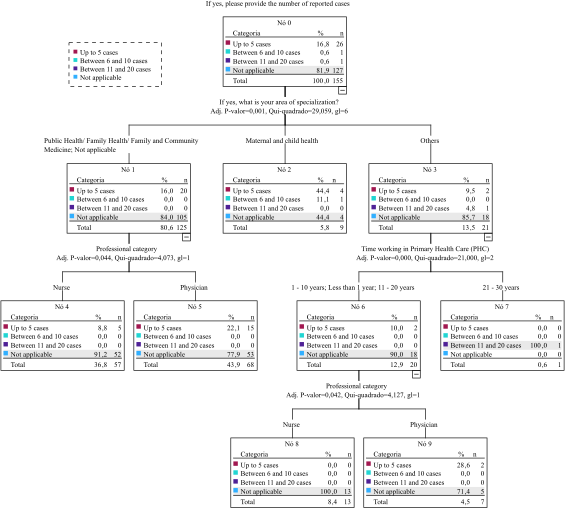
Figure 1 presents the decision tree illustrating the association between the number of reported child abuse cases and the study variables. The variables most strongly associated with reporting were specialization in maternal and child health (p<0.001), being a physician (p = 0.044), and having 21–30 years of experience in primary health care (p<0.001).
4. Dialogue
Articles 13 and 245 of the Statute of Children and Adolescents (ECA) [20], together with Ministry of Health Ordinances No. 1968/2001 [21] and No. 104/2001 [22], established the requirement for professionals to report violence against children, which constitutes an action of utmost importance for measuring the epidemiological dimension of these injuries and the formulation of policies aimed at their prevention [19].
The Notifiable Diseases Information System (SINAN) is responsible for consolidating reports of violence cases submitted by health units. It should be noted that the Ministry of Health provides training that covers everything from the proper completion of forms, data processing, and analysis, to the dissemination of information. However, it is observed that many municipalities and states still do not properly maintain the system [23].
The identification and documentation of child abuse remain major challenges in pediatric practice, resulting in cases that go unnoticed and are not formally reported [24]. The acceptance of physical punishment as a culturally accepted form of discipline hinders the identification and prevention of cases of violence [14]. Furthermore, the lack of sufficient knowledge and sensitization among professionals, whose practices are still guided by the biomedical model, compromises the proper management of children who have experienced violence and the measures to address it [12].
The results showed that physicians, particularly those with training in maternal and child health and longer professional experience, reported more cases of child abuse. This finding corroborates the study by Martins-Júnior et al. [25], who demonstrated that, among physicians, nurses and dentists, physicians make the most reports.
In addition, Silva-Oliveira et al. [19] stated that older professionals with longer time in the public service are those who are most likely to notice and report cases of child abuse. A recent study conducted by Mandadi et al. [5] identified that physicians trained in pediatric emergency medicine have high confidence and knowledge about the treatment of child abuse.
A concerning finding was that not all professionals who had encountered suspected cases in the previous year reported them. Most respondents identified the Child Protection Council as the preferred reporting destination, corroborating the results found by Silva-Oliveira [19].
Limited knowledge and uncertainty about recognizing signs and symptoms of child abuse are among the main barriers to reporting suspected maltreatment [24]. Other barriers include insufficient knowledge of reporting procedures [26], previous negative experiences after reporting [27], and the absence of strong legal consequences for failure to report [28].
According to Lima [26], even when training is provided, health systems continue to face challenges in ensuring that violence remains a sustained priority on the public health policy agenda. The decrease in reporting rates since 2020 may be related to pandemic-related restrictions and concerns about COVID-19 transmission, which may have led to underreporting [29].
One of the initiatives that can assist in the identification of signs and factors associated with child abuse is the dissemination of screening, identification, and assessment tools for the different forms of violence experienced in childhood and adolescence. A study by Oliveira (2016) identified eight instruments with this purpose, five of which are intended for identifying violence in domestic settings. The author believes that the proper use of these tools can contribute to the accurate identification and reporting of cases.
Nevertheless, it is necessary to analyze whether it is prudent or fair to require reporting of cases in a scenario where, often, there is no policy to support, protect and assist these professionals responsible for reporting violence against children [30].
The convenience-based selection of health units constitutes a limitation of this study, as it may introduce selection bias and restrict the generalizability of the findings to all Family Health Strategy teams in the municipality. Although the participating units encompassed different healthcare contexts, a systematic comparison of their demographic and geographic characteristics with those of non-selected units was not performed. Therefore, the findings should be interpreted in light of the specific context of the participating units. Furthermore, the presence of small terminal subgroups in the CHAID decision tree may introduce instability in lower-level splits; therefore, these results should be interpreted with caution.
5. Conclusion
Reporting suspected cases of child abuse is a complex challenge involving not only health professionals’ technical knowledge but also personal, institutional, and ethical factors.
Physicians with longer professional experience and training in maternal and child health were more likely to report suspected cases. However, reporting decisions were also associated with multiple barriers, including fear, uncertainty about confidentiality and lack of information about the reporting process.
These findings highlight the importance of strategies that strengthen training and support for health professionals, ensuring that they have the confidence and clear, adequate information needed to act ethically and effectively. Measures such as implementing protocols, offering psychological and legal support, and promoting an institutional culture that values child protection can contribute to increase the reporting of suspected cases.
Therefore, this study reinforces the need for a multidisciplinary and intersectoral approach, where the commitment to child safety is shared among health professionals, managers and regulatory bodies, aiming not only at complying with legislation, but, above all, at guaranteeing the fundamental rights of children.