I. INTRODUCTION
Nonsteroidal anti-inflammatory drugs (NSAIDs) are widely used for pain, fever and inflammation treatment for its inhibition of prostaglandin synthesis. NSAIDs can be administrated intravenously to achieve a more intense and rapid effect while avoiding the most common adverse effects, or orally. The oral presentations are varied and include immediate release formulations as soft gelatin capsules or tablets and modified release formulations.
NSAIDs are almost completely absorbed after the oral administration of an immediate release formulation despite their acidic properties which could lead to a certain absorption window, especially for extended-release formulations, due to the gradual increase of pH observed through the intestinal tract.[1] At higher pH values, these drugs ionize and their capacity to permeate membranes is diminished. NSAIDs show high plasma protein binding, liposolubility and are eliminated by metabolism and posterior glucuronidation.[2][3]
Some NSAIDs, as Ketoprofen and Ibuprofen, present one chiral center. Although physicochemically identical, isomers can exhibit different pharmacokinetic and pharmacodynamic properties.[4]·[5] These drugs are clinically administered as a racemic mixture though its anti-inflammatory activity is attributed almost entirely to the S- enantiomer. One of the possible metabolism routes for these drugs is the conversion of the R to S enantiomer.[6]·[7]·[8] The process occurs through an Acyl-CoA Thioester intermediate that can either undergo an epimerization reaction or transform into the parent drug by hydrolysis. Since only an R-Acyl-CoA Thioester intermediate has been observed in-vitro, the conversion has proven to be unidirectional. This has also been demonstrated in-vivo by oral administration of the enantiomers separately. [9]·[10]
The epimerization reaction is mediated by an enzyme found mainly in liver but also in intestine and other organs.[11]·[12]·[13]It has been reported that the mean residence time at the gastro intestinal tract affects the conversion rate between isomers. Slow absorption rates lead to higher conversion ratios.[8]·[14]·[15] However, it is systematically observed in different published studies that the phenomenon occurs after the ingestion of a meal.
This has been previously reported by our group for Ketoprofen[16]. Although only of the administered Ketoprofen dose undergoes chiral inversion[17], an increase in S/R isomers concentration ratio could be observed after food ingestion. Given its pKa, Ketoprofen could be secreted with pancreatic and intestinal juice in agreement with the pH-partition theory, following a driving force given by the blood-juice difference of pHs. [18]·[19]·[20] R-to-S conversion of secreted drug following meal intakes with subsequent reabsorption into the systemic circulation could explain the evident S/R ratio increase.
Ibuprofen, the most widely consumed NSAID, on the other hand, exhibits a much higher chiral inversion ratio of 63% of the oral administered drug and was therefore chosen for the present study. [21] . The experimental design of the study was based on a previously reported study. [23] In this study, although both involved formulations showed an increase in the S/R isomer ratio after lunch, an unexpected increase of R-to-S conversion ratio was early observed for the faster-absorbed formulation that could not be associated with food administration. Saccharose was one of the excipients in this formulation, a powerful stimulator of pancreatic secretion even in cephalic phase.[24]
The aim of this investigation was to determine the effect of food in the absorption and enteric reabsorption process of Ibuprofen, particularly saccharose as a stimulator of pancreatic juice secretion, in addition to studying the effect that it could have on the chiral inversion rate.
II. MATERIALS AND METHODS
a) Subjects and study design
Six healthy Caucasian volunteers (3 women and 3 men) between 22 and 31 years old with mean body weight of 61 and 92 kg, respectively, were enrolled in a two-treatment (fasting and fed), two-period (first and second week) and two-sequence (fasting-fed and fed-fasting) crossover study where a single dose of 600 mg of Ibuprofen was given.
An immediate release formulation was selected for a rapid drug release, avoiding any possible excipient-related interference with drug pancreatic secretion, important to achieve the aim of the study. The chosen formulation was a soft gelatin capsule (Actron®, Bayer), since pancreatic secretion is not stimulated by gelatin.[25]
The study was carried out administering the Ibuprofen capsule with only 200 mL of water at one period (Fasting stage) and with 20 g of saccharose in 200 mL of water at the other period (Fed stage). During the Fedstage, another 20 g of saccharose in 200 mL of water were given two hours post dose and 4 hours post dose, lunch was ingested. For the Fasting stage, fasting was prolonged throughout the whole 8-hour study. Subjects maintained an eight-hour overnight fasting period before each stage but were given a light breakfast three hours before drug administration in order to disrupt the prolonged fasting and ensure the safety of the volunteers. One-week washout interval was kept between each period. The present study distinguishes from previously reported ones due to this absolute fasting stage that allows a purer comparison between fed and fasting conditions.
The study protocol was designed according to the clinical research guidelines and was approved by the Institutional Ethics Review Committee of the Faculty of Chemistry (Uruguay). Written informed consent was obtained from all subjects before their entry in the study. The study was performed in the Bioavailability and Bioequivalence Centre for Medicine Evaluation (CEBIOBE as abbreviation of its Spanish spelling), situated in "Dr. Juan J. Crottogini" Hospital (Montevideo, Uruguay).
b) Sampling and chemical analysis
Blood samples were drawn from the antecubital vein through cannulation and immediately placed into heparinized tubes. The samples were scheduled at 0 (before dose intake) and 20, 40, 60, 90, 120, 140, 160, 180, 210, 240, 360 and 480 minutes after dosing. Plasma was separated by centrifugation and stored at -25°C until analysis. Stability of the samples was proven for the storage period. Sample preparation involved extraction of Ibuprofen with a mixture of hexane and ethyl acetate from 0.5 mL of acidified plasma, evaporation of the organic phase under a stream of nitrogen and reconstitution of the residue with mobile phase. Fifty microliters of a Furosemide solution (3000 μg/mL) were used as internal standard. Drug quantification in plasma was performed using a validated HPLC-UV chiral method, which was an adaptation of a previously published methodology. [26] Mobile phase consisted of 20 mM phosphate buffer at pH 7.0 and acetonitrile in the v/v ratio of 99/1 and the flow rate was 0.5 mL/min. CHIRALPACK AGP® column (5μ, 100 x 4,0 mm) with silica guard column was used. The detector was set at 220 nm. The analysis was carried out at 15°C and the injection volume was 20 μL. The lower limit of quantification was 0.6029 mg/L, and linearity was proven up to 40.23 mg/L. For concentrations located at the lower, middle, and higher portions of the calibration curve, intra and inter-day coefficients of variation (precision) and relative errors (accuracy) were below 13%. An 83% recovery from plasma samples was achieved.
c) Pharmacokinetic and statistical analysis
Concentration values were obtained for the 6 volunteers. Mean concentration-time profile of ibuprofen enantiomers in plasma after the administration of the drug under fed and fasting conditions, were constructed.
Maximum R- and S-ibuprofen plasma concentration ( ) and their respective time-to-peak ( ) were obtained from the experimental concentration-vs-time profile in each individual. Area under the plasma concentration-time curve (AUC) from 0 to the last quantifiable concentration for each volunteer and each enantiomer was calculated using the trapezoidal rule. Elimination half-life ( ) for the R-enantiomer was calculated in each individual as the ratio between Ln (2) and the slope of the best fit line for the terminal Ln-concentration-vs-time decay. Since R-to-S conversion might lead to altered S-enantiomer's elimination half-life, this was not calculated. Mean , AUC and ( standard deviation) and median (range) were calculated.
Mean , AUC and were compared via paired Student's t-test between fasting and fed administration. Also mean and AUC were compared between R- and S-ibuprofen in both fasting and fed states. Statistical significance to reject the null hypothesis of equality is assumed when the p-value is less than 0.05 In addition, means of S/R concentration ratios were calculated at each sampling time as an indicator of the conversion rate of the R enantiomer to S enantiomer and S/R area under concentration-time curves (S/R AUC) were compared via paired Student's t-test between fasting and fed administration.
III. RESULTS Table 1: Summarizes the pharmacokinetic results obtained
| t1⁄2 (min) ± SD | AUC (mg.min/L) ± SD | (mg/L) ± SD | (min) (range) | S/R AUC ratio ± SD | ||||
| R | R | S | R | S | R | S | ||
| Mean | ||||||||
| Fasting | 147,2± 22,6a | 4828± 1279a | 4502± 670 | 28,78± 6,52 | 27,54± 4,56 | 75 (20-160) | 75 (20-160) | 0,9761± 0,2523a |
| Fed | 78,82± 7,68a | 3077± 342a,b | 4432± 1020b | 23,38± 6,83 | 28,29± 4,68 | 90 (90-140) | 90 (90-140) | 1,441± 0,277a |
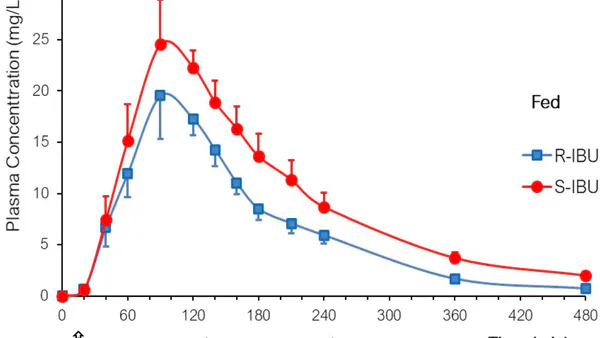
Figures 1 shows mean concentration-time profile of Ibuprofen enantiomers in plasma after the administration of the drug under fed and fasting conditions. Almost complete elimination of the administered drug is achieved after 8 hours.
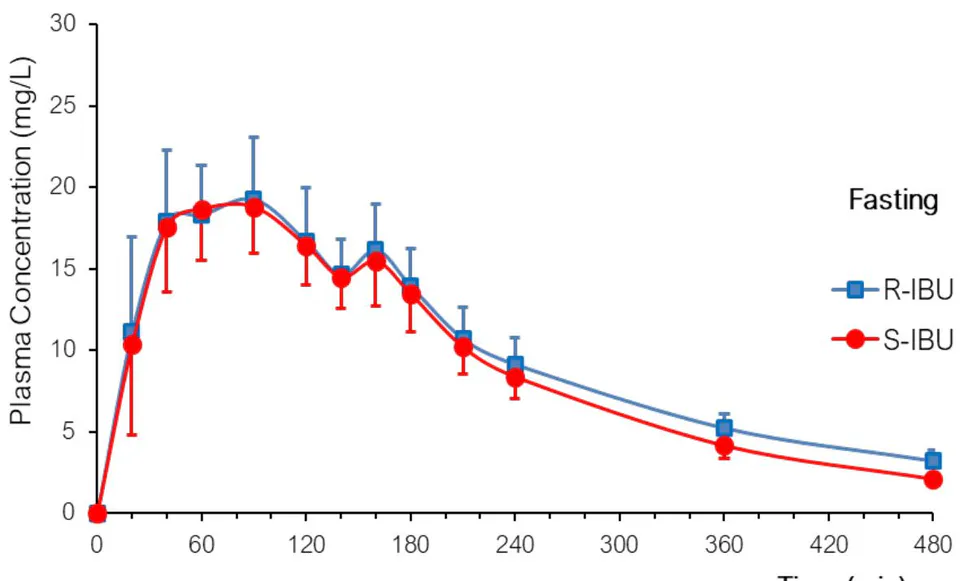
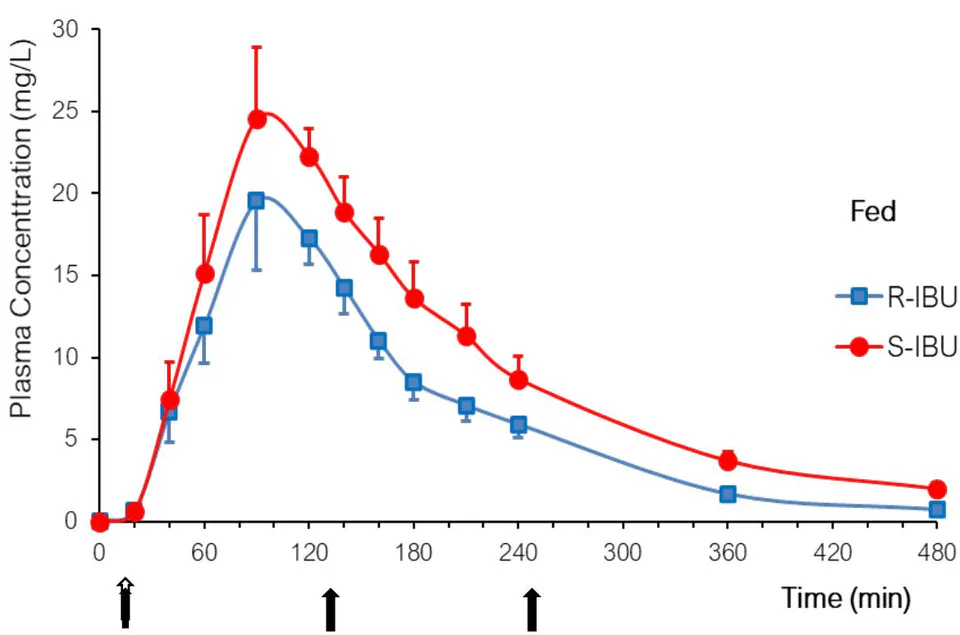
S isomer concentrations are consistently lower than R isomer concentrations in the Fasting stage and higher in the Fed stage. Mean S/R AUC ratio in the Fasting stage was 0.976 while in the Fed stage a 1.44 ratio was achieved (p<0.01). In men, S/R ratio was always above 1 (R-Ibuprofen plasma concentrations were always lower than for S-Ibuprofen concentrations) but higher in the Fed stage compared to the complete fasting conditions. However, in women, S/R plasma concentration ratios were opposite for the different stages (below 1 for Fasting stage and over 1 for Fed stage).
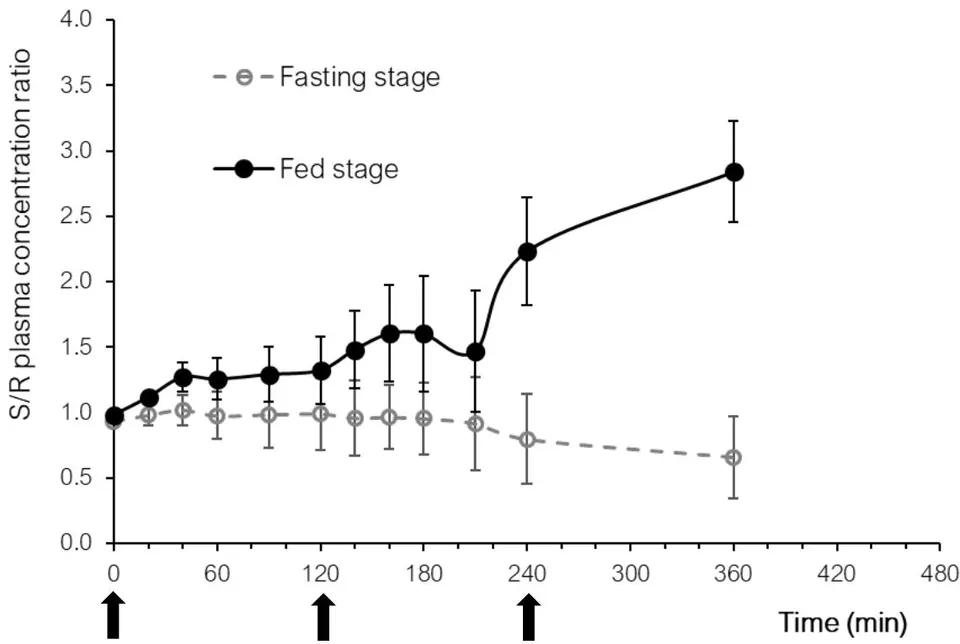
Figure 2 shows S/R plasma concentration ratio progress throughout time for both administration conditions. S/R plasma concentration ratios diminished throughout time for the Fasting stage while these ratios increased under fed condition, becoming significantly higher from those observed in fasting stage after 2 h post-dose.
IV. Discussion
On one hand, AUC for the R-isomer obtained during the Fed stage denoted a significant reduction in bioavailability, or clearance augmentation, or both, compared to the Fasting stage. The diminished of the R-isomer during Fed stage suggests that, at least, an increase in systemic clearance has occurred.
In the Fed stage, by administering the dose with saccharose, repeating the ingestion at 2 hours after dosing and the lunch ingestion 4 hours after dose, the cardiac output fraction delivered to the splanchnic region was favored throughout the whole period. Thus, intestinal and hepatic clearance increased. It has been reported that cardiac output fraction to pancreas and intestine increases up to 50% after food ingestion. [27]
Intestinal clearance might have increased even more than the given by the increase of the cardiac output fraction. As mentioned previously, given Ibuprofen's acidic properties, the pH difference between blood and pancreatic/intestinal juice, may induce drug transfer to these fluids. Ibuprofen could then be secreted to the intestinal lumen, stimulated by the ingestion of food or saccharose, returning to blood stream by absorption at this level. A supplementary amount of drug molecules reaches the enterocytes, which might have increased the intestinal clearance above expected. However, the lower number of molecules that reach the liver through the pancreatic vein, might result in a lower-than-expected increase of hepatic clearance in Fed stage.
On the other hand, AUC for the S-isomer remained constant during both stages. It would be rare to assume that systemic clearance remained unchanged for S-isomer under both administration conditions but not for R-isomer. Therefore, a countervailing increase in bioavailability must have occurred. Since the only reported difference between the enantiomer's metabolizing pathways is the unidirectional R-to-S conversion, only an augmented bioinversion can explain these results. If intestinal clearance was indeed the most affected, then chiral inversion could be situated, not only in liver, but also in intestine. It should be noticed on figure 2 that S/R concentration ratio increases after the ingestion of saccharose or food, revealing the importance of the intestinal site for the R-to-S conversion.
Pre systemic chiral inversion has been discarded by other authors due to the high bioavailability that R-Ibuprofen exhibits.[21] However, this is not sufficient to conclude that bio inversion does not occur at this level. Enzyme saturation during drug absorption could explain the low R-to-S pre systemic conversion. Chiral inversion at the enterocyte could be favored when Ibuprofen absorption is achieved through (reabsorption processes) or followed by (administration with saccharose) pancreatic/intestinal juice secretion. This high pH secretion might spread partially ionized molecules of ibuprofen across the intestine, diminishing its absorption rate, and hence, avoiding enzyme saturation.
Although few subjects were enrolled in this study, a significant difference between isomer's plasma exposition was evident between both administration conditions, Fasting and Fed stage. To our knowledge, there are no other reported stereoselective pharmacokinetic analysis with a complete fasting regimen as
Sex differences seemed to be present, however, confirmation of this trend should be made in a trial with a larger number of subjects. Isomer plasma levels were similar for men and women except for R isomer levels in the Fasting stage where women achieved a 60% higher R-AUC.R-to-S basal conversion rate in men, which normally have higher body masses than women, may be increased by avoidance of enzyme saturation therefore exhibiting higher S/R ratios in Fasting stage compared to women.
V. CONCLUSIONS
The study allowed a clear comparison between fasting and fed administration conditions due to the complete fasting regimen that characterized one of the study's stages.
R-and S-Ibuprofen exhibited different disposition characteristics. S/R concentration ratios were much higher during Fed stage compared to Fasting stage.
By administering saccharose or food, cardiac output fraction delivered to the splanchnic region is favored and thus, systemic clearance increased. R-isomer concentrations decrease as expected but S-isomer levels remained unchanged compared to the Fasting stage, possibly due to a countervailing increase in bioavailability given by a higher R-to-S conversion rate during Fed stage. The increased chiral inversion might be explained by the supplementary amount of drug molecules that reaches the enterocytes through pancreatic/intestinal secretions stimulated by food ingestion.
ACKNOWLEDGMENTS
Funding statement: This investigation has not received any funding. This investigation has not received any funding. First author received funds as fellow from the National Agency Of Investigations And Innovation (ANII, as abbreviation of its Spanish spelling) under the code POS_NAC_2014_1_102512 and Postgraduate Academic Commission (CAP, as abbreviation of its Spanish spelling).
Conflicts of interest/Competing interests: The authors do not have any conflict of interest regarding the present investigation.
Authors' contributions:
Marianela Lorier: Designed study/Performed research/Analyzed data/Wrote Paper Marta Vázquez: Designed and supervised study/Analyzed data Pietro Fagiolino: Designed and supervised study/Analyzed data Manuel Ibarra: Supervised analytical research Natalia Guevara: Performed research