
Neural Networks and Rules-based Systems used to Find Rational and Scientific Correlations between being Here and Now with Afterlife Conditions
Neural Networks and Rules-based Systems used to Find Rational and

Article Fingerprint
ReserarchID
9S72L
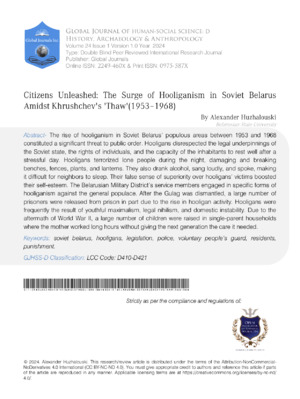
The rise of hooliganism in Soviet Belarus’ populous areas between 1953 and 1968 constituted a significant threat to public order. Hooligans disrespected the legal underpinnings of the Soviet state, the rights of individuals, and the capacity of the inhabitants to rest well after a stressful day. Hooligans terrorized lone people during the night, damaging and breaking benches, fences, plants, and lanterns. They also drank alcohol, sang loudly, and spoke, making it difficult for neighbors to sleep. Their false sense of superiority over hooligans’ victims boosted their self-esteem. The Belarusian Military District’s service members engaged in specific forms of hooliganism against the general populace. After the Gulag was dismantled, a large number of prisoners were released from prison in part due to the rise in hooligan activity. Hooligans were frequently the result of youthful maximalism, legal nihilism, and domestic instability. Due to the aftermath of World War II, a large number of children were raised in single-parent households where the mother worked long hours without giving the next generation the care it needed.
Alexander Huzhalouski. 2026. \u201cCitizens Unleashed The Surge of Hooliganism in Soviet Belarus Amidst Khrushchevs Thaw 1953-1968\u201d. Global Journal of Human-Social Science - D: History, Archaeology & Anthropology GJHSS-D Volume 24 (GJHSS Volume 24 Issue D1): .
Crossref Journal DOI 10.17406/GJHSS
Print ISSN 0975-587X
e-ISSN 2249-460X
The methods for personal identification and authentication are no exception.
Total Score: 121
Country: Belarus
Subject: Global Journal of Human-Social Science - D: History, Archaeology & Anthropology
Authors: Alexander Huzhalouski (PhD/Dr. count: 0)
View Count (all-time): 117
Total Views (Real + Logic): 944
Total Downloads (simulated): 33
Publish Date: 2026 01, Fri
Monthly Totals (Real + Logic):
Neural Networks and Rules-based Systems used to Find Rational and
A Comparative Study of the Effeect of Promotion on Employee
The Problem Managing Bicycling Mobility in Latin American Cities: Ciclovias
Impact of Capillarity-Induced Rising Damp on the Energy Performance of
The rise of hooliganism in Soviet Belarus’ populous areas between 1953 and 1968 constituted a significant threat to public order. Hooligans disrespected the legal underpinnings of the Soviet state, the rights of individuals, and the capacity of the inhabitants to rest well after a stressful day. Hooligans terrorized lone people during the night, damaging and breaking benches, fences, plants, and lanterns. They also drank alcohol, sang loudly, and spoke, making it difficult for neighbors to sleep. Their false sense of superiority over hooligans’ victims boosted their self-esteem. The Belarusian Military District’s service members engaged in specific forms of hooliganism against the general populace. After the Gulag was dismantled, a large number of prisoners were released from prison in part due to the rise in hooligan activity. Hooligans were frequently the result of youthful maximalism, legal nihilism, and domestic instability. Due to the aftermath of World War II, a large number of children were raised in single-parent households where the mother worked long hours without giving the next generation the care it needed.
We are currently updating this article page for a better experience.

Lorem ipsum dolor sit amet, consectetur adipiscing elit. Ut elit tellus, luctus nec ullamcorper mattis, pulvinar dapibus leo.































































