

I. INTRODUCTION
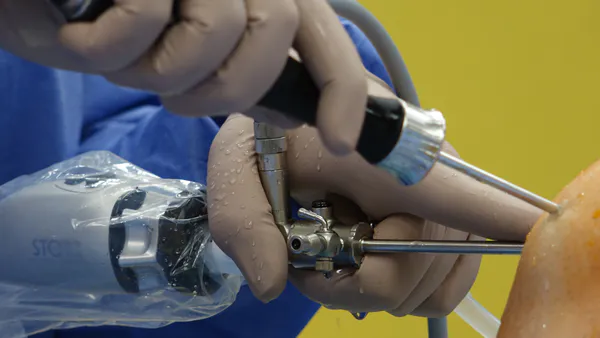
The Anterior Cruciate Ligament (ACL) has a major role in normal working of knee . Rupture of ACL is one of the most common diagnosis in young patients either due to RTA or sports trauma. Reconstruction of the ACL allows the patient to resume sporting activities and prevents damage in meniscus and articular cartilage in turn reducing chances of arthritis. There are two techniques for reconstruction of ACL, open technique and arthroscopic assisted technique. Arthroscopic assisted technique has many advantages over open procedure but it needs more expertise and cost comparatively. Currently, ACL reconstruction is most often performed using an arthroscopic assisted technique. Literature is deficient of ACL reconstruction data in developing countries. In developing countries like Pakistan, cost is the major issue. Athroscopic assisted ACL reconstruction is more expensive than open procedure. There is no large data available for such population which shows the clinical outcome after open & arthroscopic ACL reconstruction. The objective of this study is to identify the clinical outcomes on basis of lyshlomknee score (LKS) system and find out patients satisfaction after performing both procedures in two groups separately.
II. MATERIAL & METHODS
Retrospective analysis of 600 patients undergoing open ACL reconstruction and arthroscopic reconstruction from 2005 to 2018 was done at Department of Orthopaedics, Ghurki hospital, Lahore. We included all those patients who were 18 to 45 years of age and had at least 1 year follow up. Amongst these patients, 500 patients underwent open ACL reconstruction while 100 had arthroscopic reconstruction.
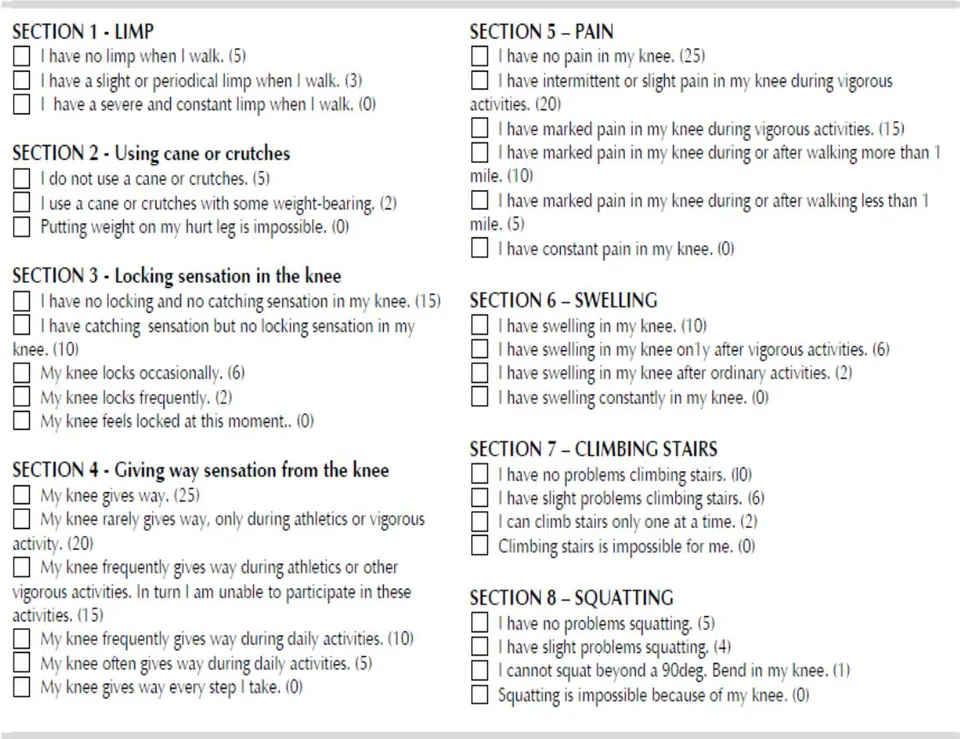
Lysholm scoring questionnaire as shown in Ffigure-1 was adopted and enquired from all the patients. Face to face interview was done with all the study participants. If the patient stated that he/she did not understand the question properly, more explanation regarding that particular question was given until the patient understood what he/she was asked. All the study participants were invited to hospital. All those participants who found to be in the clinically stable state, were excluded from this study. All those cases that had any new related injury after ACL reconstruction or arthroscopic reconstruction were also excluded from the study. Patients who had evidence of clinical and radiological degenerative change in the knee were also excluded.A standard script was followed for all the interviews to maintain a level of consistency. All the ethical standards written in "The Declaration of Helsinki 1964" and its later amendments were fully followed in this study.
Means along with standard deviation were calculated for the lysholm scoring between patients undergoing ACL reconstruction or arthroscopic reconstruction. Chi square test was applied to compare the qualitative variables like gender, while remaining quantitative variables like age, duration of follow up and LKS were compared using t-test for any significant difference in between both the groups. P value less than or equal to 0.05 was considered as statistically significant.
III. RESULTS
In this study, a total of 600 patients were included among these majority 554 (92.3%) were male and 46 (7.7%) were female patients with an average age of years. Overall, mean duration of follow up was noted to be months.
Table 1 showed the demographic profile of patients underwent two different surgical procedures, in group 1 500 involved underwent open ACL among these 93% were males and 7% were females with an average age of years and follow up duration of 12 months as compared to group 2 where the patients of arthroscopic reconstruction took part in the study n=100 among these 89% were male participants and 11% were females with an average age of years and had the follow up duration of 12 months. The study reveals that there was no significant difference in between both the groups in terms of gender, age but duration of follow up were different in both groups as (p value ).
Table 2 demonstrates the functional outcome of patients using Lysholm knee score among two groups of patients. In open ACL patients, majority 55% patients reported excellent outcome, 30% with good outcome with an average score of whereas in arthroscopic reconstruction group, majority reported excellent functional outcome as 90% reported excellent functional outcome and 2% with poor outcome with an average score of 90.88 ±13.22 and statistically significant difference were obtained in the mean LKS score in both groups as (p-value≤0.05).
| Characteristics | Open ACL (n=500) | Arthroscopic Reconstruction (n=100) | p-value | |
| Gender | Male | 465(93) | 89(89) | 0.2136 |
| Female | 35(7) | 11(11) | ||
| Age (mean+SD) | 30.27+_ 4.2 | 29.57+_ 4.7 | 0.1366 | |
| Duration of follow up | 12 | 12 | ||
| Outcome | Group 1Open ACL | Group 2Arthroscopic ACL | |||
| n=500 | Mean±S.D | n=100 | Mean±S.D | p-value | |
| Excellent | 450(90) | 55(55) | |||
| Good | 20(4) | 82.78 ±14.78 | 30(30) | 90.88±13.22 | *0.021 |
| Fair | 20(4) | 10(10) | |||
| Poor | 10(2) | 5(%) | |||
IV. Discussion
Open ACL reconstruction and arthroscopic reconstruction are not new as lots of literature is available about these two but the debate regarding which approach is better is still going on. In this retrospective analysis, our objective was to compare LKS scores following ACL reconstruction and arthroscopic reconstruction, and comparing with each other.
Overall, 92.3% of the patients in our findings were male. It has been a well established fact that male population is more exposed to road accidents and outdoor activities, this could be the major reason why significantly more male are reported involving reconstruction procedures.
Quite a few systems have been developed in the recent years evaluating pre as well as post operative condition of knee area. Different protocols are available but most are based on functional as well clinical evaluations. O'Donoghue is known to be the 1 to apply scale system aiming to evaluate post operative results. Our objective was to compare the post operative outcome of ACL reconstruction and arthroscopic reconstruction in knee injuries based on follow up (at least 1 year). Various methods were considered aiming to evaluate knee region. We got attracted to Lysholmknee scaling (LKS) score which is based on the modified Lysholm protocol and has been used extensively all around the world. LKS has also been noted to have high reliability, validity as well as responsiveness all over the world. This was the very reason that we adopted this scale and we are confident that translating results using such scale will further benefit larger proportions of our population.
In the present study, open ACL patients, mean LKS was noted to be 82.78 with a standard deviation of 14.78 whereas in arthroscopic reconstruction group, mean LKS was noted to be 90.88 with a standard deviation of 13.22 while the difference between the two groups was statistically significant. In a recent study conducted by L. de Villiers to find out the prevalence of osteoarthritis in the knee in the long term after ACL reconstruction, 43 patients were evaluated as per LKS. Mean KLS score was noted to be 84.35 in those patients. These results are very similar to our findings where we noted mean KLS score to be 82.78 in our patients.
A study done by Kose O et al noted the mean LKS score to be 93.56 which is close to what we found in the present study. Overall mean follow up in that study was recorded to be 33.4 months which is quite higher in comparison to what we had in our findings. While comparing, open ACL reconstruction and arthroscopic reconstruction group, mean LKS was noted to be significantly higher in arthroscopic reconstruction patient showing overall better results of following this technique.
V. CONCLUSION
Majority of our patients were male. Although both studied procedures got good overall LKS but patients following arthroscopic reconstruction had significantly better LKS in comparison to open ACL reconstruction.