
I. INTRODUCTION
The neck is a vulnerable area comprising different vital organs of multiple physiological systems. Due to juxtaposition of these anatomical structures, there is a high predisposition of multi-systemic injuries with potentially life threatening lesions of the major blood vessels that conceder most common injured structure.
TNVI represent 5-10% of all severe trauma cases. The neck is a complex anatomical area because in a small space there are abundant critical aerodigestive, neurological, and vascular structures. over the neck injury does not usually occur in isolation, therefore trauma are potentially dangerous and require prompt diagnosis and treatment.
Mostly injured components in cervical trauma related to vascular structures. The most common mechanism is penetrating injury which mostly involved the common carotid artery, while the vertebral artery was less common injured due to its anatomical position. High velocity penetrating trauma can cause secondary injuries "blunt trauma" by shock wave. The major venous injuries seen after penetrating trauma are the internal jugular vein and external jugular vein, in such cases venous injuries are never recognized due to its lower pressure.
Vascular injury is suggested by history and physical examination. Patient clinical presentation and symptoms still hold an important place in the management of penetrating neck injuries (PNIs), patients with signs of significant neck injury, particularly those with "hard" signs of vascular and/or aerodigestive injuries, require immediate surgical exploration.
When an arterial injury is identified during neck exploration, current consensus agrees that primary repair of the artery is preferred than ligation, irrespective of any abnormality in focal preoperative neurologic examination findings. Optimal management of patients with PNIs remains a controversial issue. The treatment strategy of PNIs acquired from military surgical practice suggested mandatory exploration as a standard treatment to avoid missed injuries. However, civilian adoption of mandatory exploration in PNIs resulted in high negative exploration rate. Therefor in the last three decades, there has been a slow shift towards selective management for these injuries, which using zones of neck to guide investigations and management a "zone-based" approach or "no zone" approach. Injuries are classified by penetration site into the three anatomical zones. Those patients should be evaluated using proper physical examination, selective use of investigations and managed according to staff experience and resource availability.
Ideally, war injuries should be treated by surgeons having military surgery experience. In fact, civilian surgeons may find themselves trapped in wars practicing military surgery without prior training or experience in this field. The purpose of this study was to review our experience with penetrating neck vascular injuries in Aden-Yemen, thereby focusing on surgical management, and early outcomes and to highlight lessons learned from that period.
II. METHOD AND PATIENTS
This retrospectively study was conducted at Department of surgery in four main hospital in Aden city from 1st of April 2015 up to 31st December 2017. All patients of both gender and any age who fulfilling the inclusion criteria were enrolled in this study. During study period, the total number of patients admitted to surgical department in relation to vascular neck injury in Aden Hospitals were 52 patients. Any of the following was considered criteria for exclusion: death before admission, patients with superficial wound (which defined by injuries superficial to the plan of the platesma) or patients with minor neck injury who did not require hospital admission.
All patients were resuscitated in emergency room according to Advanced Trauma Life Support protocols in the hospital field. The clinical diagnosis was done at the time of the admission by history tacking, physical examination and investigations (laboratory, radiological and ultrasound), and/or confirmed during operative intervention.
The variable was collected retrospectively using a questionnaire and interviewing the patients including: age, sex, residence, clinical presentations that include detailed history of the injuries, hemodynamic status, external bleeding, expanding or large haematoma, neurological deficit and palpable thrill/audible bruit, associated injuries, operative finding, treatment option, and outcomes. Types of morbidity included neurological deficit, wound infection, A-V fistula and hoarseness.
Data and statistical analysis: data were presented as a proportion, medians or mean ± standard deviation as a appropriated and the analysis will be covered out using SPSS version 22 (SPSS Inc., Chicago, IL, USA). Quantitative variables like age and duration of symptoms were presented by calculating means ± standard deviation (SD). Qualitative variables like gender, symptoms and operative finding were presented by calculating frequencies and percentages. The statistical significance of differences between categorical variables were calculated by the chi-square test, Fisher's exact test. P-value of <0.05 was considered as statistically significant.
III. RESULTS
During the study period from April 2015 to December 2017, the total number of patients with neck vascular injury was 52 patients. Most of the patients were male (98.1%). The age ranges from 9 to 60 years with a mean age was years. The peak age of patients with neck vascular injury in this study was in second decade (46.2%) followed by the third decade (26.9%) of life.
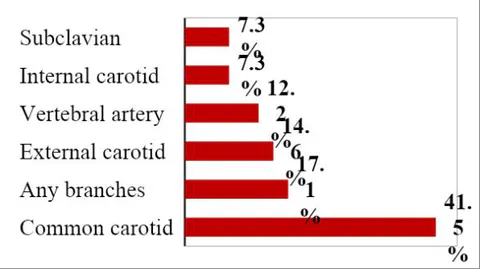
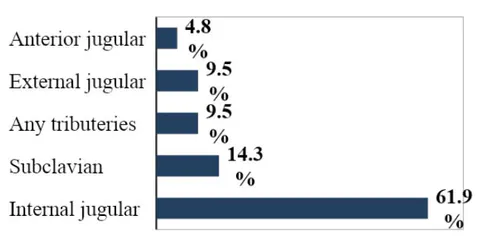
The majority of injuries was penetrating (96.2%); gunshot was the predominant mechanism of injury (75%), followed by sharp object injury (15.4%). Stab wound and road traffic accidents represent (3.8%) for each, and iatrogenic injury (1.9%). About (76.9%) of patients presented within the first 6 hours to the hospital and (42.3%) of the patients were unstable at the time of presentation. More than half of patients had their injuries on the right side; and the same percentage of injury in zone 2, while 17% of the studied patients had their injury in multiple zones. Concerning presentation of patients, the highest percentage of them presented with small non pulsatile hematoma (28.8%), followed by external bleeding (26.9%) and pulsatile hematomas (25%). Table I In our study, we found arteries were the commonest injured vessel (71.2%), followed by veins (28.8%). Concerning type of injury, the most common finding was partial cut (55.9%), complete cut (44.1%). The commonest injured vessel is the carotid arteries, the common carotid artery represent (41.5%), followed by external carotid artery (14.6%) and vertebral artery in (12.2%), whereas the internal jugular vein was the most common vein injured (61.9%). Fig.1,2
About two third of our patients had another associated injuries, the most common associated injuries were aerodigestive tract injury (38.2%), followed by brachial plexus injury (23.5%).
The operative intervention was the main therapeutic option for most patients it represent (94.2%) and only (5.8%) of patients managed by non-operative procedures. Among those managed operatively, repair was performed in most of them (55.9%), while the ligation performed in (44.06%). The common type of repair was simple anatomical repair that represent (51.5%) followed by using graft in (33.3%) and end-to-end anastomosis in (21.2%) of patients.
| Variables | No. | % | ||
| Mechanism of neck vascular injury | Penetrating | 50 | 96.2 | |
| Type of penetrating | Gunshot | 39 | 75.0 | |
| Sharp object | 8 | 15.4 | ||
| Stab wound | 2 | 3.8 | ||
| Iatrogenic | 1 | 1.9 | ||
| Blunt | 2 | 3.8 | ||
| Time of presentation (hrs) | < 6 | 40 | 76.9 | |
| ≥ 6 | 12 | 23.1 | ||
| Hemodynamic state | Stable | 30 | 57.7 | |
| Unstable | 22 | 42.3 | ||
| Site of injury | Right | 30 | 57.7 | |
| Left | 20 | 38.5 | ||
| Bilateral | 2 | 3.8 | ||
| Zone of injury | zone 1 | 6 | 11.5 | |
| zone 2 | 30 | 57.7 | ||
| zone 3 | 7 | 13.5 | ||
| Multiple zoon | 9 | 17.3 | ||
| Presentation | Small non pulsatile hematoma | 15 | 28.8 | |
| External bleeding | 14 | 26.9 | ||
| Rapid expanding hematoma | 13 | 25.0 | ||
| Neurological deficit | 7 | 13.5 | ||
| Palpable thrill/Audible bruit | 3 | 5.8 | ||
Our study showed that neck vascular injury in the hospitals are associated with (19.2%) mortality. Complications were found in (50%) patients with vascular neck injury. The most common complications was the neurological deficit (42.3%), while wound infection, A-V fistula, and hoarseness occur in (3.8%), (1.9%) and (1.9%) of patients respectively. The hospital stay ranged from one to more than 15 days. About (50%) of the studied patients stay in hospital 1-7 days, while (40.4%) stay 8-14 days and (9.6%) of them stay more than 15 days, as shown in Table II.
| Variables | No. | % | |
| Morbidity | No | 26 | 50.0 |
| Yes | 26 | 50.0 | |
| Type of morbidity | Neurological deficit | 22 | 42.3 |
| Wound infection | 2 | 3.8 | |
| A-V fistula | 1 | 1.9 | |
| Hoarseness | 1 | 1.9 | |
| Hospital stay (days) | 1-7 | 26 | 50.0 |
| 8-14 | 21 | 40.4 | |
| >15 | 5 | 9.6 | |
| Mortality | No | 42 | 80.8 |
| Yes | 10 | 19.2 | |
IV. DISCUSSION
This study deliberate the first study in Yemen, could be due to the lack of national data. Therefore, we conducted this retrospective descriptive study to establish the frequencies of clinical patterns and the outcomes of TVNI in population of Aden hospitals within two consecutive years; from 1 April 2015 up to 31 Dec 2017.
Analysis of the personal characteristics of patients in this study showing a high prevalence of TNVIs among young males (98.1%), being similar to the studies reported by Martinakis et al in Athens and Reva et al in Russia.
The peak age for TNVIs in this study was in the second decade (46.2%) follow by third decade of life (26.9%). Similar observation was reported in other studies.
More than half of the patients in this study were solider (65.4%) while the incidence of traumatic injuries in Civilian (34.6%), showing a similarity to studies performed by White et al and Rasmussen et al reports that civilian traumatic injuries of neck vessels are relatively uncommon.
The predominant mechanism of injury to the neck in this study is PNIs; (75% gunshot, 15.4% sharp objects and 3.8% stab wound) with a percentage of (96.2%), which is consistent with almost all other studies. The blunt injuries are rare and consist (3.8%) of studied patient as demonstrated by other studies.
Findings at emergency department are small non pulsatile hematoma (28.8%), external bleeding (26.9%), rapid expanding hematoma (25.0%), neurological deficit (13.5%) and palpable thrill-audible bruit (5.8%), nearly similar result found by Reva et al report cases on Physical examination reviled non pulsatile hematoma (36%), active bleeding from neck wound (19.6%), expanding or large hematoma in the injured area (19.6%), neurological deficit (17.4%), and asymptomatic injury (15.2%), while Teixeira et al reports external Bleeding (64%), expanding hematoma (22%), and Nasr et al reviled (65.5%) of the sample had active bleeding and (17.2%) hematomas.
In these study, commonest injured vessel were arteries it represent (71.2%), veins injury reviled (28.81%) this is in agreement with previous reports, where Prichayudh et al report 36 patients underwent immediate neck exploration, identified (55.6%) arterial injuries, (19.4%) venous injury, Bodanapally et al report 51 patient, (76.5%) patients had arterial injuries, in contrast to another study by Ghnnam et al that report commonly affected anatomical structures were the neck veins (24.5%), followed by neck arteries (10.2%). However other studies were reported venous injury more than arteries injury. These differences may because majority of jugular venous injuries are probably unrecognized without exploration owing to the low-pressure venous system.
In current study, a higher proportion of TNVIs had associated injuries (65.4%), while (34.6%) of patients had isolated neck trauma. Biffl et al demonstrated similar incidence of associated injuries (33.1%). The most common associated injuries were aerodigestive tract injury (38.2%) similar to Pirrelli et al , in this study brachial plexus represent (23.5%), spinal injury represent (14.7%), and facial injury (11.8%).
Our study shows that, the operative intervention was the therapeutic option for most patients it represent (94.2%), only (5.8%) were managed by conservative management. One study report neck exploration was performed in (88.2%) in his series while other demonstrated (84.4%) surgical intervention.
In this series 49 patients, underwent exploration, for positive physical examination findings and workup, this is supported by a study by Thomas et al published a prospective study in which complementary diagnostic studies were used based on physical examination findings and no CTA was performed, showing good results. Furthermore, Mahmoodie et al and his group demonstrated that physical examination did not miss any major vascular or esophageal injuries that required intervention.
Among those managed operatively, repair was perform in most of them (55.9%) whereas the ligation performed in (44.06%). The common type of repair was simple repair that represent (51.5%) follow by using graft (33.3%) and end-to-end anastomosis (21.2%). One study established surgical interventions mainly included simple repair (53%).
In the studied hospitals patients are treated with primary repair for carotid artery regardless of the degree of consciousness depression and preoperative condition similar to was found in Pirrelli et al study. Other author recommend repair for CAI only in the absence of severe neurologic deficit. The overall mortality rate was (19.2%) this is high compared to other studies, in which mortality rates ranged from (11.8%) as Al Thani et al as well Ghnnam et al (12.2%).
The hospital stay ranged from one to more than fifteen days. About (50.5%) of the studied patients stay 1–7 days, while 8-14 days represent (40.4%) and (9.6%) they stay more than 15 days. Ghnnam et al proved the mean duration of hospital stay 6.6 days; it is similar to this series.
Complications found in (50%) of the studied patient's. The common complications were the neurological deficit (42.3%), wound infection (3.8%), while A-V fistula and hoarseness (1.9%) for each, similar finding was reported by Reva et al.
V. CONCLUSION
TNVIs represent an alarming serious entity. Dominant presentation is penetrating injuries, exclusively among young male, mainly exposed to gunshot wound. The need for operative intervention should be based on clinical features. Moreover, further researches and an institutional protocol guidelines management are requested.