





I. INTRODUCTION
Primary headache disorders are among the commonest disorders, affecting people in all countries. Estimate is that one person in three experiences severe headache at one stage of their life. Life time prevalence of any type headache as estimated from population based studies is more than 90% for man and 95% for the women. Migraine is one of the important causes of primary headaches. Migraine has a one-year period prevalence of 12 percent (17.1 percent in women and 5.6 percent in men). Cumulative incidence of migraine by age 85 is 18.5 percent in males and 44 percent in females. Migraine is a neurovascular disease characterized by a broad spectrum of symptoms, varying from headaches that are typically unilateral and have a pulsating quality, associated with various neurological symptoms such as nausea, increased sensitivity to light and sound (photophobia and phonophobia), and aura, which may consist of visual, sensory or motor disturbances. (The International Classification of Headache Disorders, 3rd edition beta version, 2013). Migraine Headache is broadly classified into migraine with aura and migraine without aura. They are diagnosed according to The International Classification of Headache Disorders, 3rd edition beta version, 2013 . Migraine with aura and migraine without aura are genetically distinct. Migraine with aura (MA) is a prevalent neurological condition with strong evidence for a genetic basis . The susceptibility gene loci for migraine with aura and without aura are different . The clinical picture of migraine is composed of 4 different stages including the prodromal stage, aura stage, headache stage and postdrome stage. Migraine headache also has some established trigger factor . Clinical profile of migraine varies person to person, country to country even in the same person. Most of the study regarding clinical profile was done in the developed countries. There is scarcity of the study revealing clinical profile in Bangladesh. This study aims to reveal the clinical profile, trigger factor, Complication functional disability, severity of migraine headache in Bangladeshi people presented in Headache clinic, Dhaka Medical College Hospital. It will give an overview of presentation of migraine and its functional consequences on the people of Bangladesh. However through this study it would be known whether the findings of other study done in abroad could be replicated or not. So it would give some light whether presentation of migraineurs in our country is same or different from other population. Thus the findings of this study will invoke further research as well about migraine.
II. METHODOLOGY
A cross sectional observational study was conducted in the Headache clinic of Dhaka Medical college Hospital from December 2019 to march 2020. Institutional ethical committee approval was obtained accordingly. Patient presented in the headache clinic, was labeled as migraine by experienced Neurologist. Migraine with or without aura was defined according to International classification of headache disorders . Patient of both sexes and all ages fulfilling the ICHD 3 criteria were included in the study. Migraine patient with other cause of headache like sinusitis, post traumatic headache and drug induced headache, were excluded from the study. Patients were enrolled by Systematic Sampling Method. Every 3 patient with migraine headache attended in a headache clinic day was enrolled in this study. Measured sample size was 196. Every patient was coded by the researcher. An informed written consent was obtained from the patients. Face to face interview was conducted by using a semi structured questionnaire containing socio-demographic parameters and relevant information about Migraine. Detailed fundus examination was done in all patients. Severity of migraine was assessed using Visual Analogue scale 1-10. Migraine Disability Assessment was done using MIDAS score. Secondary causes of headache were excluded using brain imaging in suspected patients The Data was collected by Research Assistant, who is a trained doctor. Variables of the collected data were uploaded in Microsoft excel sheet. The data was analyzed by using simple descriptive statistics like mean, median and prevalence rates, standard deviation. Chi square rest was done to observe the significance.
III. RESULTS
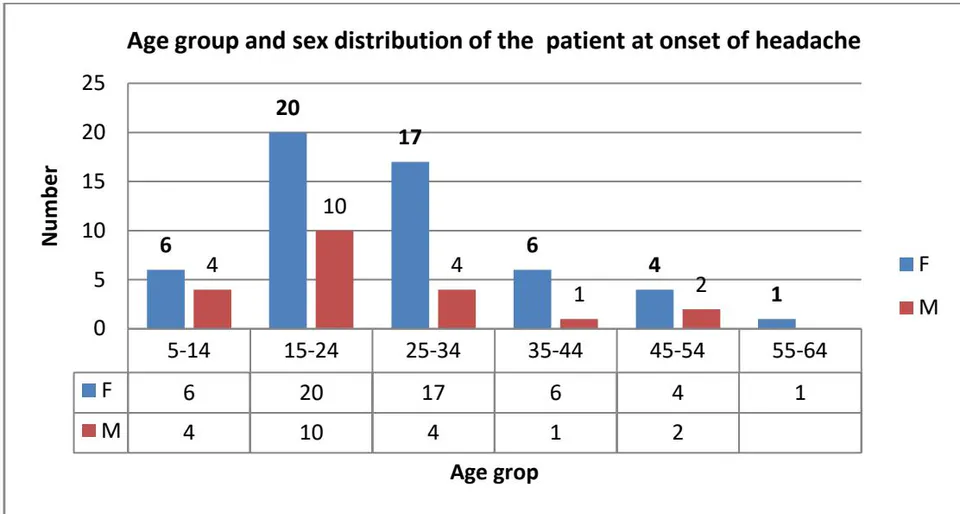
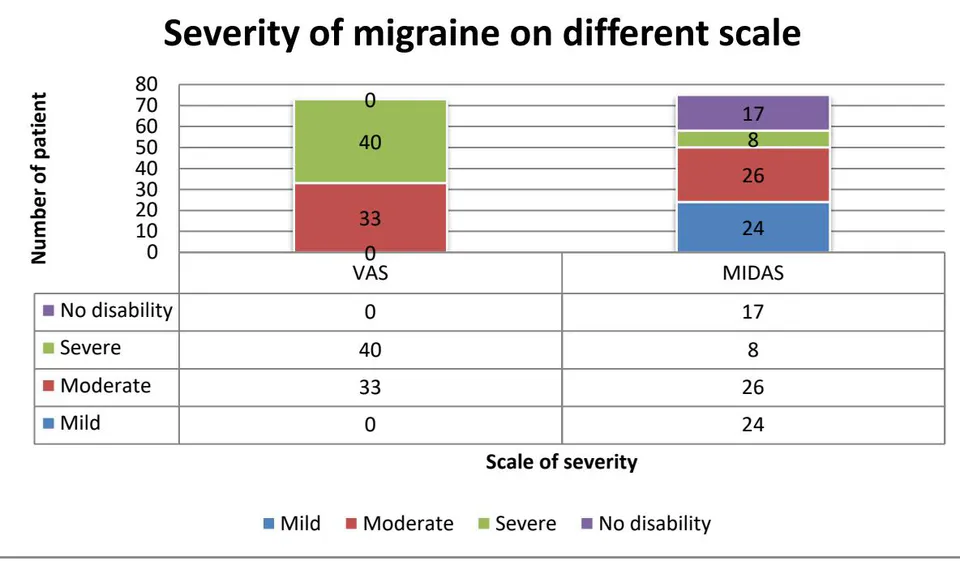
About 854 patients with headache were attended in the headache clinic during the study period. Of that 234 patients were diagnosed as migraine and 75 patents were enrolled in this study by systematic sampling. Most of them (72%) were female. Mean age of the study population at presentation was Years. Most of the patient is in the age group of 19-38. Onset of Headache occurred at years (Table 1). Onset of migraine occurs in 15-24 and 25-34 age group with significantly higher in female (Figure 1). About 36% of the study population had positive family history which is significantly common in migraine with aura patient. Most common migraine subtype was Migraine without aura (70.67%). Duration of headache was on average 17.6 hour, duration of prodrome was 2.26 hours and duration of aura was 31.34 minutes. In 47% cases patient presented with single aura and in 53% cases patient presented with multiple aura. Phobia associated in most of the cases. Quiet a large number of the patient (37.33%) had history of nocturnal arousal due to headache. About 37% of the patient had migraine complication and 42% patient presented with different co-morbidity. VAS Severity score . MIDAS severity score (Table 1). Most of them presented with either unilateral (34.67%) or bilateral headache (50.67%). In episodic migraine most of the patient's frequency of headache was 2/week (26.67%). On the other hand 25.33% of the patient had headache in almost all the days in a week that is chronic daily headache. Visual aura (100%) was the most prevalent aura subtype followed by Brainstem aura (42%). Almost all the patient had photophobia (91.77%) (Table 2). In most of the cases patient had multiple trigger factors (53%). In most of the cases prodrome (42.67%), postdrome (49.33%) and co-morbidities (32%) were single. Trigger factors were present in 81.33% (61) of the patient. Of that Sun exposure (37.70%), anxiety (32.79%), insomnia (37.70%) and journey (31.11%) were common (Table 4). Prodrome was present in 65.33% of the cases. Neck stiffness (67.34%) and Irritability (42.85%) were the most prevalent symptoms. Postdrome were present in 77.33% cases (Table 3). Among them Lack of concentration and Mood change were the prevalent symptoms. About 42% of the patient presented with co-morbidity. Generalized anxiety disorder (37.5%), NUD (21.8%) and Hypertension (25%) were the most common co-morbidity. About 37% of the patient presented with migraine complication and chronic migraine with anxiety (21%) was the most prevalent complication. Complications were more prevalent among the female.
| Traits | Mean ± SD or N (%) |
| Age | 31.4±12.5 Years |
| age of onset of Headache | 25.2±11.86 years |
| Sex Distribution | |
| Male | 21(28%) |
| Female | 54(72%) |
| Family History | 27(36%) |
| Positive with Aura patient | 10(52%) |
| Positive without Aura patient | 17(30%) |
| P value <0.5 | |
| Migraine subtypes | |
| Migraine without Aura | 53(70.67%) |
| Migraine with Aura | 18(24%) |
| Migraine aura sine Headache | 1(1.33%) |
| Special form of childhood Migraine | 3(4%) |
| Benign cyclical vertigo | 1(1.33%) |
| Abdominal Migraine | 1(1.33%) |
| Cyclical vomiting syndrome | 1(1.33%) |
| Headache duration | 17.6±16.12hours |
| Duration of aura | 31.34 minutes |
| Number of Aura (among the aura patient) | |
| Single Aura | 10(47%) |
| Multiple Aura | 9(53%) |
| Duration of prodrome | 2.26 hour |
| Phobia | 71(96.67%) |
| Nocturnal Arousal due to headache | 28(37.33%) |
| VAS Severity score | 7.24±1.67 |
| MIDAS severity score | 7.78±5.9 |
| Complications of migraine | 28(37.33%) |
| Co-morbidity | 32(42.66%) |
Severity of migraine on different scale
| Trait | Frequency (%) |
| Site of headache | |
| Unilateral | 26 (34.67) |
| Bilateral | 38 (50.67) |
| Alternating | 7 (9.33) |
| Frequency of headache(most common) | |
| 2/week | 20 (26.67) |
| 7/week | 19 (25.33) |
| 3/week | 11 (14.67) |
| 1/week | 11 (14.67) |
| Aura subtype(among the patient with Aura) | |
| Visual | |
| Brain stem | 19 (100) |
| Motor | 8 (42) |
| Sensory | 1 (5) |
| 2 (10) | |
| Phobia subtype | |
| Photophobia | 69 (91.77) |
| Phonophobia | 49 (65.17) |
| Osmophobia | 14 (18.62) |
| Complication | |
| Absent | 47 (62.67) |
| Present | 28 (37.33) |
| • Chronic migraine with anxiety | 16 (21.33) |
| • Chronic migraine with Medication overuse | 8 (10.67) |
| • Migralepsy | |
| • Status Migrainosus | 2 (2.67) |
| 2 (2.67) |
| Trigger factors | N (%) | Prodrome | N (%) | Postdrome | N (%) | Co-morbidity | N (%) |
| Sun exposure | 23(37.70%) | Neck stiffness | 33(67.34%) | Lack of concentration | 24(41.37%) | Hypertension | 8(25%) |
| Anxiety | 20(32.79%) | Fatigue | 11(22.44%) | Mood change | 21(36.20%) | Diabetes | 4(12.5%) |
| Insomnia | 23(37.70%) | Irritability | 21(42.85%) | fatigue | 18(31.03%) | Depression | 4(12.5%) |
| Journey | 19(31.11%) | Craving for food | 2(4%) | sleep | 22(37.93%) | Generalized anxiety disorder | 12(37.5%) |
| Temperature change | 10(16.39%) | Sleepiness | 4(8.1%) | Non-Ulcer dyspepsia | 7(21.8%) | ||
| Sound | 11(18.03%) | Yawing | 2(4%) | Psycogenic Dyspnoea | 2(6.2%) | ||
| Stress and exertion | 8(13.11%) | Psycogenic vertigo | 4(12.5%) | ||||
| Menstruation | 7(11.47%) | ||||||
| Single | 28% | 42.67% | 49.33% | 32% | |||
| Multiple | 53% | 22.67% | 28 | 10.67% | |||
| Absent | !9% | 34.67% | 22.67% | 57.33% |
IV. DISCUSSION
Migraine is one of the important primary headache disorders. Globally migraine burden among the headache patients is about 11-15% . In this study migraine burden among the headache patients presented in headache clinic found to be about 25%. This is a little bit higher as it was a hospital based study, mild Tension type headache in most of the cases don't appear in Hospital. The mean age of the onset of the migraine headache in this study was found to be 25.2±11.86 years, in most of the cases (-68%) they presented in 15-34 years age group. It is found that mostly migraine starts before the age of 40 . Like other study females are the worst suffer of the migraine in the present study as well (F: M 2.6:1). Migraine is largely a familial disorder. In this study 36% of the patient with migraine had positive family history which is significantly higher in patients with migraine with aura (52% vs. 30% p value <0.5). Migraine has several known trigger factors. In this study about 81% of the patient has single or multiple trigger factors. Along with other known factor sun exposure and journey was found to be the important trigger factors for Bangladeshi population. Bangladeshi female usually do not take alcohol and pure chocolate intake is less among Bangladeshi population. So these factors as a trigger were not found in this study. This study revealed that about 11% of the patient had catamenial migraines which include both cyclical and non-cyclical form. According to MacGregor , the prevalence of cyclical catamenial migraine is 7.2%. Migraine headache started with prodrome which persists for hours to days . In this study 65% of the patient had prodrome which persisted for average 2.21 hour. A significant number of the patient had multiple prodromes (22%). Neck stiffness and irritability was the most prevalent prodrome. Migraine headache is broadly classified as migraine with aura and without aura. In this study 24% of the patient with migraine had aura. In USA 30.8 percent of female migraineurs and 32 percent of male migraineurs have aura . In this study 22% of the female migraineurs and 33% of male migraineurs had aura. Four special form of migraine (Cyclical vomiting syndrome, Abdominal migraine, Benign cyclical vertigo, Episodic torticollis) are found in pediatric population . In this study abdominal migraine benign cyclical vertigo and cyclical vomiting syndrome was found. Among the Patient with aura 99 percent has a visual aura. Most (60%) patients has a combination of aura symptoms, 39 percent has a visual aura exclusively. However, more than one aura symptom occurred, especially in succession in 96 percent and simultaneously in four percent of patients . In this study 53% of the aura patient had combination of aura and 47% patient had exclusive visual aura. In the present study 100% of the patient had visual aura, 42% had brainstem aura and 10% had sensory aura. Aura symptoms usually persist for 5-60 minutes. In this study Average duration of aura was 31 minutes. Migraine pain is unilateral in 60 percent of cases and bilateral in 40 percent. However, 15 percent of the patient migraine always occurring on the same side . In this study about 50% patient had bilateral headache, 35% patient had unilateral headache and 10% cases had alternating headache (ie. Stared unilaterally and then become bilateral). Migraine headache usually persisted for 4-72 hours. In this study average duration of headache was about 18 hours. Migraine headache is by definition moderate to severe headache. In this study 44% had moderate headache and 56% had severe headache according to VAS score.
Frequency of migraine attack varies in different study. In a study among the neurologist it was found that, 25 percent, four or more severe attacks a month; 35 percent, one to four severe attacks per month; 38 percent, one or less severe attacks per month; and 37 percent, five or more headache days per month. In this study 25% patient had chronic daily headache, 26% patient had >5 attack/month and 15% patient had <4 attack per month. In almost all cases migraine is associated with phobia. In this study 92% patient had photophobia and 62% had phonophobia. Postdrome is the fourth and final phase of a migraine attack. For those having a severe migraine episode, the shift from headache to postdrome can be difficult to identify. Postdrome usually persist <24 hour. In one study it is found that 90% patient had postdrome, 67% patient had loss of concentration and 75% has tiredness . In this study 77% patient had postdrome symptoms, of which lack of concentration is found in 41%, fatigue in 36% and mood change in 36% of cases. Co-morbidity makes migraine management challenging. In this study bout 42% of the patient presented with co-morbidity. Functional co-morbidity (Generalized anxiety disorder, Depression, Non-ulcer dyspepsia, Rage attack) is the most prevalent in this study. Migraine poses a significant impact in the daily life of the migraineurs due to its complications and functional disability. Chronic migraine with anxiety, medication overuse, migralepsy & status migrainosus were found as a complication of migraine in this study. In this study a significant number of the patient was found with medication overuse (10%). Functional disability in this study was assessed with MIDAS score. As patient had to recall the previous 3 months events the findings might not be representative. According to MIDAS score Patient largely had Mild (32%) to Moderate (34.67%) disability, 8% patient severe disability.
This study characterizes patients with headache disorders who sought medical treatment with a headache neurology specialist. Therefore, it is inappropriate to generalize the results of this study to headache disorders in the community. In this study sample size was limited. In some cases patient had to recall previous events. There was possibility of recall bias in this study.
V. CONCLUSION
Proper diagnosis, assessment of the severity, detection of the trigger factors, counseling would be the cornerstone of migraine management. To make a plan and guideline of management, clinical profile of the disease of the respective population is the paramount importance. This study was the attempt to know the profile and impact of migraine in Bangladeshi population. Migraine with brainstem aura occurs in significant number of the patient having moderate disability. So, further study is needed to evaluate brain stem migraine to characterize it and better management.
APPENDIX
MIDAS score: (Migraine Disability Assessment score (MIDAS))
| On how many days in the last 3 months did you miss work or school because your headaches? | (days) |
| How many days in the last 3 months was your productivity at work or school reduced by half or more because of your headaches? (Do not include days you counted in question 1 where you missed work or school.) | (days) |
| On how many days in the last 3 months did you not do household work because of your headaches? | (days) |
| How many days in the last three months was your productivity in household work reduced by half of more because of your headaches?(Do not include days you counted in question 3 where you did not do household work.) | (days) |
| On how many days in the last 3 months did you miss family, social or leisure activities because of your headaches | (days) |
| MIDAS Score | (points) |
| Score Interpretation: | |
| Score | Grade |
| 0-5 | Little or no disability |
| 6-10 | Mild disability |
| 11-20 | Moderate disability |
| >20 | Severe Disability |


