

Neural Networks and Rules-based Systems used to Find Rational and Scientific Correlations between being Here and Now with Afterlife Conditions
Neural Networks and Rules-based Systems used to Find Rational and

Article Fingerprint
ReserarchID
6G5U1
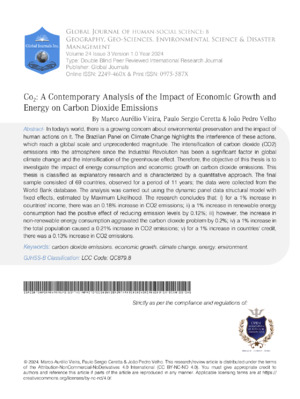
In today’s world, there is a growing concern about environmental preservation and the impact of human actions on it. The Brazilian Panel on Climate Change highlights the interference of these actions, which reach a global scale and unprecedented magnitude. The intensification of carbon dioxide (CO2) emissions into the atmosphere since the Industrial Revolution has been a significant factor in global climate change and the intensification of the greenhouse effect. Therefore, the objective of this thesis is to investigate the impact of energy consumption and economic growth on carbon dioxide emissions. This thesis is classified as explanatory research and is characterized by a quantitative approach. The final sample consisted of 69 countries, observed for a period of 11 years; the data were collected from the World Bank database. The analysis was carried out using the dynamic panel data structural model with fixed effects, estimated by Maximum Likelihood. The research concludes that: i) for a 1% increase in countries’ income, there was an 0.18% increase in CO2 emissions; ii) a 1% increase in renewable energy consumption had the positive effect of reducing emission levels by 0.12%; iii) however, the increase in non-renewable energy consumption aggravated the carbon dioxide problem by 0.2%; iv) a 1% increase in the total population caused a 0.21% increase in CO2 emissions; v) for a 1% increase in countries’ credit, there was a 0.13% increase in CO2 emissions.
João Pedro Velho. 2026. \u201cCO2: A Contemporary Analysis of the Impact of Economic Growth and Energy on Carbon Dioxide Emissions\u201d. Global Journal of Human-Social Science - B: Geography, Environmental Science & Disaster Management GJHSS-B Volume 24 (GJHSS Volume 24 Issue B3): .
Crossref Journal DOI 10.17406/GJHSS
Print ISSN 0975-587X
e-ISSN 2249-460X
The methods for personal identification and authentication are no exception.
Total Score: 103
Country: Brazil
Subject: Global Journal of Human-Social Science - B: Geography, Environmental Science & Disaster Management
Authors: João Pedro Velho, Marco Aurélio Vieira, Paulo Sergio Ceretta, , (PhD/Dr. count: 0)
View Count (all-time): 146
Total Views (Real + Logic): 873
Total Downloads (simulated): 22
Publish Date: 2026 01, Fri
Monthly Totals (Real + Logic):
Neural Networks and Rules-based Systems used to Find Rational and
A Comparative Study of the Effeect of Promotion on Employee
The Problem Managing Bicycling Mobility in Latin American Cities: Ciclovias
Impact of Capillarity-Induced Rising Damp on the Energy Performance of
In today’s world, there is a growing concern about environmental preservation and the impact of human actions on it. The Brazilian Panel on Climate Change highlights the interference of these actions, which reach a global scale and unprecedented magnitude. The intensification of carbon dioxide (CO2) emissions into the atmosphere since the Industrial Revolution has been a significant factor in global climate change and the intensification of the greenhouse effect. Therefore, the objective of this thesis is to investigate the impact of energy consumption and economic growth on carbon dioxide emissions. This thesis is classified as explanatory research and is characterized by a quantitative approach. The final sample consisted of 69 countries, observed for a period of 11 years; the data were collected from the World Bank database. The analysis was carried out using the dynamic panel data structural model with fixed effects, estimated by Maximum Likelihood. The research concludes that: i) for a 1% increase in countries’ income, there was an 0.18% increase in CO2 emissions; ii) a 1% increase in renewable energy consumption had the positive effect of reducing emission levels by 0.12%; iii) however, the increase in non-renewable energy consumption aggravated the carbon dioxide problem by 0.2%; iv) a 1% increase in the total population caused a 0.21% increase in CO2 emissions; v) for a 1% increase in countries’ credit, there was a 0.13% increase in CO2 emissions.
We are currently updating this article page for a better experience.

Lorem ipsum dolor sit amet, consectetur adipiscing elit. Ut elit tellus, luctus nec ullamcorper mattis, pulvinar dapibus leo.































































