## I. INTRODUCTION
The proliferation of technological tools and programming environments provides the opportunity for creative coding activities for children and increases the need for appropriate teaching practices (Papavlasopoulou, Sharma, & Giannakos, 2020). Due to rapid changes in technology, children are increasingly exposed to these systems. This naturally makes children wonder about how objects work or move automatically (Lee and Junoh, 2019). As a result of the opportunities offered by new technological tools and programming environments, coding practices have enabled the design of effective learning experiences (Papavlasopoulou, Giannakos, & Jaccheri, 2019). Coding is a relatively new form of literacy but has become an essential tool for reading, interpreting data and communicating with others in a digital society (Bers, 2018a).
Studies on coding activities have increased in recent years and its effect on many skills has been proven. By participating in coding activities, children learn critical thinking, higher-order thinking, problem solving (Çakır et al., 2021), creative thinking (Çakır et al., 2021), numerical thinking (Tonbuloglu & Tonbuloglu, 2019), executive function (Arfé, Vardanega and Ronconi, 2020), scientific process (Turan & Aydoğan, 2020), algorithmic thinking (Shim & Kwon, 2019), design (Tuomi et al., 2018), logical thinking (Bocconi et al., 2016) and collaboration (also Oliveira et al., 2018) can improve their skills. Constructivist theory clarifies how coding activities can support so many skills. There are strong opinions for children who are supported by a constructivist approach to learn to code (Kafai & Burke, 2015). Constructivism assumes that when children are deeply and actively involved in constructing their own meaningful structures, their interactions with others are strengthened, they structure the learning process themselves, and thus knowledge is gained better (Papavlasopoulou, Giannakos, & Jaccheri, 2019).
Coding-based practices are important for the development of children with normal development, as well as supporting the development of children with special needs (Cannon et al., 2011; Hwang and Taylor, 2016; Israel, Maynard, and Williamson, 2013; Meyen and Greer, 2010; Pennington et al., 2014; Taylor, Vasquez & Donehower, 2017; Taylor, 2018; Van Staden, 2013; Waters & Boon, 2011). Among disability types, students with ASD are educated in more inclusive environments with ever more access to general education curriculum, including STEM education (Fleury et al., 2014). As a result of the social and communication difficulties of children with ASD, opportunities such as repetition and predictability provided by coding activities instead of learning with adults or peers cause them to turn to coding practices (Knight et al., 2019).
Coding is a complex and abstract process; therefore, teaching and learning can be difficult (Çakır et al., 2021). For children with disabilities, this process can be more complex. It is stated that children with disabilities generally underperform in STEM education compared to their typically developing peers (Basham & Marino, 2013). Especially considering the competencies of children with autism, it seems more difficult to design coding activities. Although there are many applications that can help children with ASD, there is little empirical evidence that any of them have positive effects, and these difficulties may be said to be effective (Hourcade et al., 2013). To overcome various obstacles to learning to code (e.g. difficulty, boredom, confusion, etc.), appropriately designed and engaging coding activities are needed (Papavlasopoulou, Giannakos, & Jaccheri, 2019). However, by integrating coding into pedagogical contexts in an intuitive and engaging experience (Sáez-López, Roman-González, & Vázquez-Cano, 2016), all developmental areas of children can be supported with carefully selected and developmentally appropriate coding practices (Bers, 2018).
Research on approaches, models and regulations regarding coding practices for children with autism spectrum disorder (ASD) is limited (Ehsan et al., 2018). As a reflection of this idea, it was aimed to test the effect of coding activities prepared for children with autism.
Within the scope of the research, "Do coding activities support the development of children with autism?" The answer to the question has been sought.
## II. METHOD
### a) Research Model
This study, which focuses on the effects of coding activities on the development of children with autism, was conducted with a single-subject experimental design model based on the quasi-experimental method.
### b) Participants
Five children with autism between the ages of 6 and 8 who were educated in a special education application center in Erzincan city center were included in the study. The teachers' views on the developmental characteristics of children with autism are as follows:
C5: He is 6 years old and a boy. Attention span is very short. He has a focus problem. He often avoids making eye contact. He sometimes exhibits aggressive behavior. His fine motor skills are good. Recognizes colors and numbers. He can mostly follow the instructions. Imitation skills are good, but there is a tendency to repeat the same things. Likes social reinforcers, loves competition.
## III. CODING BASED APPLICATION DESIGN
The application was made using the "Scratch 3.0 Block" based coding tool. The Scratch 3.0 program was downloaded from (https://scratch.mit.edu/download) and installed on the computer. It is planned to carry out activities such as "finding a shadow", "finding a mate", "creating a pattern" and "completion" to be used in the application.
In this context, the animals to be used in the application (https://www.pngwing.com/tr) and "google images" (https://www.google.com.tr/imghp?hl=tr&tab=ri&authuser=0&ogbl) site".png The pictures have been downloaded with the file extension". The shadows of the downloaded animal images were removed using the "Corel Draw" program to use in the "shadow finder" activity.
The activities were carried out in the following order.
Finding Shadow: A blank project page has been opened in Scratch. Colorful images of animals and shadow images made with the "Corel Draw" program were added to the program as puppets. Decor is added from the decor section and the event name is written in the decor editing section. When the command to start the activity is given, the shadows of the animals appear on the screen in order. After the animals appear on the screen, the color image of the animal whose shadow is desired appears in the middle. The positions of the shadows of the animals have been determined and the code has been added. Drag mode, non-drag code has been added to prevent shadows from dragging. In colored animal images, it is determined which animal will appear on the screen, respectively. In order to indicate that if the child carries the image of the colored animal on a wrong animal shadow, a code was written to indicate that the answer would be wrong, so that the colored image would not be placed in the wrong animal shadow and would go back to its middle position.
In Figure 1, visuals related to the design of the shadow finding activity are presented.

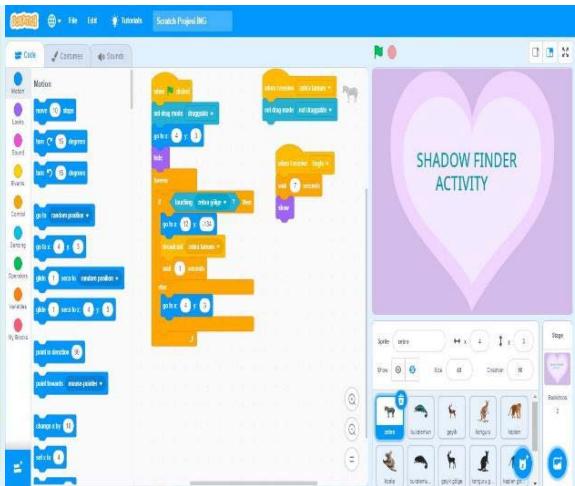 Figure 1: Designing the shadow finding activity
Finding a Spouse: A blank project page has been opened in Scratch. Images of animals were added as puppets twice. Decor is added from the decor section and the event name is written in the decor editing section. The first added dummy will appear on the side. The second added puppet is positioned in the middle in such a way that its size will constantly increase and decrease and its shape will be visible. When the child clicks on the partner of the puppet that appears in the middle, that puppet will disappear and the next puppet will be passed. If he clicks on the wrong dummy, it will not disappear. Code that cannot be dragged into puppets has been written.
In Figure 2, the visuals related to the design of the mate-finding activity are presented.
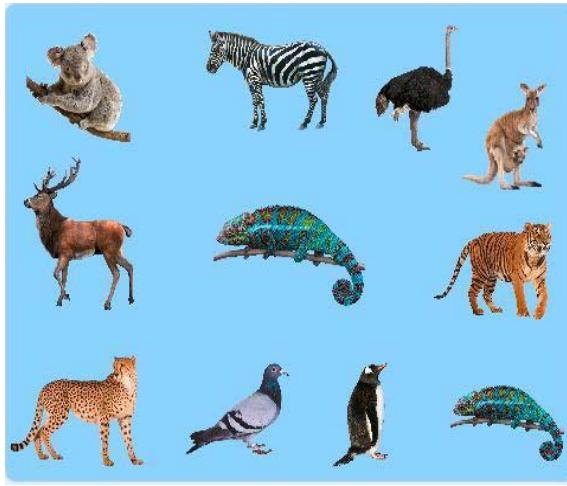
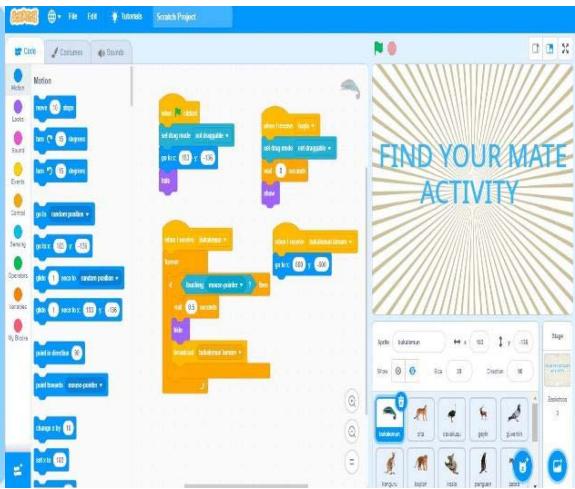 Figure 2: Designing the mate-finding activity
Creating Patterns: A blank project page has been opened in Scratch. Images of animals were added as puppets to form a pattern. A question mark puppet has been added to ask about the next animal. Decor is added from the add decor section and the event name is written on the decor from the decor editing section. After the first animal appeared, attention was drawn by increasing and decreasing its size. Then the second animal appeared and the same attention was drawn by increasing and decreasing the size. Then, the first animal appeared in the third row, again conspicuously. The fourth animal, on the other hand, appeared as a question mark puppet and immediately appeared in both animals in the middle of the screen. If the child chooses the right one of these animals, the pattern will be completed and there will be a transition to the other pattern level. If it makes a wrong pattern, the code is written so that the puppet will not settle and the process will continue until the right pattern is found.
In Figure 3, visuals related to the design of the pattern-making activity are presented.
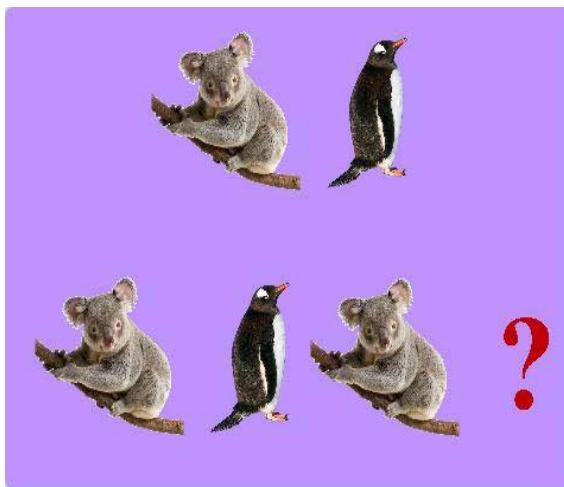
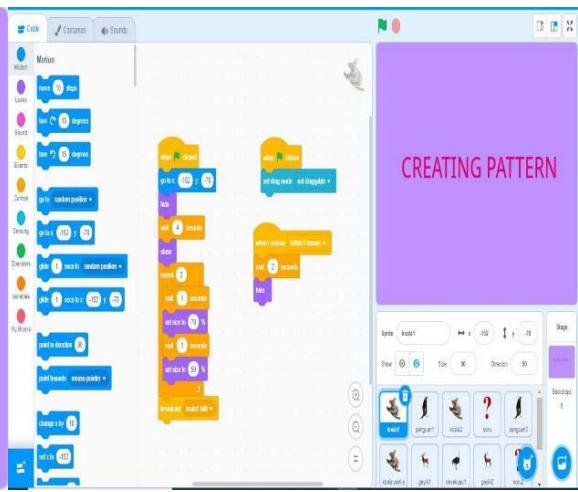 Figure 3: Designing the pattern-making activity
Completion: A blank project page has been opened in Scratch. Animal images to be used are added as puppets. Decor is added from the decor section and the event name is written on the decor from the decor editing section. The added animals are divided into two from the costume editing part and positioned on the screen. Necessary codes have been written so that children can complete the process using either the lower part or the upper part. If the correct match is made, the completed version of the animal will be displayed on the screen. If a wrong completion is made, the puppet will return to its original position and the completion will not take place until the student reaches the correct result. After all the completion process is completed, it will be passed to the vertical completion section.
In Figure 4, visuals related to the design of the completion activity are presented.
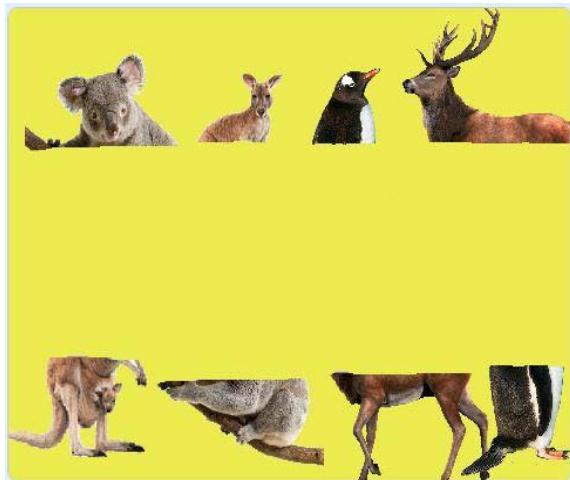
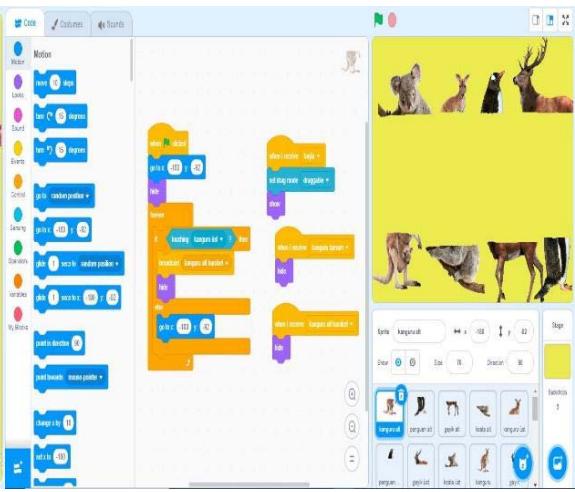 Figure 4: Designing the completion activity
### a) Implementation Process
Before the implementation phase, information about the developmental characteristics of the children was collected. In this context, information was obtained from the school administrator about the demographic information of the children, the types and degrees of disability. Afterwards, the children's teachers were interviewed one by one and information was given about the application, and feedback was received on whether the children could participate in the application. It was thought that the use of animals with autism in coding activities would leave more lasting effects, since animals show vitality with their voices and movements and are interesting creatures. The names of the animals in a list with images of different animals were asked to the children, and it was determined which animals they did not know. Animals such as cats, dogs, horses and chickens that children with autism frequently see in their environment were considered to be used in practice, but in order to determine the effectiveness of the program in acquiring concept knowledge, it was decided to use mostly animals whose names the children did not know. In this context, animal images such as chameleon, cheetah, ostrich, deer, pigeon, kangaroo, tiger, koala, penguin and zebra were used.
The application was carried out two days a week for two weeks. The applications were completed in four sessions: "shadow finding", "matching", "patterning" and "completion". The applications were carried out in an empty practice class under the supervision of a teacher in the classroom where the children were educated. The children took turns coming to the application class with their teachers from their classrooms, and one-to-one application was made by the researchers. During the application, the teachers both supported the researcher in the orientation of the children to the activities and were in the application class as an observer. Children were not interfered with during the application, and they were expected to experience the activities to be done by noticing them.
In Figure 5, visuals related to the implementation of coding activities are presented.
For children who did not understand the application, the researcher made an exemplary application and became a model for the child, and then the child was given the opportunity to experience the activity again. The applications were made to the children twice. In each session, the activity done in the previous session was repeated and the children were reinforced. The applications took approximately 10-15 minutes for each session and child. Since children with autism will have more health problems than children with normal development in general, the pandemic process was taken into consideration, shielding, mask and gloves were worn during the application, and cleaning rules were meticulously observed.
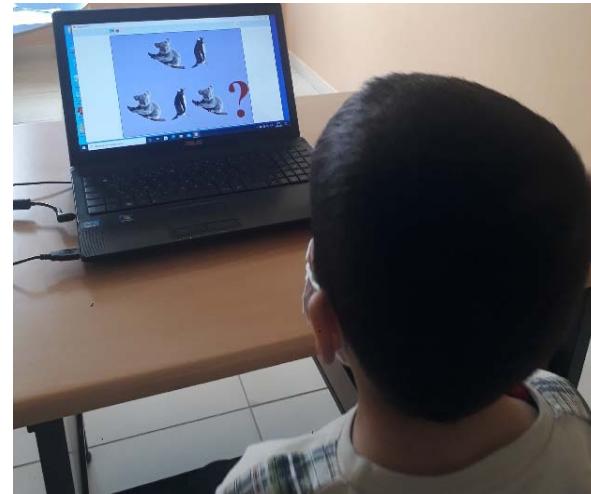
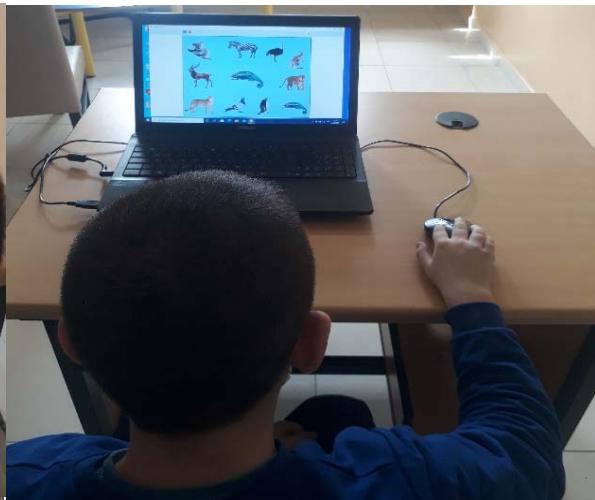
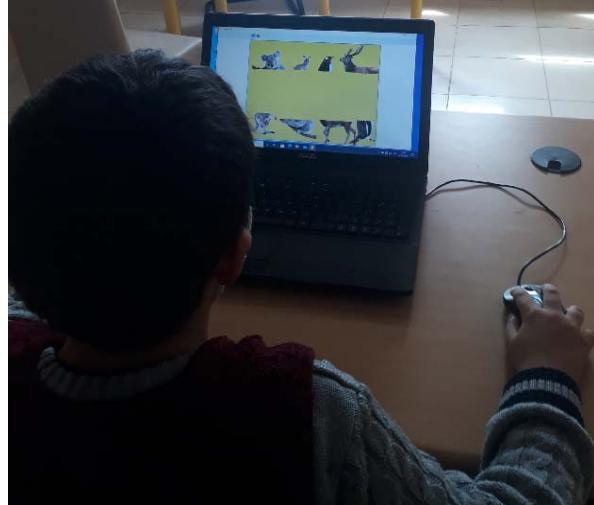
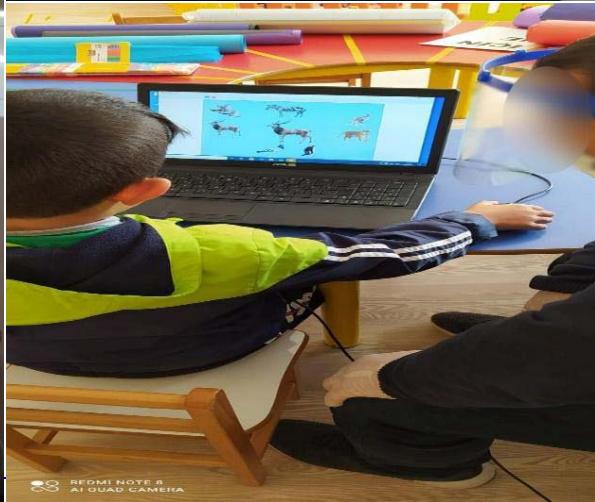 Figure 5: Implementation of coding activities
### b) Measures
Dunn Sensory Profile, Interview Form, Questionnaire Form and Concept Evaluation Form were used in the research.
Dunn Sensory Profile: Developed by Winnie Dunn (1999), Kayihan et al. (2015), the assessment tool, adapted to Turkish culture, measures the sensory profile of children aged 3-10 years. The test is completed by the person (parent or caregiver) with whom the child has one-to-one contact in his daily life. The Sensory Profile Test consists of three parts: sensory processing, modulation (concentration), behavioral and emotional responses. In this study, the multi-sensory processing (7 questions) subsection of the sensory processing
section was used. During the test, it is asked how often the child does the behavior specified in each question. In response to each question: always (0% of time for normal behavior), often (25% of time for normal behavior), sometimes (time for normal behavior 50% of time), rarely (time for normal behavior% of time) 75), never (normal behavior duration 100% of the time), is asked to tick one of the options. While statistical evaluation is made, scoring is made from 1 to 5, with "always" 1 point and "never" 5 points. In this evaluation, 1 point indicates the situation with the most impaired behavior related to the sensory profile and 5 points indicate the situation with completely normal behavior.
Interview Form: This form was developed by the researcher in order to determine the contribution of teachers' coding activities to children with autism. In the form, questions were asked to the teachers about the behaviors they observed in children and their achievements during and after the coding activities.
Questionnaire Form: This form consists of closed-ended questions to measure the general competencies of children with autism (attention, visual perception, reaction to stimuli and compliance with instructions) and application competencies (shading, finding a partner, creating and completing a pattern) of teachers' coding activities. The questionnaire is scored between 1-5. While 1 point indicates the lowest level of skill, 5 points indicate the highest level of skill.
Concept Evaluation Form: This form was created by the researcher. Animal pictures are shown while applying the form. When the picture is shown to the child, "What is it called?" and if he knows, the "knows" tab is marked, if he does not know, the "doesn't know" tab is marked. Children were asked about the names of animals such as chameleon, cheetah, ostrich, deer, pigeon, kangaroo, tiger, koala, penguin and zebra.
### c) Data Collection
Before collecting the data, necessary permissions were obtained from the Human Research Ethics Committee of Erzincan Binali Yildirim University (Protocol No: 04/07, Date: 31/03/2021). Information was given about the purpose of the researcher and the application process by interviewing school administrators and teachers. Afterwards, the parents of the children were interviewed, detailed explanations were made about the purpose and importance of the coding activities to be applied to the children, their contributions to the children, and the implementation process, and they were asked to sign the parent consent form. Dunn Sensory Profile was applied to the mothers before and after the application. The questionnaire form was applied to the teachers before and after the application. The interview form was applied to the teachers after the application. The Concept Evaluation form was applied to the children before and after the application.
### d) Analysis of Data
In the study, t-test was performed for dependent samples in the analysis of the data obtained from the Dunn Sensory Profile. Thus, it was tested whether there was a significant difference between the pretest and posttest. Average scores were obtained in the questionnaire form applied to the teachers, and thus, comments were made about the results before and after the training. Interviews with teachers were reported using descriptive analysis method. The results obtained from the concept evaluation form were compared by making percentage calculations.
## IV. RESULTS
### a) Data Obtained from Mothers
The pretest-posttest results of the multiple sensory processing scores of children with autism are given in Table 1.
Table 1: T-Test Results for Dependent Samples Regarding the Difference Between Multisensory Processing Post-Test Scores and Pre-Test Scores of Children with Autism
<table><tr><td>Dependent variable</td><td>Group</td><td>n</td><td>X̄</td><td>SS</td><td>Sd</td><td>t</td><td>p</td></tr><tr><td rowspan="2">Multi-sensory Processing</td><td>Pre-Test</td><td>5</td><td>17,40</td><td>2,96</td><td rowspan="2">4</td><td rowspan="2">-2,994</td><td rowspan="2">,040</td></tr><tr><td>Post-Test</td><td>5</td><td>22,00</td><td>1,41</td></tr></table>
When Table 1 is examined, it is seen that the multi-sensory processing post-test scores of children with autism are significantly higher than the pre-test scores. Accordingly, it can be said that coding activities have a significant effect on the multi-sensory processing scores of children with autism.
Data Obtained from Teachers
#### 1. Results Obtained from the Interview Form
C1's Teacher: After the practice, the children began to say the names of the animals. Although the implementation period of the activities was short, he learned new animal names. It focused more easily on coding activities than our activity apps. Attention span increased. Because the activities caught the attention of the child. Motor skills and hand-eye coordination improved. He started to use the laptop mouse better. His visual perception is better developed. The ability to imitate has improved. He started making the movements and sounds of the animals he learned.
C2's Teacher: Thanks to the coding activities, the child learned animals that he did not know before. He wasn't normally a boy who made his reactions clear. However, it was obvious that he was having fun during this event. At first, he was hesitant to come to class for practice. When she saw that the activities were fun, she started to give positive reactions. Completion and matching activities in coding activities improved his attention.
C4's Teacher: Visually, it became a more permanent application. The child is already interested in the digital environment. So it was about coding activities. After the application, the number of animals he knew increased. Focus time lapsed. He was very enthusiastic about coming to the practice class. As his interest increased, his swinging behavior decreased during the activity. He paid more attention to the instructions given about the activity and directed towards the goal.
C5's Teacher: He confused the concepts as he had difficulty in memorizing what he had learned. At first, he could not complete the activities. But then he focused. He was very excited while doing the activities. He was making better eye contact during the application. I once asked him if he liked the activities. He said that he liked it very much, that he was happy. He was very careful in finding the shadow of animals at events.
#### 2. Results Obtained from the Questionnaire Form
Table 2 shows the average of the results of the answers given by the teachers before and after the application on general competence and practical competences of children with autism.
Table 2: Results Obtained from the Questionnaire Form
<table><tr><td>Features</td><td>Before
application (X̄)</td><td>After
(application (X̄))</td></tr><tr><td>General qualification items</td><td></td><td></td></tr><tr><td>1. The child has a good attention span, the child is focused.</td><td>2,4</td><td>3,6</td></tr><tr><td>2. The child's visual perception level is high.</td><td>3</td><td>3,4</td></tr><tr><td>3. The child responds positively to different/interesting stimuli.</td><td>2,4</td><td>3</td></tr><tr><td>4. The child acts in accordance with the instructions.</td><td>1,8</td><td>2,4</td></tr><tr><td>Application-related items</td><td></td><td></td></tr><tr><td>1. The child matches the given object with its shadow.</td><td>3,2</td><td>3,4</td></tr><tr><td>2. The child finds the match of the given objects.</td><td>3,2</td><td>3,4</td></tr><tr><td>3. The child places the appropriate object in the empty place in a given pattern.</td><td>3,2</td><td>3,4</td></tr><tr><td>4. The child completes half by finding the other half of the given object.</td><td>3</td><td>3,4</td></tr></table>
When Table 2 is examined, it is seen that the post-training averages of children's attention, visual perception, reaction to different/interesting stimuli, and acting in accordance with instructions have increased compared to pre-education. When the results of the application skills are examined, it can be said that the skills of finding the match of the objects, completing the pattern, finding the other half of the objects and matching the objects increased after the training.
### b) Results from Children
The results of the answers given by the children with autism regarding the concept evaluation form before and after the application are presented in Table 3.
Table 3: Results of the Concept Evaluation Form
<table><tr><td>Sequence
No.</td><td>Concepts</td><td colspan="2">Before
application</td><td colspan="2">After
application</td></tr><tr><td></td><td></td><td>Know</td><td>Don't
know</td><td>Know</td><td>Don't
know</td></tr><tr><td>1</td><td>Chameleon</td><td>-</td><td>5</td><td>1</td><td>4</td></tr><tr><td>2</td><td>Cheetah</td><td>-</td><td>5</td><td>2</td><td>3</td></tr><tr><td>3</td><td>Ostrich</td><td>-</td><td>5</td><td>2</td><td>3</td></tr><tr><td>4</td><td>Deer</td><td>1</td><td>4</td><td>2</td><td>3</td></tr><tr><td>5</td><td>Pigeon</td><td>-</td><td>5</td><td>1</td><td>4</td></tr><tr><td>6</td><td>Kangaroo</td><td>1</td><td>4</td><td>3</td><td>2</td></tr><tr><td>7</td><td>Tiger</td><td>-</td><td>5</td><td>4</td><td>1</td></tr><tr><td>8</td><td>Koala</td><td>-</td><td>5</td><td>1</td><td>4</td></tr><tr><td>9</td><td>Penguin</td><td>2</td><td>3</td><td>4</td><td>1</td></tr><tr><td>10</td><td>Zebra</td><td>1</td><td>4</td><td>2</td><td>3</td></tr><tr><td></td><td>Total (f)</td><td>5</td><td>45</td><td>22</td><td>28</td></tr><tr><td></td><td>Total (%)</td><td>%10</td><td>% 90</td><td>%44</td><td>% 56</td></tr><tr><td></td><td>Rise (%)</td><td></td><td colspan="3">%44-%10=%34</td></tr></table>
While the number of animals children knew before the application was five (10%), the children knew the names of 22 (44%) animals after the application. The rate of increase in the number of animals that children know has been determined as $34\%$.
## V. DISCUSSION AND CONCLUSION
According to the results obtained from the evaluation form applied to the mothers, it was determined that the multi-sensory processing skills of the children with autism increased significantly after the education compared to the pre-education. The visuality of coding activities, their attractiveness, the opportunity for children to observe the results of the activities, and the fact that they provide opportunities such as giving instructions during the application can support their sensory development. According to our research, there is no research to determine the effect of coding activities on the sensory processing skills of children with autism. However, since providing more stimuli to children with autism supports their sensory processing skills (Case-Smith, Weaver, & Fristad, 2015), coding activities are likely to support their sensory processing skills. Children with special needs show lower performance in STEM applications than their peers (Basham & Marino, 2013). However, coding activities prepared in line with the developmental characteristics of the disabled and especially the children with autism, who are in the more disadvantaged group in terms of sensory processing skills, can support their development at a higher level.
According to the results obtained from the questionnaire form applied to the teachers, it was concluded that coding activities increased the attention, visual perception, interest and ability to act in accordance with the instructions of children with autism. However, after the application, children with autism compared the objects before the application; It was determined that the ability to find the shadow of objects and create patterns increased. According to the results obtained from the open-ended questionnaire applied to the teachers, it was determined that coding activities increased the skills of children with autism such as vocabulary, attention/focus time, motor skills, hand-eye coordination, visual perception, imitation ability, interest, having fun, keeping in mind, and making eye contact. has been done. Coding activities support children's skills as they include interesting and fun applications. It is stated that integrating coding into pedagogical contexts in an intuitive and interesting experience can change children's skills such as logic, critical thinking, problem solving and their attitudes towards computer use (Sáez-López, Roman-González, & Vázquez-Cano, 2016). It has been revealed that applications made with robotic coding improve the cooperation (Wainer et al., 2010), communication (Knight et al., 2019), hand-eye coordination (Sullivan & Bers, 2013) and basic collection (Yikmis, 2016) skills of children with autism.
According to the concept knowledge form applied to children with autism, it was determined that the concept knowledge after education (44%) increased significantly compared to before education (10%). Since coding activities offer visual stimuli, the concept information of the visual is better memorized and remembered better when asked. Studies to determine the effect of coding activities on the concept knowledge of children with autism are limited. When technology-based studies were examined, activities were applied using multimedia to teach children with autism to verbally describe letters, syllables, words, text, reading comprehension and composition. As a result of the research, improvements were recorded in sentence writing, phonological synthesis skills and writing skills of children with autism (Basil & Reyes, 2003). Similarly, multi-sensory coding strategies applied to hearing- impaired children were found to be effective in the development of reading and vocabulary skills (Van Staden, 2013).
There is limited research on STEM teaching; It is stated that there are no studies evaluating coding, robotic or programming skills as dependent variables. However, research has pointed out the problems that students with disabilities may encounter during their performance in STEM education. However, among these, very few have openly discussed issues related to individuals with autism spectrum disorder (ASD) (Ehsan et al., 2018). This research is an important research in terms of filling the gap in terms of investigating the effect of coding activities for children with autism. However, it is considered important to ground the research within the framework of constructivist theory. Coding is the area where constructivism theory is widely applied (Kafai & Burke, 2015). According to this theory, learning is gained to the extent that children experience the active construction of works that can be seen by the world and are acquired through doing (Papavlasopoulou, Giannakos, & Jaccheri, 2019). In line with this view, the research was based on coding activities, children were expected to complete the activities themselves, they were not intervened unless it was necessary, and they were supported by giving positive feedback.
In the study, the effects of coding activities on many developmental characteristics of children with autism were tested. The results reveal that coding activities make significant contributions to the development of children with autism. In fact, coding events are now featured on many digital event pages. However, these activities should be programmed within the framework of their competencies, taking into account the developmental characteristics of children with autism. In this context, priority should be given to designing coding activities aimed at acquiring basic skills for children with autism. Technology classes should be established in schools where children with autism are educated, and digital-based activities should be offered within the framework of the program. Practical training on digital activities and applications should be given to teachers of children with autism and special education teacher candidates. Researchers should design coding activities for children with moderate and severe autism disabilities and their effects on different developmental areas should be tested.
### a) Limitations
Since the research was conducted during the pandemic period, it was able to be conducted on five children. Because parents do not want to send their children with autism to school due to the epidemic. However, since the designed activities are not suitable for children with moderate and severe autism, they were not applied to more children. The language and intellectual disability problems of children with moderate and severe autism were not included in the study, since children's problems in understanding the instructions and giving appropriate answers to the instructions were limited. Another limitation of the study is children's difficulties in using the computer mouse. As a contribution of some teachers coding activities; Although hand-eye coordination improved because children used mice during activities, some children had difficulty using mice. Considering this limitation, subsequent researchers on the subject can apply coding activities using touch screens, taking into account the developmental characteristics of children.
Generating HTML Viewer...
References
15 Cites in Article
Barbara Arfé,Tullio Vardanega,Lucia Ronconi (2020). The effects of coding on children's planning and inhibition skills.
James Basham,Matthew Marino (2013). Understanding STEM Education and Supporting Students through Universal Design for Learning.
M Bers (2018). Coding as a literacy for the 21st century.
S Bocconi,A Chioccariello,G Dettori,A Ferrari,K Engelhardt (2016). Developing computational thinking in compulsory education -Implications for policy and practice.
J Cannon,S Easterbrooks,P Gagne,J Beal-Alvarez (2011). Improving DHH Students' Grammar Through an Individualized Software Program.
Jane Case-Smith,Lindy Weaver,Mary Fristad (2015). A systematic review of sensory processing interventions for children with autism spectrum disorders.
Recep Çakır,Özgen Korkmaz,Önder İdil,Feray Uğur Erdoğmuş (2021). The effect of robotic coding education on preschoolers’ problem solving and creative thinking skills.
Caio De Oliveira,Edna Canedo,Henrique Faria,Luis Amaral,Rodrigo Bonifacio (2018). Improving Student’s Learning and Cooperation Skills Using Coding Dojos (In the Wild!).
Winnie Dunn (1999). Sensory Profile.
S Turan,F Aydoğdu (2020). Effect of coding and robotic education on pre-school children's skills of scientific process.
Annalene Van Staden (2013). An evaluation of an intervention using sign language and multi-sensory coding to support word learning and reading comprehension of deaf signing children.
J Wainer,E Ferrari,K Dautenhahn,B Robins (2010). The effectiveness of using a robotics class to foster collaboration among groups of children with autism in an exploratory study.
No ethics committee approval was required for this article type.
Data Availability
Not applicable for this article.
How to Cite This Article
Fatih Aydogdu. 2026. \u201cCoding Activities for Children with Autism: A Sample Application\u201d. Global Journal of Human-Social Science - G: Linguistics & Education GJHSS-G Volume 23 (GJHSS Volume 23 Issue G8): .
Explore published articles in an immersive Augmented Reality environment. Our platform converts research papers into interactive 3D books, allowing readers to view and interact with content using AR and VR compatible devices.
Your published article is automatically converted into a realistic 3D book. Flip through pages and read research papers in a more engaging and interactive format.
Our website is actively being updated, and changes may occur frequently. Please clear your browser cache if needed. For feedback or error reporting, please email [email protected]
Thank you for connecting with us. We will respond to you shortly.