Colonial Traces of Fractionalization: The Possibilities of Africa Moving Beyond the Walls to a Sustained Growth

§ University of Nebraska at Omaha University of Nebraska at Omaha

Send Message

To: Author

Colonial Traces of Fractionalization: The Possibilities of Africa Moving Beyond the Walls to a Sustained Growth

Article Fingerprint

ReserarchID

MBRM27Z3

Colonial Traces of Fractionalization: The Possibilities of Africa Moving Beyond the Walls to a Sustained Growth Banner

AI TAKEAWAY

Connecting with the Eternal Ground
  • English
  • Afrikaans
  • Albanian
  • Amharic
  • Arabic
  • Armenian
  • Azerbaijani
  • Basque
  • Belarusian
  • Bengali
  • Bosnian
  • Bulgarian
  • Catalan
  • Cebuano
  • Chichewa
  • Chinese (Simplified)
  • Chinese (Traditional)
  • Corsican
  • Croatian
  • Czech
  • Danish
  • Dutch
  • Esperanto
  • Estonian
  • Filipino
  • Finnish
  • French
  • Frisian
  • Galician
  • Georgian
  • German
  • Greek
  • Gujarati
  • Haitian Creole
  • Hausa
  • Hawaiian
  • Hebrew
  • Hindi
  • Hmong
  • Hungarian
  • Icelandic
  • Igbo
  • Indonesian
  • Irish
  • Italian
  • Japanese
  • Javanese
  • Kannada
  • Kazakh
  • Khmer
  • Korean
  • Kurdish (Kurmanji)
  • Kyrgyz
  • Lao
  • Latin
  • Latvian
  • Lithuanian
  • Luxembourgish
  • Macedonian
  • Malagasy
  • Malay
  • Malayalam
  • Maltese
  • Maori
  • Marathi
  • Mongolian
  • Myanmar (Burmese)
  • Nepali
  • Norwegian
  • Pashto
  • Persian
  • Polish
  • Portuguese
  • Punjabi
  • Romanian
  • Russian
  • Samoan
  • Scots Gaelic
  • Serbian
  • Sesotho
  • Shona
  • Sindhi
  • Sinhala
  • Slovak
  • Slovenian
  • Somali
  • Spanish
  • Sundanese
  • Swahili
  • Swedish
  • Tajik
  • Tamil
  • Telugu
  • Thai
  • Turkish
  • Ukrainian
  • Urdu
  • Uzbek
  • Vietnamese
  • Welsh
  • Xhosa
  • Yiddish
  • Yoruba
  • Zulu
Font Type
Font Size
Font Size
Bedground

Abstract

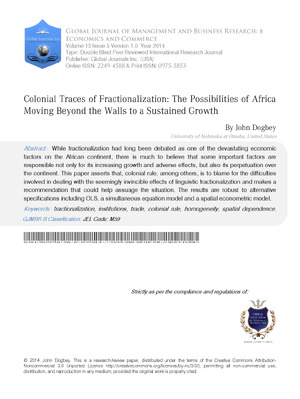
While fractionalization had long been debated as one of the devastating economic factors on the African continent, there is much to believe that some important factors are responsible not only for its increasing growth and adverse effects, but also its perpetuation over the continent. This paper asserts that, colonial rule, among others, is to blame for the difficulties involved in dealing with the seemingly invincible effects of linguistic fractionalization and makes a recommendation that could help assuage the situation. The results are robust to alternative specifications including OLS, a simultaneous equation model and a spatial econometric model.

References

15 Cites in Article
  1. Alesina Alberto,Devleescjauwer Arnaud,Easterly William,Kurlat Sergio,Romain Wacziarg (2003). Fractionalization.
  2. Robert Barro (1991). Economic Growth in a Cross Section of Countries.
  3. Bertocchi Graziella,Fabio Canova (2002). Did colonization matter for growth? An Empirical exploration into the historical causes of Africa's underdevelopment.
  4. Barry Chiswick (2008). The Economics of Language: An Introduction and Overview.
  5. A Cohen (1969). Customs and Politics in Urban Africa.
  6. Collier Paul (1993). Ethnicity, Politics, and Economics Performance.
  7. Easterly William (2001). Can institutions resolve ethnic conflicts?.
  8. Easterly William,Ross Levine (1997). Africa's Growth Tragedy: Policies and Ethnic Ethnic Divisions.
  9. Robin Grier (1999). Colonial legacies and economic growth.
  10. Knack Stephen,Philip Keefer (1997). Does Social Capital Have an Economic Payoff? A 10. Cross-country Investigation.
  11. T Leeson,Peter (2005). Endogenizing fractionalization.
  12. A Rubinstein (1998). Economics and Language.
  13. Adam Smith (1776). An Inquiry into the Nature and Causes of the Wealth of Nations.
  14. J Thornton (1995). Africa and Africans in the Making of the Atlantic World.
  15. J Vansina (1968). Long-distance trade-routs in central Africa.

Funding

No external funding was declared for this work.

Conflict of Interest

The authors declare no conflict of interest.

Ethical Approval

No ethics committee approval was required for this article type.

Data Availability

Not applicable for this article.

How to Cite This Article

John Dogbey. 2014. "Colonial Traces of Fractionalization: The Possibilities of Africa Moving Beyond the Walls to a Sustained Growth". Global Journal of Management and Business Research, Global Journal of Management and Business Research - B: Economic & Commerce GJMBR-B Volume 14 (GJMBR Volume 14 Issue B5).
Download Citation

Journal Specifications

Crossref Journal DOI 10.17406/GJMBR

Print ISSN 0975-5853

e-ISSN 2249-4588

Keywords
Classification
GJMBR-B Classification JEL Code: M59
Version of record

v1.2

Issue date
September 3, 2014

Language
English
Experiance in AR

Explore published articles in an immersive Augmented Reality environment. Our platform converts research papers into interactive 3D books, allowing readers to view and interact with content using AR and VR compatible devices.

Read in 3D

Your published article is automatically converted into a realistic 3D book. Flip through pages and read research papers in a more engaging and interactive format.

Article Matrices
Total Views: 1.2K
Total Downloads: 100
All Trends

Request Access

Please fill out the form below to request access to this research paper. Your request will be reviewed by the editorial or author team.
X

This is the heading

Lorem ipsum dolor sit amet, consectetur adipiscing elit. Ut elit tellus, luctus nec ullamcorper mattis, pulvinar dapibus leo.


High-quality academic research articles on global topics and journals.

Colonial Traces of Fractionalization: The Possibilities of Africa Moving Beyond the Walls to a Sustained Growth

John Dogbey
John Dogbey University of Nebraska at Omaha