0. INTRODUCTION
- In particle physics, six leptons and six antileptons are labelled by a group of unified three symbols , , (00.1), which are their identity quantum numbers in particle community.
The values of and are illustrated in Table1 below, in which there are all together 36 positions filled with integers and zero.
Experimental scientists discover: , and are conserved separately in weak interactions for leptons and their antileptons. especially the sum are conserved too, which are along with the horizontal direction in Table1 [1]
Theoretical scientists wonder: Is there an unified math approach which could explain Where The values, integers , and zero, of of leptons and of antileptons, that appear in Table1, come from?
- The experimental searchers for neutrino oscillations, they obtain Pontecorvo-Maki-Nakagawa-Sakata Matrix, PMNS [2], which is the extremely perfect achievement from their spirits of awe and adventure. long time persistent effor in analysing the data collected from weak interaction. There are many profound digits appear in the nine elements of PMNS that given in Matrix(1) and Matrix(2) below.
Theoretical searchers wonder: the origin of these mysterious digits, that occupy the elements of these matrices, where the odd digit arrangements come from?
| Particle | Lepton number L | II | Electron Lepton number Le | Muon Lepton number Lμ | Tau Lepton number Lτ |
| νe | +1 | | | +1 | 0 | 0 |
| e- | +1 | | | +1 | 0 | 0 |
| νμ | +1 | | | 0 | +1 | 0 |
| μ- | +1 | | | 0 | +1 | 0 |
| ντ | +1 | | | 0 | 0 | +1 |
| τ- | +1 | | | 0 | 0 | +1 |
| — | — | — | — | — | |
| νe | -1 | | | -1 | 0 | 0 |
| e+ | -1 | | | -1 | 0 | 0 |
| νμ | -1 | | | 0 | -1 | 0 |
| μ+ | -1 | | | 0 | -1 | 0 |
| ντ | -1 | | | 0 | 0 | -1 |
| τ+ | -1 | | | 0 | 0 | -1 |
| — | — | — | — | — | |
| Anti Particle | Lepton number L | II | Electron Lepton number Le | Muon Lepton number Lμ | Tau Lepton number Lτ |
Matrix(1)
" The UPMNS looks very different from that of CKM, which is very diagonal. The leptonic sector is characterized by a very lare degree of mixing. As of today, the origin of this pattern remains an unsolved and profound puzzle!". André Rubbia [3] And
Matrix(2) As of today, assuming the unitary of the matrix and three active neutrinos, the absolute values of the elements of the matrix are estimated from a global fit of all measurements, which gives (Esteban et al., 2020) " PASCAL PAGANINI [4]
And
Matrix(3)
Matrix(0)
The magnitudes of the element digits of PMNS in Matrix(1) and Matrix(2) could be graphical approached by the circle areas in Matrix(3) qualitatively above [5]. Andzel J. Buras:
" The explanation of these patterns and in particular why they differ from each other remains an important goal of the theorists. " and " Why the mixing angles of CKM matrix so small and those of PMNS matrix rather large? "
1. COLOR OF FLAVOR OF LEPTONS
This paper attempts to explore and answer the above two "come from? " questions. So two concepts of • Color Similarity and • lepton color are introduced following
Current particle physics shows an amazing Flavor Similarity between three generations of quark and those of leptons below
Since six quarks and six antiquarks have been unified by means of " fundamental color representation of six flavor of quarks and their six antiquarks [6,7,8,9,10], And in this idea, why not continues to have a try to do the six flavor of leptons and the six antileptons? That is, besides Flovor Similarity (0.00), there may be
Base on (0.00), This paper postulates an ansatz, If the six fermion leptons & their antileptons (0.00) also are attributed to color degree of freedom as six fermion quarks & their antiquarks were done in Stand Model historically, and then the third component isospin of a lepton could be written by • lepton color , as below
Or details
Further we, very naturally, could obtain a universal color representation of leptons and antileptons below, which is the analogous to that of quarks [7]. And isospin (0.0) is an underlying classifications of three generation of leptons.
| lepton flavor r | ντ | | | νμ | | | νe | ||| | e- | | | μ- | | | τ- |
| I3(lα) | I3(vτ)+5/2 | | | I3(vμ)+3/2 | | | I3(ve)+1/2 | ||| | I3(e-) -1/2 | | | I3(μ-) -3/2 | | | I3(τ-) -5/2 |
| la | ντR | ντG | ντB | | | νeR | νeG | νeB | | | μR- μG- μB- | | | τR- τG- τB- |
| lRGB | +3/2 | +5/2 | +7/2 | | | -1/2 | +1/2 | +3/2 | | | -5/2 | -3/2 | -1/2 |
| ντR+ντG+ντB | | | νμR+νμG+νμB | | | νeR+νeG+νeB | | | eR+eG+eB | | | μR+μG+μB- | | | τR+τG+τB- | |
| +15/2 | +9/2 | +3/2 | -3/2 | -9/2 | -15/2 | ||||||
| anti-lepton flavor r | ντ | | | νμ | | | νe | ||| | e+ | | | μ+ | | | τ+ |
| I3(lα) | I3(vτ)-5/2 | | | I3(vμ)-3/2 | | | I3(ve)-1/2 | ||| | I3(e+) +1/2 | | | I3(μ+) +3/2 | | | I3(τ+) +5/2 |
| lα | ντR | ντG | ντB | | | νeR | νeG | νeB | | | μR+ μG+ μB+ | | | τR+ τG+ τB+ |
| lRGB | -3/2 | -5/2 | -7/2 | | | +1/2 | -1/2 | -3/2 | | | +5/2 | +3/2 | +1/2 |
| ντR+ντG+ντB | | | νμR+νμG+νμB | | | νeR+νeG+νeB | | | eR+eG+eB | | | μR+ μG+ μB+ | | | τR+ τG+ τB+ | |
| -15/2 | -9/2 | -3/2 | +9/6 = +3/2 | +27/6 = +9/2 | +45/6 = +15/2 |
- Remark: we see the color values of each lepton in Table2 are selected from the third components of one-half spin below
Comparability between color freedom of quarks [1] and that of leptons above:
Quark are closed-color, color confinement, quark color one-sixth series [7]
Lepton are opened-color, color freer, lepton color one-half series (0.7).
Both quark and lepton are the third components of Non-Hermitian spin angular momentum in Spin Topological Space STS.[11]. and are Hermitian operators in STS.
This paper are particular about neutrino lepton numbers, further Table1 is down to Table3 below
| Particle | Lepton number L | | | Electron Lepton number Le | Muon Lepton number Lμ | Tau Lepton number Lτ |
| νe | +1 | | +1 | 0 | 0 |
| νμ | +1 | | 0 | +1 | 0 |
| ντ | +1 | | 0 | 0 | +1 |
2. COLOR SCALAR PRODUCTS OF NEUTRINO LEPTON NUMBER
Inspire with the idea of quarkcolor scalar product [10] and base on ansatz, Color Similarity mentioned previously, further an amusing leptoncolor scalar product is introduced to essential of lepton numbers of six leptons and six antileptons in Table1. This paper lays emphases on neutral leptons, neutrinos, then the leptoncolor scalar product representations of Table 3 are given on details following (0)
Matrix(4)
Matrix(5)
Matrix(5) is the digit graph of lepton number conservation (Table1).
From now on, we discuss the case of the left handed neutrino family
Example of in expression (0) with Table3 below (left handed neutrino ) is given explicitly following
and lepton weak interaction paring
Further
Finally
The processes of the eight other elements in expression (0) could be obtained as the same way (as notation " " following:
3. COLOR SCALAR PRODUCTS OF BROKEN NEUTRINO LEPTON NUMBER
Definition of Broken Neutrino Lepton Number
Where below
- Leptoncolor broken of lepton weak interaction paring in neutrino flavor oscillations are given following
OR
Using Table2 and (11.1),(11.2),(11.3), the nine elements in expression (10) could be obtained following:
An example of color scalar products with (12.1) are given below
As the same way (as notation "♦")
The above three results are put into (10), obtain below
L _ {\text{Broken}} (v) = \left( \begin{array}{c c c c} \overrightarrow{v _ {e} ^ {\dagger}} & \overrightarrow{n} _ {e} & \overrightarrow{v _ {e} ^ {\dagger}} & \overrightarrow{n} _ {\mu} \\\overrightarrow{v _ {\mu} ^ {\dagger}} & \overrightarrow{n} _ {e} & \overrightarrow{v _ {\mu} ^ {\dagger}} & \overrightarrow{n} _ {\mu} \\\overrightarrow{v _ {\tau} ^ {\dagger}} & \overrightarrow{n} _ {e} & \overrightarrow{v _ {\tau} ^ {\dagger}} & \overrightarrow{n} _ {\mu} \end{array} \right) = \left( \begin{array}{c c c c} \frac{- 120}{260} & \frac{+ 94}{260} & \frac{+ 26}{260} & 0.000 \\\frac{+ 60}{260} & \frac{- 177}{260} & \frac{+ 117}{260} & 0.000 \\\frac{+ 60}{260} & \frac{+ 83}{260} & \frac{- 143}{260} & 0.000 \\0.000 & 0.000 & 0.000 & \frac{- 440}{260} = \frac{- 22}{13} \end{array} \right) = \left( \begin{array}{c c c c} [A] & [D] & [F] \\[E] & [B] & [H] \\[G] & [I] & [C] \end{array} \right) \tag{13}Matrix(6)
Matrix(7)
Matrix(7) is the digit graph of broken neutrino lepton number .
4. NEUTRINO MASS LEPTON NUMBER , NEUTRINO LEPTON COUPLING CONSTANT AND PMNS
Plus (0) and (13), Obtain (14) below
We call the right term in expression (14), Neutrino Mass Lepton Number below
Introduce a marvellous constant, (16)
Multiply (16) and (15), (or Matrix(10) below)
\begin{array}{l} \mathsf{G} _ {L} (\upsilon) \cdot \mathsf{L} _ {\text{Mass}} (\upsilon) \\= \mathsf{G} _ {L} (v) \cdot \left( \begin{array}{c c c c} \frac{+ 1 4 0}{2 6 0} & \frac{+ 9 4}{2 6 0} & \frac{+ 2 6}{2 6 0} & 1.0 0 0 \\\frac{+ 6 0}{2 6 0} & \frac{+ 8 3}{2 6 0} & \frac{+ 1 1 7}{2 6 0} & 1.0 0 0 \\\frac{+ 6 0}{2 6 0} & \frac{+ 8 3}{2 6 0} & \frac{+ 1 1 7}{2 6 0} & 1.0 0 0 \\1.0 0 0 & 1.0 0 0 & 1.0 0 0 & \frac{+ 1 7}{1 3} \end{array} \right) = (\frac{1 3}{8}) \left( \begin{array}{c c c c} \frac{+ 1 4 0}{2 6 0} & \frac{+ 9 4}{2 6 0} & \frac{+ 2 6}{2 6 0} & 1.0 0 0 \\\frac{+ 6 0}{2 6 0} & \frac{+ 8 3}{2} & \frac{+ 1 1 7}{2} & 1.0 0 0 \\\frac{+ 6 0}{2} & \frac{+ 8 3}{2} & \frac{+ 1 1 7}{2} & 1.0 0 0 \\1.0 0 0 & 1.0 0 0 & 1.0 0 0 & \frac{+ 1 7}{1} \end{array} \right) \\= \left( \begin{array}{c c c c} \frac{+ 1 4 0}{1 6 0} & \frac{+ 9 4}{1 6 0} & \frac{+ 2 6}{1 6 0} & \frac{+ 2 6 0}{1 6 0} \\\frac{+ 6 0}{1 6 0} & \frac{+ 8 3}{1 6 0} & \frac{+ 1 1 7}{1 6 0} & \frac{+ 2 6 0}{1 6 0} \\\frac{+ 6 0}{1 6 0} & \frac{+ 8 3}{1 6 0} & \frac{+ 1 1 7}{1 6 0} & \frac{+ 2 6 0}{1 6 0} \\\frac{+ 2 6 0}{1 6 0} & \frac{+ 2 6 0}{1 6 0} & \frac{+ 2 6 0}{1 6 0} & \frac{+ 1 7}{8} \end{array} \right) = \left( \begin{array}{c c c c} 0.8 7 5 & 0.5 8 7 5 & 0.1 6 2 5 & 1.6 2 5 \\0.3 7 5 & 0.5 1 8 7 5 & 0.7 3 1 2 5 & 1.6 2 5 \\0.3 7 5 & 0.5 1 8 7 5 & 0.7 3 1 2 5 & 1.6 2 5 \\1.6 2 5 & 1.6 2 5 & 1.6 2 5 & 2.1 2 5 \end{array} \right) = \left| U_{\mathrm{PMNS}} \right|Comparing (17) with Matrix(1), Matrix(2) and Matrix(3) mentioned previously, we obtain an interesting result below:
5. NEUTRINO BACKGROUND LEPTON NUMBER AND DARK MATTER-ENERGY
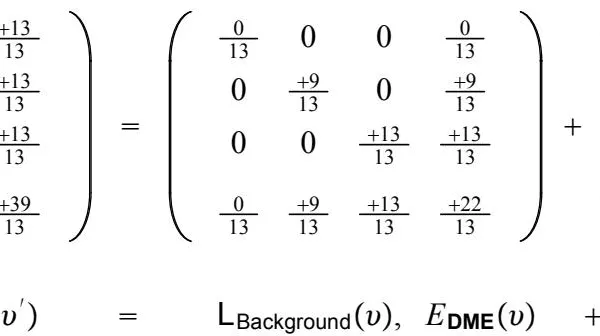
For a more understanding of formula (14) and formula (17), we transform the left second term, to the right side, further formula (14) turns to (18) below
\left( \begin{array}{c c c c}+ 1. 0 0 0 _ {1 1} & 0. 0 0 0 _ {1 2} & 0. 0 0 0 _ {1 3} & + 1. 0 0 0 \\0. 0 0 0 _ {2 1} & + 1. 0 0 0 _ {2 2} & 0. 0 0 0 _ {2 3} & + 1. 0 0 0 \\0. 0 0 0 _ {3 1} & 0. 0 0 0 _ {3 2} & + 1. 0 0 0 _ {3 3} & + 1. 0 0 0 \\+ 1. 0 0 0 & + 1. 0 0 0 & + 1. 0 0 0 & + 3. 0 0 0\end{array} \right) = \left( \begin{array}{c c c c c c c}\frac{+ 1 2 0}{2 6 0} _ {1 1} & \frac{- 9 4}{2 6 0} _ {1 2} & \frac{- 2 6}{2 6 0} _ {1 3} & 0. 0 0 0 \\\frac{- 6 0}{2 6 0} _ {2 1} & \frac{+ 1 7 7}{2 6 0} _ {2 2} & \frac{- 1 1 7}{2 6 0} _ {2 3} & 0. 0 0 0 \\\frac{- 6 0}{2 6 0} _ {3 1} & \frac{- 8 3}{2 6 0} _ {3 2} & \frac{+ 1 4 3}{2 6 0} _ {3 3} & 0. 0 0 0 \\0. 0 0 0 & 0. 0 0 0 & 0. 0 0 0 & \frac{+ 4 4 0}{2 6 0} = \frac{+ 2 2}{1 3}\end{array} \right) + ( \begin{array}{c c c c c c c}\frac{+ 1 4 0}{2 6 0}_{1 1}&\frac{+ 9 4}{2 6 0}_{1 2}&\frac{+ 2 6}{2 6 0}_{1 3}&- \frac{1 . 0 0 0}{2}\\\frac{+ 6 0}{2 6 0}_{2 1}&\frac{+ 8 3}{2 6 0}_{2}&\frac{+ \mathrm{i} \overline {{1}}}{2}_{2}^{\prime}_{3}&- \frac{1 . 0 0}{2}\\\frac{+ \mathrm{i} \overline {{6}}}{2}_{3}^{\prime}_{1}&\frac{+ \mathrm{i} \overline {{8}}}{2}_{3}^{\prime}_{3}&\frac{+ \mathrm{i} \overline {{1}}}{2}_{3}^{\prime}_{3}&- \frac{1 .}{2}\\- \frac{1 .}{2}_{3}^{\prime}_{1}&- \frac{\mathrm{i}}{2}_{3}^{\prime}_{3}&- \frac{\mathrm{i}}{2}_{3}^{\prime}_{3}&- \frac{\mathrm{i}}{2}_{3}^{\prime}_{3}\\- \frac{\mathrm{i}}{2}_{3}^{\prime}_{3}&- \frac{\mathrm{i}}{2}_{3}^{\prime}_{3}&- \frac{\mathrm{i}}{2}_{3}^{\prime}_{3}&- \frac{\mathrm{i}}{2}_{3}^{\prime}_{3}\\- \frac{\mathrm{i}}{2}_{3}^{\prime}_{3}&- - - - - - - - - - - - - - - - - - - - - - - - - - - - - - - - - - - - - - - - - - - - - - - - - - - - - - - - - - - - - - - - - - - - - - - - - - - - - - - - - - - - - - - - - - - - - - - - - - - -Lepton Number Conservation = Neutrino Background Lepton Number + Neutrino Mass Lepton Number
Here
Neutrino Background Lepton Number (Broken Neutrino Lepton Number ) (19)
Next analogous to the process of (16) and (17), Matrix(10), we multiply (16) and Matrix(9) in (18) above. Further obtain (20) following
\begin{array}{l} \mathsf{G} _ {L} (\upsilon) \cdot \mathsf{L} _ {\mathrm{B a c k g r o u n d}} (\upsilon) \\= \mathsf{G} _ {L} (v) \cdot \left( \begin{array}{c c c c} \frac{+ 1 2 0}{2 6 0} & \frac{- 9 4}{2 6 0} & \frac{- 2 6}{2 6 0} & 0.0 0 0 \\\frac{- 6 0}{2 6 0} & \frac{+ 1 7 7}{2 6 0} & \frac{- 1 1 7}{2 6 0} & 0.0 0 0 \\\frac{- 6 0}{2 6 0} & \frac{- 8 3}{2 6 0} & \frac{+ 1 4 3}{2 6 0} & 0.0 0 0 \\0.0 0 0 & 0.0 0 0 & 0.0 0 0 & \frac{+ 2 2}{1 3} \end{array} \right) = (\frac{1 3}{8}) \left( \begin{array}{c c c c} \frac{+ 1 2 0}{2 6 0} & \frac{- 9 4}{2 6 0} & \frac{- 2 6}{2 6 0} & 0.0 0 0 \\\frac{- 6 0}{2 6 0} & \frac{+ 1 7 7}{2 5 6} & \frac{- 1 1 7}{2 6 0} & 0.0 0 0 \\\frac{- 6 0}{2 6 0} & \frac{- 8 3}{2 6 0} & \frac{+ 1 4 3}{2 6 0} & 0.0 0 0 \\0.0 0 0 & 0, \quad \quad \quad \quad \quad \quad \quad \quad \quad \quad \quad \quad \quad \quad \quad \quad \quad \quad \quad \quad \quad \quad \quad \quad \quad \quad \quad \quad \quad \quad \quad \quad \quad \quad \quad \quad \quad \quad \quad \quad \quad \quad \quad \quad \quad \quad \quad \quad \quad \quad \end{array} \right) \\= \left( \begin{array}{c c c c} \frac{+ 1 2 0}{1 6 0} & \frac{- 9 4}{1 6 0} & \frac{- 2 6}{1 6 0} & 0.0 0 0 \\\frac{- 6 0}{1 6 0} & \frac{+ 1 7 7}{1 6 0} & \frac{- 1 1 7}{1 6 0} & 0.0 0 0 \\\frac{- 6 0}{1 6 0} & \frac{- 8 3}{1 6 0} & \frac{- 1 4 3}{1 6 0} & 0.0 0 0 \\0.0 0 0 & 0.0 0 0 & 0.0 0 0 & \...\end{array} \right)We call formular (20) , Neutrino Dark Matter-Energy , resulted from neutrino background lepton number, which accounts to 56% of that total lepton number conservation, a slight large than 44% resulted from Neutrino Mass Lepton Number To obtain experimental observations, after the diagonalization of neutrino lepton number (18), obtain (21) below:
Then multiply and (21), gain (22) below
Trace of Matrix:
■b Last, again turn to (18), multiply and (18). gain (23) below
If the diagonalization of (23), we could obtain (22) again.
CONCLUSIONS
- The conservation of Lepton number (18) is characterized by Matrix(8): in which there are three classifications of matrix element digit-sum below
- Horizontal sum:
- Vertical sum:
- Diagonal sum: (24)
- Neutrino background lepton number is characterized by Matrix(9) below:
- Horizontal sum:
- Vertical sum:
- Diagonal sum: (25)
- Neutrino mass lepton number is characterized by Matrix(10) below:
- Horizontal sum:
- Vertical sum:
- Diagonal sum: (26)
We see:
Lepton number Matrix(8) could be decomposed into two parts, Matrix(9) and Matrix(10) .
- 1), 2) and 3) show: the conservation properties of Matrix(8) in three different directions.
- 4), 5) show: the conservation properties of Matrix(9) ; but (6) shows the value of neutrino background lepton number is not zero, no a "really pure vacuum"! its diagonal sum 6), trace is detectable.
- 7), 8) show: the conservation properties of Matrix(10) ; but (9) shows the value of neutrino mass lepton number is Only Partly BE Broken in diagonal direction 9). BUT those along with horizontal and vertical directions are still conserved.
All that happened, are due to the Leptoncolor brokenon of lepton weak interaction paring in neutrino flavor oscillations
The nine digits, which are restricted to the seven digit-sums conditions previously mentioned, three horizontal sums, three vertical sums and one diagonal sum. Remain two dependent parameters that may be related to Higgs particle?
Physical observable matrix broken quantum operator, neutrino mass lepton number )
Neutrino dark matter-energy (broken quantum operator, neutrino background lepton number )