0. Introduction
Part.A Quark
- Color Representation of Flavor - 2.* Colored Quark3. Spin-Color State, Spin of Colored Baryon qqq + qqqcolor SU(4)
Part.B Gluon
- Approaching to observable experimental baryons 【Preliminary on 5., 6., and 7.】
- 5.* Colored Gluon
Gluon Corlor
Gluon Corlor Matrix, or
Gluon Color gggcolor Associated with Baryon gggcolor(qqq) = g(qqq)color
Corlor Ground State of Gluon SU(4)
Spin of Gluon SU(4), a highly symmetric figure
Observable Experimental Baryons
Part.D Meson Constituent Related to Gluon
- Spin-Color State, Spin of Colored Meson Nonet
- Gluon Color associated with meson
- Corlor Ground State and Corlor Excited State of Gluon Nonet
- Spin of Gluon Nonet
- Observable Experimental Mesons
Conclusions
0. INTRODUCTION
Hadronic constituents is an amusing topic in particle physics, there are many expeditionary ways to approach to this puzzle [1]. QCD provides powerful methods, and bases on many great studies are going around in this domain [2] In this paper we offer a new idea of color concept: Three colors, ren R, green G and blue B that range from "visible light" are extended to optical "color spectrum" of flavor [3]. Different flavor could possess same color , but occupies different "wavelength" . Then all flavors are unified into a common isospin space and become the discrete function of R, G and B. Along with this way, we are going to discuss hadronic constituents following.
The structure of this paper includes four parts: Part.A Quark, Part.B Gluon, Part.C Baryon and Part.D Meson.
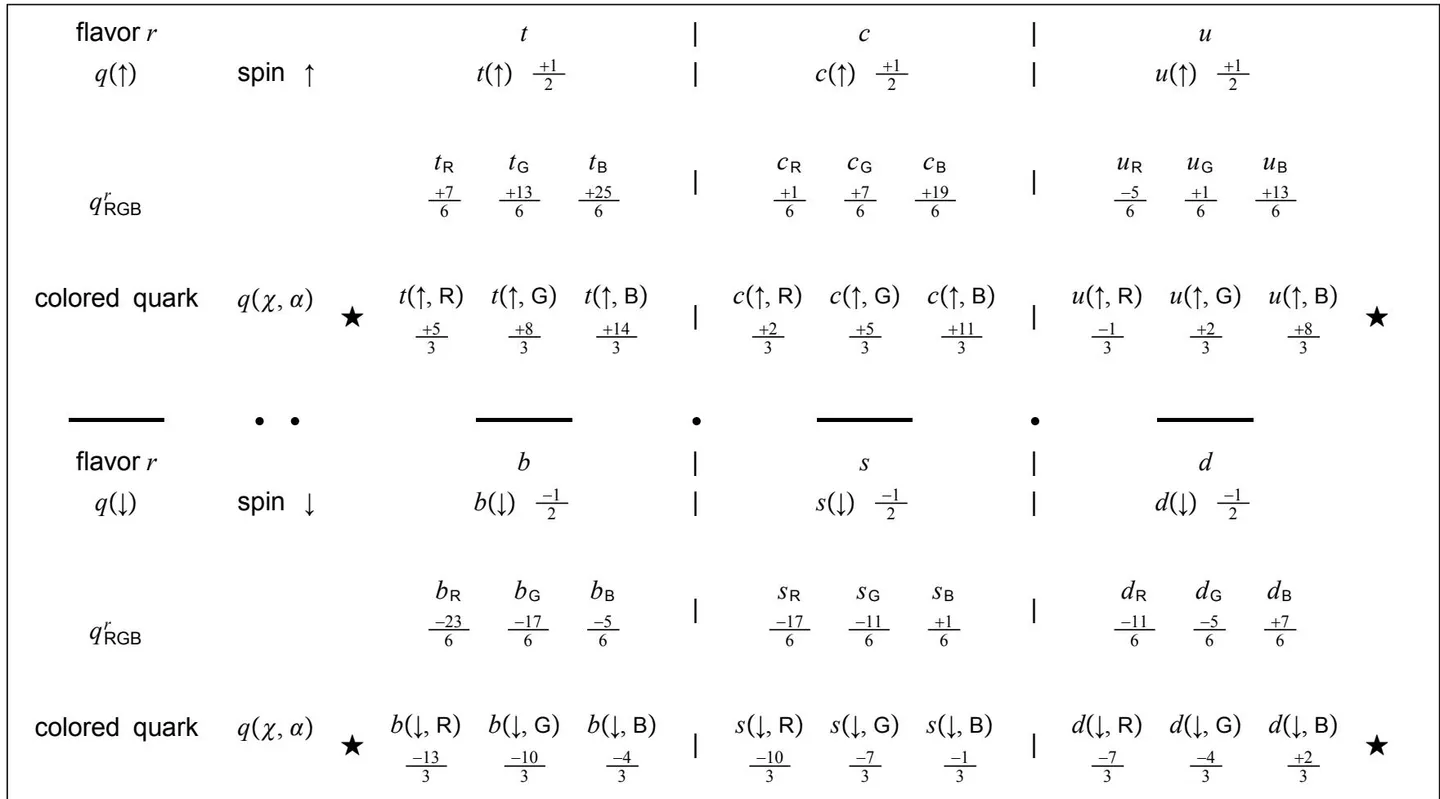
Part.A: Table.1 is of the essence, "color spectrum" is endowed with one-sixth spin series [4],[5], named as quark color , which are values of three color components of a quark respectively. The algebra sum , of spin angular momentum of quark and quark color of the quark, is the value of colored quark (for convenience, sometime colored baryons are labelled by symbol ). And Table.2 shows colored quark possesses properties of one-third series. Because colored baryons are comprised of three colored quarks, so introduce spin-color state that an array of the colored quarks . Further by spin-color state representation (Figure.2) of colored baryon, (Figure.3) of charmed colored baryons is obtained.
Part.B: Detailed research work of preliminary to colored gluon is given. colored gluon (section.5*) is more complex than colored quark section.2*. Quark color only needs a single quantum number (in Table.1), however gluon color (7) includes two quantum numbers and , which related to both quark and antiquark . Detailed gluon color are provided in Table.4, which are frequently quoted in most calculations of this paper. And for the beauties of math symmetry, we transform Table.4 into Table.5 gluon color matrix , this matrix can give conveniences in dealing with variety of gluon state.
Part.C: Based on both color ground state to obtain spin of colored gluon of charmed SU(4) (Figure.7). Then use colored baryon and colored gluon by formula (11) get [1] of observed baryons. Another quivalent way to observed baryons is [2], by considering spin coupling between quark and gluon to get . And considering color coupling between quark and gluon to get .
Part.D: By four spin-color states (14.0) of colored meson, discuss formation of observed pseudoscalar mesons, vector mesons (Table.11 color ground state (A)) and that of observed scalar mesons, pseudovector mesons (Table.12 color excited state (B))
Two tables below depict the outline of idea of color in particle physics that presented in this paper
| colored baryon | colored gluon | || | colored meson | colored gluon |
| total angular momentum | total angular momentum | || | total angular momentum | total angular momentum |
| qqq + qqqcolor | ggg + gggcolor | || | qbar + qbarcolor | gg + ggcolor |
| spin angular momentum | spin angular momentum | || | spin angular momentum | spin angular momentum |
| qqq | ggg | || | qbar | gg |
| color angular momentum | color angular momentum | || | color angular momentum | color angular momentum |
| qqqcolor | gggcolor | || | qbarcolor | ggcolor |
Table 0.1: angular momentum elements of colored baryon, colored gluon (left) and of colored meson, colored gluon (right) Table 0.2: formations of observed baryon (left) and formation of observed meson (right)
| observed baryon S3(qqq, experimental) | || | observed meson S3(qq̅, experimental) | ||
| √/ | || | √/ | √/ | |
| colored baryon | colored gluon | || | colored meson | colored gluon |
| S3(qqq, qqqcolor) | S3(ggg, gggcolor) | || | S3(qq̅, qqcolor) | S3(gg, ggcolor) |
experimental) of observed baryon consists of of colored baryon and of colored gluon, here gluon color is associated with the baryon qqq.
experimental) of observed meson consists of of colored meson and of colored gluon, here gluon color is associated with the meson
Part.A Quark
1. COLOR REPRESENTATION OF FLAVOR
In current Standard Model SM, six fundamental quarks or { or } are assigned to five different flavor isospin spaces. Among them, quarks and to an isodoublet with , remaining four quarks to isosinglet with in one of four different flavor isospin spaces respectively. Paper [3] assumes these six quarks could be unified into a common isospin multiplets space. Every one of the six quarks is with in math frame Spin Topological Space STS. Based on Pauli Exclusion Principle, their flavours could be labelled by the third component of each quark respectively. Here the physical concept of flavor of a quark is supposed to be related to so-called Colour Spectrum Diagram of Flavour CSDF.
In this paper more advanced understanding of CSDF is offered, which is expressed in Table.1 below. And we will use this table to research for the structure of hadrons later paragraphs. Where is color spectral line array of flavor , by which, the concrete values of isospin of quark could be obtained. The concrete values of are given from one-sixth spin series [4],[5]
and
are called as quark color and as antiquark color.
| quark flavor r | t | | c | | u | | || d | | s | | b |
| I3(q) | I3(t) +5/2 | | I3(c) +3/2 | | I3(u) +1/2 | | I3(d) -1/2 | | I3(s) -3/2 | | I3(b) -5/2 |
| qα | tR | cR | uR | dR | sR | bR |
| qRGB | +7/6 | +13/6 | +7/6 | +13/6 | -17/6 | -17/6 |
| tR+tG+tB | cR+cG+CB | uR+uG+UB | dR+dG+dB | sR+sG+sB | bR+bG+bB | |
| +45/6 = +15/2 | +27/6 = +9/2 | +9/6 = +3/2 | -9/6 = -3/2 | -27/6 = -9/2 | -45/6 = -15/2 | |
| anti-quark flavor r | i | c | i | d | s | bar{b} |
| I3(q) | I3(i) -5/2 | | I3(c) -3/2 | | I3(i) -1/2 | | I3(d) +1/2 | | I3(s) +3/2 | | I3(b) +5/2 |
| qα | iR | iG | iR | iR | iR | bar{b} |
| qRGB | -7/6 | -13/6 | -7/6 | -13/6 | +17/6 | +17/6 |
| iR+iG+iB | iR+iG+iB | iR+iG+iB | iR+iG+iB | iR+iG+iB | bar{b} | |
| -45/6 = -15/2 | -27/6 = -9/2 | -9/6 = -3/2 | -9/6 = +3/2 | +27/6 = +9/2 | +45/6 = +15/2 |
2. COLORED QUARK
In current Standard Model SM baryon consists of three quarks, meson is comprised of a quark and an antiquark; baryons and mesons are observable, as colorless. quarks and antiquarks are unobservable because of their colorful. Color can't be observable, i.e. so-called color confinement phenomenon. In a word, we could not observe spin quark particle nor observe quark color .
In this paper an idea of so-called colored quark labelled is suggested: colorless angular momentum spin 1/2 quark particle turns into colorful by directly being colored by quark color , which is the algebra sum (4.0) of colorless quark spin or and quark color ( )
First we consider a special case (4), later on, in Part.D, back to (4.0)
As examples of (4), for colored quark
colored red up quark (4.1) colored green up quark (4.2) colored blue up quark (4.3)
Formula (4) shows spin values (the third components) of colored quark possess one-third series fraction property.
【Emphasis】in current theory, color identities of particles are thought to adhere to . Color and Spin belong to different spaces. However, in contrast, according to definition (4.0), quark color and quark spin belong to a common space STS, Spin Topological Space.
We extend colored up quarks (4.1),(4.2),(4.3) to all six flavors, then obtain Table.2 for six colored quarks.
3. SPIN-COLOR STATE,SPIN OF COLORED BARYON qqq+qqqcolor SU(4)
- Spin-Color State of Colored baryon is an array of three colored quarks that come from formula (4)
- Colored baryon is expressed by spin-color state by
Examples of spin-color states for baryon composites are following:
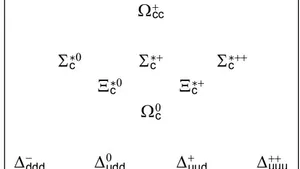
In this way, we transform charmed baryon SU(4) Figure.1 into spin-color state of charmed colored baryon SU(4) Figure.2
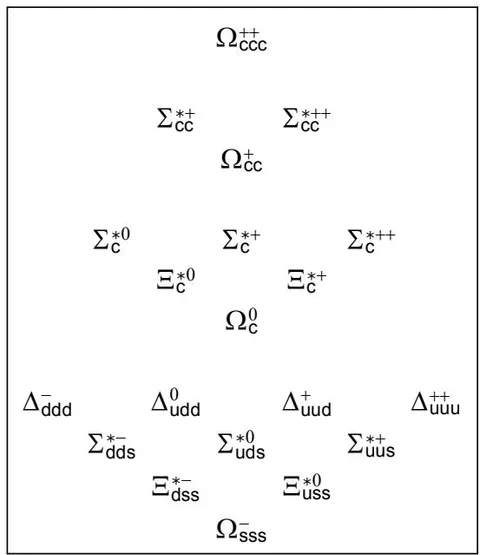
Figure 2: Spin-Color States of charmed colored baryon SU(4)
Further, obtain
Figure 3: Weight diagram of of spin-color state for charmed colored baryon SU(4)
【Emphasis】Figure.3 shows spin (the third components) of charmed colored quark SU(4) possess one-third series fraction property.
Part.B Gluon
Obviously, both colored quarks (in Table.2) and colored baryons (in Figure.2), which are colored particles, are unobservable. On the contrary, observed baryons are observable which are colorless. To coordinate the conflict, we are back to reunderstand the early original quark model [1]. We see: this model does not include any interaction among quarks, or any interaction between quark and antiquark. That is to say, the model only comprises quark particles, in fact, it is a static one. So seems to be necessary of adding some other particles that possess decolorant function, further absorb and balance the color conflict mentioned before.
The first and better cadinate is gluon , of cause, the gluon should be colorful too. So we turn to the cadidates ggg and , here ggg is spin angular momentum of gluon and is its color. In order to overcome the conflict with spin one-third series fraction property of colored baryons, ggg and should be associated with relevant qqq and qqqcolor and should also possess a similar arrays of three components of qqq and qqqcolor (mare detailed figures about ggg and would be presented later, Part.C section 8)
4. APPROACHING TO OBSERVABLE EXPERIMENTAL BARYONS
and are important roles, from which observable experimental baryons could be formed in STS. To approaching to the purpose, two equivalent calculation methods, 【1】 and 【2】 are given by following Table.3. (And Figure.3 is a part of【1】)
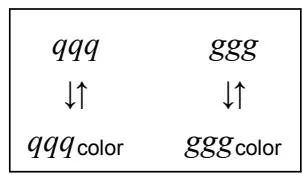
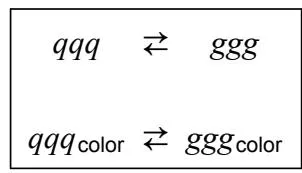
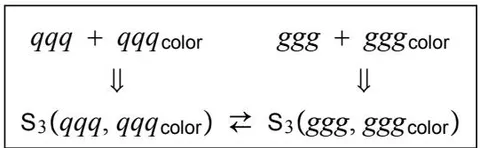
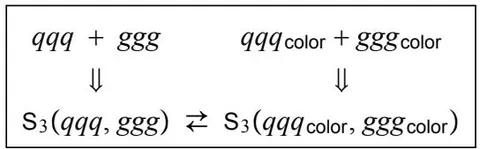

To find out the concrete presentations of and in above table, preliminary researches on gluon are given following
【Preliminary on 5., 6., and 7.】
5. COLORED GLUON
Go without saying, analogy to colored quark mentioned (section 2.*), colored gluon is defined as colored gluon: (6) which is the algebra sum (6) of colorless gulon spin and gluon color .
Where symbol is the third component of spin angular momentum of gluon, and gluon color is color of force-mediating gluon, which between two interacting quarks and antiquark . (6) shows colorless spin 1 gluon becomes colorful gluon being colored by gluon color , As examples of (7) of gluon color which results from quark-antiquark pair and pair .
we see: the values of gluon color possesses zero and integral number properties.
【Emphasis】both values of quark corlor and values of gluon corlor all come from CSDF, Fundamental Color Representation of flavor (Table.1)
6. GLUON CORLOR
Gluon corlor is Color-Flavor Antisymmetric Matrix, CFAM,
with respective to:
As examples of (8) below
and (8.5)
and (8.8) In this way, concrete details of Gluon color is given by Table.4 below, that includes eighteen matrices which are arranged in color-flavor Aantisymmetric matrix .
Following
- , former six matrices, belong to diagonal figures;
- , latter twelve matrices , , ,... to off-diagonal figures
| gaβ(r, w) | ω | wR | wG | wB |
| rα+wβ | -a/6 | -b/6 | -c/6 | |
| r | (r, w) | |||
| rR | gRR | gRθ | gRB | |
| +α/6 | 0 | -1 | -3 | |
| rG | gGR | gGθ | gGB | |
| +b/6 | +1 | 0 | -2 | |
| rB | gBR | gBG | gBB | |
| +c/6 | +3 | +2 | 0 |
Here concise symbol is a matrix element of CFAM that related to quark and antiquark . And
More detailed following
| gaβ(t, t) | ω | tR-7/6 | tG-13/6 | tB-25/6 |
| tα+ tβ | ||||
| r | (t, t) | |||
| tR | gRR | gRGR | gRBR | |
| +7/6 | 0 | -1 | -3 | |
| tG | gGR | gGG | gGB | |
| +13/6 | +1 | 0 | -2 | |
| tB | gBR | gBG | gBB | |
| +25/6 | +3 | +2 | 0 |
| gaβ(c,bar) | ω | barC_R | barC_G | barC_B |
| ca+barCβ | -1/6 | -7/6 | -19/6 | |
| r | (c,bar) | |||
| CR | gRR | gRGR | gRB | |
| +1/6 | 0 | -1 | -3 | |
| cG | gGR | gGG | gGB | |
| +7/6 | +1 | 0 | -2 | |
| CB | gBR | gBG | gBB | |
| +19/6 | +3 | +2 | 0 |
| gaβ(u,bar)uα+ubarβ | ω | ubarR+5/6 | ubarG-1/6 | ubarB-13/6 |
| r | (u,bar) | |||
| UR | gRR | gRG | gRB | |
| -5/6 | 0 | -1 | -3 | |
| ug | gGR | gGG | gGB | |
| +1/6 | +1 | 0 | -2 | |
| ub | gBR | gBG | gBB | |
| +13/6 | +3 | +2 | 0 |
| gαβ(b,bar) | ω | barR | barG | barB |
| bα+barβ | +23/6 | +17/6 | +5/6 | |
| r | (b,bar) | |||
| br | gRR | gRG | gRB | |
| -23/6 | 0 | -1 | -3 | |
| bg | gGR | GGG | gGB | |
| -17/6 | +1 | 0 | -2 | |
| bB | gBR | GBG | GBB | |
| -5/6 | +3 | +2 | 0 |
| gaβ(s, s̅) | ω | sR+17/6 | sG+11/6 | sB-1/6 |
| sa+sb | ||||
| r | (s, s̅) | |||
| sR | gRR | gRGR | gRBR | |
| -17/6 | 0 | -1 | -3 | |
| sG | gGR | gGG | gGB | |
| -11/6 | +1 | 0 | -2 | |
| SB | gBR | gBG | gBB | |
| +1/6 | +3 | +2 | 0 |
| gaβ(d, d)da+ dB | ω | dR+11/6 | dG+5/6 | dB-7/6 |
| r | (d, d) | |||
| dR | gRR | gRG | gRB | |
| -11/6 | 0 | -1 | -3 | |
| dG | gGR | gGG | gGB | |
| -5/6 | +1 | 0 | -2 | |
| dB | gBR | gBG | gBB | |
| +7/6 | +3 | +2 | 0 |
| (u,d) | +11/6 | +5/6 | -7/6 | (d,u) | +5/6 | -1/6 | -13/6 |
| -5/6 | gRR | gRg | gRB | -11/6 | gRR | gRg | gRB |
| +1 | 0 | -2 | -1 | -2 | -4 | ||
| +1/6 | gGR | gGG | gGB | -5/6 | gGR | GGG | gGB |
| +2 | +1 | -1 | 0 | -1 | -3 | ||
| +13/6 | GBR | GBG | GBB | +7/6 | GBR | BGG | BBB |
| +4 | +3 | +1 | +2 | +1 | -1 |
| (u,s) | +17/6 | +11/6 | -1/6 | (s,u) | +5/6 | -1/6 | -13/6 |
| -5/6 | gRR | gRoverline{G} | gRB | -17/6 | gRR | gRoverline{G} | gRB |
| +2 | +1 | -1 | -2 | -3 | -5 | ||
| +1/6 | gGR | gGG | gGB | -11/6 | gGR | gGG | gGB |
| +3 | +2 | 0 | -1 | -2 | -4 | ||
| +13/6 | gBR | gBG | gBB | +1/6 | gBR | gBG | gBB |
| +5 | +4 | +2 | +1 | 0 | -2 |
| (c,d) | +11/6 | +5/6 | -7/6 | (d, c) | -1/6 | -7/6 | -19/6 |
| +1/6 | gRR | gRg | gRB | -11/6 | gRR | gRg | gRB |
| +2 | +1 | -1 | -2 | -3 | -5 | ||
| +7/6 | gGR | GG | GB | -5/6 | gGR | GG | GB |
| +3 | +2 | 0 | -1 | -2 | -4 | ||
| +19/6 | GBR | BG | BB | +7/6 | GBR | BG | BB |
| +5 | +4 | +2 | +1 | 0 | -2 |
| (c,s) | +17/6 | +11/6 | -1/6 | (s,c) | -1/6 | -7/6 | -19/6 |
| +1/6 | gRR | gRoverline{G} | gRB | -17/6 | gRR | gRoverline{G} | gRB |
| +3 | +2 | 0 | -3 | -4 | -6 | ||
| +7/6 | gGR | gGG | gGB | -11/6 | gGR | gGG | gGB |
| +4 | +3 | +1 | -2 | -3 | -5 | ||
| +19/6 | gBR | gBG | gBB | +1/6 | gBR | gBG | gBB |
| +6 | +5 | +3 | 0 | -1 | -3 |
| (c, u) | +5/6 | -1/6 | -13/6 | (u, c) | -1/6 | -7/6 | -19/6 |
| +1/6 | gRR | gRG | gRB | -5/6 | gRR | gRG | gRB |
| +1 | 0 | -2 | -1 | -2 | -4 | ||
| +7/6 | gGR | gGGB | gGBB | +1/6 | gGR | gGG | gGBB |
| +2 | +1 | -1 | 0 | -1 | -3 | ||
| +19/6 | gBR | gBG | gBBB | +13/6 | gBR | gBG | gBBB |
| +4 | +3 | +1 | +2 | +1 | -1 | ||
| (c,s) | +17/6 | +11/6 | -1/6 | (s, c) | -1/6 | -7/6 | -19/6 |
| +1/6 | gRR | gRG | gRB | -17/6 | gRR | gRG | gRB |
| +3 | +2 | 0 | -3 | -4 | -6 | ||
| +7/6 | gGR | gGG | gGB | -11/6 | gGR | gGG | gGB |
| +4 | +3 | +1 | -2 | -3 | -5 | ||
| +19/6 | gBR | gBG | gBB | +1/6 | gBR | gBG | gBB |
| +6 | +5 | +3 | 0 | -1 | -3 |
| (d,s) | +17/6 | +11/6 | -1/6 | (s,d) | +11/6 | +5/6 | -7/6 |
| -11/6 | gRR | gRG | gRB | -17/6 | gRR | gRG | gRB |
| +1 | 0 | -2 | -1 | -2 | -4 | ||
| -5/6 | gGR | gGGB | gGB | -11/6 | gGR | gGG | gGB |
| +2 | +1 | -1 | 0 | -1 | -3 | ||
| +7/6 | gBR | gBG | gBB | +1/6 | gBR | gBG | gBB |
| +4 | +3 | +1 | +2 | +1 | -1 | ||
| (c, t) | -7/6 | -13/6 | -25/6 | (t, c) | -1/6 | -7/6 | -19/6 |
| +1/6 | gRR | gRG | gRB | +7/6 | gRR | gRG | gRB |
| -1 | -2 | -4 | +1 | 0 | -2 | ||
| +7/6 | gGR | gGGR | gGB | +13/6 | gGR | gGG | gGB |
| 0 | -1 | -3 | +2 | +1 | -1 | ||
| +19/6 | gBR | gBG | gBB | +25/6 | gBR | gBG | gBB |
| +2 | +1 | -1 | +4 | +3 | +1 |
| (c,b) | +23/6 | +17/6 | +5/6 | (b, c) | -1/6 | -7/6 | -19/6 |
| +1/6 | gRR | gRg | gRB | -23/6 | gRR | gRg | gRB |
| +4 | +3 | +1 | -4 | -5 | -7 | ||
| +7/6 | gGR | gGG | gGB | -17/6 | gGR | gGG | gGB |
| +5 | +4 | +2 | -3 | -4 | -6 | ||
| +19/6 | gBR | gBG | gBB | -5/6 | gBR | gBG | gBB |
| +7 | +6 | +4 | -1 | -2 | -4 |
| (t,s) | +17/6 | +11/6 | -1/6 | (s,t) | -7/6 | -13/6 | -25/6 |
| +7/6 | gRR | gRG | gRB | -17/6 | gRR | gRG | gRB |
| +4 | +3 | +1 | -4 | -5 | -7 | ||
| +13/6 | gGR | gGGR | gGB | -11/6 | gGR | gGG | gGB |
| +5 | +4 | +2 | -3 | -4 | -6 | ||
| +25/6 | gBR | gBG | gBB | +1/6 | gBR | gBG | gBB |
| +7 | +6 | +4 | -1 | -2 | -4 |
| (t,b) | +23/6 | +17/6 | +5/6 | (b,t) | -7/6 | -13/6 | -25/6 |
| +7/6 | gRR | gRG | gRB | -23/6 | gRR | gRG | gRB |
| +5 | +4 | +2 | -5 | -6 | -8 | ||
| +13/6 | gGR | GG | GB | -17/6 | gGR | GG | GB |
| +6 | +5 | +3 | -4 | -5 | -7 | ||
| +25/6 | GBR | BG | BB | -5/6 | GBR | BG | BB |
| +8 | +7 | +5 | -2 | -3 | -5 |
| (b,s) | +17/6 | +11/6 | -1/6 | (s,b) | +23/6 | +17/6 | +5/6 |
| -23/6 | gRR | gRG | gRB | -17/6 | gRR | gRG | gRB |
| -1 | -2 | -4 | +1 | 0 | -2 | ||
| -17/6 | gGR | GG | GGB | -11/6 | gGR | GG | GGB |
| 0 | -1 | -3 | +2 | +1 | -1 | ||
| -5/6 | GBR | GBG | GBB | +1/6 | GBR | GBG | GBB |
| +2 | +1 | -1 | +4 | +3 | +1 |
7. GLUON CORLOR MATRIX, or
We could rewrite Table.4 Gluon corlor into Table.5 Gluon Corlor Matrix, below. And use label instead of , then antisymmetric relation, (8.5) and (8.8) are rewritten as
include nine subtables, among them: three are color diagonal 1, 2, 3 subtables with and six color off-diagonal 4, 6, 8, subtables with and 5, 7, 9 subtables with .
In next two sections, C and D, we will use to construct gulon color and
| 1 | R | ω | t | c | u | d | s | b | 2 | G | ω | t | c | u | d | s | b | 3 | B | ω | t | c | u | d | s | b |
| R | -7/6 | -1/6 | +5/6 | +11/6 | +17/6 | +23/6 | G | -13/6 | -7/6 | -1/6 | +5/6 | +11/6 | +17/6 | B | -25/6 | -19/6 | -13/6 | -7/6 | -1/6 | +5/6 | ||||||
| r | RR | r | GG | r | BB | |||||||||||||||||||||
| t | +7/6 | 0 | +1 | +2 | +3 | +4 | +5 | t | +13/6 | 0 | +1 | +2 | +3 | +4 | +5 | t | +25/6 | 0 | +1 | +2 | +3 | +4 | +5 | |||
| c | +1/6 | -1 | 0 | +1 | +2 | +3 | +4 | c | +7/6 | -1 | 0 | +1 | +2 | +3 | +4 | c | +19/6 | -1 | 0 | +1 | +2 | +3 | +4 | |||
| u | -5/6 | -2 | -1 | 0 | +1 | +2 | +3 | u | +1/6 | -2 | -1 | 0 | +1 | +2 | +3 | u | +13/6 | -2 | -1 | 0 | +1 | +2 | +3 | |||
| d | -11/6 | -3 | -2 | -1 | 0 | +1 | +2 | d | -5/6 | -3 | -2 | -1 | 0 | +1 | +2 | d | +7/6 | -3 | -2 | -1 | 0 | +1 | +2 | |||
| s | -17/6 | -4 | -3 | -2 | -1 | 0 | +1 | s | -11/6 | -4 | -3 | -2 | -1 | 0 | +1 | s | +1/6 | -4 | -3 | -2 | -1 | 0 | +1 | |||
| b | -23/6 | -5 | -4 | -3 | -2 | -1 | 0 | b | -17/6 | -5 | -4 | -3 | -2 | -1 | 0 | b | -5/6 | -5 | -4 | -3 | -2 | -1 | 0 |
RR(rw)
Gg(rw)
B(B(rw) color off-diagonal :
| 4 | G | ω | t | c | u | d | s | b |
| R | -13/6 | -7/6 | -1/6 | +5/6 | +11/6 | +17/6 | ||
| r | RG | |||||||
| t | +7/6 | -1 | 0 | +1 | +2 | +3 | +4 | |
| c | +1/6 | -2 | -1 | 0 | +1 | +2 | +3 | |
| u | -5/6 | -3 | -2 | -1 | 0 | +1 | +2 | |
| d | -11/6 | -4 | -3 | -2 | -1 | 0 | +1 | |
| s | -17/6 | -5 | -4 | -3 | -2 | -1 | 0 | |
| b | -23/6 | -6 | -5 | -4 | -3 | -2 | -1 |
Rg(rw)
| 6 | B | ω | t | c | u | d | s | b |
| G | -25/6 | -19/6 | -13/6 | -7/6 | -1/6 | +5/6 | ||
| r | GB | |||||||
| t | +13/6 | -2 | -1 | 0 | +1 | +2 | +3 | |
| c | +7/6 | -3 | -2 | -1 | 0 | +1 | +2 | |
| u | +1/6 | -4 | -3 | -2 | -1 | 0 | +1 | |
| d | -5/6 | -5 | -4 | -3 | -2 | -1 | 0 | |
| s | -11/6 | -6 | -5 | -4 | -3 | -2 | -1 | |
| b | -17/6 | -7 | -6 | -5 | -4 | -3 | -2 |
GB(rw)
| 8 | R | ω | t | c | u | d | s | b |
| B | -7/6 | -1/6 | +5/6 | +11/6 | +17/6 | +23/6 | ||
| r | BR | |||||||
| t | +25/6 | +3 | +4 | +5 | +6 | +7 | +8 | |
| c | +19/6 | +2 | +3 | +4 | +5 | +6 | +7 | |
| u | +13/6 | +1 | +2 | +3 | +4 | +5 | +6 | |
| d | +7/6 | 0 | +1 | +2 | +3 | +4 | +5 | |
| s | +1/6 | -1 | 0 | +1 | +2 | +3 | +4 | |
| b | -5/6 | -2 | -1 | 0 | +1 | +2 | +3 |
BR(rw) color off-diagonal :
| 5 | R | ω | t | c | u | d | s | b |
| G | -7/6 | -1/6 | +5/6 | +11/6 | +17/6 | +23/6 | ||
| r | GR | |||||||
| t | +13/6 | +1 | +2 | +3 | +4 | +5 | +6 | |
| c | +7/6 | 0 | +1 | +2 | +3 | +4 | +5 | |
| u | +1/6 | -1 | 0 | +1 | +2 | +3 | +4 | |
| d | -5/6 | -2 | -1 | 0 | +1 | +2 | +3 | |
| s | -11/6 | -3 | -2 | -1 | 0 | +1 | +2 | |
| b | -17/6 | -4 | -3 | -2 | -1 | 0 | +1 |
GR(ωr)
| 7 | G | ω | t | c | u | d | s | b |
| B | -13/6 | -7/6 | -1/6 | +5/6 | +11/6 | +17/6 | ||
| r | BG | |||||||
| t | +25/6 | +2 | +3 | +4 | +5 | +6 | +7 | |
| c | +19/6 | +1 | +2 | +3 | +4 | +5 | +6 | |
| u | +13/6 | 0 | +1 | +2 | +3 | +4 | +5 | |
| d | +7/6 | -1 | 0 | +1 | +2 | +3 | +4 | |
| s | +1/6 | -2 | -1 | 0 | +1 | +2 | +3 | |
| b | -5/6 | -3 | -2 | -1 | 0 | +1 | +2 |
B G(ωr)
| 9 | B | ω | t | c | u | d | s | b |
| R | -25/6 | -19/6 | -13/6 | -7/6 | -1/6 | +5/6 | ||
| r | RB | |||||||
| t | +7/6 | -3 | -2 | -1 | 0 | +1 | +2 | |
| c | +1/6 | -4 | -3 | -2 | -1 | 0 | +1 | |
| u | -5/6 | -5 | -4 | -3 | -2 | -1 | 0 | |
| d | -11/6 | -6 | -5 | -4 | -3 | -2 | -1 | |
| s | -17/6 | -7 | -6 | -5 | -4 | -3 | -2 | |
| b | -23/6 | -8 | -7 | -6 | -5 | -4 | -3 |
RB(ωr)
8. GLUON COLOR gggcolor ASSOCIATED WITH BARYON gggcolor (qqq) = g(qqq)color
- Gluon is due to Boson, so its angular momentum spin could be written as , .
- Gluon color component , the likeness of color of flavor , is an array that comprises three matrix elements respectively listed in subtables of Table.5 .
- stands for colored gluon that related to baryon As example:
For special case below:
Definition color ground state of the gluon:
abbreviation , while associated with baryon and ground state of
As example of associated with baryon uud. From subtables 3, 4 and 5 in Table.5 we could get ground state of (9.3) that will be appear in Figure.4.2 below
9. CORLOR GROUND STATE OF GLUON SU(4)
Corlor ground state of Gluon SU(4), associated with baryon , consists of four groups of gulon multiplets: Figure.4.1 includes gluon ground states for groups singlet, triplet, hexaplet and Figure.4.2 for group decuplet.
Remark all of Figure.4.1 and Figure.4.2 are color ground state of gluon: that is
Notation
Then get
Figure 4.1: weight diagram of color ground state for gluon singlet, triplet and hexaplet of SU(4)
| singlet gulon | g(ccc; 0)color ((cū), (cū), (cū)) (RR, GG, BB) | ||
| triplet gulon | g(ccd; 0)color ((cū), (cū), (dū)) (RR, GB, BG) | g(cus; 0)color ((cū), (uū), (sū)) (RG, GB, BR) | |
| g(ccs; 0)color ((cū), (cū), (sū)) (GG, RB, BR) | |||
| hexaplet gulon | g(cdd; 0)color ((cū), (dū), (dū)) (GB, RR, BG) | g(cud; 0)linear combination ((cū), (ud), (dū)) | g(cuu; 0)color ((cū), (uū), (uū)) (RG, BB, GR) |
| (g(cds; 0)color ((cū), (dū), (sū)) (GB, RG, BR) | g(cus; 0)color ((cū), (uū), (sū)) (RG, GB, BR) | ||
| g(css; 0)color ((cū), (sū), (sū)) (RB, GG, BB) |
And decuplet gulon
(20
(20
(BB,RG,GR)
(RR,GG,BB)
(BB, RG, GR) g(uds) linear combination color ( 1 RRR, GBB G (du), (sd), (us) RRR, BG, GB
(BB,GB,BG)
(RG,BB,GR)
(20
)RR,GG,BB
Figure 4.2: Weight diagram of ground state for gluon decuplet of SU(4)
10. SPIN OF GLUON SU(4), A HIGHLY SYMMETRIC FIGURE
We obtain a highly symmetric figure of the presentation of spin angular momentum of gluon SU(4). Referring to 1) in section 8
Figure 5: Weight diagram for spin angular momentum of gluon SU(4) To illustrate symmetric properties in above table, we first consider horizontal polynomial sequences below. For clearer view, using symbol to instead of
| one polynomial | ccc* +3 (0,-1,+4) | ||||||
| two polynomials | ccd* 0 (-1,-1,+2) | ccu* +4 (+1,0,+3) | cds* -2 (-1,-1,0) | cus* +2 (+1,0,+1) | dss* -4 (-1,-1,-2) | uss* 0 (+1,0,-1) | |
| three polynomials | cdd* -3 (-2,-1,0) | cud* +1 (0,0,+1) | cuu* +5 (+2,+1,+2) | dds* -5 (-2,-1,-2) | uds* -1 (0,0,-1) | uus* +3 (+2,+1,0) | |
| four polynomials | ddd* -6 (-3,-1,-2) | udd* -2 (-1,0,-1) | uud* +2 (+1,+1,0) | uuu* +6 (+3,+2,+1) | |||
Arrange the above polynomials as following geometric toy bricks
| ccc* +3 | ccc* +3 | ||||||
| (0, -1, +4) | (0, -1, +4) | ||||||
| ccd* 0 | ccu* +4 | ccd* 0 | ccu* +4 | ||||
| (-1, -1, +2) | (+1, 0, +3) | (-1, -1, +2) | (+1, 0, +3) | ||||
| cdd* -3 | cud* +1 | cuu* +5 | cdd* -3 | cud* +1 | cuu* +5 | ||
| (-2, -1, 0) | (0, 0, +1) | (+2, +1, +2) | (-2, -1, 0) | (0, 0, +1) | (+2, +1, +2) | ||
| ddd* -6 | udd* -2 | uud* +2 | uuu* +6 | ddd* -6 | udd* -2 | uud* +2 | uuu* +6 |
| (-3, -1, -2) | (-1, 0, -1) | (+1, +1, 0) | (+3, +2, +1) | (-3, -1, -2) | (-1, 0, -1) | (+1, +1, 0) | (+3, +2, +1) |
Figure 6: Gulon spin symmetric polynomial of Figure.5
Further we see regulations
1) right inclination sequence from top left to bottom right
2) left inclination sequence from top right to bottom left
3) right inclination sequence from bottom right to top left
4) left inclination sequence from bottom left to top right
11. OBSERVABLE EXPERIMENTAL BARYONS
Now from Figure.5 and Figure.4.1, Figure.4.2, we obtain Figure.7 below
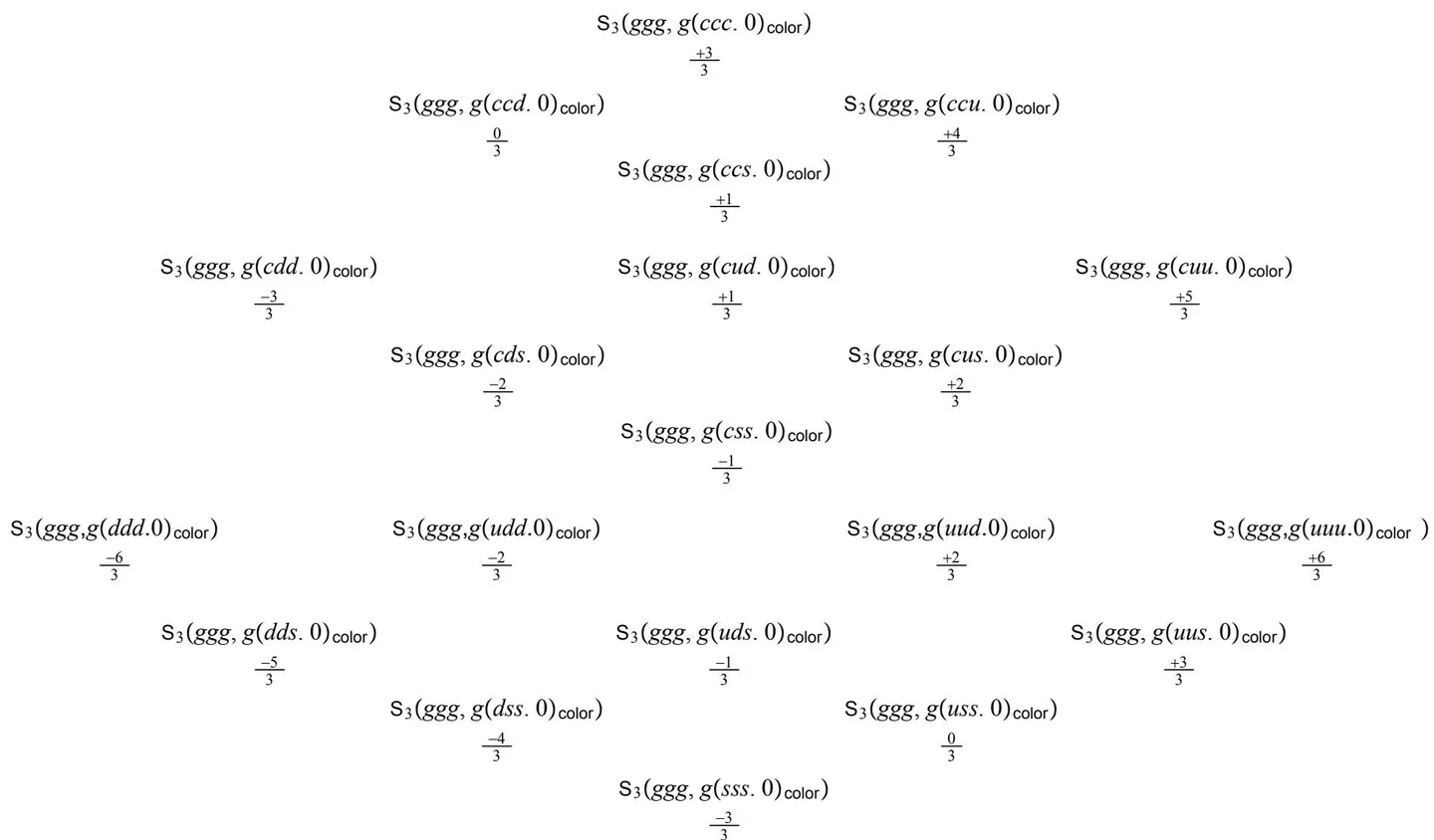
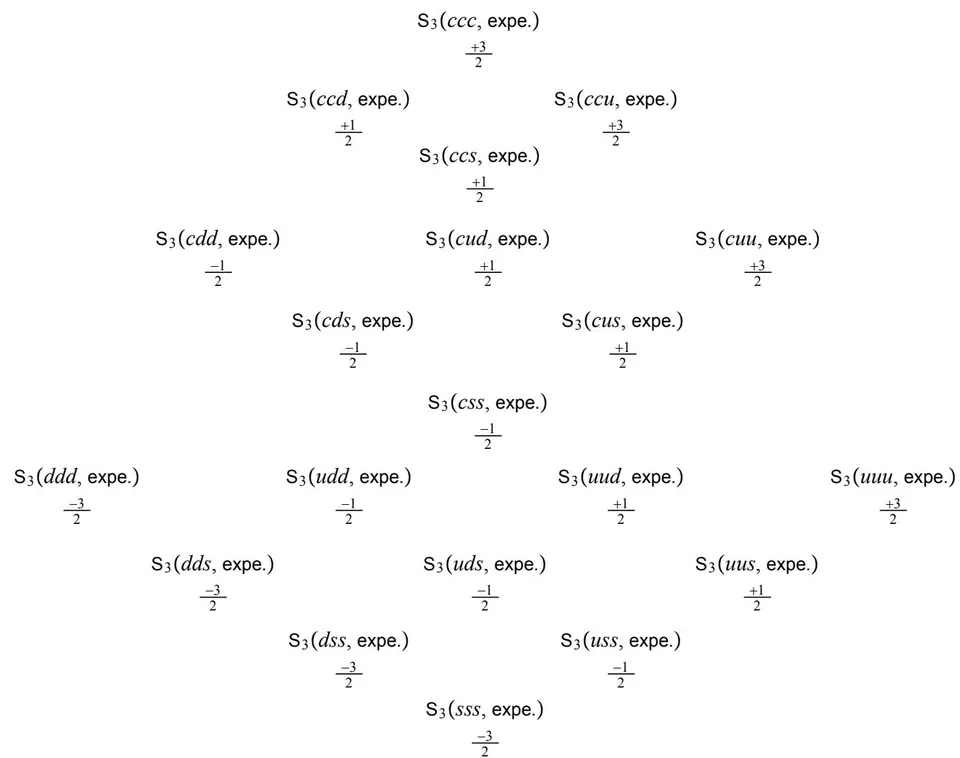
The above values of experiment) are obtained by using formula (11)
【Emphasis】The spin experimental values of Figure.8 weight diagram are consistent with formula (4) Part.A
Next, back to section.4, we discuss the right part【2】of Table.3 Part.B following:
This time, we consider spin coupling between quark Figure 9 and gluon (Figure 5), then obtain Figure.11 (below). And consider color coupling between quark Figure.10 and gluon (Figure.4.1, Figure.4.2), then obtain Figure.12 (below).
Analogy to the similar proceeds in【1】previously, here by【2】, following from Figure.11, we get (Figure.13), and from Figure.12 get (Figure.14). At last, Using formula (12) to calculate the third component of charmed colored baryon SU(4)
Then comparing with , it is shown: the result (12) is the same as the result (11), which is presented by Figure.8. that is
Summary
Because the concrete presentations of (Figure.9), (Figure.10) and (Figure.5), (Figure.4.1, Figure.4.2) could be found out, we can use Table.3 to discuss observable experimental baryons.
To construct experimental baryon, the routine result of coupling [1] between corled quark and colored gulon is identical to [2] between spin coupling and color coupling .
Figure 9: spin angular momentum qqq of charmed colored baryon SU(4)
Figure 10: weight diagram of color spin qqqcolor of charmed colored baryon SU(4)
Figure 11: qqq + ggg of charmed corlored baryon SU(4)
Figure 12: of charmed colored baryon SU(4)
Then obtain of Figure.11:
Figure 13: of spin coupling and obtain of Figure.12:
Figure 14: of color coupling
Part.D Meson Constituent Related to Gluon
12. SPIN COLOR STATE, SPIN OF COLORED MESON NONET In order to discuss colored mesons, we extend Table.2 (Part.A) colored quarks into Table.6 and Table.7 below
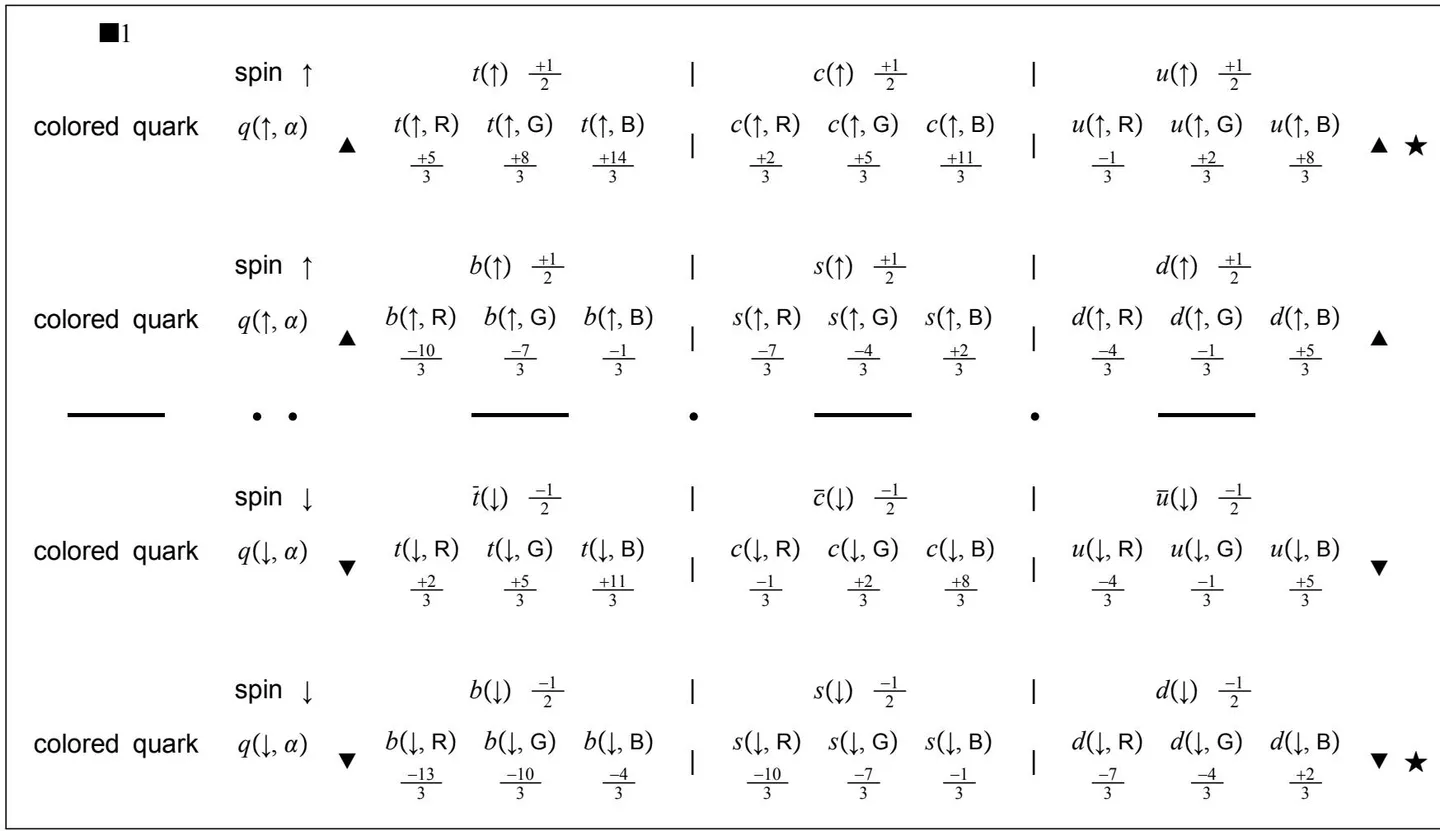
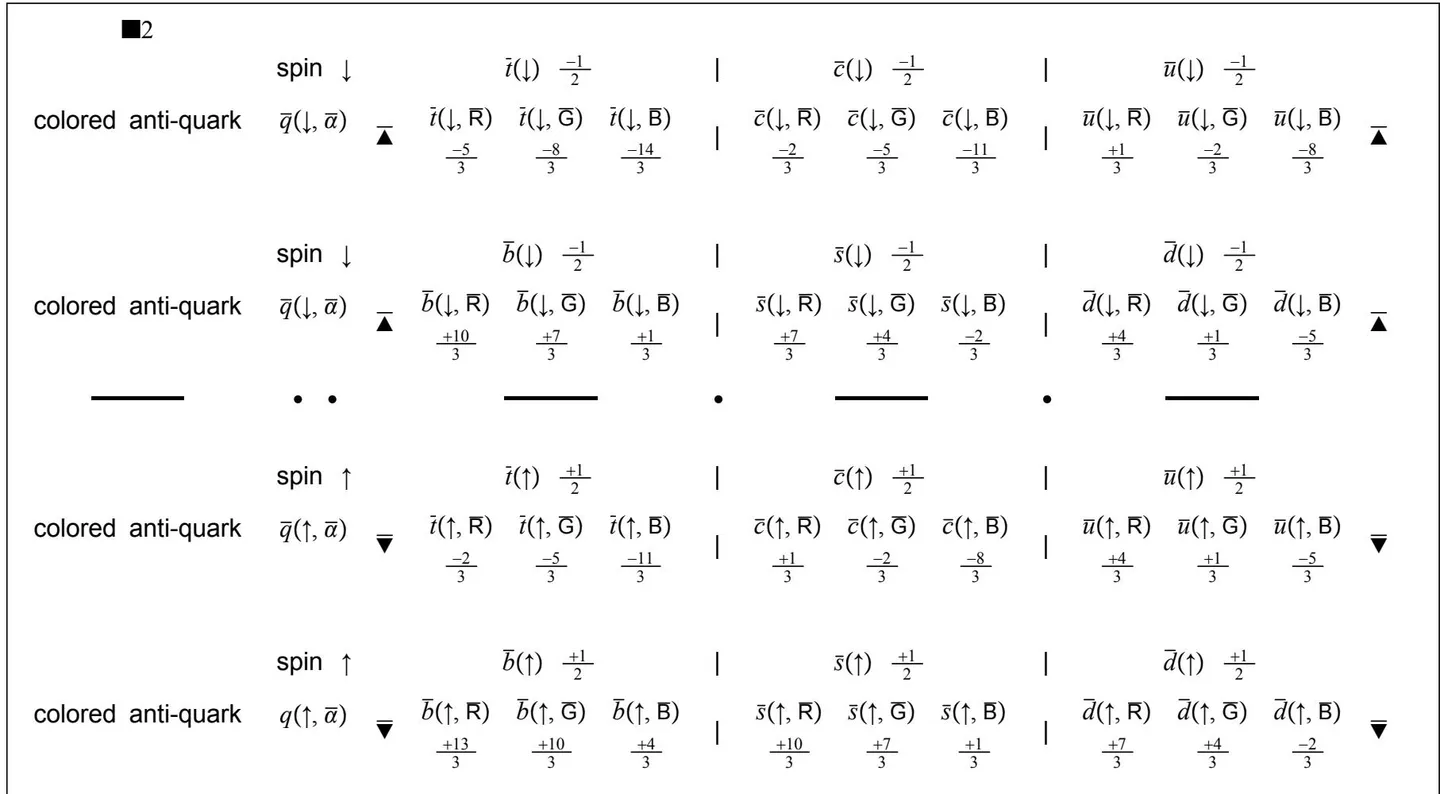
【Emphasis】Formula (4.0) Part.A is the domain of definition of colored quark in Table.6 and Table.7 Because every colored meson comprises a colored quark and a colored antiquark, so colored meson (be written as an array that labelled by symbol ) could be obtained directly from the combinations of the colored quarks (Table.6) and the colored antiquarks (Table.7). Further, colored mesons are expressed by following four spin-color states of representations:
These spin-color states for meson composites satisfies condition (soon see below):
Now we are prepared to discuss two special cases and
- Figure.15, Figure.16, Figure.17, Figure.18
- Figure.19, Figure.20, Figure.21, Figure.22
If only care for the results of and , refer to SUMMARY OF MESON at the end of this section.
- (Figure.15, 16, 17, 18 below)
- 《A1》The spin angular momentum directions, between quark and antiquark , are anti-parallel:
Figure 15.1: of colored mesons
Figure 15.2: of colored mesons
Figure 16.1: of colored mesons
Figure 16.2: of colored mesons
《A2》The spin angular momentum directions, between quark and antiquark , are parallel:
Figure 17.1: of colored mesons
Figure 17.2: of colored mesons
Figure 18.1: of colored mesons
Figure 18.2: of colored mesons
Summary
Figure.15.3 ,Figure.16.3 Figure.18.3
- 《B》 (Figure.19, 20, 21, 22 below)
- 《B1》The spin angular momentum directions, between quark and antiquark , are anti-parallel:
Figure 19.1: of colored mesons
Figure 19.2: of colored mesons
Figure 20.1: of colored meson
Figure 20.2: of colored mesons
《B2》The spin angular momentum directions, between quark and antiquark , are parallel:
Figure 21.1: of colored mesons
Figure 21.2: of colored mesons
Figure 22.1: of colored mesons
Figure 22.2: of colored mesons
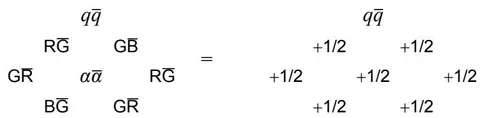
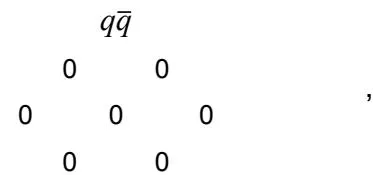
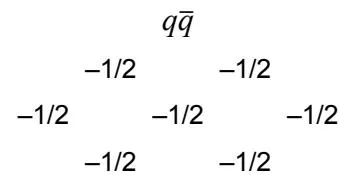
Summary
13. GLUON COLOR ASSOCIATED WITH MESON
Because gluon color (7) (part.B) is related to quark color and antiquark color , mesons are comprised of a quark and an antiquark, further in when discussing cloed mesons, we introduce gluon color (similar to in discussing baryons section.8 previously), is an array that comprises two matrix elements that listed in subtables of Table.5 .
Next, three examples of , 1), 2) and 3), base on using Table.5 gluon color matrix , are given below.
We see: in case 1) and 2), the arithmetic sum of two matrix elements in the array are all zero, but the square sum of their are variations on color sclection of quark and antiquark
- the example of associated with meson , we get
- the example of associated with meson , we get
3), both arithmetic sum and square sum of two matrix elements in the array are not zero.
- CORLOR GROUND STATE, AND COLOR EXCITED STATE OF GLUON NONET
Formula (23.1) and formula (24.2) are named as ground states of and that of respectively, due to the square sums of (23.1) and (24.2) are minimums.
Formula (25.1) and (25.2) are named as excited states of and that of respectively.
In this way, we are going to discuss corlor ground state, and excited state , of gluon nonet. First, we collect all matrix elements of that based on Table.5 to make up Table.8.
| i | c | u | d | s | b | 田 = RR, GG, BB | |
| t | 田 | RG | GB | RB | |||
| c | GR | 田 | RG | GB | RB | ||
| u | BG | GR | 田 | RG | GB | RB | |
| d | BR | BG | GR | 田 | RG | GB | |
| s | BR | BG | GR | 田 | RG | ||
| b | BR | BG | GR | 田 | |||
| i | c | u | d | s | b |
Then using this table, it is easy to extend ground states (23.1) and (24.2) to corlor ground state of colored gluon nonet Table.9.1 below. And extend (25.2) to corlor excited state of colored gluon nonet Table.10.1 below
| g(d̅s, 0)color 0 (d̅s), (s̅d) (R̅G, G̅R) (0, 0) | g(u̅s, 0)color 0 (u̅s), (s̅u) (G̅B, B̅G) (0, 0) | ||||
| g(d̅u, 0)color 0 (d̅u), (ud) (G̅R, R̅G) (0, 0) | g(d̅d, 0)color 0, g(u̅u, 0)color 0 (d̅d), (d̅d), (u̅u), (u̅u) (田, 田) | g(u̅d, 0)color 0 (u̅d), (d̅u) (R̅G, G̅R) (0, 0) | |||
| g(s̅u, 0)color 0 (s̅u), (u̅s) (B̅G, G̅B) (0, 0) | g(sd̅, 0)color 0 (sd̅), (d̅s) (G̅R, R̅G) (0, 0) | ||||
| • • • | • • • | • • • | • • • | • • • | • • • |
| g(d̅s)color +1 (d̅s), (s̅d) (G̅R, B̅B) (+2, -1) | g(u̅s)color +2 (u̅s), (s̅u) (B̅G, R̅R) (+4, -2) | ||||
| g(d̅u)color -1 (d̅u), (ud) (R̅G, B̅B) (-2, +1) | g(d̅d)color 0, g(u̅u)color 0 (d̅d), (d̅d), (u̅u), (u̅u) (田, 田) | g(u̅d)color +1 (u̅d), (d̅u) (G̅R, B̅B) (+2, -1) | |||
| g(s̅u)color -2 (s̅u), (u̅s) (G̅B, R̅R) (-4, +2) | g(sd̅)color -1 (sd), (d̅s) (R̅G, B̅B) (-2, +1) |
| S3(g(d̅s, 0)color) (d̅s), (s̅d) (RG, GR) 0 | S3(g(u̅s, 0)color) (u̅s), (s̅u) (GB, BG) (0, 0) | |||||
| S3(g(d̅u, 0)color) (d̅u), (u̅d) | S3(g(d̅d, 0)color), S3(g(u̅u, 0)color) (d̅d), (d̅d), (u̅u), (u̅u) | S3(g(u̅d, 0)color) (u̅d), (d̅u) (RG, GR) 0 | • | Table.9.2 Spin Component S3 of Color Ground state of colored gluon nonet S3(g(q̅q)color) = S3(g(q̅q, 0)color) | ||
| (GR, RG) 0 | 0 | 0 | • | • | • | |
| S3(g(s̅u, 0)color) (s̅u), (u̅s) | S3(g(s̅d, 0)color) (s̅d), (d̅s) | |||||
| (BG, GB) 0 | S3(g(u̅s)color) (GR, RG) | |||||
| • • • | • • • | • • • | • • • | • • • | • • • | • • • |
| S3(g(d̅s)color) (d̅s), (s̅d) | S3(g(u̅s)color) (u̅s), (s̅u) | |||||
| (GR, BB) +1/2 | S3(g(u̅d)color) (BG, RR) | |||||
| S3(g(d̅u)color) (d̅u), (u̅d) | S3(g(d̅d)color), S3(g(u̅u, 0)color) (d̅d), (d̅d), (u̅u), (u̅u) | S3(g(u̅d)color) (u̅d), (d̅u) | • | Table.10.2 Spin Component S3 Color Excited state of colored gluon nonet S3(g(q̅q)color) | ||
| (RG, BB) -1/2 | (田, 田) | +1/2 | • | • | ||
| S3(g(s̅u)color) (s̅u), (u̅s) | S3(g(s̅d)color) (s̅d), (d̅s) | |||||
| (GB, RR) | (RG, BB) | |||||
| -1 | -1/2 |
15. SPIN OF GLUON NONET
Analogy to section.10 mentioned before, once we used symbol ggg to express spin angular momentum of gluon SU(4) for baryon qqq, here symbol gg is used to indicate spin angular momentum of gluon nonet associated with meson . And the value of is expressed by and below:
For color ground state
Table.9.2
For corlor excited state
Table.10.2
Substitute (26), Table.9.2 and (27), Table.10.2 into (28), obtain spin of colored gluon that dissociated with meson nonet
16. OBSERVABLE EXPERIMENTAL MESON
Analogy to formula (11) Part.C for baryon mentioned, here we using (29) for meson. and obtain Table.11 and Table.12 below experimental) (29)
| 《A》S3《A》 of meson | S3(qq, qqcolor) | || | S3(gg) | S3(g(qq, 0)color) | S3(gg, g(qq, 0)color (28) | || | S3(qq, experiment.) | |||||||||
| 1- Vector meson | +1 | +3/2 | +2 | -1 | 0 | 0 | +1 | -1/2 | +1 | +1 | ||||||
| S3(q(↑, α), q(↑, α)) | 0 | +1/2 | +1 | || | +4 | +3 | +2 | 0 | 0 | 0 | +2 | +3/2 | +1 | || | +1 | +1 |
| -1/2 | 0 | +5 | +4 | 0 | 0 | +5/2 | +2 | +1 | +1 | |||||||
| (17.3) | (26.1) | (9.2) | ||||||||||||||
| Pseudoscalar meson | +1/2 | +1/2 | -1 | -1 | 0 | 0 | -1/2 | -1/2 | 0 | 0 | ||||||
| 1/2{S3(q(↑, α), q(↓, α))} | +1/2 | +1/2 | +1/2 | || | -1 | -1 | -1 | 0 | 0 | 0 | -1/2 | -1/2 | -1/2 | || | 0 | 0 |
| -S3(q(↓, α), q(↑, α)) | +1/2 | +1/2 | -1 | -1 | 0 | 0 | -1/2 | -1/2 | 0 | 0 | ||||||
| (19) | (26.2) | (9.2) | ||||||||||||||
| 1- Vector meson | +1/2 | +1 | -1 | -2 | 0 | 0 | -1/2 | -1 | 0 | 0 | ||||||
| 1/2{S3(q(↑, α), q(↓, α))} | -1/2 | 0 | +1/2 | || | +1 | 0 | -1 | 0 | 0 | 0 | +1/2 | 0 | -1/2 | || | 0 | 0 |
| +S3(q(↓, α), q(↑, α)) | -1 | -1/2 | +2 | +1 | 0 | 0 | +1 | +1/2 | 0 | 0 | ||||||
| (15.3),(16.3) | (26.3) | (9.2) | ||||||||||||||
| m | ||||||||||||||||
| 1- Vector meson | 0 | +1/2 | -4 | -5 | 0 | 0 | -2 | -5/2 | -1 | -1 | ||||||
| S3(q(↓, α), q(↓, α)) | -1 | -1/2 | 0 | || | -2 | -3 | -4 | 0 | 0 | 0 | -1 | -3/2 | -2 | || | -1 | -1 |
| -3/2 | -1 | -1 | -2 | 0 | 0 | -1/2 | -1 | -1 | -1 | |||||||
| (18.3) | (26.4) | (9.2) | ||||||||||||||
Table 12: Formation Of Observed Scalar Mesons, Pseudovector Mesons. (color excited state
)
| 《B》S3(B) of meson | S3(qq, qqcolor) | || | S3(gg) | S3(g(qq)color) | S3(gg, g(qq)color (28) | || | S3(qq, experiment.) | |||||
| Pseudovector meson | +1/2 | +1/2 | +5/2 | +2 | +1/2 | +1 | +3/2 | +3/2 | +1 | +1 | ||
| S3(q(↑, α), q(↑, a)) | +1/2 | +1/2 | +1/2 | +7/2 | +3 | -1/2 | 0 | +3/2 | +3/2 | +3/2 | +1 | +1 |
| +1/2 | +1/2 | +4 | +7/2 | -1 | -1/2 | +3/2 | +3/2 | +1 | +1 | |||
| (21.3) | (27.1) | (10.2) | ||||||||||
| Scalar meson | +1/2 | +1/2 | -3/2 | -2 | +1/2 | +1 | -1/2 | -1/2 | 0 | 0 | ||
| 1/2{S3(q(↑, α), q(↓, a))} | +1/2 | +1/2 | +1/2 | -1/2 | -1 | -3/2 | -1/2 | -1/2 | -1/2 | -1/2 | 0 | 0 |
| -S3(q(↓, α), q(↑, a))} | +1/2 | +1/2 | 0 | -1/2 | -1 | -1/2 | -1/2 | -1/2 | 0 | 0 | ||
| (19) | (27.2) | (10.2) | ||||||||||
| Pseudovector meson | 0 | 0 | -1/2 | -1 | +1/2 | +1 | 0 | 0 | 0 | 0 | ||
| 1/2{S3(q(↑, α), q(↓, a))} | 0 | 0 | 0 | +1/2 | 0 | -1/2 | -1/2 | 0 | 0 | 0 | 0 | 0 |
| +S3(q(↓, α), q(↑, a))} | 0 | 0 | +1 | +1/2 | -1 | -1/2 | 0 | 0 | 0 | 0 | ||
| (19.3), (20.3) | (27.3) | (10.2) | ||||||||||
| Pseudovector meson | -1/2 | -1/2 | -7/2 | -4 | +1/2 | +1 | -3/2 | -3/2 | -1 | -1 | ||
| S3(q(↓, α), q(↓, a)) | -1/2 | -1/2 | -1/2 | -5/2 | -3 | -7/2 | -1/2 | -3/2 | -3/2 | -3/2 | -1 | -1 |
| -1/2 | -1/2 | -2 | -5/2 | -1 | -1/2 | -3/2 | -3/2 | -1 | -1 | |||
| (22.3) | (27.4) | (10.2) | ||||||||||
SUMMARY OF MESON
【S1】 In case of colored meson
colored pseudoscalar meson is singlet of spin-color state
colored vector meson is triplet of spin-color state
In case of colored meson
colored scalar meson is singlet of spin-color state
colored pseudovector meson is triplet of spin-color state
【S2】
colored mesons 《A》turns into observed pesudoscalar meson and obvserved vector meson
colored mesons «B» turns into observed scalar meson and obsverved pseudovector meson
【S3】
Meson composite weight diagram from solely role, quark-antiquark to two roles, quark-antiquark and gluons. Using gluon corlor ground state and gluon corlor excited state to instead of orbital angular momentums and of quarks in current theory.
CONCLUSIONS
From point of view of color symmetry between , , and , , about , Tabele.8 seems to be a bit off-pecfect, something leaved out. If want to restore symmetric color world, Table.8 could be extended to Table.13. Then new possible flavors should be put into particle physics. Following is the chart of the possible gluon color ground state resulted from flavors , , and , ,
| X3 | X2 | X1 | t | c | u | d | s | b | |||||
| ⊕ = RR, GG, BB | |||||||||||||
| t | BR▲ | BG▲ | GR▲ | ⊕ | RG | GB | RB | ○ | ○ | ||||
| ▲ ⊆ X1, X2, X3 | |||||||||||||
| c | BR▲ | BG▲ | GR | ⊕ | RG | GB | RB | ○ | ▼ ⊆ Y1, Y2, Y3 | ||||
| u | BR▲ | BG | GR | ⊕ | RG | GB | RB | ||||||
| d | BR | BG | GR | ⊕ | RG | GB | RB▼ | ||||||
| s | ○ | BR | BG | GR | ⊕ | RG | GB▼ | RB▼ | |||||
| b | rW | ○ | ○ | BR | BG | GR | ⊕ | RG▼ | GB▼ | RB▼ | |||
| t | c | u | d | s | b | Y1 | Y2 | Y3 | |||||
Where and are the possible existent flavors, which respectively arranged at the left side and the right side of known six flavors. That is: , . Symbols and indicate new gluon color ground states between and