In this paper, making use of the observational data of Comets observed in Ancient and Mediaeval Korea, we anew elucidated the observational history of the comet 2P/Encke become well known up to now. We found that out of comets corresponding to a few hundred observed in ancient and mediaeval Korea, the observations of comets the periods of which was approximately 3.3year amount to 32 cased. This means that the comet 2P/Encke which had been discovered in AD 1786 in western world had been in AD 54, it had been already observed 32times in Korea up to AD 1638.
## I. INTRODUCTION
Commencing from BC 275, in Korea, the astronomical phenomena recorded through observations for about 2000 years amount to more than ten thousand [9, 14-17]. Out of them the observation of comets, beginning from the observation of comet 27P/Crommelin in BC 44, amounts to a few hundreds. However, in the book "Physical Characteristics of comets" by Vsekhsyakskii published in 1964, the observation data of comets recorded in ancient and mediaeval Korea are quite absent [11].
In the book "Cometograph" by Kronk [12], the historical and scientific data on comets observed from Before Christ investigated synthetically, but the study of comets observed in ancient and mediaeval Korea has a number of shortcoming that some of them missed.
The observational data of comets observed in ancient and mediaeval Korea are making important contribution to the study of modern cometary astronomy [10, 13].
For example, Ref [13] elucidated that the Comet 27P/Crommelin discovered in AD 1547 in western world had been discovered in BC 44 in ancient Korea and had observed 16 times up to AD 1547.
In this paper, on the basis of experience found the Comet 27P/Crommelin in Ref [13], from the observation dates of comets amounting to a few hundreds, by a method calculating the period, we performed the quest for finding the periodic comets.
## II. ANALYSIS OF THE OBSERVED DATA
In the ancient and mediaeval times, in the absence of telescope, one would have observed comets by naked eye, and therefore, mainly luminous comets would have been observed and recorded. Therefore, we have chosen the Comet 2P/Encke discovered in AD 1786 as a luminous comet. Its period is 3.3 year [11]. Therefore, we quested the comet that the difference of observational dates was divided by an integer when one divides by 3.3 year. The results are presented in Table 1 and they correspond to appearances of the Comet 2P/Encke, which amount to 32 times.
In Table 1, the first date of observation of the comet in Gregorian calendar, the same date recorded in original chronicle, constellation where comet appeared, period, number of observed days, size of comet, and finally name of country observed the comet beside Korea are presented.
The periods presented in Table 1 are not the true period determined through the calculation of orbital elements. Those periods are values closest to 3.3 year, a multiplication of which by an integer yields the difference of neighboring observation dates.
According to Table1, the Comet 2P/Encke had orbited 524 times from AD54 to AD 1786 when its period is assumed to be 3.3 year. According to Ref [11], the period of the Comet 2P/Encke in a duration from AD 1786 to AD 1954, changed between 3.281 year and 3.318 year. $(\Delta T = 0.037$ year).
Table 1: List of observations of Comet 2P/Encke
<table><tr><th>Julian Date</th><th>Original Date</th><th>Constellation</th><th>Period (Year)</th><th>Duration of Observation (Day)</th><th>Length</th><th>Note for Reference</th></tr><tr><td>54.February</td><td>Yu Ri Wamg 31thyear, 2ndmonth</td><td>Ja Mi Won(Dra, UMa, Cep, Cam)</td><td>3.3</td><td>1</td><td></td><td>Italy, China</td></tr><tr><td>153.October</td><td>Il Song Wang 20thyear, 10thmonth</td><td>East, North-East</td><td>3.02</td><td>1</td><td></td><td>Korea</td></tr><tr><td>186.October</td><td>Cho Go Wang 21thyear, 10thmonth</td><td>West-North</td><td>3.3</td><td>20</td><td></td><td>Korea</td></tr><tr><td>383. September</td><td>So Su Rim Wang 13thyear, 9thmonth</td><td>West-North</td><td>3.28</td><td>1</td><td></td><td>Korea</td></tr><tr><td>640-January</td><td>Mu Wang 41thyear,1stmonth</td><td>West-North</td><td>3.24</td><td>1</td><td></td><td>Korea</td></tr><tr><td>647.August</td><td>Jin Dek Wang 1styear, 8thMonth</td><td>South</td><td>3.79</td><td>1</td><td></td><td>Korea</td></tr><tr><td>676.July</td><td>Mun Mu Wang 16thyear, 7thmonth</td><td>BukHa(Gem), Jok(Per)</td><td>3.21</td><td>1</td><td>6~7bo</td><td>Japan, China, Europe</td></tr><tr><td>683.October</td><td>Sin Mun Wang 3rdyear, 10thmonth</td><td>Ogo (Aur)</td><td>3.63</td><td>1</td><td></td><td>China</td></tr><tr><td>699.February</td><td>Hyo So Wang 8thyear, 2ndmonth</td><td>East</td><td>3.07</td><td>1</td><td></td><td>Korea</td></tr><tr><td>759.April-May 1st</td><td>Kyong Dok Wang 18thyear, 3rdmonth</td><td>West</td><td>3.16</td><td>spring-autumn</td><td></td><td>Korea</td></tr><tr><td>838.November</td><td>Hui Gang Wang 3rdyear</td><td>West</td><td>3.18</td><td>1</td><td></td><td>China, Japan, Germany</td></tr><tr><td>1006</td><td>Mok Jong Wang 9thyear</td><td>West</td><td>3.34</td><td>1</td><td></td><td>Korea</td></tr><tr><td>1019.February 6</td><td>Hyon Jong Wang 9thyear,12thmonth, JongSa day</td><td>Chon Si Won, Jong Jeng, JongYin, Si Ru(Ser, Per)</td><td>3.48</td><td>1</td><td></td><td>Korea</td></tr></table>
However, in Table1, the longest period is 3.78 year, and the shortest one is 3.12 year and its difference is $\Delta T = 0.66$ year, but this difference is not difference produced from the exact periods, as mentioned above. However, the average of the periods presented in Table 1 is 3.31 year and is close to the true period 3.3 year.
In Table 1, out of the 32 observations of the Comet 2P/Encke, the comet observed AD153, AD 186, AD 640, AD 647, AD 683 AD 699, AD 1006, AD 1404, AD 1417, AD1459, AD 1595, AD 1601 and AD 1638 are observed exclusively in Korea. Remaining observations had been performed also in China, Japan, Deutschland, Italy and so on, and therefore, dates of first appearance of the comet and sites of the comet were able to compare each other. A number of was different from one to other [12, 18-21].
Now, let us consider the variation of absolute magnitude $H_{10}$ of the Comet 2P/Encke, which is expressed by following formula
$$
H _ {1 0} = m - 5 l g \Delta - 1 0 l g r
$$
where $m$ is apparent magnitude of the comet, $\Delta$ is geocentric distance and $r$ is heliocentric distance of the comet.
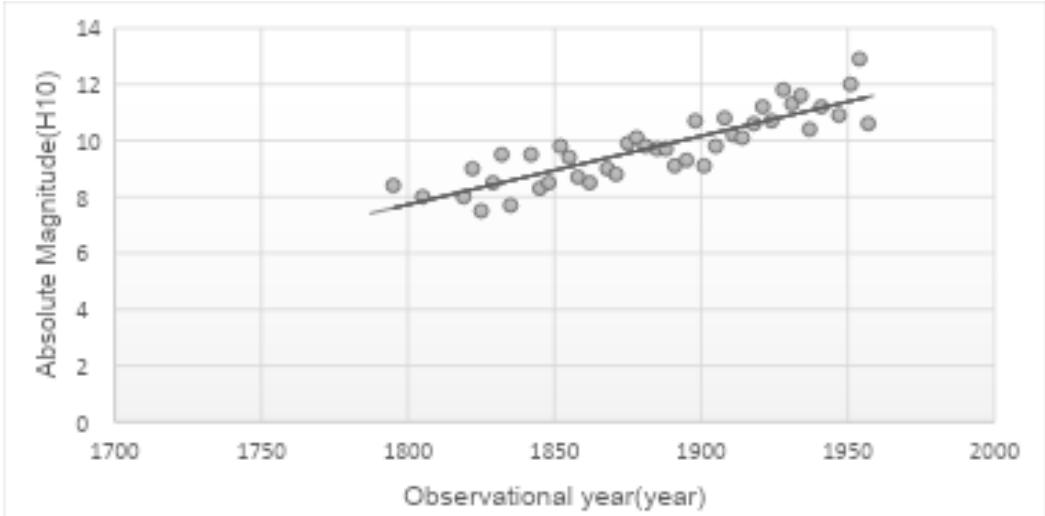 Fig.1: Absolute Magnitude Change Curve of Comet 2P/Encke
The variation of absolute magnitude of the comet in duration from AD 1786 to AD 1957 is presented in Fig 1 [11].
- As we can see, the absolute magnitude of the Comet 2P/Encke, varied about $2.^{m}0 - 2.^{m}5$ in duration AD 1786-AD 1954.
- This means that a rate of variation of absolute magnitude is $1.^{m}18$ per a year. If we assume that this variation rate in present was the same in the long past, we obtain an incredible value of absolute magnitude that the absolute magnitude in AD 54 was as more luminous as $20^{m}$. However, the variation rate of absolute magnitude cannot be constant, so can we obtain the conclusion that in the past, the Comet 2P/Encke would have been very bright.
- The Comet 1P/Halley had had an absolute magnitude of $H_{10} = 2.^{m}0$ in AD 760, whereas it diminished to 4. $^{m}6$ in AD 1910, and the Comet 27P/Crommelin from $H_{10} = 6.^{m}2$ in AD 1457 to 10. $^{m}7$ in AD 1956. Such examples show that these comets had been very bright in BC 466 and BC 44 first observed, respectively.
- Therefore, the Comet 2P/Encke also would have been very luminous in AD 54, and on account of this, this comet could have been observed in ancient Korea.
## III. CONCLUSION
- In this paper, we examined extensively observational data of comets observed in ancient and mediaeval Korea and quested the comets repeatedly observed after about 3.3 year. In this procedure, we found that the 32 observation cases are correspond to the Comet 2P/Encke.
- From the curve of variation of absolute magnitude of the Comet 2P/Encke from AD 1786 to AD 1954, we could suppose that this comet would be very bright in ancient Korea before mediaeval epoch, and therefore was able to easily observe by naked eye.
- After the Comet Halley was discovered in BC 466 and the comet of Crommelin in BC 44, the bright comet Encke would be also discovered in AD 54. Thus, we could elucidate that this comet probably, was one out of the comets which mankind had begun to observe first in the earliest time.
Generating HTML Viewer...
References
21 Cites in Article
F Stephenson (1999). Solar and Lunar Eclipse Records in Early Korean History.
F Stephenson (2014). New Insights From Recent Studies in Historical Astronomy: Following in the Footsteps of F. Richard Stephenson.
F Stephenson (1997). Historical Eclipses and Earth's Rotation.
N.-Z Dai,M.-D Chen (1980). Historical auroral data from China, Korea and Japan from the legendary period to A.D. 1747.
F Stephenson (2002). Eclipse Records in Early Korean History: The Koryo-sa.
S.-I Chu (1968). Supernovae from ancient astronomical Korean records.
John Dickel (2006). The Radio Spectra of Supernova Remnants.
J Eddy,F Stephenson,K Yau (1989). On pre-telescopic sunspot records.
S Imoto,I Hasegawa (1958). Ancient novae and meteor showers.
J Kim,M Han,C Kwak,Y Jong (2021). The Data Book of Astronomical Phenomena Observed for 2000 Years in Korea.
I Nha,W Oh,Y Oh,S Nha (2017). Scientists of the Gwansang-gam.1: Observers of Comet1P/ Halley in 1759.
S Vsekhsvyatskii (1964). Physical Characteristics of Comets.
Gary Kronk (1999). Cometography.
Y Jong,J Kim (2019). Comet 27P/Crommelin Observed in Ancient Korea.
Mun Kwang-Myonga,Ju Jong-Song,Kim Kum-Song,Pak Chol,Sok Paek (1959). Generation Z students’ attitudes to printed books Inertia of the historical perception process, diversification of usefulness in the DPR Korea.
Mun Kwang-Myonga,Ju Jong-Song,Kim Kum-Song,Pak Chol,Sok Paek (1960). Generation Z students’ attitudes to printed books Inertia of the historical perception process, diversification of usefulness in the DPR Korea.
Kwang-Hyok Kim,Myong-Ho Cho,Chol-Ho Ryang,Ju-Song Im,Song-Yong Cho,Yong-Jun Han (2011). Translation Memory Retrieval Using Lucene.
Patrick Moore (2000). The Data Book of Astronomy.
Li Yang,Jianghao Liu,Lingya Gu (1983). Detailed Insights to Liquid Absorption and Liquid-Paper Interaction.
F Ye,Houhanshu (1982). zhong bronze bell Zhonghua Liuban Liuban in middle tempo, one of the “eight great pieces” of Jiangnan Sizhu Zhonghua Shujü China Bookshop in Beijing Zhongyang Mingzu Central Chinese orchestra in Beijing Yuetuan Zhu bamboo, a category of ancient classification for musical instruments References.
F Xuanling (1982). zhong bronze bell Zhonghua Liuban Liuban in middle tempo, one of the “eight great pieces” of Jiangnan Sizhu Zhonghua Shujü China Bookshop in Beijing Zhongyang Mingzu Central Chinese orchestra in Beijing Yuetuan Zhu bamboo, a category of ancient classification for musical instruments References.
Explore published articles in an immersive Augmented Reality environment. Our platform converts research papers into interactive 3D books, allowing readers to view and interact with content using AR and VR compatible devices.
Your published article is automatically converted into a realistic 3D book. Flip through pages and read research papers in a more engaging and interactive format.
In this paper, making use of the observational data of Comets observed in Ancient and Mediaeval Korea, we anew elucidated the observational history of the comet 2P/Encke become well known up to now. We found that out of comets corresponding to a few hundred observed in ancient and mediaeval Korea, the observations of comets the periods of which was approximately 3.3year amount to 32 cased. This means that the comet 2P/Encke which had been discovered in AD 1786 in western world had been in AD 54, it had been already observed 32times in Korea up to AD 1638.
Our website is actively being updated, and changes may occur frequently. Please clear your browser cache if needed. For feedback or error reporting, please email [email protected]
Thank you for connecting with us. We will respond to you shortly.