
I. INTRODUCTION
Commencing from BC 275, in Korea, the astronomical phenomena recorded through observations for about 2000 years amount to more than ten thousand [9, 14-17]. Out of them the observation of comets, beginning from the observation of comet 27P/Crommelin in BC 44, amounts to a few hundreds. However, in the book "Physical Characteristics of comets" by Vsekhsyakskii published in 1964, the observation data of comets recorded in ancient and mediaeval Korea are quite absent [11].
In the book "Cometograph" by Kronk [12], the historical and scientific data on comets observed from Before Christ investigated synthetically, but the study of comets observed in ancient and mediaeval Korea has a number of shortcoming that some of them missed.
The observational data of comets observed in ancient and mediaeval Korea are making important contribution to the study of modern cometary astronomy [10, 13].
For example, Ref [13] elucidated that the Comet 27P/Crommelin discovered in AD 1547 in western world had been discovered in BC 44 in ancient Korea and had observed 16 times up to AD 1547.
In this paper, on the basis of experience found the Comet 27P/Crommelin in Ref [13], from the observation dates of comets amounting to a few hundreds, by a method calculating the period, we performed the quest for finding the periodic comets.
II. ANALYSIS OF THE OBSERVED DATA
In the ancient and mediaeval times, in the absence of telescope, one would have observed comets by naked eye, and therefore, mainly luminous comets would have been observed and recorded. Therefore, we have chosen the Comet 2P/Encke discovered in AD 1786 as a luminous comet. Its period is 3.3 year [11]. Therefore, we quested the comet that the difference of observational dates was divided by an integer when one divides by 3.3 year. The results are presented in Table 1 and they correspond to appearances of the Comet 2P/Encke, which amount to 32 times.
In Table 1, the first date of observation of the comet in Gregorian calendar, the same date recorded in original chronicle, constellation where comet appeared, period, number of observed days, size of comet, and finally name of country observed the comet beside Korea are presented.
The periods presented in Table 1 are not the true period determined through the calculation of orbital elements. Those periods are values closest to 3.3 year, a multiplication of which by an integer yields the difference of neighboring observation dates.
According to Table1, the Comet 2P/Encke had orbited 524 times from AD54 to AD 1786 when its period is assumed to be 3.3 year. According to Ref [11], the period of the Comet 2P/Encke in a duration from AD 1786 to AD 1954, changed between 3.281 year and 3.318 year. year).
| Julian Date | Original Date | Constellation | Period (Year) | Duration of Observation (Day) | Length | Note for Reference |
|---|---|---|---|---|---|---|
| 54.February | Yu Ri Wamg 31thyear, 2ndmonth | Ja Mi Won(Dra, UMa, Cep, Cam) | 3.3 | 1 | Italy, China | |
| 153.October | Il Song Wang 20thyear, 10thmonth | East, North-East | 3.02 | 1 | Korea | |
| 186.October | Cho Go Wang 21thyear, 10thmonth | West-North | 3.3 | 20 | Korea | |
| 383. September | So Su Rim Wang 13thyear, 9thmonth | West-North | 3.28 | 1 | Korea | |
| 640-January | Mu Wang 41thyear,1stmonth | West-North | 3.24 | 1 | Korea | |
| 647.August | Jin Dek Wang 1styear, 8thMonth | South | 3.79 | 1 | Korea | |
| 676.July | Mun Mu Wang 16thyear, 7thmonth | BukHa(Gem), Jok(Per) | 3.21 | 1 | 6~7bo | Japan, China, Europe |
| 683.October | Sin Mun Wang 3rdyear, 10thmonth | Ogo (Aur) | 3.63 | 1 | China | |
| 699.February | Hyo So Wang 8thyear, 2ndmonth | East | 3.07 | 1 | Korea | |
| 759.April-May 1st | Kyong Dok Wang 18thyear, 3rdmonth | West | 3.16 | spring-autumn | Korea | |
| 838.November | Hui Gang Wang 3rdyear | West | 3.18 | 1 | China, Japan, Germany | |
| 1006 | Mok Jong Wang 9thyear | West | 3.34 | 1 | Korea | |
| 1019.February 6 | Hyon Jong Wang 9thyear,12thmonth, JongSa day | Chon Si Won, Jong Jeng, JongYin, Si Ru(Ser, Per) | 3.48 | 1 | Korea |
However, in Table1, the longest period is 3.78 year, and the shortest one is 3.12 year and its difference is year, but this difference is not difference produced from the exact periods, as mentioned above. However, the average of the periods presented in Table 1 is 3.31 year and is close to the true period 3.3 year.
In Table 1, out of the 32 observations of the Comet 2P/Encke, the comet observed AD153, AD 186, AD 640, AD 647, AD 683 AD 699, AD 1006, AD 1404, AD 1417, AD1459, AD 1595, AD 1601 and AD 1638 are observed exclusively in Korea. Remaining observations had been performed also in China, Japan, Deutschland, Italy and so on, and therefore, dates of first appearance of the comet and sites of the comet were able to compare each other. A number of was different from one to other [12, 18-21].
Now, let us consider the variation of absolute magnitude of the Comet 2P/Encke, which is expressed by following formula
where is apparent magnitude of the comet, is geocentric distance and is heliocentric distance of the comet.
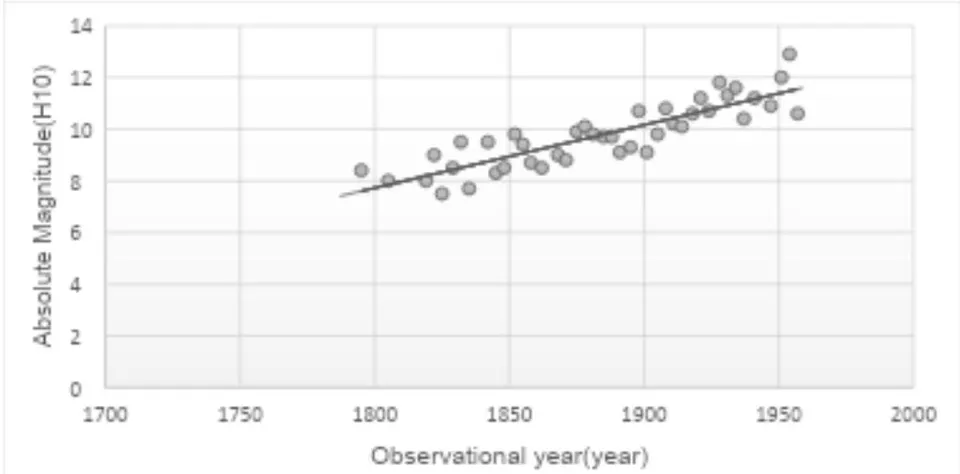
The variation of absolute magnitude of the comet in duration from AD 1786 to AD 1957 is presented in Fig 1 [11].
- As we can see, the absolute magnitude of the Comet 2P/Encke, varied about in duration AD 1786-AD 1954.
- This means that a rate of variation of absolute magnitude is per a year. If we assume that this variation rate in present was the same in the long past, we obtain an incredible value of absolute magnitude that the absolute magnitude in AD 54 was as more luminous as . However, the variation rate of absolute magnitude cannot be constant, so can we obtain the conclusion that in the past, the Comet 2P/Encke would have been very bright.
- The Comet 1P/Halley had had an absolute magnitude of in AD 760, whereas it diminished to 4. in AD 1910, and the Comet 27P/Crommelin from in AD 1457 to 10. in AD 1956. Such examples show that these comets had been very bright in BC 466 and BC 44 first observed, respectively.
- Therefore, the Comet 2P/Encke also would have been very luminous in AD 54, and on account of this, this comet could have been observed in ancient Korea.
III. CONCLUSION
- In this paper, we examined extensively observational data of comets observed in ancient and mediaeval Korea and quested the comets repeatedly observed after about 3.3 year. In this procedure, we found that the 32 observation cases are correspond to the Comet 2P/Encke.
- From the curve of variation of absolute magnitude of the Comet 2P/Encke from AD 1786 to AD 1954, we could suppose that this comet would be very bright in ancient Korea before mediaeval epoch, and therefore was able to easily observe by naked eye.
- After the Comet Halley was discovered in BC 466 and the comet of Crommelin in BC 44, the bright comet Encke would be also discovered in AD 54. Thus, we could elucidate that this comet probably, was one out of the comets which mankind had begun to observe first in the earliest time.