



Communicating Science through Art. Victorias Cells Project

Send Message

To: Author

Communicating Science through Art. Victorias Cells Project

Article Fingerprint

ReserarchID

C5E3E

Communicating Science through Art. Victorias Cells Project Banner

AI TAKEAWAY

Connecting with the Eternal Ground
  • English
  • Afrikaans
  • Albanian
  • Amharic
  • Arabic
  • Armenian
  • Azerbaijani
  • Basque
  • Belarusian
  • Bengali
  • Bosnian
  • Bulgarian
  • Catalan
  • Cebuano
  • Chichewa
  • Chinese (Simplified)
  • Chinese (Traditional)
  • Corsican
  • Croatian
  • Czech
  • Danish
  • Dutch
  • Esperanto
  • Estonian
  • Filipino
  • Finnish
  • French
  • Frisian
  • Galician
  • Georgian
  • German
  • Greek
  • Gujarati
  • Haitian Creole
  • Hausa
  • Hawaiian
  • Hebrew
  • Hindi
  • Hmong
  • Hungarian
  • Icelandic
  • Igbo
  • Indonesian
  • Irish
  • Italian
  • Japanese
  • Javanese
  • Kannada
  • Kazakh
  • Khmer
  • Korean
  • Kurdish (Kurmanji)
  • Kyrgyz
  • Lao
  • Latin
  • Latvian
  • Lithuanian
  • Luxembourgish
  • Macedonian
  • Malagasy
  • Malay
  • Malayalam
  • Maltese
  • Maori
  • Marathi
  • Mongolian
  • Myanmar (Burmese)
  • Nepali
  • Norwegian
  • Pashto
  • Persian
  • Polish
  • Portuguese
  • Punjabi
  • Romanian
  • Russian
  • Samoan
  • Scots Gaelic
  • Serbian
  • Sesotho
  • Shona
  • Sindhi
  • Sinhala
  • Slovak
  • Slovenian
  • Somali
  • Spanish
  • Sundanese
  • Swahili
  • Swedish
  • Tajik
  • Tamil
  • Telugu
  • Thai
  • Turkish
  • Ukrainian
  • Urdu
  • Uzbek
  • Vietnamese
  • Welsh
  • Xhosa
  • Yiddish
  • Yoruba
  • Zulu
Font Type
Font Size
Font Size
Bedground

Abstract

The Specific Objective-Victoria’s cells project was created from the idea of easier training of healthcare personnel and facing theoretical and practical aspects of improving communication. This innovative method allows one to associate benign and malignant cellular images and/or patterns characterized by a wide range of shapes and color shades, evoking animals, common objects, and colorful aquariums with features easily memorized by analogy under the microscope. The project implies different sections subclassified using different iconography able to draw the viewer’s interest and easily memorize the cytological interpretations and describe practical interventions to promote effective communication in cancer screening with different, new, and interactive information tools.

I. THE SPECIFIC OBJECTIVE

Victoria's cells project was created from the idea of easier training of healthcare personnel and facing theoretical and practical aspects of improving communication. This innovative method allows one to associate benign and malignant cellular images and/or patterns characterized by a wide range of shapes and color shades, evoking animals, common objects, and colorful aquariums with features easily memorized by analogy under the microscope. The project implies different sections subclassified using different iconography able to draw the viewer's interest and easily memorize the cytological interpretations and describe practical interventions to promote effective communication in cancer screening with different, new, and interactive information tools.

II. MATERIALS AND METHODS

Cervicovaginal cytology (Papanicolau staining) processed with conventional and liquid-based cytology (LBC).

III. RESULTS

The images are visual of the impact that communicate and educate about the importance of studying cells and their diagnostic role and significance, in order to bring the population closer to prevention. The pictures can be organized into different sections, embracing diagnostic iconography.
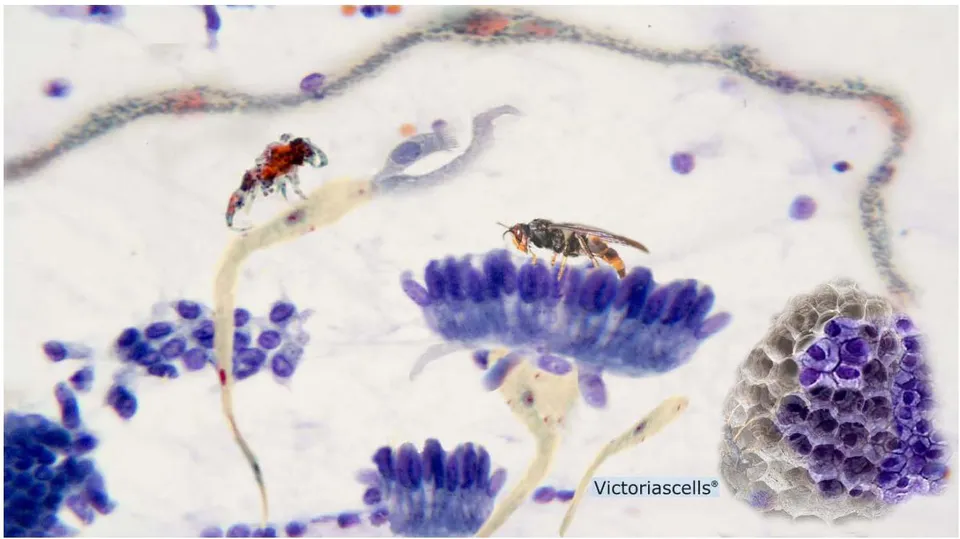
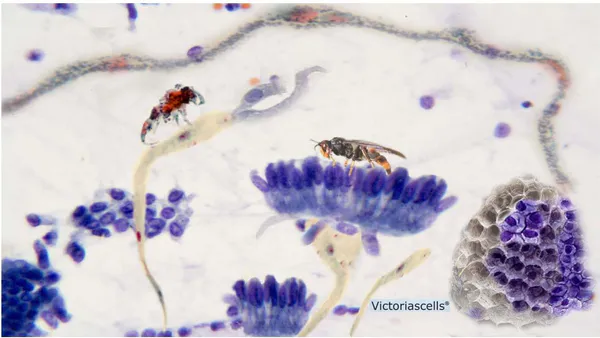
IV. THE BEE

Endocervical cells in all prospects with few immature bee-shaped squamous cells.

Metaplasia recalls the sea turtle's shell or mycetes resembles a starfish. A 3-D sly cat of endometrial cells, a tender little elephant of squamous cells, a dog, and a koala of keratinized cells. Other preparations resemble endocervical and squamous cells resembling fish tanks, a geisha of keratinized squamous cells, or a plunging diver of granulocytes. Furthermore, a hummingbird of endometrial cells, soars in flight, in a sea of endocervical cells mimicking water lilies and peonies. The section of malignant mockery is composed of SIL patterns looking like monsters, eyes,

or a foul tongue, while AGC resembles an eagle and feathers.

V. CONCLUSIONS

The recognition of visual images can make the study of cytology simpler and enjoyable leading to the final purpose of prevention and cure.

Funding

No external funding was declared for this work.

Conflict of Interest

The authors declare no conflict of interest.

Ethical Approval

No ethics committee approval was required for this article type.

Data Availability

Not applicable for this article.

How to Cite This Article

Vittoria Lombardo. 2026. "Communicating Science through Art. Victorias Cells Project". Global Journal of Medical Research - K: Interdisciplinary GJMR-K Volume 23 (GJMR Volume 23 Issue K3).

Download Citation

Alt: Scientific article on communication technology's impact on vital signs monitoring and project implementation.
Journal Specifications

Crossref Journal DOI 10.17406/gjmra

Print ISSN 0975-5888

e-ISSN 2249-4618

Keywords
Classification
GJMR-K Classification QU 300
Version of record

v1.2

Issue date
May 24, 2023

Language
English
Experiance in AR

Explore published articles in an immersive Augmented Reality environment. Our platform converts research papers into interactive 3D books, allowing readers to view and interact with content using AR and VR compatible devices.

Read in 3D

Your published article is automatically converted into a realistic 3D book. Flip through pages and read research papers in a more engaging and interactive format.

Article Matrices
Total Views: 523
Total Downloads: 25
All Trends

Request Access

Please fill out the form below to request access to this research paper. Your request will be reviewed by the editorial or author team.
X

This is the heading

Lorem ipsum dolor sit amet, consectetur adipiscing elit. Ut elit tellus, luctus nec ullamcorper mattis, pulvinar dapibus leo.

High-quality academic research articles on global topics and journals.

Communicating Science through Art. Victorias Cells Project

Vittoria Lombardo
Vittoria Lombardo

