I. INTRODUCTION
Anaerobic bacteria dominate the root canal microbiota and these are largely responsible for initiating and sustaining periapical diseases.
Among these, few microorganisms are treatment resistant and are more prevalent in refractory cases. E.Faecalis is most commonly found facultative anaerobein the endodontic failure teeth due to its inherent ability of tolerance to starvation, extremes of pH, salt concentration, biofilm formation, dentin tubular invasion, and emergence of antibiotic resistant strains which has made their eradication challenging during endodontic treatment.
The presence of complex and inaccessible areas like lateral canals, ramifications, apical deltas etc. render mechanical instrumentation and irrigation insufficient to achieve complete disinfection and asepsis of root canal.4 Thus arises the need of intracanal medicaments between successive treatment sessions to disinfect the root canal system. Calcium hydroxide has been considered as a gold standard among intracanal medicaments due to its high alkaline pH and antibacterial action. However, recent studies have questioned the efficacy of calcium hydroxide in reducing microbial numbers even after prolonged contact with the root canal specifically against E.Faecalis5,6 and Candidia albicans.7 Therefore, the search for alternative medicaments that can target such microorganisms led to the discoveries of newer antimicrobial agents. Recently, triple antibiotic paste (a mixture of metronidazole, ciprofloxacin and minocycline) has been introduced as an intracanal medicament for disinfecting the root canal system.
Various studies in the literature are available emphasizing the role of vehicle for intracanal medicament as they may have the ability to facilitate the better diffusion of medicament through dentinal tubules and anatomical aberrations and may reduce the bacterial loads in infected root canal. Although saline was most commonly used but it has no antibacterial efficiency. So Chlorhexidine has been added by many researchers due to its substantive antibacterial activity as a medicament vehicle and has antibacterial efficacy comparable to that of sodium hypochlorite.[8,9] So the purpose of this investigation was to compare the antimicrobial efficacy of triple antibiotic paste and calcium hydroxide using different types of vehicles i.e saline and chlorhexidine against E.faecalis.
II. METHODOLOGY
The microbial species used in this study was E.Faecalis (ATCC29212) which was grown overnight in BHI agar plate. The microbial strain was tested against the two medicaments: Calcium hydroxide (Group-I) and Triple antibiotic paste (Group-II). The medicaments were tested at concentrations of , , , , and using both normal saline and chlorhexidine as vehicles.
From the BHI agar plates, the microorganisms were inoculated into tube containing of sterile saline solution. A suspension of E.Faecalis was adjusted to CFU/mL turbidity using McFarland tube as standard. Sterile swabs were dipped into suspension and were used to flood the tested organism into the Muller hinton agar plate. Round wells were punctured in each agar plate for each group. Wells were then filled with the medicament, followed by aerobic incubation at for 24hrs in an incubator. Growth inhibition zones were formed around all the wells whose diameters were subsequently recorded by measuring the shortest distance between the outer margin of the well and initial microbial growth (Fig. 1).
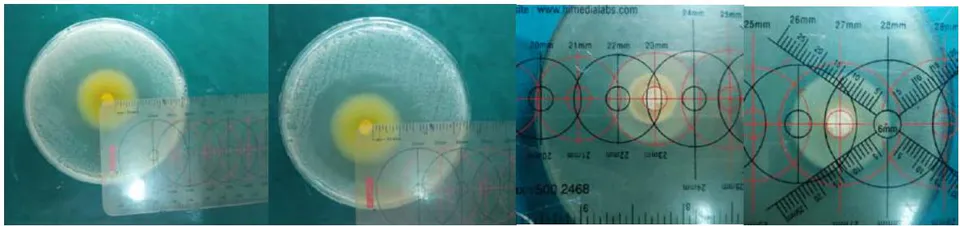
Each experiment was performed in triplicate for each tested material. The mean and standard deviation of the inhibitory zones were calculated. The data was statistically analyzed using Oneway Anova and Bonferroni Post hoc Test.
III. RESULTS
The mean and standard deviation of diameters of the growth inhibition zones for each concentration of the preparations are presented in Graph 1.
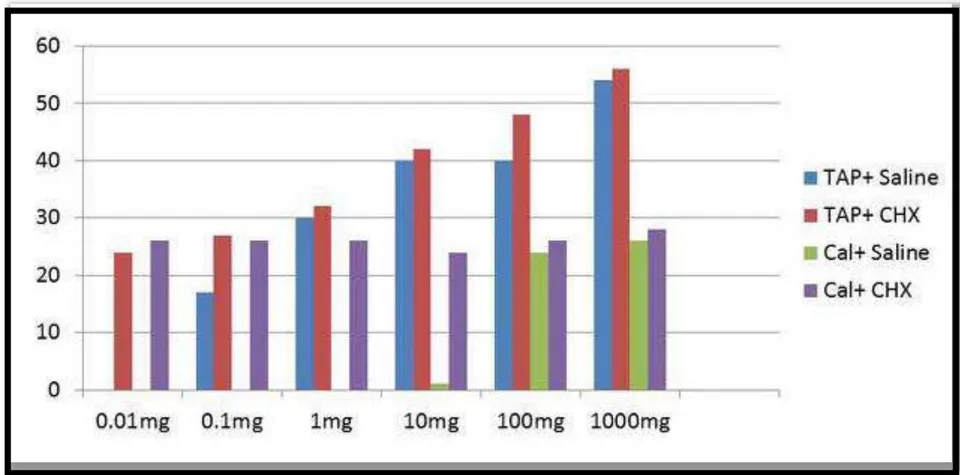
and concentrations, TAP with chlorhexidine was found to be significantly better than TAP with saline and calcium hydroxide with saline but had comparatively equal efficacy to that of calcium hydroxide and chlorhexidine group.
No statistical significant difference was found in TAP group at all other concentrations above after mixing with either saline or chlorhexidine. However, calcium hydroxide group showed a larger zone of inhibition when mixed with chlorhexidine as compared to saline, difference being statistically significant at concentrations 0.01mg/ml, 0.1mg/ml, 1mg/ml and 10mg/ml.
| INTERGROUP COMPARISON | ||||
| Sum of Squares | Mean Square | F | Sig. | |
| 0.01mg | 1881.000 | 627.000 | 501.600 | <.001**** |
| 0.1mg | 1407.000 | 469.000 | 134.000 | <.001**** |
| 1000mg | 2364.000 | 788.000 | 175.111 | <.001**** |
| 100mg | 1353.000 | 451.000 | 69.385 | <.001**** |
| 10mg | 3236.250 | 1078.750 | 239.722 | <.001**** |
| 1mg | 1992.000 | 664.000 | 189.714 | <.001**** |
At very high concentration i.e , statistical significant difference was seen in intragroup comparison of TAP and Chlorhexidine group.
IV. DISCUSSION
During of the Complete elimination of the microorganisms from the root canals cannot be achieved uniformly by chemomechanical preparation alone due to the varying vulnerabilities of the involved species and the anatomical complexities of root canals. Among all the facultative anaerobes, Enterococcus faecalis may be regarded as one of the most resistant species in the oral cavity and a possible cause of failure of root canal treatment. E. faecalis was thus selected for testing antimicrobial efficacy of medicaments in this study. Various researchers have successfully used it to evaluate the efficacy of antibacterial agents as it represents an organism, most commonly isolated from previously treated root canals. Moreover, E. Faecalis is relatively easy to culture and is resistant to commonly used medicaments especially calcium hydroxide.[10,11] In our study, agar diffusion test was used to evaluate and compare the invitro antimicrobial activities of medicaments. Agar diffusion test has frequently been used for the evaluation of antibacterial effects of various endodontic materials in numerous studies also. It also offers many advantages over other methods: simplicity, low cost, the ability to test enormous numbers of microorganisms and antimicrobial agents, and the ease to interpret results provided.
Calcium hydroxide has been the most commonly used intracanal medicament due to its high pH which alters the biological properties of bacterial cell wall lipopolysaccharides of gram -ve species thereby inactivating membrane transport mechanism. However, more recently, concern has been growing about the inadequate antimicrobial efficacy of calcium hydroxide against E. Faecalis as buffering action of dentin neutralizes its action at deeper layers of dentinal tubules resulting in survival of micro-organisms,[15,16] emphasizing the need of change of vehicle. Numerous studies have been reported proving the increase in efficiency of calcium hydroxide when chlorhexidine was used as a vehicle as it has broad spectrum antimicrobial activity and has very low toxicity even at the higher concentrations. Its substantive antimicrobial activity is due to its cationic properties which leads to its adsorption onto hydroxyapatite in the dentin and released subsequently beyond the actual medication period. The results of the study by Turk et al. showed calcium hydroxide mixed with other vehicles was less effective than calcium hydroxide mixed with chlorhexidine digluconate against E. faecalis. Therefore chlorhexidine was used as one of the vehicles in this study. In our study, the bactericidal effect of calcium hydroxide with saline against E. Faecalis was lower at low concentrations whereas calcium hydroxide with chlorhexidine was found to be effective at even lower concentrations which may be due to the presence of chlorhexidine in it. Same results were found by Gomes et al proving the inefficiency of calcium hydroxide at lower concentrations. Whereas the concentrated mixture of calcium hydroxide i.e has similar efficacy in both the vehicles i.e saline and chlorhexidine.
At higher concentrations, TAP shows its equal efficacy when mixed with either of two vehicles. So the efficacy of TAP may be attributed to its mixed antibiotic contents not the vehicle. But according to various studies, at higher concentrations, TAP was found to cause dentin demineralization and also its minocycline component causes the discoloration of tooth.[19] However at recommended concentration for TAP by AEE i.e , TAP mixed with chlorhexidine was found to be more effective than that of saline vehicle. This finding thus indicated that alteration of vehicle was found to be beneficial as it increases the efficacy of triple antibiotic paste as an intracanal medicament. So, chlorhexidine gluconate can be substituted for saline as the vehicle in triple antibiotic paste to increase the antimicrobial efficacy of the mixture.
More in vivo and invitro studies are required to illustrate the efficacy of CHX as an intracanal medicament and to assess whether its substantivity property can actually inhibit microbial colonization in filled canals after treatment. Even then also the results of our study justify its use as an intracanal medicament vehicle in endodontics.