
Introduction
Human Activity Recognition (HAR) has become a growth domain of research, with its evolution intrinsically related to the need for adequate monitoring systems in fields such as healthcare, security, search and rescue, or assisted living . In the early stages of development, systems mostly relied on sensors that people could wear and camera-based monitoring solutions, which were limited by the fact that the non-invasive/wearable battery needed to be charged frequently and camera-based systems suffered from the privacy of users, which is paramount in a privacy-centred environment like a bathroom. The transition to non-invasive sensing HAR in recent times is especially significant in the medical industry, providing an avenue for continuous monitoring of patients in hospitals and the detection of falls in elderly and physically challenged people, where comfort factors, privacy, and long-term use have to be maintained. Channel State Information (CSI)-based activity recognition using commercial Wi-Fi apparatus is a classic example of such a progression. By taking advantage of existing infrastructure—the Wi-Fi routers, network interface cards and off-the-shelf antennas that operate on the 2.4 GHz frequency—it is possible to monitor activities of daily life at a low cost and without compromising privacy . Recent advances in the diagnosis of diseases and therapeutic interventions have led to a significant increase in life expectancy, especially concerning the elderly population. While this is a significant achievement for public health, this also places great pressure on healthcare infrastructure, particularly with the capacity of hospitals and long-term care resources. According to the projections of the United Nations, by the year 2050, the elderly population of the world will be over two billion . This demographic shift highlights the urgent need to have scalable, cost-effective and non-invasive monitoring solutions which will support ageing in place and assisted living environments. In such a context, the introduction of non-invasive technologies such as a Software-Defined Radio (SDR)-based sensing system is an interesting development direction for elderly care homes and community care centres. SDR platforms result in flexible, reconfigurable wireless sensing systems for activity monitoring and fall detection that neither need to be used in wearable devices nor require any intrusive cameras, thus improving compliance and privacy. Software-defined radio (SDR) readers have seen tremendous developments over the past decade, with Miller line coding and non-coherent reception schemes originally implemented. Subsequent advances led to the development of listener-only (sniffer) systems using non-linear signal processing and the advancement from Buettner’s two board system to the single transceiver platform has been a major development to evaluate the performance of the RFID tag .
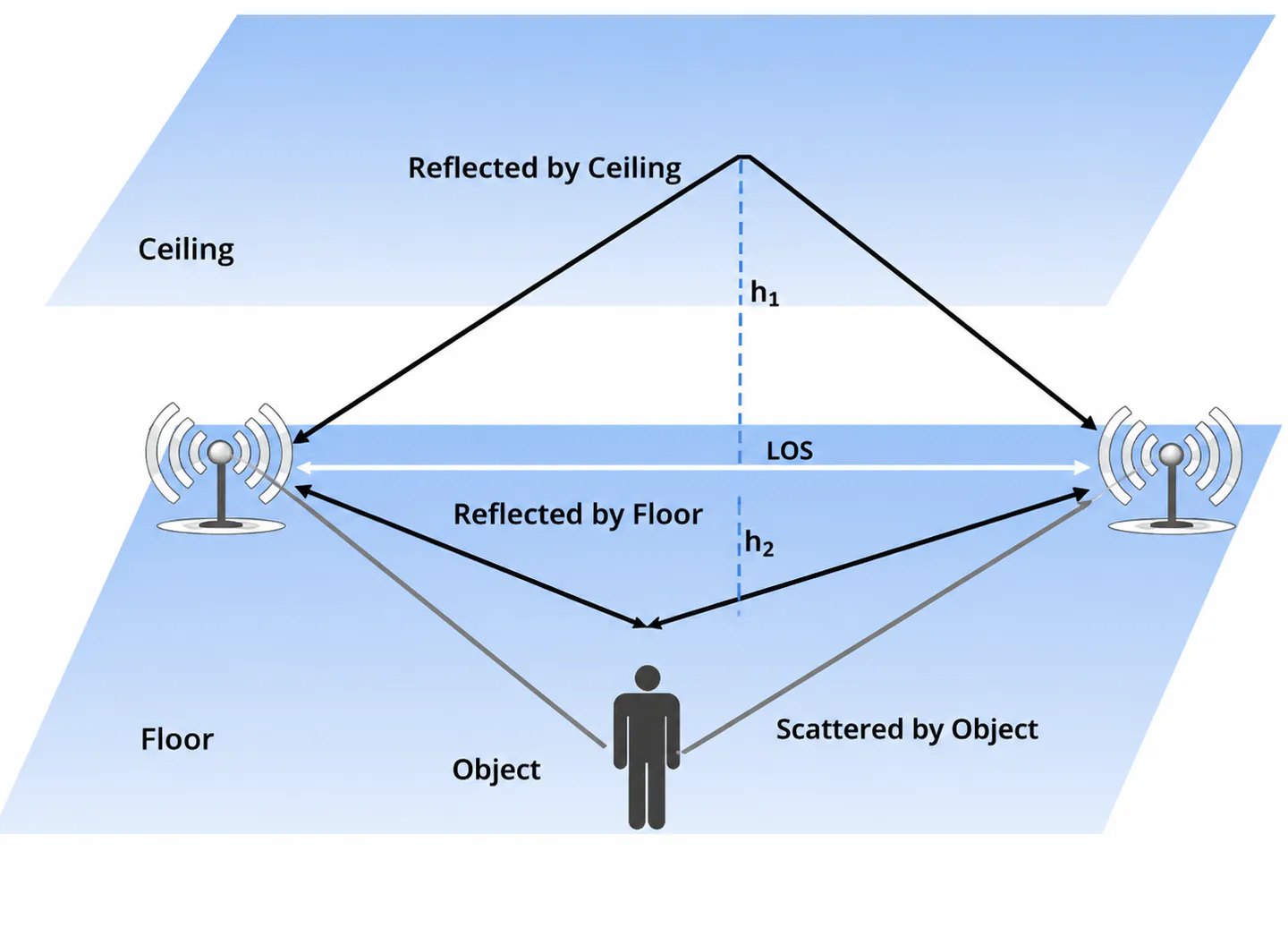
When a human body occupies a physical space, then the reflection or diffraction of an electromagnetic signal from the human body creates an extra propagation path. For this reason, the effects of human motion, including both small and large motion, are reflected in the signal propagation, and these effects are reported in the form of Channel State Information (CSI) from the received signals. The USRP transmitter continuously sends wireless signals with a specific frequency while the USRP receiver is corresponding to these sent signals. The non-intrusive software-defined radio (SDR) framework has three key functional subsystems: the transmitter, the radio or wireless channel, and the receiver as shown in Figure 1.
where (watts) = average power with which the transmitter radiates with antenna gain (dBi), and (dBi) = receiver antenna gain. Assuming Line of sight, surface area, , and the power density (power per unit area) is:
Since the amount of power captured by the antenna depends on the effective aperture :
where = wavelength (metre), = speed of light, and = carrier frequency. The received power is Power density Effective aperture ():
In dBi, the equation becomes:
where (MHz) = frequency, (km) = distance, (dBi) = transmitter gain, and (dBi) = receiver gain:
The authors in and presented the analysis of the signal propagation model in an indoor environment as follows:
For the ground reflection path, the power received by the receiver can be expressed as :
where = distance from the reflection point on the ceiling/floor to the line-of-sight path.
When a person exists in the indoor environment, several scattered paths are produced by the human body. This scattered power should also be added to the final received power, denoted as follows :
where represents a brief representation of the path length caused by the human body .
Suppose the intensity magnitudes of the line-of-sight path and the ground reflection path are and , respectively. is the intensity magnitude of other radio propagation paths, such as the reflections of the surroundings . As a result, human body actions in radio-frequency coverage change the signal propagation path, causing the received signal power () to fluctuate significantly. In the absence of motion interference, received power () remains essentially stable , and the total received power () in the indoor static environment is expressed below in Equation
According to scattering theory , in the dynamic environment , , and will not change their values. The total received power by the receiver is the sum of incident and scattered waves as below :
where is the intensity magnitude of scattered wave caused by the target object.
The authors in used domain-independent GAN for activity recognition on Wi-Fi CSI. The model is a generalization across environments, which improves the reliability of contactless monitoring systems. In , Semi-Supervised GANs with Temporal Convolutions for Human Activity Recognition was proposed to alleviate the dependence on labelled data while extracting the spatiotemporal patterns in the RF or CSI signal. Research in fully connected generative adversarial networks for human activity recognition which learn end-to-end from raw sensor data, providing scalable and non-contact monitoring. The authors in explored GANs and achieved reliable human activity recognition. In an SDR-based platform of activity recognition using a flexible hardware and software setup for the real-time, non-invasive monitoring of human activities in indoor environments was designed. The work in proposed a non-invasive, intelligent, real-time HAR based on an SDR sensing solution for next-generation healthcare applications with robust and accurate monitoring. The work in implements interpretable passive multimodal sensor fusion for human identification and activity recognition to increase accuracy and transparency for non-invasive monitoring systems. Researchers in presented an SDR-based testbed for smart healthcare, which allows scalable and contactless monitoring of patient activities and is suitable for research and practical deployment in the healthcare environment.
This paper focuses on the lack of a systematic and comparative evaluation of deep learning architectures that are used in radio-related activity recognition where the underlying representations are quantitatively analysed Channel State Information (CSI) or RF signal features from Software-Defined Radio (SDR) platforms. Accordingly, the present work carries out a systematic comparison of five deep learning models to assess their reliability, robustness and generalisation capability in the context of activity recognition—from a contactless perspective. The ultimate goal here is to identify an optimal model which generates higher accuracy, scalability, and deployability in real-world applications, such as healthcare monitoring, intelligent environments, and security systems. The remainder of this manuscript is structured as follows. Section 2 describes the materials and method employed. Section 3 discusses the results obtained while the paper is concluded in Section 4 with summary of the study’s findings and recommendations.
Materials and Method
This section outlines the experimental framework for the empirical evaluation of the deep learning architectures for software-defined radio-based HAR using the University of Glasgow dataset. The proposed pipeline covers all the essential steps of the learning process: from careful preparation of data and exploratory analysis all the way through generative modelling, supervised classification and systematic performance evaluation. By combining both traditional machine learning approaches and state-of-the-art deep learning construction, the research aims to provide a solid, comprehensive evaluation of CSI-based activity recognition. The main objectives of the investigation are multifarious. First, the work focuses on the preprocessing and standardisation of CSI data collected at different places and areas, which would make the experimental conditions consistent and reliable. Second, it probes the separability of classes of activities in the form of dimensionality reduction techniques, helpful for a preliminary evaluation of the structure of discrimination in the data. Third, a Conditional Generative Adversarial Network (cGAN) is trained to model and generate realistic CSI signals since this can be used to support data augmentation and increase learning robustness. Finally, the research explores and compares the performance of a diverse set of classifiers (Convolutional Neural Networks, CNNs; Decision Trees; Multilayer Perceptron, MLP; Long Short-Term Memory networks, LSTMs; and ResNet-based models) for the specific purpose of activity recognition.
Dataset Description
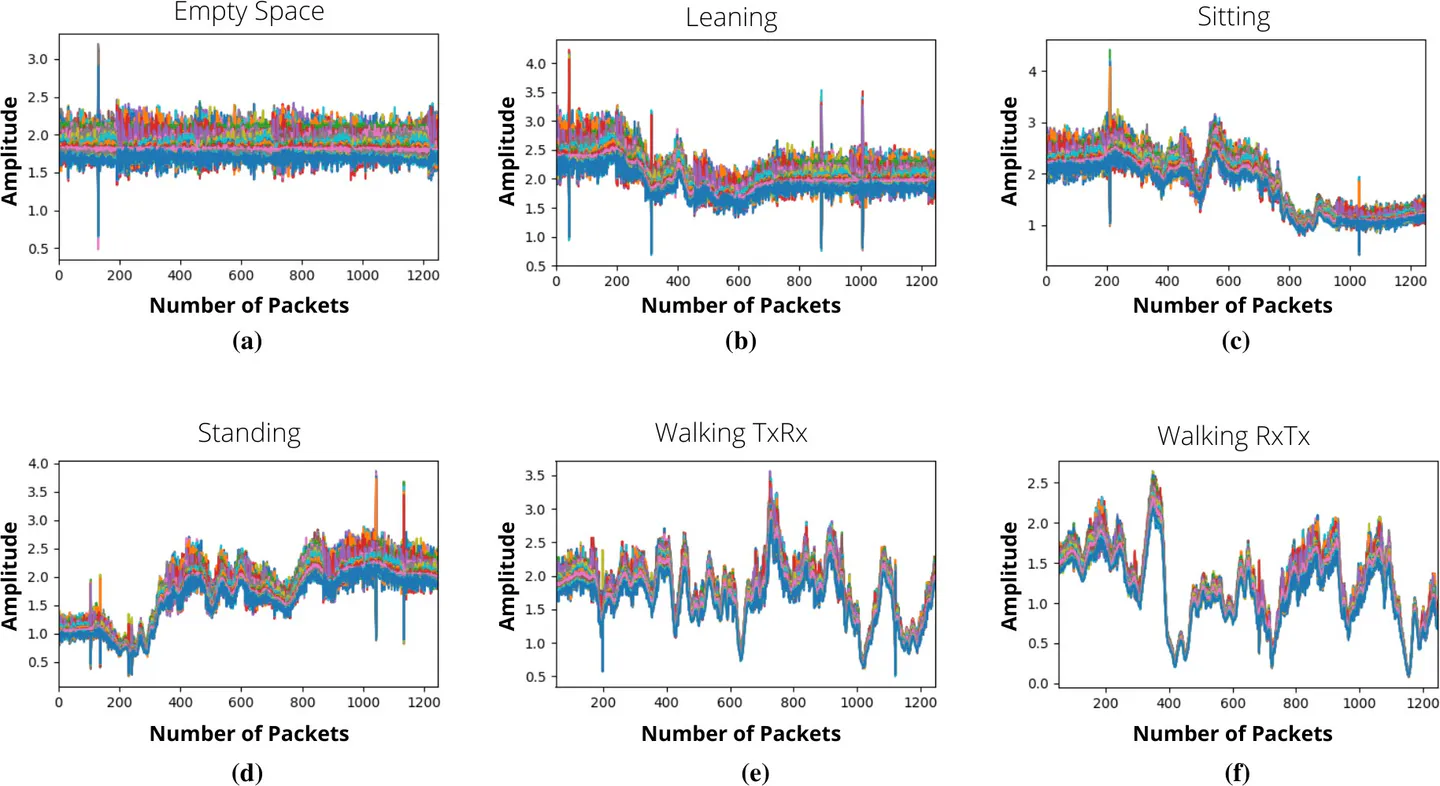
This study employs the publicly available channel state information (CSI) dataset at the University of Glasgow using a software-defined radio (SDR) system, which comprises Universal Software Radio Peripheral (USRP) models X300/X310, utilised to collect the data on the four activities, and subsequently pre-processed and fed into a generative adversarial network machine learning algorithm for classification . Figure 2 depicts the dataset for training. The dataset is based on a downloadable compressed archive, which contains CSI recordings made at Location 3 partitioned into 3 discrete spatial zones, i.e., Zone 1 (Z1), Zone 2 (Z2), and Zone 3 (Z3). Each of the constituent samples in the repository is stored as an individual Comma Separated Values (csv) file. These files register, for 51 orthogonal frequency multiplication (OFM) sub-carriers, the CSI amplitude, thus recording the modulation of the wireless propagation channel by the presence and movement of human beings. The packet length has variation in each sample, which reflects the natural scenario in wireless communications where packet reception depends on the state of the environment and the movements of people. This heterogeneity increases the realism of the dataset and presents a strict challenge to activity-recognition systems in order to generalise with proficiency. In order to ensure both equity and repetition in training and assessment procedures, each class of activities contains exactly 100 samples, ensuring that at least at a class level, there is a perfectly balanced training data set. This equilibrium reduces the bias from classification, empowers the reliable benchmark of the methodology performance, and makes the corpus very suitable for the development and validation of machine learning and deep learning models dedicated to the recognition of human activity based on CSI. A scan at the directory level verifies even distribution of classes, thus ruling out class imbalance as a confounding factor. This way, the result of comparing the model performance is guaranteed to be the capacity and representation power of the model and not the bias in the dataset.
Experimental Setup
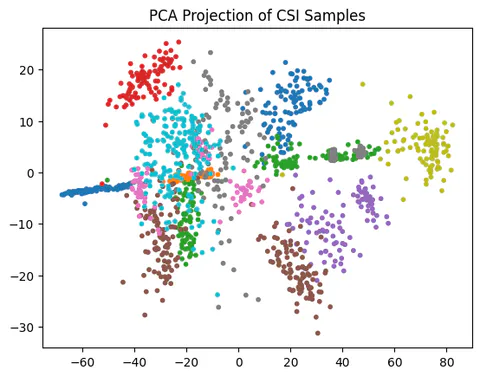
The experiments in this study were implemented using Python 3.10 in the Google Colab environment. The computational setup consisted of an Intel® Core™ i5-4210U CPU @ 1.70GHz (up to 2.40GHz) and 8GB RAM. The analysis leveraged key Python libraries, including Scikit-learn for model construction and performance evaluation and Pandas for data handling. A three-fold cross-validation was employed to ensure robust evaluation across data splits. This analysis began with the importation of the necessary libraries needed for the program: os for directory and file control, NumPy for numeric calculation, pandas for data transformation, and tqdm for the progress bar. The framework proved to be stable and efficient for developing the models and training and evaluating the models. In order to analyse the intrinsic separability of the Channel State Information (CSI) data before the application of deep learning models, an exploratory analysis of the feature using Principal Component Analysis (PCA) was conducted. As a preprocessing step, all CSI samples were first flattened into fixed-length vectors of 5000 elements, thus guaranteeing uniform dimensionality within samples despite variations in packet length. This transformation allows for consistent comparing, dimensionality reduction and retaining the underlying signal characteristics which are relevant for human activity. The high-dimensional flattened CSI vectors were next projected onto a two-dimensional space by PCA, which captures major directions of variance present in the data set. Distinct clustering patterns are obtained for several classes of activities, suggesting that different human activities lead to characteristic and recurring perturbations on the wireless channel. In particular, the Walking and No Activity classes show large separability and form well-separated and isolated clusters. This behaviour represents the strong time and frequency changes caused by movement compared with the relatively static signal patterns of an empty/stationary environment. Contrarily, activities related to posture, such as sitting and standing, have a partial overlap in the PCA space. Nonetheless, the existence of discernible cluster structures implies that even though difficult, it is still possible to separate these classes when applying more expressive feature learning techniques. Overall, the visualisation using the PCA-based approach supports the conjecture that CSI signals inherently contain discriminative, activity-specific patterns. This preliminary separability analysis is strong motivation for the use of deep learning models, which are well-suited for modelling higher-order, non-linear relationships and could further aid in increasing class discrimination more than linear projections can, as shown in Figure 3.
Data Preprocessing
In the data preprocessing phase, CSI matrices are resized to the fixed dimension of 1240 packets by 51 subcarriers and thus provide a uniform temporal and spectral representation for all samples. After preprocessing, the dataset has a three-dimensional structure with a final shape of (1400, 1240, 51), where the three dimensions stand for the number of samples, the packets in time, and the frequency subcarriers, respectively. This is a standard tensor representation to ensure that you can use it seamlessly across many different kinds of deep learning architectures, such as Convolutional Neural Networks (CNNs), Long Short-Term Memory (LSTMs), Conditional Generative Adversarial Networks (GANs) and ResNet-based architectures. As a result, the preprocessing framework provides a solid basis for the fair comparison of various deep learning approaches and for the effective training of deep learning approaches. These preprocessing steps were implemented using Python libraries such as LabelEncoder and StandardScaler from the Scikit-learn library, optimising the dataset for effective training of the classifiers. The dataset is divided into training and testing parts with a ratio of 80/20, and a strategy of stratification is adopted to maintain the same class distribution of each activity in both data subsets.
Machine Learning Model
The main model used in this study is the conditional generative adversarial network classifier.
Generative models, including their canonical versions, form an outstanding methodological class for HAR systems due to their proficiency in fitting complex data distributions and striking a good balance between generating and discriminating. Empirical investigations have shown that GANs produce improved quality and higher resolution results than competing approaches based on deep learning, so they have been shown to be efficient in creating authentic instances of recognition; this empirical superiority underlay the choice of GANs for the present investigation . Conditional Generative Adversarial Network (cGAN) was implemented with the help of TensorFlow/Keras. The architecture consists of three main components, which include a generator, a discriminator, and the combined GAN model for adversarial training. The generator is designed in such a way as to synthesise CSI sequences conditioned on specific classes of human activities. It takes as input a 100-dimensional latent noise vector, which is sampled from a typical distribution and helps with randomness and variety. The discriminator is in charge of differentiating real and synthetic CSI sequences while at the same time supporting their associated activity labels. It receives both the CSI sequence as well as corresponding class labels embedded in it; the pair is jointly processed for evaluating the authenticity in a class-aware manner. The discriminator architecture consists of several strided one-dimensional convolutional layers, which are effective for the capture of temporal features and reduce the dimension of the sequences. LeakyReLU activations are used all over so as to make stable gradient flow and avoid vanishing gradient problems.
Performance Evaluation
The evaluation metrics used for evaluating our outcomes consist of accuracy, precision, recall, and F1-score. In addition, we include a comparative analysis of our results in comparison with five alternative models.
where TP is True Positives, TN is True Negatives, FP is False Positives, and FN is False Negatives.
Results and Discussion
This section presents and compares the performance results of deep learning and classical machine learning models for HAR. The evaluation is based on classification metrics including precision, recall, F1-score and accuracy.
Model Performance Results
The performance is presented in Table 1, providing a breakdown of the model’s classification results.
| Class | Precision | Recall | F1-score | Support |
|---|---|---|---|---|
| Leaning | 0.8788 | 0.9667 | 0.9206 | 60 |
| No Activity | 1.0000 | 1.0000 | 1.0000 | 60 |
| Sitting | 0.9828 | 0.9500 | 0.9661 | 60 |
| Standing | 0.9825 | 0.9333 | 0.9573 | 60 |
| Walking | 1.0000 | 0.9750 | 0.9873 | 40 |
| Accuracy | — | — | 0.9643 | 280 |
| Macro Avg | 0.9688 | 0.9650 | 0.9663 | 280 |
| Weighted Avg | 0.9666 | 0.9643 | 0.9648 | 280 |
Table 1: Performance report
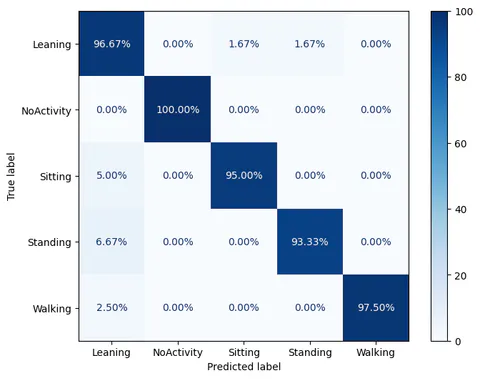
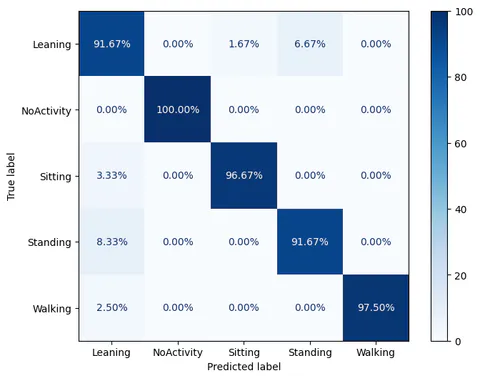
This investigation introduces the generative adversarial network (GAN) models to improve the detection of macro-activities. The confusion matrix shown in Figure 1 presents a full analysis of the model to classify 5 different human activities. The activity classes, namely leaning, no activity, sitting, standing and walking, were with remarkable precision classified as shown on the diagonal of the confusion matrix: 96.67% for leaning, 100% for no activity, 95.00% for sitting, 93.33% for standing and 97.50% for walking. These results highlight the success of the conditional generative adversarial network in accurately identifying human activity. Off-diagonal elements, representing misclassifications, are generally quite sparse and mainly occur between activities that have the postural characteristics that overlap. In contrast, the classes with no activity and walking have very small confusions with other classes, and this reflects very good separability for these more distinct activities. The unweighted average of the diagonal elements makes the total classification accuracy about 96.5%. This high performance validates the use of the model in human activity recognition tasks and especially in those where it is necessary to achieve the discrimination of static and dynamic behaviours with high dependability.
Model Performance across different machine and deep learning
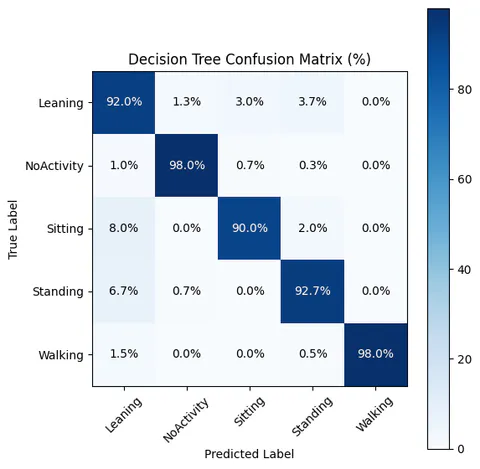
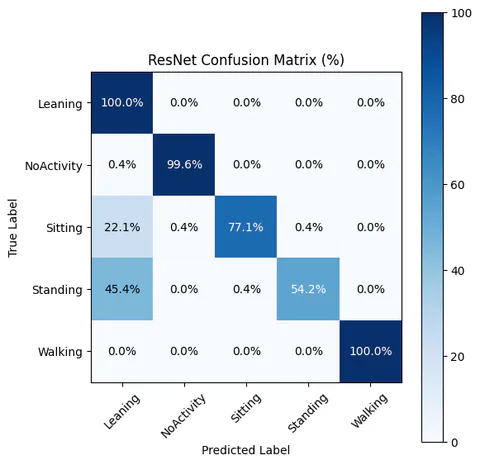
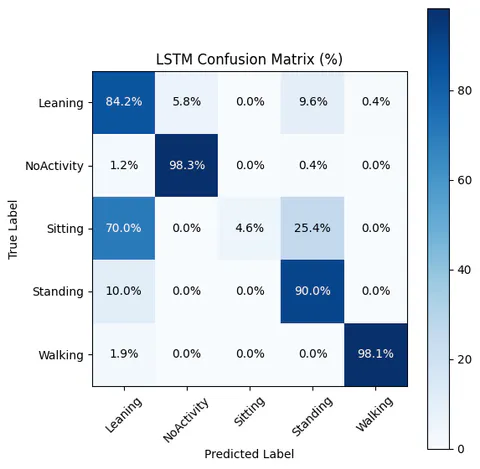
This section assesses the performance of four types of models: the Decision Tree classifier, the Long Short-Term Memory (LSTM) network, 1D ResNet architecture (deep residual learning), and the Convolutional Neural Network (CNN) comparison to distinguish and attribute the performances only to architecture and not to data bias. The purpose of the comparative analysis is to determine the most effective modelling method for activity recognition of human activity using CSI data. Table 4 shows a comparative analysis of the classification accuracy using some models such as 1D ResNet, Decision Tree, LSTM and CNN based approach. The comparative results obtained for the decision tree, 1D ResNet, LSTM and CNN models signify an overall accuracy of 94%, 86.2%, 75% and 95.36%, respectively. Figure 5 identifies very important misclassifications: leaning is mistaken for sitting (8 percentile points) or standing (6.7 percentile points), and smaller percentages are wrongly identified as no activity (1 percentile point) and walking (1.5 percentile points). Figure 6 illustrates that the sitting posture is often mistaken for the leaning posture (22.1% of the time), and a large degree of overlap exists between standing and leaning (45.4% of the time), illustrating the visual similarity of these static postures. In Figure 7, sitting is predominantly misclassified as leaning, i.e., 70%, and standing, i.e., 25.4%, as a result of the close correspondence of temporal motion characteristics for these static or semi-static type activities. The most frequent misunderstandings are between leaning and standing (9.6%) and leaning and no activity (5.8%), while the confusion between standing and walking is relatively low, with the largest number of errors directed into the leaning class. These results suggest that dependence on temporal information alone may not be sufficient for the LSTM in order to discriminate activities with small contrasts of motion accurately. Notably, the CGAN-based method achieves a competitive or superior accuracy, which demonstrates the efficacy of generative augmentation and class-conditioned learning for the improvement of classification results.
| S/N | Classifier | Overall accuracy (%) |
|---|---|---|
| 1 | CNN | 95.36 |
| 2 | Decision tree | 94.1 |
| 3 | 1D ResNet | 86.2 |
| 4 | LSTM | 75 |
| 5 | CGAN | 96.4 |
Table 2: Model Performance Comparison
Conclusion
This study evaluated deep learning architectures and classical machine learning architectures based on a publicly available SDR dataset. Experimental results show that the cGAN-based model achieved the highest accuracy of 96.4%, and CNN and Decision Tree show the close accuracy of 95.36% and 94.1%, respectively. Again, the performance of 1D ResNet was 86.2%, and that of LSTM was comparatively less at 75%. These results highlight the power of convolutional and adversarial models in learning discriminative signal features from the signal representations of the SDR, which, compared to purely sequential architectures, such as LSTM, demonstrate its limitation of the complex dynamics of radio frequency signals. Our findings established the significance of advanced deep learning in bridging the gap between human activity recognition technology and real-world deployment.
The authors acknowledge the use of the Software-Defined Radio dataset, made publicly available by the University of Glasgow Repository, which supported the validation of the classification models in this study.