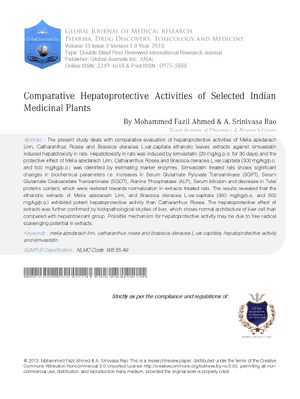
Comparative Hepatoprotective Activities of Selected Indian Medicinal Plants

§ NIZAM INSTITUTE OF PHARMACY

Send Message

To: Author

Comparative Hepatoprotective Activities of Selected Indian Medicinal Plants

Article Fingerprint

ReserarchID

MRK0BV4

Comparative Hepatoprotective Activities of Selected Indian Medicinal Plants Banner

AI TAKEAWAY

Connecting with the Eternal Ground
  • English
  • Afrikaans
  • Albanian
  • Amharic
  • Arabic
  • Armenian
  • Azerbaijani
  • Basque
  • Belarusian
  • Bengali
  • Bosnian
  • Bulgarian
  • Catalan
  • Cebuano
  • Chichewa
  • Chinese (Simplified)
  • Chinese (Traditional)
  • Corsican
  • Croatian
  • Czech
  • Danish
  • Dutch
  • Esperanto
  • Estonian
  • Filipino
  • Finnish
  • French
  • Frisian
  • Galician
  • Georgian
  • German
  • Greek
  • Gujarati
  • Haitian Creole
  • Hausa
  • Hawaiian
  • Hebrew
  • Hindi
  • Hmong
  • Hungarian
  • Icelandic
  • Igbo
  • Indonesian
  • Irish
  • Italian
  • Japanese
  • Javanese
  • Kannada
  • Kazakh
  • Khmer
  • Korean
  • Kurdish (Kurmanji)
  • Kyrgyz
  • Lao
  • Latin
  • Latvian
  • Lithuanian
  • Luxembourgish
  • Macedonian
  • Malagasy
  • Malay
  • Malayalam
  • Maltese
  • Maori
  • Marathi
  • Mongolian
  • Myanmar (Burmese)
  • Nepali
  • Norwegian
  • Pashto
  • Persian
  • Polish
  • Portuguese
  • Punjabi
  • Romanian
  • Russian
  • Samoan
  • Scots Gaelic
  • Serbian
  • Sesotho
  • Shona
  • Sindhi
  • Sinhala
  • Slovak
  • Slovenian
  • Somali
  • Spanish
  • Sundanese
  • Swahili
  • Swedish
  • Tajik
  • Tamil
  • Telugu
  • Thai
  • Turkish
  • Ukrainian
  • Urdu
  • Uzbek
  • Vietnamese
  • Welsh
  • Xhosa
  • Yiddish
  • Yoruba
  • Zulu
Font Type
Font Size
Font Size
Bedground

Abstract

The present study deals with comparative evaluation of hepatoprotective activities of Melia azedarach Linn, Catharanthus Rosea and Brassica oleracea L.var.capitata ethanolic leaves extracts against simvastatin induced hepatotoxicity in rats. Hepatotoxicity in rats was induced by simvastatin (20 mg/kg p.o. for 30 days) and the protective effect of Melia azedarach Linn, Catharanthus Rosea and Brassica oleracea L.var.capitata (300 mg/kg/p.o. and 500 mg/kg/p.o.) was identified by estimating marker enzymes. Simvastatin treated rats shows significant changes in biochemical parameters i.e. increases in Serum Glutamate Pyruvate Transaminase (SGPT), Serum Glutamate Oxaloacetate Transaminase (SGOT), Alanine Phosphatase (ALP), Serum bilirubin and decrease in Total proteins content, which were restored towards normalization in extracts treated rats. The results revealed that the ethanolic extracts of Melia azedarach Linn, and Brassica oleracea L.var.capitata (300 mg/kg/p.o. and 500 mg/kg/p.o.) exhibited potent hepatoprotective activity than Catharanthus Rosea. The hepatoprotective effect of extracts was further confirmed by histopathological studies of liver, which shows normal architecture of liver cell than compared with hepatotoxicant group. Possible mechanism for hepatoprotective activity may be due to free radical scavenging potential in extracts.

References

54 Cites in Article
  1. (2004). Plotosus: [96:1—>0], [98:1-42], [99:0-41], [212:1-40], [242:0->l] Paraplotosus: [264:0—>1] Amblyceps: [9:0—>2] Liobagrus: [47:1-40], [265:0—>1], [348:0-41] Parakysis: [47:1—>0], [144:0-41], [185:0-42], [206:0-41], [227:0-41], [236:1—>0], Akysis: [164:1-42], [325:0-41], [428:0-41] Bagarius: [80:0-41], [109:0—>1] Gagata: [5:0-41], [81:0-41], [83:0—>1], [104:0-41], [325:3-40] Glyptostemon: [48:1-42], [139:1-40], [148:2—>0L [178:0-41], [192:0—>1],.
  2. ±0.55 b.
  3. Group V 112.2±0.
  4. Unknown Title.
  5. ±1.
  6. Unknown Title.
  7. Group IX .98±2.74 b.
  8. Hai Zhong Huo,Bing Wang,Yong Liang,Yong Yang,Bao,Yan Gu (2011). Hepatoprotective and Antioxidant Effects of Licorice Extract against CCl4-Induced Oxidative Damage in Rats.
  9. Scott Friedman,James Grendell,Kenneth Mcquaid (2003). Current diagnosis & treatment in gastroenterology.
  10. Peter Friedman (2006). GI/Liver Secrets.
  11. G Ostapowicz,R Fontana,F Schiødt (2002). Results of a prospective study of acute liver failure at 17 tertiary care centers in the United States.
  12. B Ricaurte,A Guirguis,H Taylor,D Zabriskie (2006). Simvastatin-amiodarone interaction resulting in rhabdomyolysis, azotemia, and possible hepatotoxicity.
  13. N Kanathur,M Mathai,R Byrd,Jr,C Fields,T Roy (2001). Simvastatin-diltiazem drug interaction resulting in rhabdomyolysis and hepatitis.
  14. B Frei,M Kim,B Ames (1990). Ubiquinol-10 is an effective lipid-soluble antioxidant at physiological concentrations.
  15. Stocker (1991). Review of Stocker et al..
  16. R Stocker,V Bowry,B Frei (1991). Ubiquinone-10 protects low density lipoprotein more efficiently against lipid peroxidation than does alphatocopherol.
  17. J Vaghasiya,S Rathod,Y Bhalodia,R Manek,S Malaviya,N Jivani (2008). Protective effect of polyherbal formulation on simvastatin hepatotoxicity in rats.
  18. A Medhat,M Shehata,S Magder (2002). Hepatitis C in a community in Upper Egypt: Risk factors for infection.
  19. Scott Friedman (2000). Molecular Regulation of Hepatic Fibrosis, an Integrated Cellular Response to Tissue Injury.
  20. F Fraschini,G Demartini,D Esposti (2002). Pharmacology of Silymarin.
  21. P Mishra,G Uniyal,S Sharma (2001). Pattern of diversity for morphological and alkaloid yield related trades among the periwinkle Catharanthus roseus accessions collected from in and around Indian Subcontinent.
  22. N Farnsworth,G Svoboda,R Blomster (1968). Antiviral activity of selected Catharanthus alkaloids.
  23. G Svoboda,D Blake (1975). The phyto-chemistry and pharmacology of Catharanthus roseus (L.) G. Don. Inc.
  24. Bhavana Srivastava,Vikas Sharma,Ektaa Vashisth,R Singh,N Pandey,A Jadhav (2001). Comparative physicochemical, phytochemical and HPTLC study of stem bark versus small branches of Flacourtia indica.
  25. C Khare (2007). Indian Medicinal Plants.
  26. P Suhag,S Merra,Kalidhar (2003). Phytochemical investigation of Melia azedarach leaves.
  27. M Corpinella,M Miranda,W Almiron,C Ferrayoli,F Almedia,S Palacios (2007). In vitro pediculicidal and ovicidal activity of an extract and oil from fruit of Melia azedarach L.
  28. Carolina Wandscheer,Jonny Duque,Mario Da Silva,Yoshiyasu Fukuyama,Jonathan Wohlke,Juliana Adelmann,José Fontana (2004). Larvicidal action of ethanolic extracts from fruit endocarps of Melia azedarach and Azadirachta indica against the dengue mosquito Aedes aegypti.
  29. A Descalzo,C Coto (1989). Inhibition of the pseudorabies virus (scis herpesvinyl) by an andvital agent isolated from the leaves of melia azedarach Rev.
  30. D Choudhary,J Singh,S Verma,B Singh (1990). Antifertility effects of leaf extracts of some plants in male rats.
  31. J Goodwin,M Brodwick (1996). Unknown Title.
  32. E Rimm,A Ascherio,E Giovannucci,D Spiegelman,M Stampfer,W Willett (1996). Unknown Title.
  33. G Trease,W Evans (1978). A Text book of Pharmacognosy.
  34. D Ecobichnon (1997). The Basis of Toxicity Testing.
  35. J Vaghasiya,S Rathod,Y Bhalodia,R Manek,S Malaviya,N Jivani (2009). Protective effect of polyherbal formulation on simvastatin hepatotoxicity in rats.
  36. Stanley Reitman,Sam Frankel (1957). A Colorimetric Method for the Determination of Serum Glutamic Oxalacetic and Glutamic Pyruvic Transaminases.
  37. Klaus Walter,Christian Schütt (1974). Acid and Alkaline Phosphatase in Serum.
  38. H Malloy,K Evelyn (1937). The determination of bilirubin with the photoelectric colorimeter.
  39. O Lowry,N Rosebrough,A Farr (1951). Protein measurement with the folin-phenol reagent.
  40. L Luna (1999). Levin, David Saul, (born 28 Jan. 1962), Chief Executive, McGraw-Hill Education, New York, since 2014.
  41. A Krajian (1963). Tissue cutting and staining.
  42. Maria Leo,Masao Arai,Mayumi Sato,Charles Lieber (1982). Hepatotoxicity of vitamin A and ethanol in the rat.
  43. A Deb (1998). Fundamental of Biochemistry.
  44. J Vaghasiya,Y Bhalodia,R Manek,T Gohil,S Rathod (2008). Oxidative stress mediated hepatotoxicity Produced by simvastatin.
  45. Richard Pasternak,Sidney Smith,C Bairey-Merz,Scott Grundy,James Cleeman,Claude Lenfant (2002). ACC/AHA/NHLBI Clinical Advisory on the Use and Safety of Statins.
  46. (2005). G.
  47. John Farmer,Guillermo Torre-Amione (2000). Comparative Tolerability of the HMG-CoA Reductase Inhibitors.
  48. Javier Parra,K Reddy (2003). Hepatotoxicity of hypolipidemic drugs.
  49. C Willis,Maddrey,Md (2005). Drug-Induced Hepatotoxicity.
  50. Yizhong Cai,Qiong Luo,Mei Sun,Harold Corke (2004). Antioxidant activity and phenolic compounds of 112 traditional Chinese medicinal plants associated with anticancer.
  51. M Pitchaon,M Suttajit,R Pongsawatmani (2007). Assessment of phenolic content and free radical scavenging capacity of some Thai indigenous plants.
  52. J Pokorny,N Yanishlieva,M Gordon (2001). Antioxidants in food, Practical Applications.
  53. Helle Madsen,Bo Nielsen,Grete Bertelsen,Leif Skibsted (1996). Screening of antioxidative activity of spices. A comparison between assays based on ESR spin trapping and electrochemical measurement of oxygen consumption.
  54. Nicoletta Pellegrini,Paolo Simonetti,Claudio Gardana,Oreste Brenna,Furio Brighenti,Piergiorgio Pietta (2000). Polyphenol Content and Total Antioxidant Activity of<i>Vini Novelli</i>(Young Red Wines).

Funding

No external funding was declared for this work.

Conflict of Interest

The authors declare no conflict of interest.

Ethical Approval

No ethics committee approval was required for this article type.

Data Availability

Not applicable for this article.

How to Cite This Article

mohdfazil ahamed. 1970. "Comparative Hepatoprotective Activities of Selected Indian Medicinal Plants". Global Journal of Medical Research, Global Journal of Medical Research - B: Pharma, Drug Discovery, Toxicology & Medicine GJMR-B Volume 13 (GJMR Volume 13 Issue B2).
Download Citation

Journal Specifications

Crossref Journal DOI 10.17406/gjmr

Print ISSN 0975-5888

e-ISSN 2249-4618

Keywords
Classification
GJMR-B Classification NLMC Code: WB 55.A9
Version of record

v1.2

Language
English
Experiance in AR

Explore published articles in an immersive Augmented Reality environment. Our platform converts research papers into interactive 3D books, allowing readers to view and interact with content using AR and VR compatible devices.

Read in 3D

Your published article is automatically converted into a realistic 3D book. Flip through pages and read research papers in a more engaging and interactive format.

Article Matrices
Total Views: 8.7K
Total Downloads: 578
All Trends

Request Access

Please fill out the form below to request access to this research paper. Your request will be reviewed by the editorial or author team.
X

This is the heading

Lorem ipsum dolor sit amet, consectetur adipiscing elit. Ut elit tellus, luctus nec ullamcorper mattis, pulvinar dapibus leo.


High-quality academic research articles on global topics and journals.

Comparative Hepatoprotective Activities of Selected Indian Medicinal Plants

mohdfazil ahamed
mohdfazil ahamed NIZAM INSTITUTE OF PHARMACY