Neural Networks and Rules-based Systems used to Find Rational and Scientific Correlations between being Here and Now with Afterlife Conditions
Neural Networks and Rules-based Systems used to Find Rational and
Article Fingerprint
ReserarchID
NM75P
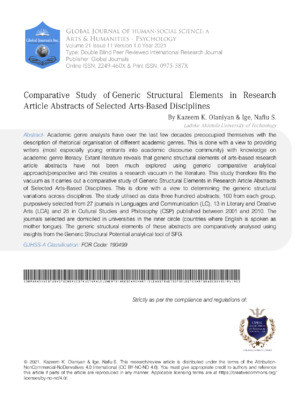
Academic genre analysts have over the last few decades preoccupied themselves with the description of rhetorical organisation of different academic genres. This is done with a view to providing writers (most especially young entrants into academic discourse community) with knowledge on academic genre literacy. Extant literature reveals that generic structural elements of arts-based research article abstracts have not been much explored using generic comparative analytical approach/perspective and this creates a research vacuum in the literature. This study therefore fills the vacuum as it carries out a comparative study of Generic Structural Elements in Research Article Abstracts of Selected Arts-Based Disciplines. This is done with a view to determining the generic structural variations across disciplines. The study utilised as data three hundred abstracts, 100 from each group, purposively selected from 27 journals in Languages and Communication (LC), 13 in Literary and Creative Arts (LCA) and 25 in Cultural Studies and Philosophy (CSP) published between 2001 and 2010. The journals selected are domiciled in universities in the inner circle (countries where English is spoken as mother tongue). The generic structural elements of these abstracts are comparatively analysed using insights from the Generic Structural Potential analytical tool of SFG.
Kazeem K. Olaniyan. 2021. \u201cComparative Study of Generic Structural Elements in Research Article Abstracts of Selected Arts-Based Disciplines\u201d. Global Journal of Human-Social Science - A: Arts & Humanities GJHSS-A Volume 21 (GJHSS Volume 21 Issue A11): .
Crossref Journal DOI 10.17406/GJHSS
Print ISSN 0975-587X
e-ISSN 2249-460X
The methods for personal identification and authentication are no exception.
Total Score: 101
Country: Nigeria
Subject: Global Journal of Human-Social Science - A: Arts & Humanities
Authors: Kazeem K. Olaniyan (PhD/Dr. count: 0)
View Count (all-time): 157
Total Views (Real + Logic): 2073

Total Downloads (simulated): 956

Publish Date: 2021 09, Wed
Monthly Totals (Real + Logic):
Neural Networks and Rules-based Systems used to Find Rational and
A Comparative Study of the Effeect of Promotion on Employee
The Problem Managing Bicycling Mobility in Latin American Cities: Ciclovias
Impact of Capillarity-Induced Rising Damp on the Energy Performance of
Academic genre analysts have over the last few decades preoccupied themselves with the description of rhetorical organisation of different academic genres. This is done with a view to providing writers (most especially young entrants into academic discourse community) with knowledge on academic genre literacy. Extant literature reveals that generic structural elements of arts-based research article abstracts have not been much explored using generic comparative analytical approach/perspective and this creates a research vacuum in the literature. This study therefore fills the vacuum as it carries out a comparative study of Generic Structural Elements in Research Article Abstracts of Selected Arts-Based Disciplines. This is done with a view to determining the generic structural variations across disciplines. The study utilised as data three hundred abstracts, 100 from each group, purposively selected from 27 journals in Languages and Communication (LC), 13 in Literary and Creative Arts (LCA) and 25 in Cultural Studies and Philosophy (CSP) published between 2001 and 2010. The journals selected are domiciled in universities in the inner circle (countries where English is spoken as mother tongue). The generic structural elements of these abstracts are comparatively analysed using insights from the Generic Structural Potential analytical tool of SFG.
We are currently updating this article page for a better experience.
Lorem ipsum dolor sit amet, consectetur adipiscing elit. Ut elit tellus, luctus nec ullamcorper mattis, pulvinar dapibus leo.