
Comparative Study of Three Clustering Algorithms for Microarray Data

1
Dicky John Davis G
Dicky John Davis G
2
Noveenaa Pious
Noveenaa Pious

Send Message

To: Author

GJSFR Volume 22 Issue G1

Article Fingerprint

ReserarchID

APHNJ

Comparative Study of Three Clustering Algorithms for Microarray Data Banner
  • English
  • Afrikaans
  • Albanian
  • Amharic
  • Arabic
  • Armenian
  • Azerbaijani
  • Basque
  • Belarusian
  • Bengali
  • Bosnian
  • Bulgarian
  • Catalan
  • Cebuano
  • Chichewa
  • Chinese (Simplified)
  • Chinese (Traditional)
  • Corsican
  • Croatian
  • Czech
  • Danish
  • Dutch
  • Esperanto
  • Estonian
  • Filipino
  • Finnish
  • French
  • Frisian
  • Galician
  • Georgian
  • German
  • Greek
  • Gujarati
  • Haitian Creole
  • Hausa
  • Hawaiian
  • Hebrew
  • Hindi
  • Hmong
  • Hungarian
  • Icelandic
  • Igbo
  • Indonesian
  • Irish
  • Italian
  • Japanese
  • Javanese
  • Kannada
  • Kazakh
  • Khmer
  • Korean
  • Kurdish (Kurmanji)
  • Kyrgyz
  • Lao
  • Latin
  • Latvian
  • Lithuanian
  • Luxembourgish
  • Macedonian
  • Malagasy
  • Malay
  • Malayalam
  • Maltese
  • Maori
  • Marathi
  • Mongolian
  • Myanmar (Burmese)
  • Nepali
  • Norwegian
  • Pashto
  • Persian
  • Polish
  • Portuguese
  • Punjabi
  • Romanian
  • Russian
  • Samoan
  • Scots Gaelic
  • Serbian
  • Sesotho
  • Shona
  • Sindhi
  • Sinhala
  • Slovak
  • Slovenian
  • Somali
  • Spanish
  • Sundanese
  • Swahili
  • Swedish
  • Tajik
  • Tamil
  • Telugu
  • Thai
  • Turkish
  • Ukrainian
  • Urdu
  • Uzbek
  • Vietnamese
  • Welsh
  • Xhosa
  • Yiddish
  • Yoruba
  • Zulu

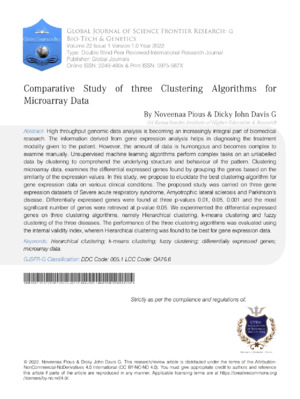
High throughput genomic data analysis is becoming an increasingly integral part of biomedical research. The information derived from gene expression analysis helps in diagnosing the treatment modality given to the patient. However, the amount of data is humongous and becomes complex to examine manually. Unsupervised machine learning algorithms perform complex tasks on an unlabelled data by clustering to comprehend the underlying structure and behaviour of the pattern. Clustering microarray data, examines the differential expressed genes found by grouping the genes based on the similarity of the expression values. In this study, we propose to elucidate the best clustering algorithm for gene expression data on various clinical conditions. The proposed study was carried on three gene expression datasets of Severe acute respiratory syndrome, Amyotrophic lateral sclerosis and Parkinson’s disease. Differentially expressed genes were found at three p-values 0.01, 0.05, 0.001 and the most significant number of genes were retrieved at p-value 0.05. We experimented the differential expressed genes on three clustering algorithms, namely Hierarchical clustering, k-means clustering and fuzzy clustering of the three diseases. The performance of the three clustering algorithms was evaluated using the internal validity index, wherein Hierarchical clustering was found to be best for gene expression data.

Funding

No external funding was declared for this work.

Conflict of Interest

The authors declare no conflict of interest.

Ethical Approval

No ethics committee approval was required for this article type.

Data Availability

Not applicable for this article.

Dicky John Davis G. 2026. \u201cComparative Study of Three Clustering Algorithms for Microarray Data\u201d. Global Journal of Science Frontier Research - G: Bio-Tech & Genetics GJSFR-G Volume 22 (GJSFR Volume 22 Issue G1): .

Download Citation

High-quality research on clustering algorithms in microarray data analysis from a reputable scientific journal.
Issue Cover
GJSFR Volume 22 Issue G1
Pg. 11- 17
Journal Specifications

Crossref Journal DOI 10.17406/GJSFR

Print ISSN 0975-5896

e-ISSN 2249-4626

Keywords
Classification
GJSFR-G Classification: DDC Code: 005.1 LCC Code: QA76.6
Version of record

v1.2

Issue date

May 14, 2022

Language

English

Experiance in AR

The methods for personal identification and authentication are no exception.

Read in 3D

The methods for personal identification and authentication are no exception.

Article Matrices
Total Views: 1598
Total Downloads: 26
2026 Trends
Research Identity (RIN)
Related Research

Published Article

High throughput genomic data analysis is becoming an increasingly integral part of biomedical research. The information derived from gene expression analysis helps in diagnosing the treatment modality given to the patient. However, the amount of data is humongous and becomes complex to examine manually. Unsupervised machine learning algorithms perform complex tasks on an unlabelled data by clustering to comprehend the underlying structure and behaviour of the pattern. Clustering microarray data, examines the differential expressed genes found by grouping the genes based on the similarity of the expression values. In this study, we propose to elucidate the best clustering algorithm for gene expression data on various clinical conditions. The proposed study was carried on three gene expression datasets of Severe acute respiratory syndrome, Amyotrophic lateral sclerosis and Parkinson’s disease. Differentially expressed genes were found at three p-values 0.01, 0.05, 0.001 and the most significant number of genes were retrieved at p-value 0.05. We experimented the differential expressed genes on three clustering algorithms, namely Hierarchical clustering, k-means clustering and fuzzy clustering of the three diseases. The performance of the three clustering algorithms was evaluated using the internal validity index, wherein Hierarchical clustering was found to be best for gene expression data.

Our website is actively being updated, and changes may occur frequently. Please clear your browser cache if needed. For feedback or error reporting, please email [email protected]
×

This Page is Under Development

We are currently updating this article page for a better experience.

Request Access

Please fill out the form below to request access to this research paper. Your request will be reviewed by the editorial or author team.
X

Quote and Order Details

Contact Person

Invoice Address

Notes or Comments

This is the heading

Lorem ipsum dolor sit amet, consectetur adipiscing elit. Ut elit tellus, luctus nec ullamcorper mattis, pulvinar dapibus leo.


High-quality academic research articles on global topics and journals.

Comparative Study of Three Clustering Algorithms for Microarray Data

Dicky John Davis G
Dicky John Davis G
Noveenaa Pious
Noveenaa Pious

Research Journals