

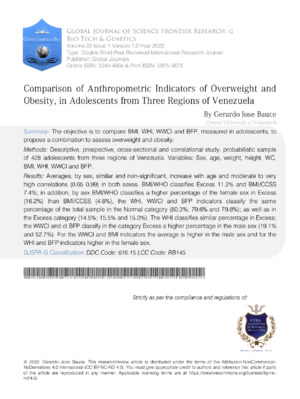

Comparison of Anthropometric Indicators of Overweight and Obesity, in Adolescents from Three Regions of Venezuela

Article ID

4930F

Comparison of Anthropometric Indicators of Overweight and Obesity in Adolescents from Three Regions of Venezuela.

Comparison of Anthropometric Indicators of Overweight and Obesity, in Adolescents from Three Regions of Venezuela

Gerardo Jose Bauce
Gerardo Jose Bauce
DOI

Abstract

The objective is to compare BMI, WHI, WWCI and BFP, measured in adolescents, to propose a combination to assess overweight and obesity. Methods: descriptive, prospective, cross-sectional and correlational study, probabilistic sample of 428 adolescents from three regions of Venezuela. Variables: Sex, age, weight, height, WC, BMI, WHI, WWCI and BFP. Results: averages, by sex, similar and non-significant, increase with age and moderate to very high correlations (0.65 0.99) in both sexes. BMI/WHO classifies Excess 11.2% and BMI/CCSS 7.4%; in addition, by sex BMI/WHO classifies a higher percentage of the female sex in Excess (16.2%) than BMI/CCSS (4.8%), the WHI, WWCI and BFP indicators classify the same percentage of the total sample in the Normal category (80.3%; 79.6% and 79.8%); as well as in the Excess category (14.5%; 15.5% and 15.0%). The WHI classifies similar percentage in Excess; the WWCI and cl BFP classify in the category Excess a higher percentage in the male sex (19.1% and 52.7%). For the WWCI and BMI indicators the average is higher in the male sex and for the WHI and BFP indicators higher in the female sex. Conclusion: BMI is more widely used; the WHI and WWCI on assessing risk or excess; correlates moderately with BMI, 0.61 and 0.62, in both sexes; the BFP behaves better, classifies with percentages similar to those of BMI/CTE, in Excess, in the two sexes; correlates highly with BMI, 0.99 and 0.89 for male and female, can make up a Scale.

Comparison of Anthropometric Indicators of Overweight and Obesity, in Adolescents from Three Regions of Venezuela

The objective is to compare BMI, WHI, WWCI and BFP, measured in adolescents, to propose a combination to assess overweight and obesity. Methods: descriptive, prospective, cross-sectional and correlational study, probabilistic sample of 428 adolescents from three regions of Venezuela. Variables: Sex, age, weight, height, WC, BMI, WHI, WWCI and BFP. Results: averages, by sex, similar and non-significant, increase with age and moderate to very high correlations (0.65 0.99) in both sexes. BMI/WHO classifies Excess 11.2% and BMI/CCSS 7.4%; in addition, by sex BMI/WHO classifies a higher percentage of the female sex in Excess (16.2%) than BMI/CCSS (4.8%), the WHI, WWCI and BFP indicators classify the same percentage of the total sample in the Normal category (80.3%; 79.6% and 79.8%); as well as in the Excess category (14.5%; 15.5% and 15.0%). The WHI classifies similar percentage in Excess; the WWCI and cl BFP classify in the category Excess a higher percentage in the male sex (19.1% and 52.7%). For the WWCI and BMI indicators the average is higher in the male sex and for the WHI and BFP indicators higher in the female sex. Conclusion: BMI is more widely used; the WHI and WWCI on assessing risk or excess; correlates moderately with BMI, 0.61 and 0.62, in both sexes; the BFP behaves better, classifies with percentages similar to those of BMI/CTE, in Excess, in the two sexes; correlates highly with BMI, 0.99 and 0.89 for male and female, can make up a Scale.

Gerardo Jose Bauce
Gerardo Jose Bauce

No Figures found in article.

Gerardo Jose Bauce. 2026. “. Global Journal of Science Frontier Research – G: Bio-Tech & Genetics GJSFR-G Volume 22 (GJSFR Volume 22 Issue G1): .

Download Citation

Journal Specifications

Crossref Journal DOI 10.17406/GJSFR

Print ISSN 0975-5896

e-ISSN 2249-4626

Issue Cover
GJSFR Volume 22 Issue G1
Pg. 19- 28
Classification
GJSFR-G Classification: DDC Code: 616.15 LCC Code: RB145
Keywords
Article Matrices
Total Views: 1486
Total Downloads: 30
2026 Trends
Research Identity (RIN)
Related Research
Our website is actively being updated, and changes may occur frequently. Please clear your browser cache if needed. For feedback or error reporting, please email [email protected]

Request Access

Please fill out the form below to request access to this research paper. Your request will be reviewed by the editorial or author team.
X

Quote and Order Details

Contact Person

Invoice Address

Notes or Comments

This is the heading

Lorem ipsum dolor sit amet, consectetur adipiscing elit. Ut elit tellus, luctus nec ullamcorper mattis, pulvinar dapibus leo.


High-quality academic research articles on global topics and journals.

Comparison of Anthropometric Indicators of Overweight and Obesity, in Adolescents from Three Regions of Venezuela

Gerardo Jose Bauce
Gerardo Jose Bauce

Research Journals





























































