Competitiveness Analysis of the Acai Berry Producers of Northeastern of Para

α
Dinaldo do Nascimento Araujo
σ
Marcelo de Souza Correia
ρ
Alexandre Jorge Gaia Cardoso

Send Message

To: Author

Competitiveness Analysis of the Acai Berry Producers of Northeastern of Para

Article Fingerprint

ReserarchID

UWNN8

Competitiveness Analysis of the Acai Berry Producers of Northeastern of Para Banner

AI TAKEAWAY

Connecting with the Eternal Ground
  • English
  • Afrikaans
  • Albanian
  • Amharic
  • Arabic
  • Armenian
  • Azerbaijani
  • Basque
  • Belarusian
  • Bengali
  • Bosnian
  • Bulgarian
  • Catalan
  • Cebuano
  • Chichewa
  • Chinese (Simplified)
  • Chinese (Traditional)
  • Corsican
  • Croatian
  • Czech
  • Danish
  • Dutch
  • Esperanto
  • Estonian
  • Filipino
  • Finnish
  • French
  • Frisian
  • Galician
  • Georgian
  • German
  • Greek
  • Gujarati
  • Haitian Creole
  • Hausa
  • Hawaiian
  • Hebrew
  • Hindi
  • Hmong
  • Hungarian
  • Icelandic
  • Igbo
  • Indonesian
  • Irish
  • Italian
  • Japanese
  • Javanese
  • Kannada
  • Kazakh
  • Khmer
  • Korean
  • Kurdish (Kurmanji)
  • Kyrgyz
  • Lao
  • Latin
  • Latvian
  • Lithuanian
  • Luxembourgish
  • Macedonian
  • Malagasy
  • Malay
  • Malayalam
  • Maltese
  • Maori
  • Marathi
  • Mongolian
  • Myanmar (Burmese)
  • Nepali
  • Norwegian
  • Pashto
  • Persian
  • Polish
  • Portuguese
  • Punjabi
  • Romanian
  • Russian
  • Samoan
  • Scots Gaelic
  • Serbian
  • Sesotho
  • Shona
  • Sindhi
  • Sinhala
  • Slovak
  • Slovenian
  • Somali
  • Spanish
  • Sundanese
  • Swahili
  • Swedish
  • Tajik
  • Tamil
  • Telugu
  • Thai
  • Turkish
  • Ukrainian
  • Urdu
  • Uzbek
  • Vietnamese
  • Welsh
  • Xhosa
  • Yiddish
  • Yoruba
  • Zulu

Abstract

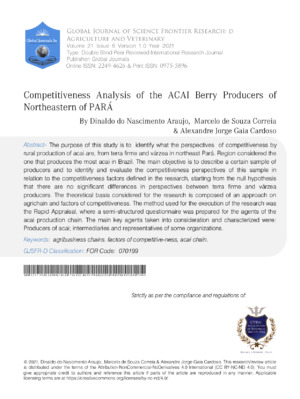
The purpose of this study is to identify what the perspectives of competitiveness by rural production of acai are, from terra firme and várzea in northeast Pará. Region considered the one that produces the most acai in Brazil. The main objective is to describe a certain sample of producers and to identify and evaluate the competitiveness perspectives of this sample in relation to the competitiveness factors defined in the research, starting from the null hypothesis that there are no significant differences in perspectives between terra firme and várzea producers. The theoretical basis considered for the research is composed of an approach on agrichain and factors of competitiveness. The method used for the execution of the research was the Rapid Appraisal, where a semi-structured questionnaire was prepared for the agents of the acai production chain. The main key agents taken into consideration and characterized were: Producers of acai; intermediaries and representatives of some organizations.

References

20 Cites in Article
  1. Paulo Marschner,Fernando Egert,Lucas Ávila,Analisa Sommer (2012). Estratégias de gestão sustentável e desempenho exportador em uma empresa da terceira geração da cadeia petroquímica.
  2. M Batalha,A Silva (2007). Gerenciamento de sistemas agroindustriais: Definições, especificida des e correntes Metodológicas.
  3. Mário Batalha,; Otávio,Hildo Souza Filho,Meirelles De (2009). Agronegócio no Mercosul: uma agenda para o desenvolvimento.
  4. Katharine Batista,Tavares (2013). Avaliação da sustentabilidade de agroecossistemas familiares agroextrativistas de açaizeiros na região das ilhas do município de Cametá, Pará. Dissertação de mestrado.
  5. Sérgio Canto,Aruana Elarrat (2001). Contribuição da ergonomia com base na análise postural durante a coleta dos frutos.
  6. Ernesto Cardozo,Henry Muchavisoy,Hulda Silva,Marcelo Zelarayán,Luís Corrêa,Márcio Leite,Fernandes Alves,Guillaume Rousseau,Xavier,Christoph Gehring (2015). Species richness increases income in agroforestry systems of eastern Amazônia.
  7. André Almeida (2021). A Política de Garantia de Preços Mínimos - PGPM e a atuação da Companhia Nacional de Abastecimento - CONAB no período após a abertura comercial: mudança institucional e novos instrumentos.
  8. Rosivanderson Corrêa,Baia (2010). Do Território Recurso ao Território Abrigo: Modo de Vida e o Processo de Valorização do Açaí no Município de Cametá-PA.
  9. Elizabeth Farina,Zylbersztajn,Decio (1998). Unknown Title.
  10. Elizabeth Farina,M Elizabeth (1999). Competitividade e coordenação de sistemas agroindustriais: um ensaio conceitual.
  11. Alfredo Homma (2012). Entrevista para o site opinião & Notícia. Açaí: o ouro negro pode ser um vilão para a Amazônia? Aumento do consumo poderia representar risco para a floresta, dizem veículos da mídia internacional.
  12. Jeniffer Lewis (2008). The power of knowledge: information transfer and açaí intensification in the peri-urban interface of Belém, Brazil.
  13. Laércio Melz,Juarez (2010). Competitividade da cadeia produtiva de carne de frango em Mato Grosso: Avaliação dos segmentos de avicultura e processamento.
  14. Ana Nogueira,Antônio Santana (2011). Benefícios socioeconômicos da adoção de novas tecnologias no cultivo do açaí no Estado do Pará.
  15. Oscar Nogueira,Francisco Figueiredo,José Câmara,Antônio Muller,Agostinho (2005). Açaí. Sistemas de produção 4.
  16. Gustavo Pinazza,Galvão De (2008). Análise da competitividade da cadeia produtiva da soja no Brasil vis-à-vis os demais países exportadores Sul-Americanos.
  17. Darlan Roman,Janaina Piana,Marie-Anne Stival Pereira E Leal Lozano,Nelson Mello,Rolf Erdmann (2012). Organizational competitiveness factors.
  18. Maria Sant’ana,Jacimara Pessoa (2022). Reaproveitamento econômico dos caroços do açaí como fonte de renda e contribuição ao meio ambiente valorando o produto nativo da Palmeira do Açai (euterpe precatoria) do município de Codajás, no Amazonas.
  19. Rafael Seixas De Amoêdo (2006). Aula Inaugural do Programa de Pós-Graduação Interdisciplinar em Ciências Humanas ministrada pelo Professor José Aldemir de Oliveira (16/08/2016) O significado da Pós-Graduação em Ciências Humanas na Amazônia..
  20. Carlos Silva,Da,Souza Filho,M Hildo,De (2007). Agricultural employment in developing countries.

Funding

No external funding was declared for this work.

Conflict of Interest

The authors declare no conflict of interest.

Ethical Approval

No ethics committee approval was required for this article type.

Data Availability

Not applicable for this article.

How to Cite This Article

Dinaldo do Nascimento Araujo. 2021. \u201cCompetitiveness Analysis of the Acai Berry Producers of Northeastern of Para\u201d. Global Journal of Science Frontier Research - D: Agriculture & Veterinary GJSFR-D Volume 21 (GJSFR Volume 21 Issue D6): .

Download Citation

Alt text: Academic research journal article on competitiveness analysis of the ACIAL Berry production in Pará.
Journal Specifications

Crossref Journal DOI 10.17406/GJSFR

Print ISSN 0975-5896

e-ISSN 2249-4626

Keywords
Classification
GJSFR-D Classification: FOR Code: 070199
Version of record

v1.2

Issue date

November 17, 2021

Language
en
Experiance in AR

Explore published articles in an immersive Augmented Reality environment. Our platform converts research papers into interactive 3D books, allowing readers to view and interact with content using AR and VR compatible devices.

Read in 3D

Your published article is automatically converted into a realistic 3D book. Flip through pages and read research papers in a more engaging and interactive format.

Article Matrices
Total Views: 1852
Total Downloads: 863
2026 Trends
Related Research

Published Article

The purpose of this study is to identify what the perspectives of competitiveness by rural production of acai are, from terra firme and várzea in northeast Pará. Region considered the one that produces the most acai in Brazil. The main objective is to describe a certain sample of producers and to identify and evaluate the competitiveness perspectives of this sample in relation to the competitiveness factors defined in the research, starting from the null hypothesis that there are no significant differences in perspectives between terra firme and várzea producers. The theoretical basis considered for the research is composed of an approach on agrichain and factors of competitiveness. The method used for the execution of the research was the Rapid Appraisal, where a semi-structured questionnaire was prepared for the agents of the acai production chain. The main key agents taken into consideration and characterized were: Producers of acai; intermediaries and representatives of some organizations.

Our website is actively being updated, and changes may occur frequently. Please clear your browser cache if needed. For feedback or error reporting, please email [email protected]

Request Access

Please fill out the form below to request access to this research paper. Your request will be reviewed by the editorial or author team.
X

Quote and Order Details

Contact Person

Invoice Address

Notes or Comments

This is the heading

Lorem ipsum dolor sit amet, consectetur adipiscing elit. Ut elit tellus, luctus nec ullamcorper mattis, pulvinar dapibus leo.

High-quality academic research articles on global topics and journals.

Competitiveness Analysis of the Acai Berry Producers of Northeastern of Para

Dinaldo do Nascimento Araujo
Marcelo de Souza Correia
Alexandre Jorge Gaia Cardoso

Research Journals