Computed Tomography in the Assessment of Cardiac Adipose Tissue and Coronary Artery Atherosclerosis

α
Surayyo Z. Yuldasheva
σ
N.M. Djuraeva
N.M. Djuraeva
ρ
A.I. Ikramov
A.I. Ikramov
Ѡ
M.F. Maksudov
M.F. Maksudov
¥
Kh.V. Abdukhalimova
Kh.V. Abdukhalimova
§
Khaybullina Z.R
Khaybullina Z.R

Send Message

To: Author

Computed Tomography in the Assessment of Cardiac Adipose Tissue and Coronary Artery Atherosclerosis

Article Fingerprint

ReserarchID

O6270

Computed Tomography in the Assessment of Cardiac Adipose Tissue and Coronary Artery Atherosclerosis Banner

AI TAKEAWAY

Connecting with the Eternal Ground
  • English
  • Afrikaans
  • Albanian
  • Amharic
  • Arabic
  • Armenian
  • Azerbaijani
  • Basque
  • Belarusian
  • Bengali
  • Bosnian
  • Bulgarian
  • Catalan
  • Cebuano
  • Chichewa
  • Chinese (Simplified)
  • Chinese (Traditional)
  • Corsican
  • Croatian
  • Czech
  • Danish
  • Dutch
  • Esperanto
  • Estonian
  • Filipino
  • Finnish
  • French
  • Frisian
  • Galician
  • Georgian
  • German
  • Greek
  • Gujarati
  • Haitian Creole
  • Hausa
  • Hawaiian
  • Hebrew
  • Hindi
  • Hmong
  • Hungarian
  • Icelandic
  • Igbo
  • Indonesian
  • Irish
  • Italian
  • Japanese
  • Javanese
  • Kannada
  • Kazakh
  • Khmer
  • Korean
  • Kurdish (Kurmanji)
  • Kyrgyz
  • Lao
  • Latin
  • Latvian
  • Lithuanian
  • Luxembourgish
  • Macedonian
  • Malagasy
  • Malay
  • Malayalam
  • Maltese
  • Maori
  • Marathi
  • Mongolian
  • Myanmar (Burmese)
  • Nepali
  • Norwegian
  • Pashto
  • Persian
  • Polish
  • Portuguese
  • Punjabi
  • Romanian
  • Russian
  • Samoan
  • Scots Gaelic
  • Serbian
  • Sesotho
  • Shona
  • Sindhi
  • Sinhala
  • Slovak
  • Slovenian
  • Somali
  • Spanish
  • Sundanese
  • Swahili
  • Swedish
  • Tajik
  • Tamil
  • Telugu
  • Thai
  • Turkish
  • Ukrainian
  • Urdu
  • Uzbek
  • Vietnamese
  • Welsh
  • Xhosa
  • Yiddish
  • Yoruba
  • Zulu

Abstract

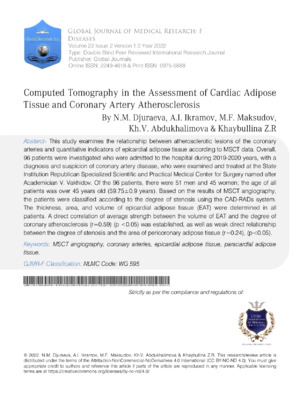
Abstarct-This study examines the relationship between atherosclerotic lesions of the coronary arteries and quantitative indicators of epicardial adipose tissue according to MSCT data. Overall, 96 patients were investigated who were admitted to the hospital during 2019-2020 years, with a diagnosis and suspicion of coronary artery disease, who were examined and treated at the State Institution Republican Specialized Scientific and Practical Medical Center for Surgery named after Academician V. Vakhidov. Of the 96 patients, there were 51 men and 45 women; the age of all patients was over 45 years old (59.75±0.9 years). Based on the results of MSCT angiography, the patients were classified according to the degree of stenosis using the CAD-RADs system. The thickness, area, and volume of epicardial adipose tissue (EAT) were determined in all patients. A direct correlation of average strength between the volume of EAT and the degree of coronary atherosclerosis (r=0.59) (p

References

19 Cites in Article
  1. Adam Nelson,Maddalena Ardissino,Peter Psaltis (2019). Current approach to the diagnosis of atherosclerotic coronary artery disease: more questions than answers.
  2. Angela Gallinabertaso,Daniela Bertol,Bruce Bartholow Duncan,Murilofoppa (2013). Epicardial Fat: Definition, Measurements and Systematic Review of Main Outcomes.
  3. Gorka Bastarrika,Jordi Broncano,U Schoepf,Florian Schwarz,Yeong Lee,Joseph Abro,Philip Costello,Peter Zwerner (2010). Relationship Between Coronary Artery Disease and Epicardial Adipose Tissue Quantification at Cardiac CT.
  4. N Bettencourt,A Toschke,D Leite,J Rocha,M Carvalho,F Sampaio,S Xará,A Leite-Moreira,Eike Nagel,V Gama (2012). Epicardial adipose tissue is an independent predictor of coronary atherosclerotic burden.
  5. Olga Bornachea,Angela Vea,Vicenta Llorente-Cortes (2018). Interplay between epicardial adipose tissue, metabolic and cardiovascular diseases.
  6. G Chumakova,N Veselovskaya,A Kozarenko,O Gritsenko (2018). 804 EPICARDIAL FAT AND A RISK OF CORONARY ATHEROSCLEROSIS.
  7. Damini Dey,Ajay Yerramasu,Shreenidhi Venuraju (2012). Increased volume of epicardial fat is an independent risk factor for accelerated progression of subclinical coronary atherosclerosis.
  8. J Ding,F Hsu,T Harris (2009). The association of pericardial fat with incident coronary heart disease: the Multi-Ethnic Study of Atherosclerosis (MESA).
  9. Glória Conceição,Diana Martins,Isabel M. Miranda,Adelino Leite-Moreira,Rui Vitorino,Inês Falcão-Pires (2020). Unraveling the Role of Epicardial Adipose Tissue in Coronary Artery Disease: Partners in Crime?.
  10. Petra Gorter,Alexander De Vos,Yolanda Van Der Graaf,Pieter Stella,Pieter Doevendans,Matthijs Meijs,Mathias Prokop,Frank Visseren (2013). Relation of Epicardial and Pericoronary Fat to Coronary Atherosclerosis and Coronary Artery Calcium in Patients Undergoing Coronary Angiography.
  11. T Ito,K Nasu,M Terashima,M Ehara,Y Kinoshita,T Ito,M Kimura,N Tanaka,M Habara,E Tsuchikane,T Suzuki (2012). The impact of epicardial fat volume on coronary plaque vulnerability: insight from optical coherence tomography analysis.
  12. I Neveen,Mohammad Samy,Walaa Fakhry,Farid (2020). Relation between Epicardial Adipose Tissue Thickness Assessed by Multidetector Computed Tomography and Significance of Coronary Artery Disease.
  13. N Nerlekar,F Ha,C Cheshire (2018). Computed tomographic coronary angiography-derived plaque characteristics predict major adverse cardiovascular events: A systematic review and meta-Analysis.
  14. A Mahabadi,J Massaro,G Rosito,D Levy,J Murabito,P Wolf,C O'donnell,C Fox,U Hoffmann (2009). Association of pericardial fat, intrathoracic fat, and visceral abdominal fat with cardiovascular disease burden: the Framingham Heart Study.
  15. Guido Rosito,Joseph Massaro,Udo Hoffmann,Frederick Ruberg,Amir Mahabadi,Ramachandran Vasan,Christopher O’donnell,Caroline Fox (2008). Pericardial Fat, Visceral Abdominal Fat, Cardiovascular Disease Risk Factors, and Vascular Calcification in a Community-Based Sample.
  16. R Russo,Di Iorio,B Di Lullo,L Russo,D (2018). Epicardial adipose tissue: New parameter for cardiovascular risk assessment in high risk populations.
  17. Rishabh Khurana,Anurag Yadav,T Buxi,J Sawhney,Kishan Rawat,Samarjit Ghuman (2008). Correlation of epicardial fat quantification with severity of coronary artery disease: A study in Indian population.
  18. S Shehata,F Zaiton,M Warda (2018). Role of MDCT in evaluation of epicardial fat volume as an independent risk factor for coronary atherosclerosis.
  19. Abdullaeva Ch.A.,Irisov J.B.,Zaxidova M.U..,Juraev M.I.,Mullaeva S.I. (2018). Effect of Cardiac Glycosides on Myocardial Hibernation in Ischemic Heart Disease.

Funding

No external funding was declared for this work.

Conflict of Interest

The authors declare no conflict of interest.

Ethical Approval

No ethics committee approval was required for this article type.

Data Availability

Not applicable for this article.

How to Cite This Article

Surayyo Z. Yuldasheva. 2026. \u201cComputed Tomography in the Assessment of Cardiac Adipose Tissue and Coronary Artery Atherosclerosis\u201d. Global Journal of Medical Research - F: Diseases GJMR-F Volume 22 (GJMR Volume 22 Issue F2): .

Download Citation

An in-depth study on cardiac adipose tissue and coronary artery atherosclerosis.
Journal Specifications

Crossref Journal DOI 10.17406/gjmra

Print ISSN 0975-5888

e-ISSN 2249-4618

Keywords
Classification
GJMR-F Classification: NLMC Code: WG 595
Version of record

v1.2

Issue date

February 28, 2022

Language
en
Experiance in AR

Explore published articles in an immersive Augmented Reality environment. Our platform converts research papers into interactive 3D books, allowing readers to view and interact with content using AR and VR compatible devices.

Read in 3D

Your published article is automatically converted into a realistic 3D book. Flip through pages and read research papers in a more engaging and interactive format.

Article Matrices
Total Views: 1694
Total Downloads: 42
2026 Trends
Related Research

Published Article

Abstarct-This study examines the relationship between atherosclerotic lesions of the coronary arteries and quantitative indicators of epicardial adipose tissue according to MSCT data. Overall, 96 patients were investigated who were admitted to the hospital during 2019-2020 years, with a diagnosis and suspicion of coronary artery disease, who were examined and treated at the State Institution Republican Specialized Scientific and Practical Medical Center for Surgery named after Academician V. Vakhidov. Of the 96 patients, there were 51 men and 45 women; the age of all patients was over 45 years old (59.75±0.9 years). Based on the results of MSCT angiography, the patients were classified according to the degree of stenosis using the CAD-RADs system. The thickness, area, and volume of epicardial adipose tissue (EAT) were determined in all patients. A direct correlation of average strength between the volume of EAT and the degree of coronary atherosclerosis (r=0.59) (p

Our website is actively being updated, and changes may occur frequently. Please clear your browser cache if needed. For feedback or error reporting, please email [email protected]

Request Access

Please fill out the form below to request access to this research paper. Your request will be reviewed by the editorial or author team.
X

Quote and Order Details

Contact Person

Invoice Address

Notes or Comments

This is the heading

Lorem ipsum dolor sit amet, consectetur adipiscing elit. Ut elit tellus, luctus nec ullamcorper mattis, pulvinar dapibus leo.

High-quality academic research articles on global topics and journals.

Computed Tomography in the Assessment of Cardiac Adipose Tissue and Coronary Artery Atherosclerosis

N.M. Djuraeva
N.M. Djuraeva
A.I. Ikramov
A.I. Ikramov
M.F. Maksudov
M.F. Maksudov
Kh.V. Abdukhalimova
Kh.V. Abdukhalimova
Khaybullina Z.R
Khaybullina Z.R

Research Journals