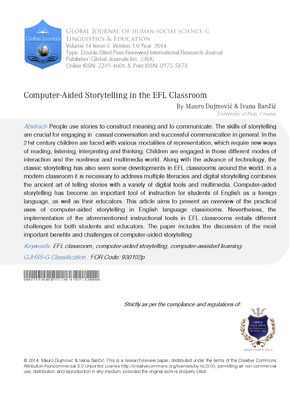
Computer-Aided Storytelling in the EFL Classroom

§ Juraj Dobrila University of Pula Juraj Dobrila University of Pula

Send Message

To: Author

Computer-Aided Storytelling in the EFL Classroom

Article Fingerprint

ReserarchID

XII1A

Computer-Aided Storytelling in the EFL Classroom Banner

Key Research Insights

Synthesized scholarly intelligence & interactive research assistant
  • English
  • Afrikaans
  • Albanian
  • Amharic
  • Arabic
  • Armenian
  • Azerbaijani
  • Basque
  • Belarusian
  • Bengali
  • Bosnian
  • Bulgarian
  • Catalan
  • Cebuano
  • Chichewa
  • Chinese (Simplified)
  • Chinese (Traditional)
  • Corsican
  • Croatian
  • Czech
  • Danish
  • Dutch
  • Esperanto
  • Estonian
  • Filipino
  • Finnish
  • French
  • Frisian
  • Galician
  • Georgian
  • German
  • Greek
  • Gujarati
  • Haitian Creole
  • Hausa
  • Hawaiian
  • Hebrew
  • Hindi
  • Hmong
  • Hungarian
  • Icelandic
  • Igbo
  • Indonesian
  • Irish
  • Italian
  • Japanese
  • Javanese
  • Kannada
  • Kazakh
  • Khmer
  • Korean
  • Kurdish (Kurmanji)
  • Kyrgyz
  • Lao
  • Latin
  • Latvian
  • Lithuanian
  • Luxembourgish
  • Macedonian
  • Malagasy
  • Malay
  • Malayalam
  • Maltese
  • Maori
  • Marathi
  • Mongolian
  • Myanmar (Burmese)
  • Nepali
  • Norwegian
  • Pashto
  • Persian
  • Polish
  • Portuguese
  • Punjabi
  • Romanian
  • Russian
  • Samoan
  • Scots Gaelic
  • Serbian
  • Sesotho
  • Shona
  • Sindhi
  • Sinhala
  • Slovak
  • Slovenian
  • Somali
  • Spanish
  • Sundanese
  • Swahili
  • Swedish
  • Tajik
  • Tamil
  • Telugu
  • Thai
  • Turkish
  • Ukrainian
  • Urdu
  • Uzbek
  • Vietnamese
  • Welsh
  • Xhosa
  • Yiddish
  • Yoruba
  • Zulu
Reading Preferences
Font Size
Line Spacing
Background

Abstract

People use stories to construct meaning and to communicate. The skills of storytelling are crucial for engaging in casual conversation and successful communication in general. In the 21st century children are faced with various modalities of representation, which require new ways of reading, listening, interpreting and thinking. Children are engaged in those different modes of interaction and the nonlinear and multimedia world. Along with the advance of technology, the classic storytelling has also seen some developments in EFL classrooms around the world. In a modern classroom it is necessary to address multiple literacies and digital storytelling combines the ancient art of telling stories with a variety of digital tools and multimedia. Computer-aided storytelling has become an important tool of instruction for students of English as a foreign language, as well as their educators. This article aims to present an overview of the practical uses of computer-aided storytelling in English language classrooms. Nevertheless, the implementation of the aforementioned instructional tools in EFL classrooms entails different challenges for both students and educators. The paper includes the discussion of the most important benefits and challenges of computer-aided storytelling.

References

12 Cites in Article
  1. Franklin Boster,S Gary,Anthony Meyer,Carol Roberto,Inge (2002). A report on the effect of the United Streaming Application on Educational Performance.
  2. Ramona Bran (2010). Message in a bottle Telling stories in a digital world.
  3. Jerome Bruner (1996). The culture of education.
  4. Kenneth Clark,Alice Hosticka,Martha Schriver,Jackie Bedell (2002). Computer Based Virtual Field Trips.
  5. Anne Hibbing,L Joan,Ranking-Erickson (2003). A picture is worth a thousand words: using visual images to improve comprehension for middle school struggling readers.
  6. Chun-Ming Hung,Gwo-Jen Hwang,Iwen Huang (2012). A Project-based Digital Storytelling Approach for Improving Students' Learning Motivation, Problem-Solving Competence and Learning Achievement.
  7. Gary Morrison,L Deborah,Lowther (2002). Integrating Computer Technology in EFL.
  8. Gunther Kress,Jon Ogborn,Isabel Martins (1996). Pedagogy of Multiliteracies: Designing social futures.
  9. Walter Ong (2002). 4 Walter Ong, from Orality and Literacy: The Technologizing of the Word (1982).
  10. Erin Riesland (2005). Visual literacy in the classroom.
  11. Bernard Robin (2008). Digital Storytelling: A Powerful Technology Tool for the 21st Century Classroom.
  12. Peter Shea (2000). Leveling the Playing Field: A Study of Captioned Interactive Video for Second Language Learning.

Funding

No external funding was declared for this work.

Conflict of Interest

The authors declare no conflict of interest.

Ethical Approval

No ethics committee approval was required for this article type.

Data Availability

Not applicable for this article.

How to Cite This Article

Ivana BanAiA, Mauro DujmoviA. 2014. "Computer-Aided Storytelling in the EFL Classroom". Global Journal of Human-Social Science - G: Linguistics & Education GJHSS-G Volume 14 (GJHSS Volume 14 Issue G5).

Download Citation

Journal Specifications

Crossref Journal DOI 10.17406/GJHSS

Print ISSN 0975-587X

e-ISSN 2249-460X

Keywords
Classification
GJHSS-G Classification FOR Code: 930102p
Version of record

v1.2

Issue date
July 17, 2014

Language
English
Experiance in AR

Explore published articles in an immersive Augmented Reality environment. Our platform converts research papers into interactive 3D books, allowing readers to view and interact with content using AR and VR compatible devices.

Read in 3D

Your published article is automatically converted into a realistic 3D book. Flip through pages and read research papers in a more engaging and interactive format.

Article Matrices
Total Views: 1.5K
Total Downloads: 80
All Trends

Request Access

Please fill out the form below to request access to this research paper. Your request will be reviewed by the editorial or author team.
X

This is the heading

Lorem ipsum dolor sit amet, consectetur adipiscing elit. Ut elit tellus, luctus nec ullamcorper mattis, pulvinar dapibus leo.


High-quality academic research articles on global topics and journals.

Computer-Aided Storytelling in the EFL Classroom

Ivana BanAiA
Ivana BanAiA Juraj Dobrila University of Pula
Mauro DujmoviA
Mauro DujmoviA