Conceptions about Teaching DNA in basic Education: A Reading based on Henri Atlan

α
Elaine Ferreira Machado
σ
Ingrid Aline de Carvalho Ferrasa
ρ
Awdry Feisser Miquelin
Ѡ
Adriane Marie  Salm Coelho
Adriane Marie Salm Coelho
¥
Nestor Cortez Saavedra Filho
α Universidade Tecnológica Federal do Paraná

Send Message

To: Author

Conceptions about Teaching DNA in basic Education: A Reading based on Henri Atlan

Article Fingerprint

ReserarchID

0Z909

Conceptions about Teaching DNA in basic Education: A Reading based on Henri Atlan Banner

AI TAKEAWAY

Connecting with the Eternal Ground
  • English
  • Afrikaans
  • Albanian
  • Amharic
  • Arabic
  • Armenian
  • Azerbaijani
  • Basque
  • Belarusian
  • Bengali
  • Bosnian
  • Bulgarian
  • Catalan
  • Cebuano
  • Chichewa
  • Chinese (Simplified)
  • Chinese (Traditional)
  • Corsican
  • Croatian
  • Czech
  • Danish
  • Dutch
  • Esperanto
  • Estonian
  • Filipino
  • Finnish
  • French
  • Frisian
  • Galician
  • Georgian
  • German
  • Greek
  • Gujarati
  • Haitian Creole
  • Hausa
  • Hawaiian
  • Hebrew
  • Hindi
  • Hmong
  • Hungarian
  • Icelandic
  • Igbo
  • Indonesian
  • Irish
  • Italian
  • Japanese
  • Javanese
  • Kannada
  • Kazakh
  • Khmer
  • Korean
  • Kurdish (Kurmanji)
  • Kyrgyz
  • Lao
  • Latin
  • Latvian
  • Lithuanian
  • Luxembourgish
  • Macedonian
  • Malagasy
  • Malay
  • Malayalam
  • Maltese
  • Maori
  • Marathi
  • Mongolian
  • Myanmar (Burmese)
  • Nepali
  • Norwegian
  • Pashto
  • Persian
  • Polish
  • Portuguese
  • Punjabi
  • Romanian
  • Russian
  • Samoan
  • Scots Gaelic
  • Serbian
  • Sesotho
  • Shona
  • Sindhi
  • Sinhala
  • Slovak
  • Slovenian
  • Somali
  • Spanish
  • Sundanese
  • Swahili
  • Swedish
  • Tajik
  • Tamil
  • Telugu
  • Thai
  • Turkish
  • Ukrainian
  • Urdu
  • Uzbek
  • Vietnamese
  • Welsh
  • Xhosa
  • Yiddish
  • Yoruba
  • Zulu

Abstract

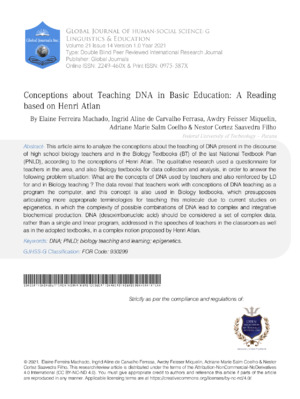
This article aims to analyze the conceptions about the teaching of DNA present in the discourse of high school biology teachers and in the Biology Textbooks (BT) of the last National Textbook Plan (PNLD), according to the conceptions of Henri Atlan. The qualitative research used a questionnaire for teachers in the area, and also Biology textbooks for data collection and analysis, in order to answer the following problem situation: What are the concepts of DNA used by teachers and also reinforced by LD for and in Biology teaching ? The data reveal that teachers work with conceptions of DNA teaching as a program the computer, and this concept is also used in Biology textbooks, which presupposes articulating more appropriate terminologies for teaching this molecule due to current studies on epigenetics, in which the complexity of possible combinations of DNA lead to complex and integrative biochemical production. DNA (desoxirribonucleic acid) should be considered a set of complex data, rather than a single and linear program, addressed in the speeches of teachers in the classroom as well as in the adopted textbooks, in a complex notion proposed by Henri Atlan.

References

15 Cites in Article
  1. Henri Atlan (2003). Ruído e determinismo: diálogos espinosistas entre antropologia e biologia.
  2. H Atlan (2006). A organização biológica e a teoria da Informação.
  3. H Atlan (2013). DNA: programa ou dados? E. Morin.
  4. Brasil (2019). Unknown Title.
  5. De (2003). Ministério da Educação Funcionamento do PNLEM.
  6. Y Chevallard (2013). Sobre a Teoria da Transposição didática: algumas considerações introdutórias.
  7. Niklas Gericke,Rebecca Carver,Jérémy Castéra,Neima Evangelista,Claire Marre,Charbel El-Hani (2017). Exploring Relationships Among Belief in Genetic Determinism, Genetics Knowledge, and Social Factors.
  8. Leyla Joaquim,Charbel El-Hani (2010). A genética em transformação: crise e revisão do conceito de gene.
  9. E Keller (2000). The Concept of the Gene in Development and Evolution.
  10. M Minayo (1997). Pesquisa social: método, teoria e criatividade.
  11. E Morin (2006). Complexidade e ética da solidariedade.
  12. C Oliveira,C Muller (2015). Unknown Title.
  13. Jöel Rosnay,De (2013). Conceitos e Operadores Transversais.
  14. G Silva,L Duarte (2016). Epigênse e epigenética: as muitas vidas do vitalismo ocidental.
  15. Pedro Souza,Marcelo Rocha (2017). Análise da linguagem de textos de divulgação científica em livros didáticos: contribuições para o ensino de biologia.

Funding

No external funding was declared for this work.

Conflict of Interest

The authors declare no conflict of interest.

Ethical Approval

No ethics committee approval was required for this article type.

Data Availability

Not applicable for this article.

How to Cite This Article

Elaine Ferreira Machado. 2022. \u201cConceptions about Teaching DNA in basic Education: A Reading based on Henri Atlan\u201d. Global Journal of Human-Social Science - G: Linguistics & Education GJHSS-G Volume 21 (GJHSS Volume 21 Issue G14): .

Download Citation

Efficient learning through DNA concepts in social sciences and biology textbooks for enhanced comprehension.
Issue Cover
GJHSS Volume 21 Issue G14
Pg. 13- 22
Journal Specifications

Crossref Journal DOI 10.17406/GJHSS

Print ISSN 0975-587X

e-ISSN 2249-460X

Keywords
Classification
GJHSS-G Classification: FOR Code: 930299
Version of record

v1.2

Issue date

January 8, 2022

Language
en
Experiance in AR

Explore published articles in an immersive Augmented Reality environment. Our platform converts research papers into interactive 3D books, allowing readers to view and interact with content using AR and VR compatible devices.

Read in 3D

Your published article is automatically converted into a realistic 3D book. Flip through pages and read research papers in a more engaging and interactive format.

Article Matrices
Total Views: 1861
Total Downloads: 879
2026 Trends
Related Research

Published Article

This article aims to analyze the conceptions about the teaching of DNA present in the discourse of high school biology teachers and in the Biology Textbooks (BT) of the last National Textbook Plan (PNLD), according to the conceptions of Henri Atlan. The qualitative research used a questionnaire for teachers in the area, and also Biology textbooks for data collection and analysis, in order to answer the following problem situation: What are the concepts of DNA used by teachers and also reinforced by LD for and in Biology teaching ? The data reveal that teachers work with conceptions of DNA teaching as a program the computer, and this concept is also used in Biology textbooks, which presupposes articulating more appropriate terminologies for teaching this molecule due to current studies on epigenetics, in which the complexity of possible combinations of DNA lead to complex and integrative biochemical production. DNA (desoxirribonucleic acid) should be considered a set of complex data, rather than a single and linear program, addressed in the speeches of teachers in the classroom as well as in the adopted textbooks, in a complex notion proposed by Henri Atlan.

Our website is actively being updated, and changes may occur frequently. Please clear your browser cache if needed. For feedback or error reporting, please email [email protected]

Request Access

Please fill out the form below to request access to this research paper. Your request will be reviewed by the editorial or author team.
X

Quote and Order Details

Contact Person

Invoice Address

Notes or Comments

This is the heading

Lorem ipsum dolor sit amet, consectetur adipiscing elit. Ut elit tellus, luctus nec ullamcorper mattis, pulvinar dapibus leo.

High-quality academic research articles on global topics and journals.

Conceptions about Teaching DNA in basic Education: A Reading based on Henri Atlan

Elaine Ferreira Machado
Elaine Ferreira Machado Universidade Tecnológica Federal do Paraná
Ingrid Aline de Carvalho Ferrasa
Awdry Feisser Miquelin
Adriane Marie  Salm Coelho
Adriane Marie Salm Coelho
Nestor Cortez Saavedra Filho

Research Journals