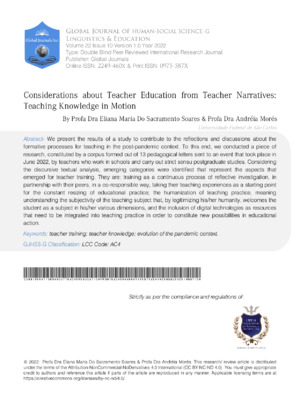
Considerations about Teacher Education from Teacher Narratives: Teaching Knowledge in Motion

1
Eliana Maria do Sacramento
2
Andréia Morés
Andréia Morés

Send Message

To: Author

GJHSS Volume 22 Issue G10

Article Fingerprint

ReserarchID

NEJYB

Considerations about Teacher Education from Teacher Narratives: Teaching  Knowledge in Motion Banner
  • English
  • Afrikaans
  • Albanian
  • Amharic
  • Arabic
  • Armenian
  • Azerbaijani
  • Basque
  • Belarusian
  • Bengali
  • Bosnian
  • Bulgarian
  • Catalan
  • Cebuano
  • Chichewa
  • Chinese (Simplified)
  • Chinese (Traditional)
  • Corsican
  • Croatian
  • Czech
  • Danish
  • Dutch
  • Esperanto
  • Estonian
  • Filipino
  • Finnish
  • French
  • Frisian
  • Galician
  • Georgian
  • German
  • Greek
  • Gujarati
  • Haitian Creole
  • Hausa
  • Hawaiian
  • Hebrew
  • Hindi
  • Hmong
  • Hungarian
  • Icelandic
  • Igbo
  • Indonesian
  • Irish
  • Italian
  • Japanese
  • Javanese
  • Kannada
  • Kazakh
  • Khmer
  • Korean
  • Kurdish (Kurmanji)
  • Kyrgyz
  • Lao
  • Latin
  • Latvian
  • Lithuanian
  • Luxembourgish
  • Macedonian
  • Malagasy
  • Malay
  • Malayalam
  • Maltese
  • Maori
  • Marathi
  • Mongolian
  • Myanmar (Burmese)
  • Nepali
  • Norwegian
  • Pashto
  • Persian
  • Polish
  • Portuguese
  • Punjabi
  • Romanian
  • Russian
  • Samoan
  • Scots Gaelic
  • Serbian
  • Sesotho
  • Shona
  • Sindhi
  • Sinhala
  • Slovak
  • Slovenian
  • Somali
  • Spanish
  • Sundanese
  • Swahili
  • Swedish
  • Tajik
  • Tamil
  • Telugu
  • Thai
  • Turkish
  • Ukrainian
  • Urdu
  • Uzbek
  • Vietnamese
  • Welsh
  • Xhosa
  • Yiddish
  • Yoruba
  • Zulu

We present the results of a study to contribute to the reflections and discussions about the formative processes for teaching in the post-pandemic context. To this end, we conducted a piece of research, constituted by a corpus formed out of 13 pedagogical letters sent to an event that took place in June 2022, by teachers who work in schools and carry out strict sensu postgraduate studies. Considering the discursive textual analysis, emerging categories were identified that represent the aspects that emerged for teacher training. They are: training as a continuous process of reflective investigation, in partnership with their peers, in a co-responsible way, taking their teaching experiences as a starting point for the constant resizing of educational practice; the humanization of teaching practice, meaning understanding the subjectivity of the teaching subject that, by legitimizing his/her humanity, welcomes the student as a subject in his/her various dimensions, and the inclusion of digital technologies as resources that need to be integrated into teaching practice in order to constitute new possibilities in educational action.

Funding

No external funding was declared for this work.

Conflict of Interest

The authors declare no conflict of interest.

Ethical Approval

No ethics committee approval was required for this article type.

Data Availability

Not applicable for this article.

Eliana Maria do Sacramento. 2026. \u201cConsiderations about Teacher Education from Teacher Narratives: Teaching Knowledge in Motion\u201d. Global Journal of Human-Social Science - G: Linguistics & Education GJHSS-G Volume 22 (GJHSS Volume 22 Issue G10): .

Download Citation

Alt: Teacher education research on knowledge evolution during the pandemic.
Journal Specifications

Crossref Journal DOI 10.17406/GJHSS

Print ISSN 0975-587X

e-ISSN 2249-460X

Keywords
Classification
GJHSS-G Classification: LCC Code: AC4
Version of record

v1.2

Issue date

November 9, 2022

Language

English

Experiance in AR

The methods for personal identification and authentication are no exception.

Read in 3D

The methods for personal identification and authentication are no exception.

Article Matrices
Total Views: 1517
Total Downloads: 37
2026 Trends
Research Identity (RIN)
Related Research

Published Article

We present the results of a study to contribute to the reflections and discussions about the formative processes for teaching in the post-pandemic context. To this end, we conducted a piece of research, constituted by a corpus formed out of 13 pedagogical letters sent to an event that took place in June 2022, by teachers who work in schools and carry out strict sensu postgraduate studies. Considering the discursive textual analysis, emerging categories were identified that represent the aspects that emerged for teacher training. They are: training as a continuous process of reflective investigation, in partnership with their peers, in a co-responsible way, taking their teaching experiences as a starting point for the constant resizing of educational practice; the humanization of teaching practice, meaning understanding the subjectivity of the teaching subject that, by legitimizing his/her humanity, welcomes the student as a subject in his/her various dimensions, and the inclusion of digital technologies as resources that need to be integrated into teaching practice in order to constitute new possibilities in educational action.

Our website is actively being updated, and changes may occur frequently. Please clear your browser cache if needed. For feedback or error reporting, please email [email protected]
×

This Page is Under Development

We are currently updating this article page for a better experience.

Request Access

Please fill out the form below to request access to this research paper. Your request will be reviewed by the editorial or author team.
X

Quote and Order Details

Contact Person

Invoice Address

Notes or Comments

This is the heading

Lorem ipsum dolor sit amet, consectetur adipiscing elit. Ut elit tellus, luctus nec ullamcorper mattis, pulvinar dapibus leo.

High-quality academic research articles on global topics and journals.

Considerations about Teacher Education from Teacher Narratives: Teaching Knowledge in Motion

Eliana Maria do Sacramento
Andréia Morés
Andréia Morés

Research Journals