I. INTRODUCTION
According to Systemic Functional Linguistics (SFL, hereafter), language serves three metafunctions: experiential, interpersonal, and textual (Halliday 1985, 1994; Halliday and Matthiessen 2004, 2014; Fawcett 2000, 2008, forthcoming). Based on the textual metafunction of language, the concept of the THEMESystem is considered. According to Halliday and Matthiessen (2004: 64), the THEMESystem construes organizing messages relevantly to the other notes around them and to the broader context in speaking or writing. The textual meaning of the clause is realized by a thematic structure consisting of two parts: Theme and Rheme. The Theme is the element that serves as the starting point of the message, while the remaining part is the Rheme that gives further information about the Theme. From a Systemic Functional approach, the studies of are based on Halliday's thematic structure (see Caffarel et al. 2004).
Research on Theme in Myanmar from a Systemic Functional approach is surprisingly scant (e.g., Hopple 2002; Rattanapitak 2009; Ozerov 2014). Rattanapitak (2009) studies theTheme system and its realizations in Myanmar from the perspective of Systemic Functional Linguistics. However, Rattanapitak's (2009) study of Theme in Myanmar does not cover interrogative and exclamative clauses. Moreover, bias in the data collection also exists because it relies on only five Burmese religious tales extracted from Min Yu Wai's (1999) book entitled "38 Welfare Tales," containing 38 stories about Buddhist teachings. To meet this literature gap, this paper aims to develop theTheme system of Myanmar by supplementing it with the enhanced Theme based on the thematic analysis of different genres of Myanmar text from a Systemic Functional perspective.
In the Theme system of Myanmar proposed in this study, two sub-systems: THEM STATUS and THEM COMPOSITION are presented in order to show the flow of information in Myanmar text. For the former, unmarked and enhanced Themes are presented, while for the latter, simple and multiple Themes are presented. Theme in Myanmar typically functions as a Subject, Complement, Adjunct, or hypotactic clause. It can also function as a Baelement in interrogative, and a Predicator in imperative. Two major types of special thematic structures, such as thematic equatives and preposed attributes are found in Myanmar. Thompson (2004/2008: 164) characterizes them as enhanced Theme in his THEMATIC systems of English. The typical organization of a multiple Theme in Myanmar is textual ^interpersonal ^experiential. This study contributes to the understanding of how Myanmar people organize their messages relevantly to the context. The result makes an important contribution to a contrastive study of THEM systems between Myanmar and foreign languages.
II. PREVIOUS STUDIES OF THEM IN MYANMAR
Based on the THEME system of English devised by Halliday (1985, 1994) and Matthiessen (1995), many linguists have constructed the THEME systems of human languages within the framework of Systemic Functional Linguistics (e.g., French by Caffarel 2004; German by Steiner and Teich 2004; Japanese by Teruya 2004; Chinese by Halliday and McDonald 2004). There are a few studies on Theme in Myanmar (see Hopple 2002; Rattanapitak 2009; Ozerov 2014). Hopple (2002) studies Topicalization in Burmese expository discourse, focusing on the topicalizing and thematic functions of the three postpositional particles: , and from a discourse point of
view. Rattanapitak (2009) presents a system network of textual resources in Burmese religious tales from a Systemic Functional approach. Since Rattanapitak's (2009) study is limited to expository discourse, it does not offer a satisfactory explanation of the textual metafunction of the Myanmar language. Based on Jacobs' (1999) concepts of informational autonomy, Ozerov (2014) investigates the grammatical means used for expressing information structure in standard colloquial Burmese by analyzing its morphosyntactic and prosodic devices. Ozerov's (2014) study is beyond the scope of Systemic Functional Linguistics. It reveals a grammatical system of informational PACKAGING in Burmese. Therefore, further research on constructing a new model of the THEMESystem of Myanmar, which can realize the textual meaning of Myanmar clauses, is necessary for Systemic Functional Linguistics.
To meet this need, this study aims to develop the THEME system of Myanmar based on the network presented by Halliday (1985, 1994; Halliday and Matthiessen 2004, 2014). It is of great significance that findings are based on the thematic analysis of different genres of Myanmar text. In this study, the elaborations of unmarked Themes in different clauses and special thematic structures of Myanmar are supported with data from authentic materials, such as literature, news articles, and databases such as SEAlang Library Burmese corpus2. The thematic compositions of simple and multiple Themes in Myanmar are also presented in this study. The results of this study will form part of a more extensive study of the Systemic Functional Grammar of Myanmar. This study will also make a significant contribution to a contrastive analysis of THEME systems between Myanmar and foreign languages.
III. CONSTRUCTION OF THE THEORY SYSTEM OF MYANMAR
TheTheme system is a grammatical resource for the organization of the clause as a message. It realizes the textual mode of meaning concerning the creation of text relevantly to the preceding text and context, which is intrinsic to language. The clause in any language has the character of a message, or quantum of information in the flow of discourse; therefore, every language has some form of organization contributing to the flow of discourse (Halliday and Matthiessen 2014: 88). Like other world languages, Myanmar clause is also organized as a message by having a special thematic status assigned to one part of it. This element is enunciated as the theme, and then it combines with the remainder to constitute a message. In spoken and written Myanmar, textual prominence (i.e., the thematic status) is given to an item by putting it first in the clause. The Theme is the first element functioning as the point of departure of the message, which locates and orients the clause within its context. In contrast, the remainder of the message (i.e., the part in which the Theme is developed) is known as the Rheme (Halliday and Matthiessen 2014: 89). Following Halliday's (1985, 1994, 2004, 2014) Theme-Rheme structure, this study explores thematic choices in different clause types in Myanmar, including simple clauses, clause complexes, and reported clauses. It also explores enhanced Themes or special thematic structures of Myanmar, such as thematic equatives and preposed attributes.
a) Theme and Mood
The choice of Theme in Myanmar clause depends on Mood choice. MOOD, the primary interpersonal system of the clause, provides interactants with the resources for giving or demanding a commodity such as information and goods-&-services - in other words, with the resources for enacting speech functions (speech acts) through the grammar of the clause: statements (giving information), questions (demanding information), offers (giving goods-&- services), and commands (demanding goods-&-services). This study focuses on major clauses of Myanmar. Minor clauses like /kaunnbye/ "ok", /hokeket/ "yes" have no Mood choice and thematic structure, and so they are left out of account in this study. A major clause in Myanmar can be either indicative or imperative. Indicative has two options: declarative and interrogative. Exclamative is a subtype of declarative. The following will present thematic structures in each Mood type of Myanmar from the perspective of a textual metafunction.
i. Theme in indicative clauses
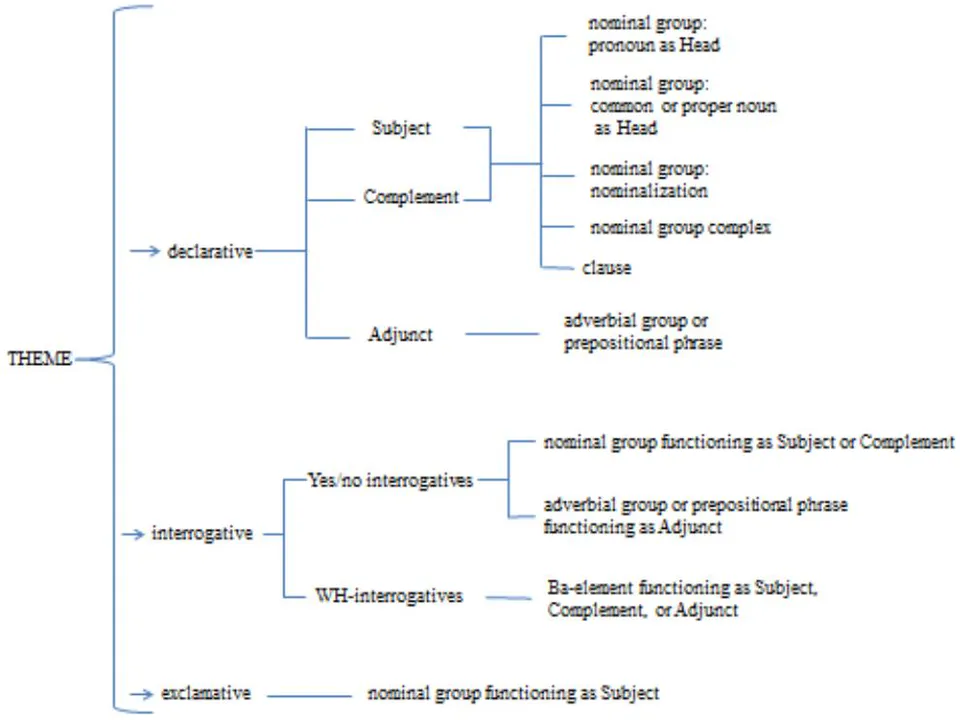
The Theme in Myanmar declarative functions as Subject, Complement, and Adjunct. The Theme functioning as a Subject or Complement is generally realized by a nominal group, nominal group complex, and clause. The Theme functioning as an Adjunct is typically realized by a prepositional phrase or an adverbial group. See Examples (1)-(3).
(1)
000600:0 009988
c00000000
sain-hma
kaunlaye:-ga
thanpayar-yay-hna-khwet
larchapaye:-the.
shop-from.ABLMARK
boy-SBJMARK
lemon-juice-two-CLF
bring.PFV-DECL.SENTSUF
| Theme | Rheme |
'The boy from the shop brought two glasses of lemon juice.'
(Journal Kyaw Ma Ma Lay 1957: 9)
(2)
32C320:
gooo
32y
gdooo
seelonn=hma
inarr
phyitmye-sothehmar
ahman
phyit-par-the.
unite=COND
strength
COP-SBJMARK
truth
COP-POLMARK-PRS.DECL.SENTSUF
Theme
Rheme
'It is true that unity is strength.'
(SEAlang Library Burmese Corpus)
(3)
2005
y
myit-taphetkannsethot
kyanor
hlannkyi-laik-the.
river-ALL
1SG.M.NOM
glance-PFV-DECL.SENTSUF
| Theme | Rheme |
'I glanced towards the river.'
Exclamative, a subtype of declarative, is a small group of clauses. It functions to express the speaker's intense emotions. It is structured in the form of Subject ^ Predicator, which is the same as Myanmar declarative. The clause-final particle: /laiktar/ distinguishes exclamative from declarative in Myanmar. The unmarked Theme in Myanmar exclamative is the Subject realized by a nominal group, as shown in Example (4).
(4) 3880:
ein-gyee-ga
kyetthayayshi-laiktar.
house-AUG-SBJMARK
splendid-EXCL
| Theme | Rheme |
'How splendid the house is!'
(Journal Kyaw Ma Ma Lay 1957: 120)
In Myanmar, the unmarked Theme in WH-interrogative is Ba-element, analogous to the WH-element representing the missing information that the speaker wants to know from other person. Thematization of Ba-element can function as Subject, Complement, or Adjunct, as shown in Examples (5a)-(5c).
(5) a. Thematization of Ba-element functioning as Subject
000
0C:O
c000000
béthue
minn-go
pyaw-khèt-darlè.
who
2SG-OBJMARK
tell-PST-INT.SENTSUF
| Theme | Rheme |
'Who told you?'
(SEAlang Library Burmese Corpus)
b. Thematization of Ba-element functioning as Complement
0000 0000
00000000000000000000000000000
béthu-go
twayt-chin-lolle.
who-OBJMARK
meet-OPT-PRS.INT.SENTSUF
| Theme | Rheme |
'Whom do you want to meet?'
(SEAlang Library Burmese Corpus)
c. Thematization of Ba-element functioning as Adjunct
000000
gcooooc
be-achein
pyanlar-hmar-le.
which-time
come.back-IRR-INT.SENTSUF
| Theme | Rheme |
'Which time will you come back?'
(SEAlang Library Burmese Corpus)
Other Theme choices in WH-interrogative in Myanmar are Subject, Complement, and Adjunct, as shown in Examples (6a)-(6c).
000IL
thue-ga
dego
bar
loke-tarlè.
3SG-SBJMARK
here
what
come
do-PRS.INT.SENTSUF
| Theme | Rheme |
'What does she come here for?'
b. Complement as Theme
8 30:30
message
oo:oo
de-pannoe-go
bénayyarhmar
htarr-malè.
this.DEM-vase-OBJMARK
where
put-IRR.INT.SENTSUF
| Theme | Rheme |
'Where will you put this vase?'
(SEAlang Library Burmese Corpus)
c. Adjunct as Theme
3000
3202
ωδδδ
goloo
aporhmar
eikkhann
béhnakhann
shi-bar-thalè.
upstairs
bedroom
how.many
exist-POLMARK-PRS.INT.SENTSUF
| Theme | Rheme |
'How many bedrooms are there upstairs?'
(Journal Kyaw Ma Ma Lay 1957: 72)
Yes/no interrogatives function to ask for the polarity of the clause between "yes" and "no". The unmarked Themes in Myanmar yes/no interrogatives are the Subject, Complement, Adjunct, and hypotactic clause. The clause-final interrogator, such as /-larr/ and /-lè/) marks the end of the Myanmar yes/no interrogative. See Examples (7a)-(7c).
(7) a. Subject as Theme
000
000000
thuedot
lar-hmar-larr.
3PL.NOM
come-IRR-INT.SENTSUF
Theme
Rheme
'Will they come?'
(SEAlang Library Burmese Corpus)
b. Complement as Theme
thuedot-go
pheik-pyeebye-larr.
3PL-OBJMARK
invite-PFV-INT.SENTSUF
'Have they been invited?'
c. Adjunct as Theme
3000 1
denayt atann shi-larr.
today class have-PRS.INT.SENTSU
| Theme | Rheme |
'Is there any class today?'
(SEAlang Library Burmese Corpus)
ii. Theme in imperative clauses
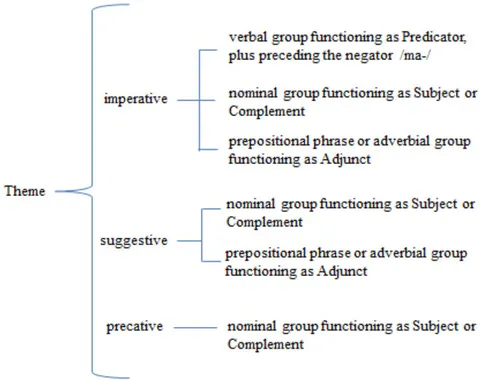
The communicative purpose of the imperative is to ask the other person to perform the action. In Myanmar, the unmarked Theme in the positive imperative is the Predicate realized by the verbal group expressing the action to be performed by the addressee, while the one in the negative imperative is the Predicate along with the pre-verbal negator /ma-/- and the post-verbal particle /-nèt/ (cf. Examples 8 and 9). As Examples (8) and (9) show, there is no Rheme in thematic structures of Myanmar imperatives whose unmarked Theme is the Predicate.
winlar-bar.
come.in-POLMARK
'Come in!'
(9)
ma-thwarr-nèt.
NEG-go-NEGIMP.SENTSUF
Theme
'Don't go!'
(SEAlang Library Burmese Corpus)
When there is Rheme in the thematic structure of Myanmar imperative, the unmarked Theme can be Subject, Complement, or Adjunct, as shown in Examples (10a)-(10c).
(10) a. Subject as Theme
0000 0000
béthuehma ma-hloke-kya-nèt.
anyone NEG-move-PLMARK-NEGIMP.SENTSUF
Theme Rheme
'Anyone, don't move!'
(SEAlang Library Burmese Corpus)
b. Complement as Theme
000 000000000000
thu-go phann-laikkyasann.
3SG-OBJMARK arrest-IMP.SENTSUF
Theme Rheme
'Arrest him!'
(SEAlang Library Burmese Corpus)
c. Adjunct as Theme
000 000000
chetchinn thu-go phann-laik-kya-sann.
immediately 3SG-OBJMARK arrest-IMP.SENTSU
Theme Rheme
'Arrest him immediately!'
The Theme in "let's" type of Myanmar imperative is the Subject, Complement, or Adjunct, as shown in Examples (11a)-(11c).
(11) a. Subject as Theme
| clô° | ŋδŋc | θγɔs | [θ]Sŋ6300CII |
| ngardot | yokeshin | thwarr | kyi-yaaun. |
| 1PL.NOM | film | go | see-SUGMARI |
| Theme | Rheme |
'We let's go and see the film!'
(SEAlang Library Burmese Corpus)
b. Complement as Theme
| ŋδŋδ | ɔŋɔː | ◎ŋδŋδθαδ |
| yokeshin | thwarr | kyi-yaaun. |
| film | go | see-SUGMARK |
| Theme | Rheme |
'Let's go and see the film!'
(SEAlang Library Burmese Corpus)
c. Adjunct as Theme
| 369. | 9895 | 80: | 1234567890 |
| denyt | yokeshin | thwarr | kyi-yaaun. |
| today | film | go | see-SUGMAR |
| Theme | Rheme |
'Let's go and see the film today!'
(SEAlang Library Burmese Corpus)
Another sub-category of the imperative is precative (i.e., a polite request for goods- & services). The unmarked Theme in precative type is Subject or Complement, as shown in Examples (12a) and (12b).
000000 00:016011
thetthet thwarr-bayazay.
Thet.Thet go-REQMARK
| Theme | Rheme |
'Let me go!'
(Journal Kyaw Ma Ma Lay 1957: 205)
| khwintpae:-bar. | ||||
| 1SG.F | stay=REL | room-OBJMARK | moment | look-let-POLMARK |
| Theme | Rheme | |||
| ‘Let me have a look at my room!’(Journal Kyaw Ma Ma Lay 1957: 71) | ||||
b) Multiple Theme
According to Halliday (1994: 52-54), every major clause has an experiential Theme (i.e., the first element with the experiential meaning of the clause). The thematic experiential constituent is labeled as the "topical Theme," which is closely associated with the topic of the clause in topic-comment analysis. It is also possible to have a purely interpersonal Theme (e.g., vocative, modal Adjuncts, and mood-marking) or textual Theme (e.g., continuative, structural, and conjunctive Adjuncts) before the experiential Theme. In this case, everything up to the experiential Theme is included in the Theme of the clause. The typical ordering of elements in a multiple Theme is textual ^interpersonal ^experiential, as shown in Example (13).
| (13) | ♂ | ♀♀ | ♂♀ | ♀♀♀ | ♀♀♀ |
| o | thethet-yé | nint | karr-go | yaunn-malotlarr. | |
| Oh | Thet.Thet-APPEL | 2SG.GEN | car-OBJMARK | sell-IRR.INT.SENTSUF |
| continuative | vocative | topical | |
| textual | interpersonal | experiential | Rheme |
| Theme | |||
'Oh Thet Thet, will you sell your car?'
(SEAlang Library Burmese Corpus)
c) Theme in clause complexes and reported clauses
Thematic choices in Myanmar clause complexes and reported clauses are investigated in this study following Halliday (1985, 1994, 2004, 2014). In a Myanmar clause complex, the dependent clause always precedes the clause on which it depends. In such case, the dependent clause is analyzed as the Theme for the whole clause complex. As every clause has a Theme, the dependent clause and the dominant clause are further analyzed into Theme-Rheme structure as in Example (14).
(14) 000000 000000 0000:00:00
thuedagar nannetsar sarr=pyeehma htaminnzabwe-thot yauk-i.
everyone breakfast eat=after.CONJ dining.table-ALL arrive-PRS.DECL.SENTSUF
| Theme-1 | Rheme-1 | ||
| topical | Rheme-2 | topical | Rheme-3 |
| Theme-2 | Theme-3 | ||
'After everyone has eaten breakfast, he arrives at the dining table.'
(SEAlang Library Burmese Corpus)
According to Thompson (2004/2008: 161), "Reporting or projection has a different kind of relationship between clauses than other types of clause complex; this is reflected in the uncertain status of projected Themes in the text; and in the case of quotes, the analysis is usually straightforward in such a way that the reporter makes a thematic choice in the projecting or reporting clause and also recycles the original speaker's thematic choice in the quote." Both Themes typically play an essential role in the development of the text, and they are analyzed separately in the reporting clause and quote, as shown in Examples (15) and (16).
hwantawmat- 'bethuega taikkhaik-tarle' hu ayaye:dagyee maye:-laiki.
ga
Juan.Tomas- who attack- quickly ask
SBJMARK PFV.INT.SENTSUF COMP PFV.DECL.SENTSUF
| Theme-1 | Rheme-1 | ||
| topical | |||
| Theme-2 | Rheme-2 | ||
"Who attacked?" asked Juan Tomas quickly.
(16) 3
'dar tanphoe-theikkyee=det palebya' hu keno-ga so-the.
this.DEM value-AUG=REL pearl=COMP Kino-SBJMARK say-DECL.SENTSUF
| Theme-1 | Rheme-1 | Theme-2 | Rheme-2 |
"It is a pearl of great value," Kino said.
In both direct speech and indirect speech in Myanmar, the reported clause comes after the Subject of the reporting clause. Each of them has its Theme. The Theme of the reported clause links in with the topic of the text, while the Theme of the reporting clause primarily develops the information by identifying the source (Thompson 2004/2008: 161). Both Themes, therefore, serve different functions in the development of the text, and they are identified separately, as illustrated in Example (17).
| (17) | ### | ### | ### | ### | ### | e- | ### | ### | ### |
| ### | ### | ### | Govemment | ### | ### | ### | |||
| ### | |||||||||
| shaye:u | pyinnyaryaye:w | pyehtaunsu | letshika | nainngand | e- | arrpa | saunywet- | pyawky | |
| e:zwar | ingyeehtarna | wingyee-ga | rlatwin | orasoeya-anayphyint | Govemment | ye: | lyetshi-bar=gyaun | arr-the. | |
| sanit-go | n | ||||||||
| firstly | Ministry.of.Edu-cation | Union.Minister-SBJMARK | at.present | governmen-t-SBJMARK | e- | enco | carry.out- | say- | |
| Govemment | urage | PROG-POLMARK=COMP | DECL.SE NTSUF | ||||||
| system | |||||||||
| - | |||||||||
| OBJMAR | |||||||||
| RK |
| conjunctive | topical | Rheme-1 | ||
| textual | experiential | |||
| Theme-1 | ||||
| topical | ||||
| Theme-2 | Rheme-2 | |||
'Firstly, the Minister of Education said that the government is encouraging e-Government system at present.' (Myanmar Alinn Daily Newspaper 2019: 8)3
d) Special thematic structures of Myanmar
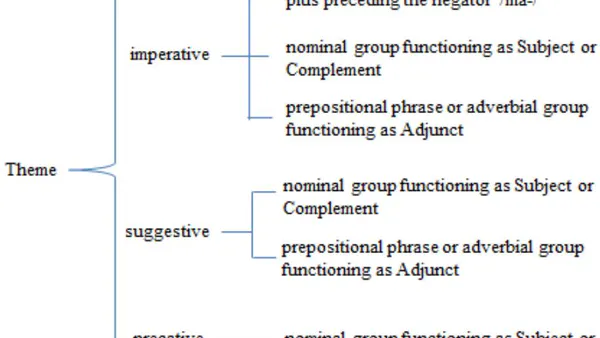
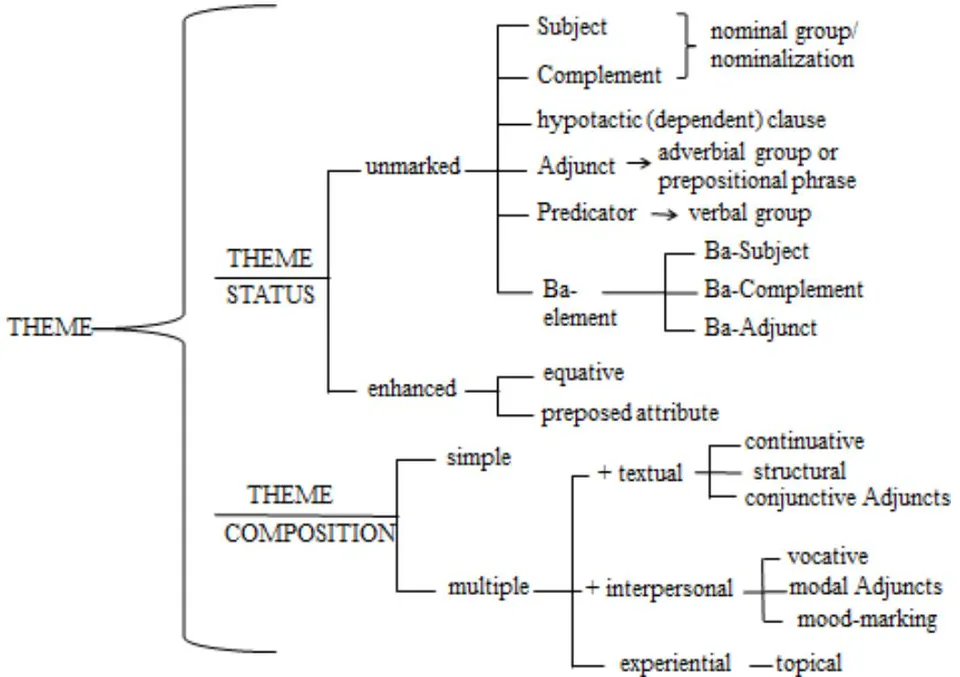
Special thematic structures of Myanmar (i.e., enhanced Theme) cover thematic equatives and preposed attributes (see Figure 3). In a thematic equative, Theme and Rheme are in the same status, which is pointed out by the verb to be, as shown in Example (18).
| (18) | dloE | cgoocococg | qoo | sdd | cgoococg | cgoococg |
| ngardo | lutlatyaye: | ya- | hnit-har | htauntkoeyarlaye:zetshit | phyit-te. | |
| t | khet=de | -khuhnit | ||||
| t | ||||||
| 1PL.NO | independenc | get- | year- | 1948-year | COP- | |
| M | e | PST=REL | SBJMAR | PRS.DECL.SENTSU | ||
| K | F | |||||
| Theme | Rheme | |||||
'The year when we got independence is 1948.'
(SEAlang Library Burmese Corpus)
The second type of special thematic structure is the preposed attribute. It is a part of the Theme that introduces the quality of the following nominal group functioning as the starting point of the clause (Thompson 2004/2008: 163). The preposed attribute plus the following nominal group as Theme in Myanmar is shown in Example (19).
| (19) | a | ööööööööö | gäöööö | eööööööö | ωö | şö | öööööö | ωööö | öööö(O)ööööö | ööööö |
| ş | şöööö | şöööö | şö | şö | şö | şö | şö | şööööööööö | şö | |
| pyinnyaryaye: | pyidaun | dauktarny | ya | nan | settanain | than | ahmattit- | thwarrya | ||
| wingyeehtarna | zu- | untphay- | na | net | yekhwe- | dwe- | achaykhanpyinnyar | uk=ywayt | ||
| wingyee | the | yt | twin | myot | ahtettannkyaunn-thot | |||||
| Ministry.of.Ed | Union- | Dr. | tod | mor | 11:30- | Than | No.1- | go=and.C | ||
| ucation | Ministe | Nyunt.Pe | ay | ning | ABLMAR K | dwe- | Basic.Education.Hi | ONJ | ||
| r | -SBJMARK | town | gh.School-ALL |
Theme-1
Rheme-1
'The Minister of Education, Dr. Nyunt Pe went to No. (1) Basic Education High School, Thandwe at 11:30 this morning and...'
| b | 成语: | ||||
| . | |||||
| kyaunntharrkyaunnthue- | aye: | channtharyarzwar | pyinnyarthinkyar | kyishu | |
| myarr | r-nayhmu- | ||||
| myarr-go | |||||
| student-PLMARK | peacefully | learn-NMLZ- | inspect | encourag | |
| PLMARK- | e- | ||||
| OBJMARK | DECL.SEN | ||||
| TSUF | |||||
| Theme-2 | Rheme-2 |
...inspected the learning of the students in peace.'
Based on the findings of thematic analyses on Myanmar's declarative, exclamative, interrogative, and imperative clauses, the THEORY system of Myanmar is demonstrated in Figure 3.
IV. CONCLUSION
This paper presents the Theme system of Myanmar from the Systemic Functional perspective. In section 2, the previous studies on Theme in Myanmar have been reviewed. There are very few studies of Theme in Myanmar from the Systemic Functional perspective. Their analysis is based on the restricted data collection; consequently, they do not offer satisfactory answers to the organization of messages in different genres of Myanmar text. To meet this need, the present study has developed a system network for Theme in Myanmar based on the findings from the thematic analysis of different clauses: declarative, interrogative, imperative, and exclamative in Myanmar by using Halliday's (1985, 1994) Theme-Rheme structure in section 3.
Findings show that the Theme system of Myanmar consists of two sub-systems: THEM STATUS and THEM COMPOSITION. The former contains two major types: unmarked and enhanced Themes, while the latter contains simple and multiple Themes. Unmarked Theme in Myanmar clauses can be Subject, Complement, Adjunct, hypotactic clause, Predicator (only in imperative), and Ba-element (only in interrogative). Enhanced Theme contains two major types: thematic equatives and preposed attributes. A multiple Theme includes textual (e.g., continuative, structural, and conjunctive Adjuncts), interpersonal (e.g., vocative, modal Adjuncts, and mood-marking), and experiential/topical Themes.
In conclusion, this study is of great significance in investigating how Myanmar speakers organize their messages coherently to the other messages around them and in the broader context of spoken and written discourse. The findings of this study characterize the textual metafunction of the Myanmar language and contribute to the Systemic Functional Grammar of Myanmar. This study has clear implications for further research on a contrastive analysis of Theme in Myanmar and foreign languages.
Abbreviations found in the Leipzig Glossing Rules
| 3PL | third person plural |
| 1SG | first person singular |
| 2SG | second person singular |
| 3SG | third person singular |
| ABLMARK | ablative marker |
| ACC | accusative |
| ADDCONN | additive connective |
| AFFMARK | affectionate marker |
| ALL | allative |
| ANA | anaphoric |
| APPEL | appellative |
| ASSOC | associative |
| CAPAMOD | capability modality |
| CAUS | causative |
| CLF | classifier |
| CMPR | comparative |
| COM | comitative |
| COMP | complementizer |
| COMPA | compassion |
| CONJ | conjunction |
| CONN | connective |
| COP | copula |
| DAT | dative |
| DECL.SENTSUF | declarative sentence suffix |
| DET | determiner |
| DIM | diminutive |
| DU | dual |
| EMPMARK | emphatic marker |
| EXCL | exclusive |
| EXPER | experiential |
| F | female |
| FUT | future |
| GEN | genitive |
| INCL | inclusive |
| INF | infinitive |
| INS | instrumental |
| INT.SENTSUF | interrogative sentence suffix |
| LOC | locative |
| M | male |
| MOD | modifier |
| NEG | negative |
| NEGDECL.SENTSUF | negative declarative sentence suffix |
| NOM | nominative |
| OBJMARK | object marker |
| OBLG | obligation |
| OPT | optative |
| PFV | perfective |
| PLMARK | plural marker |
| POLMARK | polite marker |
| POSTDECL.SENTSUF | positive declarative sentence suffix |
| PROG | progressive |
| PRS | present |
| PST | past |
| PURP | purposive |
| REFL | reflexive |
| REL | relative |
| SBJMARK | subject marker |
| SUP | superlative |