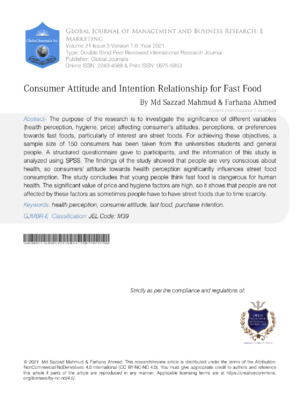
Consumer Attitude and Intention Relationship for Fast Food

§ Hochschule Worms, United International University

Send Message

To: Author

Consumer Attitude and Intention Relationship for Fast Food

Article Fingerprint

ReserarchID

MBRVO991

Consumer Attitude and Intention Relationship for Fast Food Banner

AI TAKEAWAY

Connecting with the Eternal Ground
  • English
  • Afrikaans
  • Albanian
  • Amharic
  • Arabic
  • Armenian
  • Azerbaijani
  • Basque
  • Belarusian
  • Bengali
  • Bosnian
  • Bulgarian
  • Catalan
  • Cebuano
  • Chichewa
  • Chinese (Simplified)
  • Chinese (Traditional)
  • Corsican
  • Croatian
  • Czech
  • Danish
  • Dutch
  • Esperanto
  • Estonian
  • Filipino
  • Finnish
  • French
  • Frisian
  • Galician
  • Georgian
  • German
  • Greek
  • Gujarati
  • Haitian Creole
  • Hausa
  • Hawaiian
  • Hebrew
  • Hindi
  • Hmong
  • Hungarian
  • Icelandic
  • Igbo
  • Indonesian
  • Irish
  • Italian
  • Japanese
  • Javanese
  • Kannada
  • Kazakh
  • Khmer
  • Korean
  • Kurdish (Kurmanji)
  • Kyrgyz
  • Lao
  • Latin
  • Latvian
  • Lithuanian
  • Luxembourgish
  • Macedonian
  • Malagasy
  • Malay
  • Malayalam
  • Maltese
  • Maori
  • Marathi
  • Mongolian
  • Myanmar (Burmese)
  • Nepali
  • Norwegian
  • Pashto
  • Persian
  • Polish
  • Portuguese
  • Punjabi
  • Romanian
  • Russian
  • Samoan
  • Scots Gaelic
  • Serbian
  • Sesotho
  • Shona
  • Sindhi
  • Sinhala
  • Slovak
  • Slovenian
  • Somali
  • Spanish
  • Sundanese
  • Swahili
  • Swedish
  • Tajik
  • Tamil
  • Telugu
  • Thai
  • Turkish
  • Ukrainian
  • Urdu
  • Uzbek
  • Vietnamese
  • Welsh
  • Xhosa
  • Yiddish
  • Yoruba
  • Zulu
Font Type
Font Size
Font Size
Bedground

Abstract

The purpose of the research is to investigate the significance of different variables (health perception, hygiene, price) affecting consumer’s attitudes, perceptions, or preferences towards fast foods, particularly of interest are street foods. For achieving these objectives, a sample size of 150 consumers has been taken from the universities students and general people. A structured questionnaire gave to participants, and the information of this study is analyzed using SPSS. The findings of the study showed that people are very conscious about health, so consumers’ attitude towards health perception significantly influences street food consumption. The study concludes that young people think fast food is dangerous for human health. The significant value of price and hygiene factors are high, so it shows that people are not affected by these factors as sometimes people have to have street foods due to time scarcity.

References

30 Cites in Article
  1. Kafi Salim Hassan,Abiodun Efisue Andrew,Bunmi Olasanmi,Kyung-Ho Kang (2014). Genetic variation and diversity analysis of rice (Oriza sativa L.) based on quantitative traits for crop improvement.
  2. (2017). Retrieved from Newagebd.
  3. Patricia Ababio,Doreen Adi,Martin Amoah (2012). Evaluating the awareness and importance of food labelling information among consumers in the Kumasi metropolis of Ghana.
  4. Emine Aksoydan (2007). HYGIENE FACTORS INFLUENCING CUSTOMERS' CHOICE OF DINING‐OUT UNITS: FINDINGS FROM A STUDY OF UNIVERSITY ACADEMIC STAFF.
  5. K Allen,J Taylor,R Kuiper (2007). Effectiveness of Nutrition Education on Fast Food Choices in Adolescents.
  6. C Aloia,S Lear,D Gasevic,S Lear,S Teo (2013). Differences in perceptions and fast food eating behaviours between Indians living in high-and low-income neighbourhoods of Chandigarh, India.
  7. R Ashakiran,D (2012). Fast Foods and their Impact on Health.
  8. E Babbie,D Muijs (2010). The Practice of Social Research.
  9. Munmun Bipasha,Shatabdi Goon (2013). Fast food preferences and food habits among students of private universities in Bangladesh.
  10. Kerri Boutelle,Jayne Fulkerson,Dianne Neumark-Sztainer,Mary Story,Simone French (2006). Fast food for family meals: relationships with parent and adolescent food intake, home food availability and weight status.
  11. (2006). NCHS Data on Developmental Disabilities.
  12. D Resnick,M (1986). Adolescents' views on food and nutrition.
  13. M Dewolf (2017). Unknown Title.
  14. Dr. Dani,Vanishree Pabalkar (2011). Exploring of Consumer behavior towards fast food Industry: A Case study on Pune.
  15. Freedman,S French,P Hannan,J Fulkerson,D Neumark-Sztainer (2001). Fast food restaurant use among adolescents: associations with nutrient intake, food choices and behavioral and psychosocial variables.
  16. Anita Goyal,N Singh (2007). Consumer perception about fast food in India: an exploratory study.
  17. A Hassan (2018). Eating Out.
  18. Nazrul Islam,G Ullah (2010). Factors Affecting Consumers Preferences On Fast Food Items In Bangladesh.
  19. D Lane (2003). Intro(duction) (i).
  20. Jan Mattsson,Helge Helmersson (2007). Eating fast food: attitudes of high‐school students.
  21. P Musaiger (2015). Consumption, Health Attitudes and Perception Toward Fast Food Among Arab Consumers in Kuwait: Gender Differences.
  22. D Neumark,M Story,C Perry,M Casey (2003). Factors influencing food choices of adolescents: findings from focus-group discussions with adolescents.
  23. H Nondzor,Y Tawiah (2015). Consumer Perception and Preference of Fast Food: A Study of Tertiary Students in Ghana.
  24. Cheol Park (2004). Efficient or enjoyable? Consumer values of eating-out and fast food restaurant consumption in Korea.
  25. Sharmila Rane (2011). Street Vended Food in Developing World: Hazard Analyses.
  26. Mohd Shaharudin,Jacqueline Junika Pani,Suhardi Wan Mansor,Shamsul Jamel Elias,Daing Maruak Sadek (2011). Purchase Intention of Organic Food in Malaysia; A Religious Overview.
  27. J Shepherd,A Harden,R Rees,G Brunton (2005). Young people and healthy eating: a systematic review of research on barriers and facilitators.
  28. Martine Stead,Laura Mcdermott,Anne Mackintosh,Ashley Adamson (1131). Why healthy eating is bad for young people’s health: Identity, belonging and food.
  29. S Stender,J Dyerberg,A Astrup (2007). Fast food: unfriendly and unhealthy.
  30. F Winarno,A Allain (2010). FAO. 2010. Breeding strategies for sustainable management of animal genetic resources. FAO Animal Production and Health Guidelines. No. 3. Rome, pp 155. ISBN 978-92-5-106391-0. Available at: http://www.fao.org/docrep/012/i1103e/i1103e00.htm (English version); http://www.fao.org/docrep/012/i1103s/i1103s.pdf (Spanish version).

Funding

No external funding was declared for this work.

Conflict of Interest

The authors declare no conflict of interest.

Ethical Approval

No ethics committee approval was required for this article type.

Data Availability

Not applicable for this article.

How to Cite This Article

Md Mahmud, Farhana Ahmed. 2021. "Consumer Attitude and Intention Relationship for Fast Food". Global Journal of Management and Business Research, Global Journal of Management and Business Research - E: Marketing GJMBR-E Volume 21 (GJMBR Volume 21 Issue E3).

Download Citation

Consumer Attitudes Toward Fast Food Satisfaction.
Journal Specifications

Crossref Journal DOI 10.17406/GJMBR

Print ISSN 0975-5853

e-ISSN 2249-4588

Keywords
Classification
GJMBR-E Classification JEL Code: M39
Version of record

v1.2

Issue date
September 22, 2021

Language
English
Experiance in AR

Explore published articles in an immersive Augmented Reality environment. Our platform converts research papers into interactive 3D books, allowing readers to view and interact with content using AR and VR compatible devices.

Read in 3D

Your published article is automatically converted into a realistic 3D book. Flip through pages and read research papers in a more engaging and interactive format.

Article Matrices
Total Views: 622
Total Downloads: 41
All Trends

Request Access

Please fill out the form below to request access to this research paper. Your request will be reviewed by the editorial or author team.
X

This is the heading

Lorem ipsum dolor sit amet, consectetur adipiscing elit. Ut elit tellus, luctus nec ullamcorper mattis, pulvinar dapibus leo.

High-quality academic research articles on global topics and journals.

Consumer Attitude and Intention Relationship for Fast Food

Md Mahmud
Md Mahmud Hochschule Worms, United International University
Farhana Ahmed
Farhana Ahmed