
Neural Networks and Rules-based Systems used to Find Rational and Scientific Correlations between being Here and Now with Afterlife Conditions
Neural Networks and Rules-based Systems used to Find Rational and

Article Fingerprint
ReserarchID
7J96E
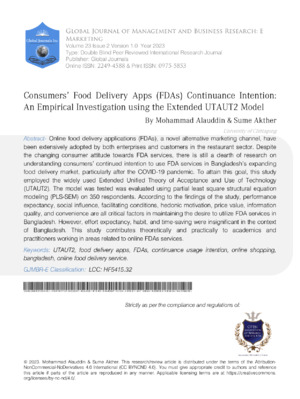
Online food delivery applications (FDAs), a novel alternative marketing channel, have been extensively adopted by both enterprises and customers in the restaurant sector. Despite the changing consumer attitude towards FDA services, there is still a dearth of research on understanding consumers’ continued intention to use FDA services in Bangladesh’s expanding food delivery market, particularly after the COVID-19 pandemic. To attain this goal, this study employed the widely used Extended Unified Theory of Acceptance and Use of Technology (UTAUT2). The model was tested was evaluated using partial least square structural equation modeling (PLS-SEM) on 350 respondents. According to the findings of the study, performance expectancy, social influence, facilitating conditions, hedonic motivation, price value, information quality, and convenience are all critical factors in maintaining the desire to utilize FDA services in Bangladesh. However, effort expectancy, habit, and time-saving were insignificant in the context of Bangladesh. This study contributes theoretically and practically to academics and practitioners working in areas related to online FDAs services.
Mohammad Alauddin. 2026. \u201cConsumers Food Delivery Apps (FDAs) Continuance Intention: An Empirical Investigation using the Extended UTAUT2 Model\u201d. Global Journal of Management and Business Research - E: Marketing GJMBR-E Volume 23 (GJMBR Volume 23 Issue E2): .
Crossref Journal DOI 10.17406/GJMBR
Print ISSN 0975-5853
e-ISSN 2249-4588
The methods for personal identification and authentication are no exception.
Total Score: 102
Country: Bangladesh
Subject: Global Journal of Management and Business Research - E: Marketing
Authors: Mohammad Alauddin, Sume Akther (PhD/Dr. count: 0)
View Count (all-time): 163
Total Views (Real + Logic): 1204
Total Downloads (simulated): 29
Publish Date: 2026 01, Fri
Monthly Totals (Real + Logic):
Neural Networks and Rules-based Systems used to Find Rational and
A Comparative Study of the Effeect of Promotion on Employee
The Problem Managing Bicycling Mobility in Latin American Cities: Ciclovias
Impact of Capillarity-Induced Rising Damp on the Energy Performance of
Online food delivery applications (FDAs), a novel alternative marketing channel, have been extensively adopted by both enterprises and customers in the restaurant sector. Despite the changing consumer attitude towards FDA services, there is still a dearth of research on understanding consumers’ continued intention to use FDA services in Bangladesh’s expanding food delivery market, particularly after the COVID-19 pandemic. To attain this goal, this study employed the widely used Extended Unified Theory of Acceptance and Use of Technology (UTAUT2). The model was tested was evaluated using partial least square structural equation modeling (PLS-SEM) on 350 respondents. According to the findings of the study, performance expectancy, social influence, facilitating conditions, hedonic motivation, price value, information quality, and convenience are all critical factors in maintaining the desire to utilize FDA services in Bangladesh. However, effort expectancy, habit, and time-saving were insignificant in the context of Bangladesh. This study contributes theoretically and practically to academics and practitioners working in areas related to online FDAs services.
We are currently updating this article page for a better experience.

Lorem ipsum dolor sit amet, consectetur adipiscing elit. Ut elit tellus, luctus nec ullamcorper mattis, pulvinar dapibus leo.































































