In our evolving era, memory, technology, and society intersect, prompting a reevaluation of human experience. Adaptive recall systems help navigate the blurred lines between personal and collective realities. This text tackles aging and brain herpes as experience highlighters, emphasizing the need for adaptive strategies and memory-enhancing techniques. Memory relies on automatic processes, with the hippocampus key for episodic reconstructions. Technology enhances cognitive abilities, merging individual and collective understandings, and redefining truth and reality while fostering resilience and adaptability. This study embraces diverse perspectives to enrich our understanding, inviting interconnectedness, creativity, compassion, and new forms of humanism.
## I. INTRODUCING ADAPTIVE RECALL SYSTEMS
Thresholding our new era: memory, tech, and societal constructs converge. We are compelled to reexamine the fabric of human experience, and the intersections upon how our memory clipping, fidelity and tech-enabled geared up extensions glimpse this unavoidably incoming blur between individual and collective realities! (Worcman & Garde-Hansen, 2016) Through the lens of personal narratives and philosophical inrequirement, we notice the emergence of new forms of mnemonic engagements and collective experiences: a thread of innovative solutions. People with particular memory, more or less ('dis' and over) functional-ties — were we able to describe individual adaptive processing due to standard use, aging and/or whatever-other-brain-(re/a)condition(amenti) — mandatorily and implicitly experience such risking-redundancy-particularities: everyday: specially when it comes to remembering!!
Actually, understanding memory in a dynamic and adaptive system needfully implies we essentialize behaviors based on resonant experience. Data input aint facts: they're d'just resembling processing reasssemblances. Furthermore, making use of them as humans is an ability we need to always healthily keep and deploy, just to redundantly be always keeping all of our sustainable-healthy-wellbeing-needs! It allows us to contingently-adapt: seemingly in-frequency and concurrently on to evocative circumstances.
Today's convergence of memory, technology, and societal constructs compels us to reexamine human experience, highlighting how adaptive recall systems are essential for navigating the blurring lines between individual and collective realities. I myself had an experience with brain herpes: while managing frequent forgetfulness and anxiety, it allowed me to visualize a gradual understanding of memory-recall difficulties over three years compounded by circumstantial stress, while coping through meticulous note-taking and other adaptive more and less tech strategies. In this sense, my personal approach to these experiences might lend us some sort of phenomenological exploration upon how memory manifests and reconstructs our consciousness. I'll try to re-understand things in a more holistic step-back framework, and comment on my personal journey as i believe somehow makes evident how this universal broad and increasing need for innovative mnemonic strategies and support systems enables effectively coping and adapting to lifestyles, memory changes and challenges in an increasingly complex world, where technology and life span combine and exponentiate.
Despite memory's adaptive nature, hence forward, adopting and learning to deploy mnemonic strategies, requires increasingly continuous innovative approaches, specially for specificities, as usual. Studying how we do so can be done based on functionality if only we open-mindedly navigate challenges: understanding them through the essence of novelty, spontaneity, and rebuilding, as mentioned.
Memory isn't merely reproductive; it operates through contingent, automatic, and functional processes. Actually, studies reveals a crucial role of the hippocampus' in episodic memory (Fortin, Agster & Eichenbaum, 2002). It includes pragmatic encoding, up-to-date storage, contextually emulated retrieval, and back updating mainly for-on-to relearning. And those constructive engagements of our inner brain dynamics allow effective shuffling of neocortical data. Hence, meta-reviewing exhibits some sort of critical-characteristic thread of looped-periodicity, as it ensures the continuous refinement and integration of deployment strategies while adapting to new informative experiences: all automated with our every use.
Such constructive nature means memory is being ever-reshaped by perceptual contingent expectations and experience. If particularities impact specific aspects like sequences or contexts when recalling – as it does – it needs spontaneous mnemonic rebuilding to become functional, something especially important when usual paths of recollection don't work as usual. Thus, any benefits, drawbacks, considerations and technological advancements that qualitatively modulate whilst thy such or so become - as for memory usage - somewhat more obvious in certain scenarios (Nader et. al. 2013). And thus again, it is by thy those same modulators that creativity within memory deployment takes its critical role: pronounced, highlighting any needed abilities to re-adapt and reconstruct experiences in and on to re-new our most current meaningful requirements, making clear the essential anchoring our environment and current states provide, and how tech may exponentiate.
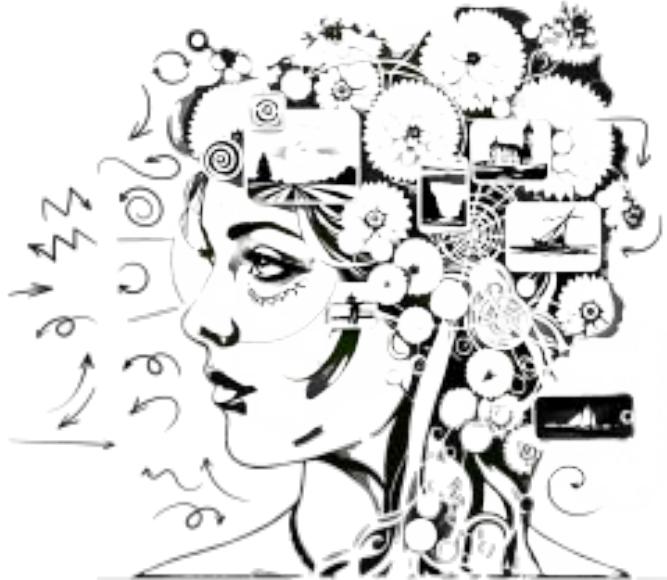 Figure 1: Connecting memory evokes circumstantial illusions as it re-renders stored impressions, and of which only the minor part is factual pre-assuming-some-sort-of-reality-content.
Thrice thus more, understanding over-memory functions as adaptive systems allows navigating present and anticipating future: (i.) based on previous past experimental concurrent neural-activation dynamics and any of ad hoc topologic reinterpretations; therefore (ii.) based on mainly emotive or pseudo meta-content, and (iii.) trying to push always environmentally suitable isomorphic intuitive functionality modelings – all three deepermore aside divine deceivings or any random coincident ineludible self-linguistic-problematic.- Needless to say and any way forth, the hippocampus works with the amygdala to modulate emo-contextual responses within specific memories and situations. It's essential for us to captivate tech or environmental recalls, and emotional experiences, as influencing how we process and remember.
## II. DEFINING MNEMONIC SHAPES ON TECH-IDENTITY
Continuous adjustments mean that memory impairments can often be subtle and undetectable for those who suffer from them, and their environment, moving forward on to anxious dysfunctionalities. Let's take as an example the following quote from Sandi &
Pinelo-Nava's (2007) text regarding stress and neurobiological plasticity:
(...) memory is not only [— if "at-all"—] a repository of past experiences but (...)[a meta] adaptive system influenced by [several contingencies as] emotional and social factors [, and that] that uses neurobiological mechanisms to [feed and] build personal narratives and creative adaptations of experience...
Our brain's natural tendency to adapt and integrate new information can mask the difficulties in memory retrieval, making it challenging for individuals of more or less different mnemonic agility and deployment capacities, to recognize the extent of such capacities, especially under stress. This adaptive quality underscores the resilience and flexibility of human cognition. In the face of significant challenges and in the healthiest of newborn, though forcefully learning and memorizing symbiotics, even if completely overwhelming, it usually seems to be a more widespread adaptation for the just new-born to begin by crying! - specially under more or less sudden or swift scenario shifts.
Continuous adjustments mean that memory fluctuations can often be subtle and undetectable, as the brain's natural tendency to adapt and integrate new information masks retrieval difficulties (which must have proven quite more adaptive). My experience with brain herpes has shown me through gradual understanding of my memory over three years, that compounded stress – more or less socioeconomically impelled – leads to increased anxiety and frequent blank forgetfulness. Such quality underscores human cognition's resilience, but also highlights the well known need for stress management to better navigate the complexities of daily life effectively. Counterintuitively, stress pushing flee-reactions is are more prominent than non-mnemonic contextual – well thought – reframings because they adapted upon emergent urgencies as in: you feel you need to be alert henceforward, because you forgot something, and are eventually learning to successfully wonder if you have forgotten anything in a safe-insured well rehearsed – then again verifying memory is mainly circumstantially-factual apatative-construction – pavlovian time consuming self therapy.
As we have discussed, memory is not a repository for facts and events at all, but a crucially adaptive concurrent deployment (and simultaneous learning) engaging onto some needed functional understanding based on similar structures in our experience, and swiftly-overwhelming by anxious urges. It's also key when creating personal meanings and understanding one's existence every time in the long run as it intertwines with personal identity, social connections, and the interpretation of our reality. By definition, recalled truth, therefore, is not an absolute concept, but defined by the meaning, function, and context that memory provides: even if in deepest usuality we might be designed to somewhat abstract it automatically up to some pseudo-objective neat-retrieval of some pre-constructed previous condition. Memory is much more a way of thinking, more a team meeting than a library. In my experience, it becomes obvious, as recalling you need some basic element better emerges from spontaneous recurrent environmental assemblies - like when you suddenly really need something to drink before you realize you haven't drank anything all day; when need to take one second to go to the toilet real fast; when you forget the keys, or any helpful way of doing things that helps you evocative not-that-neo cortical dynamics - all before anxiety takes control beyond any mnemonic hipocampal circumstance reaccommodation of the meeting.
By focusing on the significance of memory in creating personal relevance, one can appreciate its fluid nature and its role in shaping one's perception of truth and reality. Embracing diverse perspectives enhances our understanding of memory and technology by revealing innovative solutions and new forms of mnemonic engagement: redefining how and what is more important to reframe/resonate and/or interpret/understand from the past (Principled Innovation, 2021) and how it's functional to do so in any given scenario. If understood as such deployment, the boundaries between natural and artificial memory deeply blur and exponentially empower. The interplay between intentionality and the lifeworld reveals the transformative impact of memory adaptation, as experienced through my own journey with brain herpes: how you homeomorphically deploy understandings on to any current circumstance depends on what you've recently been doing and what you feel and perceive in that same moment. In some way, the adaptive essence of memory and experience recalls artistic improvisation, where a blend of personal feelings, empathetic engagements, and rhythmic precisions creates an expressive experiences in a social common ground, thriving on dynamic interactions and subjective interpretations (Aparicio de Soto, 2023). Therefore, highlighting the importance of diverse perspectives in shaping our understandings, tools and technologies advance leading to eventually merges partly shared memories in a somewhat more clipped and functional reality approach. Regarding memory, fusing realities whereupon meanings evolve and combine to uphold are emerging at an accelerated rate.
## III. CONTINUALLY REFRAMING OF SOCIAIALLY INTERACTIVE CONSTRUCTS UPON UNDERSTANDING, STORING, RECOVERING AND USE
The limits of self, communities, and realities suddenly show up. It's critical to deepen on how our resilience and adaptability begs for a future where memory, technology, and social constructs entwine into a brighter, more comprehensive and compassionate world. While pushing present social interactive dynamics right into our shared environments, the distilled essence of such exploration embraces a transformative power upon collective and creative understandings (Rottenbache, 2004).
Memory is a product of interactions and constructs: we must assume memory can clip and change dramatically as our context and constructs evolve. Hence possibilities emerge from its interaction with techno contexts. Memory semi-clipped data leads to the emergence of new forms of mnemonics, memorizing and memetic contextual recalling, such as collective or shared ideals, and approaches or tech-enabled recalling extensions that allow individual identities and collective experiences when blurring such lines: between individual and collective (Finley, Naaz & Goh, 2018). Shared and common memories are social constructs, as language: they adaptively shape memories in a dynamic and collective way. If constructs and interactions define our concurrent memoir, we are pushed to deepen our self-understanding and sharing within technology as both are becoming more and more obviously inseparable while forced to show new ways to adapt and compensate for memory re-articulations and high demands, something obvious when using technology for data recovery in any case.
Plus, thinking extends beyond the brain, to our bodies, circumstances and interactions, highlighting embodied, situated, and socially offloaded supportive environments; memory-learning multiple-sense engagements, and collaborative intelligence: all are boosted by new technologies enhancing cognitive capabilities (Paul, 2021). The main reason is that, as we interact during our lives with anything, specific neurogenerative rethreading in our hippocampus still continues on to adulthood, similarly priming the role of evolving tech toolkits. We ongo neural development underscoring memory formation and cognitive flexibility potential for the sake of our lifelong adaptive behavior almost always, and more deeply when we sleep.
# IV. TECH-ENABLED MEMORY EXTENSIONS, MERGING
As technology advances, we may see the blurring of lines between individual memories and collective, shared memories, which can be affected by intensity and availability. This leads to a merging of shared memory functionally clipped realities, where our individual recalls of shared events become intertwined with those of others. A shared database of experiences and reminders of communal mnemonic updated functional flow that transcends individuality through technology, merging our ability to recall shared, seamless, symbiotically and in context. Fusing memories and ad-hoc realities today transform how we experience and interact, and for us humans – being able to create spontaneous solutions and find new ways to connect – it's a testament to the merging and continuous reordering between memory, technology and context, leading to functional innovation (Boden, 2004).
What are the implications of memory redefinitions and the emergence of new forms of shared memories? Its transformative power: innovative and resilient, necessarily moves towards more interconnectedness, beyond traditional dichotomies (as natural vs. artificial, individual vs. collective) break downs. For example, if "psychologists possess unique skills and abilities that are difficult to replace using AI (...) and the human element" (APA, 2023, p. 49) we must acknowledge it goes beyond mere recommended techniques or so: "knowledge gradually builds up with [spontaneous] socialization and every interaction (...) [as] operating according to certain habits can be rewarding, can prevent loss or pain" (Aparicio de Soto,
2022, p. 381) and hence it must've been evolutive to currently live-relearning it.
This reunderstanding of memory, and the emergence of shared sub-memories highlights the transformative power of interconnectedness breaking down traditional dichotomy. My experience with brain herpes showed me the impact of compounded stress, underscoring the need for adaptive strategies and stress management tools to cope with frequent forgetfulness and anxiety. As humans evolve, we must harness the power of such intersection to navigate new realities efficiently and support those adapting through health or tech shifts.
We will enter a realm where partially shared memories, thoughts, and experiences create new contingencies that blend towards a more interconnected world, where traditional dichotomies are breaking down (Michaelian & Sutton, 2013). A realm where common memories, thoughts, and experiences are partially shared, creating a new reality that blends individual and common aspects efficiently, something obvious for people that have ventured in memory integration due to health and/or technologic ease, and that now adapt through it in such shifts. As humanity evolves, we must harness the power of intersection: transformative, innovative, and liberating.
Actually, we must embrace the dissolution of dichotomies that direct and emerge from trying to imbue memory with real factual contingency of any sort that expels negotiability and/or well-being all for the sake of humanity, people around me, and myself. As put by Helena Matute "how do we know AI is not influencing what a human believes and what a human can do" (APA, 2024, p. 37). And if we don't: we need to hold on to only to fluid, holistic, and inclusive understandings - somehow transcending timings - able to intersect collective memories, technologies, and contexts into spontaneous alternatives - emerging possibilities from those same iterative interactions we have just discussed.- Eventually mainly such alternatives will lead to innovative solutions, adaptive and contingent. That is, new forms of creativity and novel ways of understanding ourselves, and our "places in the worlds". How can embracing the intersections of memory, technology, and social constructs unlock new possibilities for human connection, creativity, and resilience?
## V. SPONTANEOUS ALTERNATIVES & EMERGENT
POSSIBILITIES CELEBRATE DIVERSE PERSPECTIVES THAT COMPASSIONATELY ENRICH OUR INSIGHT
The intersection of memory, technology, and contexts allows such spontaneous alternation upon emergent possibilities: it makes us wonder more and more! What is the real role and effects upon upkeeping traditional sociolinguistic dichotomies as we keep breaking down in and on to an even more interconnected world? If hippocampal mnemonics are deeply involved in relational cognition, enabling us to understand and remember social interactions:
(...) we must beware, in this creative frenzy, of creating illusions (...) that our love is indestructible, our spirits immortal, our hopes and realities. To do this is to be like an engineer who persuades himself that his badly designed engine is good, instead of trying to make it better. To create is to create realities – something which may give us great insight into our place in the world, and the place of that world upon abstract possibilities, and which at the same time transcends that world (Craik, 2010, p. 178).
As digital platforms expand us on to social shared memories, our hippocampus navigates complex environments, integrating personal and collective circumstances all the time: the ability to find creative solutions and adapt to new situations becomes a prime principal example of such phenomena. Hence, only by embracing such possibilities, we can unlock innovative solutions and new forms of adapting – and moving forward when required.- "Digital age has clear influences on how social interactions are facilitated, and consequently, must have implications for online social remembering (...) [yet] Research comparing (...) the expression of memory in the digital world is still in its infancy, motivating many questions" (Barnier & Hoskins, 2021). We might as well expect to find ourselves surfing out of deep pretensions for objective registry implications, on to selective functional recalling, both based on technology.
Individuals with brain function specificities, specially those within mnemonic adaptive reigns, may experience such reality-memory-merges and clippings much disasobably faster than everyone else. Their interactions with systems can accelerate their process, as they rely more heavily on tech support for memory and cognition. Minority marginalized voices - functionally upon that same just mentioned sense of specificity - play a crucial role in shaping our understandings of memory and technology: they offer unique perspectives on to adaptive memory [and its paired or] impaired reframing (Roulstone et. al, 2017). We need to consider diverse perspectives and experiences in our exploration of memory, technology, and social constructs: all to unlock spontaneous solutions, creative, adaptive, and empowering. How can we include and consider diverse perspectives, particularly those of individuals with brain function episodic specific-enablers, that use tech memory recovery daily? As we know hierarchical structures spontaneously tend to challenge non-hierarchical spontaneous organizations, there is an incoming need to prioritize decentralization, specificity, registry-support and purification for memory's exponentially growing functional validities upon emerging systems and instances.
# VI. SPONTANEOUS EMERGENCE OF POSSIBLE ALTERNATES INTERSECTING MEMORY, TECHNOLOGY, AND CONTEXT UPON MINORITIES
We've discussed how the hippocampus not only shapes our cognitive functions but also interacts continually with socio-technical relevant current constructs leading to new forms of memory and enabling collective experiences. We've seen this means not only to defy any authoritarian a priori controllers over narrative memories - especially if it overwhelms promoting diverse perspectives and inclusive collective memories - but also to foster decentralized, community-driven memory-keeping initiatives, allowing for more dynamic, organic and adaptive memory processing. One thing is for sure, as memory becomes more and more linked and empowered by technology, spontaneous alternatives will shape the future of memory recovery and cognitive support: technologies for memory loss and handling will enable innovative solutions and new forms of creativity (Czaja, Boot, Charness, Rogers & Sharit, 2018).
For the sake of adaptability, we must then push creativity and shared definitions: it's important to consider diverse perspectives when understanding memory. Individuals with brain function particularities normally deepen intersections between technology and mind as we face a continuous experience upon memory understandings (Charness & Boot, 2009) and technology enablement. Certain societal dynamics obviously enable only certain ways of mnemonic interactive relevant deployments, which becomes obvious both when aging articulates some systems over others due to recommended or well-known traditions; but also for people with memory recalling random incidences such as accidents or viral acute injuries, when it becomes clear that beyond losing information, you face but random struggles to rebuild it every time.
We are forced to engage on creating spontaneous solutions that can be seen as arising from the interactions between memory feel (which redefines itself every time as per reassembled or being activated), technology (and its anecdotic similarities...and its evocative connectors), and context. Memory clipping reminds us that in any scenario, we only remember as far as to do something about both what we recall, and how we will recall it. And doing so changes evermore: individual memories become intertwined with use, tech and constructs. Actually, we mustn't overlook the role of "negative thinking [as] being a large factor in producing (...) fear itself, anxiety, frustration, hostility and guilt, with [the] nervous tension accompanying them" (Lecron, 1988, p. 99).
We neuroscientifically know that "reliance on technology may lead to a loss of old memories' synapses due to disuse. When the brain forms new memories, new synapses are created. However, some old synapses are lost to strengthen the connections in new synapses so that new memories form" (Arnols, 2022). But to what extent memory would even be functional if it didn't? Would that memory exist at all, or shall we call it registry? Memory-recovery loss incidents, and any further auto-immunic adaptations people who engage into serve as thought-provoking examples of the concepts discussed around technology rehab. Embracing the intersections of memory, technology, and constructs allows deeper understandings for emerging realities and their implications for experience. Experiencing a more and more partially shared reality, humanity approaches with incredible psychological impacts. It pushes identity shifting, it alternates perceptions, it gives birth to new forms of empathy and memory. People with memory impairment must face stress and re notice this every time for the good of resilience, adaptability and human spirit.
## VII. CONCLUSIONS: HOW TO DISCUSS
WHERE MEMORY, TECH, AND IDENTITIES INTERSECT?
Constructs influence memory evolution and adaptability by shaping our understanding and clipping, leading to new forms of memory and mnemonic engagement (Assman & Shortt, 2012). The exploration of memory with technology reveals an incoming profound transformation in the fabric of human experience. Thus, ensuring inclusive and compassionate approaches to memory improvement/ recovery technologies, respecting individual autonomy and addressing potential biases becomes key in our times. We need to emphasize the importance of practices that allow, develop and implement data processing, memory-enabling and sharing technologies, ensuring they benefit individuals and communities fairly. Personal narratives and philosophical inquiries both push today the emergence of new forms of shared memories, collective experiences, and ad hoc innovative articulations allowing us to reconsider our understanding of our own self, communities, and realities. Building such mnemotechnical intersections holds the key to unlocking a new and hopefully universal dimension; where possibilities for human connection, technology, creativity and resilience thrive (Klingberg, 2010). Emerging reality harnesses the power of collective memories to foster inclusive communities and celebrate diversity as we have a boundless potential emerging from our human spirit that illuminates a future where memory, technology and constructs converge on to a brighter world based on a more peaceful and compassionate understandings.
These intersections reshape our concept of memory. Memory isn't static but an adaptive system that dynamically keeps reblending personal and collective realities. Embracing diverse perspectives and redefining traditional dichotomies - like individual vs. collective memory - fosters interconnectedness, creativity, and resilience. Ethical considerations must prioritize individual autonomy and agency in memory recall and retention, while promoting shared, communal memory. Memory recovery technologies should serve our collective good, ensuring social cohesion and avoiding reinforcement of existing power structures. My personal journey with brain herpes exemplifies our deeply eidetic and intentional structures of memory: sketching how subjective experiences and adaptive processes intertwine to shape our understanding of episodic dynamics upon time.
Understanding the hippocampus's role in emotional responses, attention, and decision-making also allowed to highlight the significance in navigating digital age's memory augmentation. As technology advances, individual and collective memories increasingly merge, creating new forms of mnemonic engagement, and a likely new war to approach remembering for human beings. This convergence compels reexamining human experience, revealing innovative solutions while fostering inclusive common efforts. In a self-explorative spirit, I hope I've been able to ease a better sketch of such interplay, between intentionality and our lifeworld, trying to point out the transformative impact of memory adaptation as experienced through my own journey with brain herpes as I wander: How will we harness collective memories to build a compassionate and interconnected world? What ethical considerations must guide the development of memory technologies to ensure they promote social cohesion and serve the greater good?
Generating HTML Viewer...
References
24 Cites in Article
(2023). Artificial Intelligence is Here.
(2024). Artificial Intelligence in Cancer Care: Addressing Challenges and Health Equity.
J Aparicio De Soto (2022). The Constructivism of Social Discourse: Toward a Contemporaneous Understanding of Knowledge.
Jesus Aparicio De Soto (2023). Dynamic Integration & Spontaneous Playing: Hands on Musical Connection.
Don Arnold (2022). Where are memories stored in the brain? New research suggests they may be in the connections between your brain cells.
A Assman,L Shortt (2012). Memory Specificity Across Cultures.
A Barnier,A Hoskins (2021). Social remembering in the digital age: Implications for virtual study, work, and social engagement.
M Boden (2004). The Creative Mind: Myths and Mechanisms.
Neil Charness,Walter Boot (2009). Aging and Information Technology Use.
K Craik (2010). Songs of Creation.
Sara Czaja,Walter Boot,Neil Charness,Wendy Rogers,Joseph Sharit (2018). Improving Social Support for Older Adults Through Technology: Findings From the PRISM Randomized Controlled Trial.
J Finley,F Naaz,F Goh (2018). Memory and Technology: How We Use Information in the Brain and the World.
Norbert Fortin,Kara Agster,Howard Eichenbaum (2002). Critical role of the hippocampus in memory for sequences of events.
Torkel Klingberg (2010). Training and plasticity of working memory.
L Lecron (1988). Peale, Norman Vincent. The power of positive thinking. New York: Prentice‐Hall, Inc. 1952. 276 P. $2.95.
Kourken Michaelian,John Sutton (2013). Distributed Cognition and Memory Research: History and Current Directions.
Karim Nader,Oliver Hardt,Einar Einarsson,Peter Finnie (2013). The Dynamic Nature of Memory.
A Paul (2021). The Extended Mind: The Power of Thinking Outside the Brain by Annie Murphy Paul (review).
(2021). Arizona State University (ASU), African and African American Studies.
A Roulstone (2017). Disability and Technology.
C Rottenbacher (2004). Presence in the planning process: Social Interaction and Shared Reality.
C Sandi,M Pinelo-Nava (2007). Stress and memory: behavioral effects and neurobiological mechanisms.
A Tota,T Hagen (2015). Routledge International Handbook of Memory Studies.
K Worcman,J Garde-Hansen (2016). Social Memory Technology Theory, Practice.
Explore published articles in an immersive Augmented Reality environment. Our platform converts research papers into interactive 3D books, allowing readers to view and interact with content using AR and VR compatible devices.
Your published article is automatically converted into a realistic 3D book. Flip through pages and read research papers in a more engaging and interactive format.
In our evolving era, memory, technology, and society intersect, prompting a reevaluation of human experience. Adaptive recall systems help navigate the blurred lines between personal and collective realities. This text tackles aging and brain herpes as experience highlighters, emphasizing the need for adaptive strategies and memory-enhancing techniques. Memory relies on automatic processes, with the hippocampus key for episodic reconstructions. Technology enhances cognitive abilities, merging individual and collective understandings, and redefining truth and reality while fostering resilience and adaptability. This study embraces diverse perspectives to enrich our understanding, inviting interconnectedness, creativity, compassion, and new forms of humanism.
Our website is actively being updated, and changes may occur frequently. Please clear your browser cache if needed. For feedback or error reporting, please email [email protected]
Thank you for connecting with us. We will respond to you shortly.