

I. INTRODUCTION
Milk ethanol stability is defined as the minimum concentration of added aqueous ethanol that gives rise to milk coagulation(1). The milk, which shows a positive reaction to the alcohol test, usually graded as second class, is used for butter making, not for condensed milk. The instability of milk to alcohol also generates technological problems in the manufacture of creamy liqueurs, such as 'neck plug' and reduced shelf life due to the instability of the emulsion(2). A Japanese study of low alcohol stability of bovine milk showed that the alcohol stability of bovine milk is related to the levels of Na and K in the milk and the blood of the cow (3).
Horne & Parker (4)(5) found that serum phase components, govern the ethanol stability/pH profile. They further confirmed that among serum phase components the ionic calcium concentration played an important role. Salts (calcium, magnesium, phosphorus and citrate) were reported to influence ethanol/pH profile parameters (6)(7).
Horne, and Parker (8), added sodium chloride to a milk sample and observed that the ethanol stability of its concentrate was enhanced and also reported that if that stability is too low, it is increased to the desired level by reducing the chloride content in a short dialysis step before concentration.
Chavez et al. (9) examined the milk samples of good hygienic quality from dairy farms and classified into two groups according to their alcohol stability. Unstable ones to ethanol (72%, v/v) presented lower values of pH, somatic cells count, casein and non-fat-solids relative to stable ethanol samples (ethanol at 78%, v/v or more); whereas freezing point, chloride, sodium, and potassium concentrations were higher in the unstable group. Joubert & Meeske (10) observed that potassium content in the diet was responsible for ethanol stability in milk.
Factors related to the animals, such as extended lactation period (11) (12), affect milk stability. Feed restriction (13) (14), excess of fiber in the diet (15), or nutrient imbalance (11), and higher permeability of the tight junctions of epithelial mammary cells (16) was probably enrolled as a causal factor of the low milk stability. During the autumn and spring, stability defects were reported in some dairy farms with good milk bacteriological quality (17) with no known reason. Similar behavior was reported by Donnelly & Horne (6), who observed that a decrease in milk ethanol sensitivity occurred frequently during winter in Ireland.
Horne (18) proposed extension measures to minimize the sensitiveness of milk to alcohol. The first one is blending 'unstable' with 'stable' milk, the second one is the mixing milk from cows of early and late lactations. He further opined that if the instability was due to too high a salt balance ratio (SBR), this could be modified directly by the addition of sodium citrate. All his suggestions are not practicable and laborious, especially in the case of small farms.
Some of the options available are to administer calcium parenterally daily, supplementation of sodium chlorides orally or resins to hinder the absorption of potassium, or administration of potassium antagonists, but these are costly and not practicable.
We also initially believed that both Potassium and Chlorides were major ions responsible for milk ethanol instability but there is no agent that can alleviate the instability of milk. We hypothesized that there is an only possible alternative system based on the principle of the Law of Similars, or cures like (The fundamental law of homeopathy) "A substance that can artificially produce specific disease-like symptoms on a healthy person; only that substance can cure a similar disease when given to the patient in the form of homeopathic medicine".
The homeopathic principle was applied on 16 cows ailing with chronic ethanol instability of milk, located in different farms under the milk shed extension area of Akshaya Kalpa Farms and Foods Private Ltd, Tiptur, Karnataka from July to September2020.
II. MATERIAL AND METHODS
Sixteen milk samples from cows showing sensitivity to alcohol were collected from 6 dairy farms located under the Akshaya Kalpa milk shed area from July-September 2020, and included in the study. Following the method of Huppertz and De Kruif (19), ethanol stability was determined by mixing 2 ml of sample (pH values between 7.0 and 2.0) with an equal volume of aqueous ethanol (0–100%, v/v, at 2.5% intervals) in a petri dish. Ethanol stability was determined by the visual coagulation of the sample at the lowest concentration of aqueous ethanol solution. The milk samples were collected in 100ml sterilized polyethylene bottles and preserved with 0.5% formalin and were refrigerated. The milk samples were collected from alcohol unstable (before treatment) and stable (after homeopathic treatment) and were analyzed. Sixteen normal milk samples from collected the six selected dairy farms were analyzed. The ions Potassium, Sodium, and Chlorides were analyzed in Easylyte analyzer, manufactured by Medica Corporation, Bedford, USA. The homeopathic medicines Kali muriatic 200 and Calcarea Phos 12 X were procured from SBL, Delhi.
| Serial number | Treatment | Ionic analysis in ((mmol/L) | ||
| Sodium | Potassium | Chloride | ||
| 1 | Before treatment Mean | 30.36875 | 35.46688 | 46.0375 |
| 2 | After treatment Mean | 30.36875 | 35.375625 | 39.1375 |
| 3 | P(T<=t) one-tail | 0.045822 | 0.001325 | 0.001440167 |
| 4 | Control milk Mean | 25.25 | 34.48 | 29.65 |
| 5 | n | 16 | 16 | 16 |
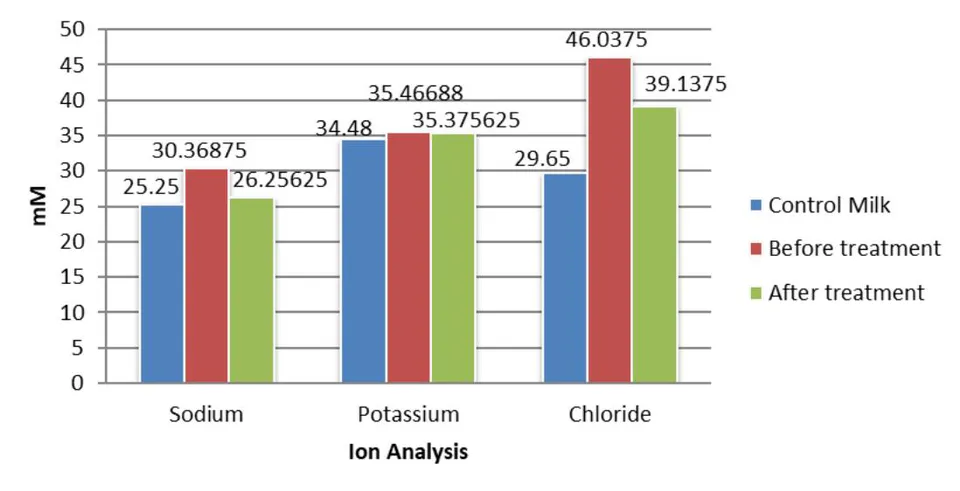
Table 1 Milk Ionic analysis (mmol/L) Reference Sodium Potassium Chlorides 1 Stable milk 19.58 38.14 40.89 9 2 Unstable 22.62 39.68 45.41 9 3 stable 23.55/5.26 38.50a/4.26 26.94/4.44 22 4 unstable 24.03/4.95 43.42b/6.15 33.62/5.35 22 5 Normal 24.2 34.7 30.2 21
Multi star (vitamin liquid), a brand product of Vet Mankind, India, was purchased from the local chemist. Ten ml of Kali muriatic 200 and 90 ml of Multistar were mixed thoroughly. Five ml of mixed liquid were dropped over the tongue in the morning and evening for 5 days and 10 pills of Calcarea Phosphorica12 x, were dropped over the tongue for another two to three days. The data were subjected to ANOVA.
III. RESULTS AND OBSERVATIONS
It was observed that all the 16cowswith milk ethanol instability became stable without any side effects. The regaining of stability was gradual after day 2, of the administration of KaliMur 200. It was further observed that there was no recurrence of instability even after 3 months. The ionic values of sodium, potassium, and chlorides of normal milk were lesser than those of affected and treated cows.
It was observed from the Table 1 that, there was no significant reduction of sodium and Potassium, but with regard to chlorides, there was a significant reduction at 1% level, after treatment of the day 7, in stable milk.
IV. Discussion
The milk of 16 cows became stable, dramatically endorsing the homeopathic theory. Administration is simple and the cost of treatment is economical. It was calculated as Rs 100/- Per course. Chlorides in the milk exists as salts of Calcium, Potassium, Sodium, and Magnesium in colloidal and aqueous forms.
In unstable milk there was significantly higher chloride content in unstable milk than in stable milk but there were no significant changes in Sodium and Potassium contents in both instable and stable milk after treatment.
The observations were in agreement with those of Chavez et al (9) Gaucheron(21) and Fagnani et al(22)(Table 2}There was no change in organoleptic character and secretion of milk. The dramatic shift milk from instability to stable within a week after administration of homeopathic-medicine, proved the hypothesis of homeopathy equivocally. The cost of treatment for seven days works out to, in Indian Rupees is 100/-. The results gave conclusive evidence that ions chlorides and calcium were the major ions responsible for alcohol instability than those of sodium and Potassium which are insignificant (higher potency) removed the detrimental effects of Potassium and Chlorides and CalcareaPhos12 x (lower potency) enriched the alcohol stability of milk.
V. CONCLUSION
We have converted alcohol unstable milk to stable one, after administration of two homeopathic remedies Kali muriatic 200 and Calcarea Phosphorica 12 x, for 7 days, given one after another and proved the efficacy of homeopathic medicines for overcoming the milk ethanol instability that has caused persistent concern since decades. More number of cows with their milk instability may be subjected to homeopathic treatment to get more confidence for the future adoption of the proposed extension strategy.
ACKNOWLEDGEMENT
We acknowledge Sri Shashi Kumar, CEO/MD and Sri Rajeev K, Head of Extension Akshaya Kalpa farms and foods Pvt LTD, Tiptur, Karnataka state for funding the research project and his staff for their technical to execute this research. We also acknowledge Dr Paran Jyothi Kanni, Director, Bangalore Allergy centre, Bangalore, for reviewing the work. We are also grateful to the technical assistance extended by Mr Nanjundaiah KS.