Cosmetics and its Health Risks

Jonathas Xavier Pereira
Thais Canuto Pereira
Universidade Federal do Rio de Janeiro Universidade Federal do Rio de Janeiro

Send Message

To: Author

Cosmetics and its Health Risks

Article Fingerprint

ReserarchID

PDDTMR0COW

Cosmetics and its Health Risks Banner

AI TAKEAWAY

Connecting with the Eternal Ground
  • English
  • Afrikaans
  • Albanian
  • Amharic
  • Arabic
  • Armenian
  • Azerbaijani
  • Basque
  • Belarusian
  • Bengali
  • Bosnian
  • Bulgarian
  • Catalan
  • Cebuano
  • Chichewa
  • Chinese (Simplified)
  • Chinese (Traditional)
  • Corsican
  • Croatian
  • Czech
  • Danish
  • Dutch
  • Esperanto
  • Estonian
  • Filipino
  • Finnish
  • French
  • Frisian
  • Galician
  • Georgian
  • German
  • Greek
  • Gujarati
  • Haitian Creole
  • Hausa
  • Hawaiian
  • Hebrew
  • Hindi
  • Hmong
  • Hungarian
  • Icelandic
  • Igbo
  • Indonesian
  • Irish
  • Italian
  • Japanese
  • Javanese
  • Kannada
  • Kazakh
  • Khmer
  • Korean
  • Kurdish (Kurmanji)
  • Kyrgyz
  • Lao
  • Latin
  • Latvian
  • Lithuanian
  • Luxembourgish
  • Macedonian
  • Malagasy
  • Malay
  • Malayalam
  • Maltese
  • Maori
  • Marathi
  • Mongolian
  • Myanmar (Burmese)
  • Nepali
  • Norwegian
  • Pashto
  • Persian
  • Polish
  • Portuguese
  • Punjabi
  • Romanian
  • Russian
  • Samoan
  • Scots Gaelic
  • Serbian
  • Sesotho
  • Shona
  • Sindhi
  • Sinhala
  • Slovak
  • Slovenian
  • Somali
  • Spanish
  • Sundanese
  • Swahili
  • Swedish
  • Tajik
  • Tamil
  • Telugu
  • Thai
  • Turkish
  • Ukrainian
  • Urdu
  • Uzbek
  • Vietnamese
  • Welsh
  • Xhosa
  • Yiddish
  • Yoruba
  • Zulu
Font Type
Font Size
Font Size
Bedground

Abstract

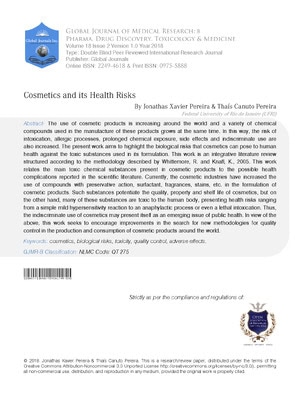
The use of cosmetic products is increasing around the world and a variety of chemical compounds used in the manufacture of these products grows at the same time. In this way, the risk of intoxication, allergic processes, prolonged chemical exposure, side effects and indiscriminate use are also increased. The present work aims to highlight the biological risks that cosmetics can pose to human health against the toxic substances used in its formulation. This work is an integrative literature review structured according to the methodology described by Whittemore, R. and Knafl, K., 2005. This work relates the main toxic chemical substances present in cosmetic products to the possible health complications reported in the scientific literature. Currently, the cosmetic industries have increased the use of compounds with preservative action, surfactant, fragrances, stains, etc. in the formulation of cosmetic products. Such substances potentiate the quality, property and shelf life of cosmetics, but on the other hand, many of these substances are toxic to the human body, presenting health risks ranging from a simple mild hypersensitivity reaction to an anaphylactic process or even a lethal intoxication. Thus, the indiscriminate use of cosmetics may present itself as an emerging issue of public health. In view of the above, this work seeks to encourage improvements in the search for new methodologies for quality control in the production and consumption of cosmetic products around the world.

References

33 Cites in Article
  1. Zoe Draelos (2015). Cosmetics: The Medicine of Beauty.
  2. J Alani,Mdp Davis,J Yiannias (2013). Allergy to cosmetics: A literature review.
  3. Zoe Draelos (2014). Facial skin care products and cosmetics.
  4. B Dreno,E Araviiskaia,E Berardesca,T Bieber,J Hawk,M Sanchez-Viera (2014). The science of dermocosmetics and its role in dermatology.
  5. Polyxeni Nicolopoulou-Stamati,Luc Hens,Annie Sasco (2015). Cosmetics as endocrine disruptors: are they a health risk?.
  6. M Vigan,F Castelain (2014). Cosmetovigilance: definition, regulation and use "in practice.
  7. Robin Whittemore,Kathleen Knafl (2005). The integrative review: updated methodology.
  8. Margit Juhász,Ellen Marmur (2014). A review of selected chemical additives in cosmetic products.
  9. Stefan Pfuhler,Hans Wolf (2002). Effects of the formaldehyde releasing preservatives dimethylol urea and diazolidinyl urea in several short-term genotoxicity tests.
  10. C Lv,J Hou,W Xie,H Cheng (2015). Investigation on formaldehyde release from preservatives in cosmetics.
  11. Erin Warshaw,Heather Buchholz,Donald Belsito,Howard Maibach,Joseph Fowler,Robert Rietschel,Kathryn Zug,C Mathias,Melanie Pratt,Denis Sasseville,Frances Storrs,James Taylor,Vincent Deleo,James Marks (2009). Allergic patch test reactions associated with cosmetics: Retrospective analysis of cross-sectional data from the North American Contact Dermatitis Group, 2001-2004.
  12. T Agner,M Flyvholm,T Menne (1999). Formaldehyde allergy: a follow-up study.
  13. T Doi,A Takeda,A Asada,K Kajimura (2012). Characterization of the decomposition of compounds derived from imidazolidinyl urea in cosmetics and patch test materials.
  14. Cecilia Anselmi,Anna Ettorre,Marco Andreassi,Marisanna Centini,Paolo Neri,Anna Di Stefano (2002). In vitro induction of apoptosis vs. necrosis by widely used preservatives: 2-phenoxyethanol, a mixture of isothiazolinones, imidazolidinyl urea and 1,2-pentanediol.
  15. A Katz,E Sherertz (1999). Facial dermatitis: Patch test results and final diagnoses.
  16. Sylwia Borowska,Malgorzata Brzóska (2015). Metals in cosmetics: implications for human health.
  17. Beatrice Bocca,Anna Pino,Alessandro Alimonti,Giovanni Forte (2014). Toxic metals contained in cosmetics: A status report.
  18. C Smith,B Alexander (2005). The relative cytotoxicity of personal care preservative systems in Balb/C 3T3 clone A31 embryonic mouse cells and the effect of selected preservative systems upon the toxicity of a standard rinse-off formulation.
  19. D Cohen,J Kaufmann (2003). Hypersensitivity reactions to products and devices in plastic surgery.
  20. J Jackson,Joseph Fowler (1998). Methyldibromoglutaronitrile (Euxyl K400): A new and important sensitizer in the United States?.
  21. C Mowad (2000). Allergic contact dermatitis caused by parabens: 2 case reports and a review.
  22. Dorota Błędzka,Jolanta Gromadzińska,Wojciech Wąsowicz (2014). Parabens. From environmental studies to human health.
  23. Achille Sertoli,Stefano Francalanci,Maria Acciai,Massimo Gola (1999). Epidemiological Survey of Contact Dermatitis in Italy (1984-1993) by GIRDCA (Gruppo Italiano Ricerca Dermatiti da Contatto e Ambientali).
  24. S Osdoit,M Guillet,G Guillet (2011). Contact sensitization to quaternium-15 acting as a warning sign for curare allergy.
  25. Michelle Park,Jonathan Zippin (2014). Allergic Contact Dermatitis to Cosmetics.
  26. Tina Suneja,Donald Belsito (2001). Thimerosal in the detection of clinically relevant allergic contact reactions.
  27. David Geier,Paul King,Brian Hooker,José Dórea,Janet Kern,Lisa Sykes,Mark Geier (2015). Thimerosal: Clinical, epidemiologic and biochemical studies.
  28. Elizabeth Yim,Katherine Baquerizo Nole,Antonella Tosti (2014). Contact Dermatitis Caused by Preservatives.
  29. Ronni Wolf,Danny Wolf,Binnur Tüzün,Yalcin Tüzün (2001). Contact dermatitis to cosmetics.
  30. John Epstein (1999). Phototoxicity and photoallergy.
  31. K Lintner,V Genet (1998). A physical method for preservation of cosmetic products.
  32. Benjamin Bandowe,Moritz Bigalke,Linda Boamah,Elvis Nyarko,Firibu Saalia,Wolfgang Wilcke (2014). Polycyclic aromatic compounds (PAHs and oxygenated PAHs) and trace metals in fish species from Ghana (West Africa): Bioaccumulation and health risk assessment.
  33. Yawei Zhang,C Kim,T Zheng (2012). Hair dye use and risk of human cancer.

Funding

No external funding was declared for this work.

Conflict of Interest

The authors declare no conflict of interest.

Ethical Approval

No ethics committee approval was required for this article type.

Data Availability

Not applicable for this article.

How to Cite This Article

Jonathas Xavier Pereira. 2018. \u201cCosmetics and its Health Risks\u201d. Global Journal of Medical Research - B: Pharma, Drug Discovery, Toxicology & Medicine GJMR-B Volume 18 (GJMR Volume 18 Issue B2).
Download Citation

Journal Specifications

Crossref Journal DOI 10.17406/gjmra

Print ISSN 0975-5888

e-ISSN 2249-4618

Keywords
Classification
GJMR-B Classification NLMC Code: QT 275
Version of record

v1.2

Issue date
June 2, 2018

Language
en
Experiance in AR

Explore published articles in an immersive Augmented Reality environment. Our platform converts research papers into interactive 3D books, allowing readers to view and interact with content using AR and VR compatible devices.

Read in 3D

Your published article is automatically converted into a realistic 3D book. Flip through pages and read research papers in a more engaging and interactive format.

Article Matrices
Total Views: 3181
Total Downloads: 1510
2026 Trends
Related Research
Our website is actively being updated, and changes may occur frequently. Please clear your browser cache if needed. For feedback or error reporting, please email [email protected]

Request Access

Please fill out the form below to request access to this research paper. Your request will be reviewed by the editorial or author team.
X

Quote and Order Details

Contact Person

Invoice Address

Notes or Comments

This is the heading

Lorem ipsum dolor sit amet, consectetur adipiscing elit. Ut elit tellus, luctus nec ullamcorper mattis, pulvinar dapibus leo.


High-quality academic research articles on global topics and journals.

Cosmetics and its Health Risks

Jonathas Xavier Pereira
Jonathas Xavier Pereira <p>Universidade Federal do Rio de Janeiro</p>
Thais Canuto Pereira

Research Journals