
I. INTRODUCTION
The news nowadays is full of reports on coronavirus. Everyone is panicking and scared. In the fall of December 2019, a novel Coronavirus (nCoV) has been identified as a new strain that has not been previously identified in humans, which was first occurred in in Wuhan City of Hubei Province of China as an outbreak of unusual respiratory condition. After this, it is continuously spreading to rest of the world. Because of its new emergence, understanding of transmission patterns, severity, clinical features and risk factors for infection among health professionals as well as general population remains limited and followed by ambiguity in epidemiological, clinical and virological characteristics.
II. SARS-COV-2
The International Committee on Taxonomy of Viruses (ICTV) announced "Severe Acute Respiratory Syndrome Coronavirus 2" as the name of the new virus. It is genetically associated with the Coronavirus that is responsible for the Severe Acute Respiratory Syndrome (SARS) outbreak in 2003. However, when related; they found both the viruses to be different. Further, on 11th February 2020, the World Health Organization (WHO) announced COVID-19 as the name of this disease and the "COVID-19 virus" as the virus responsible for this disease. As its transmission rate is high, WHO has declared the outbreak of the COVID-19 as a global health emergency on January 30, 2020.
Case definition by WHO
WHO has recently updated the case definitions based on the current information available. Suspect Case is a patient with acute respiratory illness {fever and at least one sign/symptom of respiratory disease (e.g., cough, shortness of breath)} and a history of travel to or residence in a country/area or territory reporting local transmission of COVID-19 disease during the 14 days prior to symptom onset or a patient/Health care worker with any acute respiratory illness and having been in contact with a confirmed COVID-19 case in the last 14 days prior to onset of symptoms or a patient with severe acute respiratory infection {fever and at least one sign/symptom of respiratory disease (e.g., cough, shortness breath)} and requiring hospitalization and with no other aetiology that fully explains the clinical presentation; or a case for whom testing for COVID-19 is inconclusive. Laboratory Confirmed case is a person with laboratory confirmation of COVID-19 infection, irrespective of clinical signs and symptoms.
III. EPIDEMIOLOGY
The epidemic of COVID-19 has broadened from china to growing number of countries. A total of 44 patients with pneumonia of unknown aetiology were reported to WHO till 3 January 2020. During this period, the causative agent of pneumonia was not identified. On January 7, 2020, the Chinese national authority identified new type of virus and reported that this virus is associated with sea food market located in Wuhan city. Two hundred eighty two confirmed cases of COVID – 19 have been reported till 20 January 2020 from China, Thailand, japan and Korea. However, it was clear that outbreak is no longer due animal to human transfer and it was evident that 2019-nCoV spreads from human to human. International traffic has been published by WHO on 27 January 2020. On 29 January 2020, "The Pandemic Supply Chain Network (PSCN)" has been set up by joint efforts of WHO and World Economic Forum. From Hubei Province, approximately 60.5% of all cases have been reported since the start of the outbreak. COVID – 19 outbreak was declared as pandemic on 11 March 2020, and asked the countries to take immediate actions and magnify response to treat, diagnose and decrease transmission to save people's lives.
A study conducted by Wang et al showed that mortality rate of COVID – 19 was 2.84%. While Wu et al reported that mortality rate of COVID – 19 was 14% and transmission rate of infection is 0.3.
A webinar on "Occupational Health Measures in the Preparedness and Response to COVID19 in the Workplace" has been conducted by WHO and the International Occupational Medicine Society Collaboration (IOMSC) on 23 March 2020. A joint World Health Organization (WHO)-China fact-finding mission estimated that the epidemic in China peaked between late January and early February 2020, and the rate of new cases decreased substantially by early March.
As of 20 April, 2020, data from WHO showed that there was total of 23,14,621 confirmed cases of COVID-19.
IV. STRUCTURE
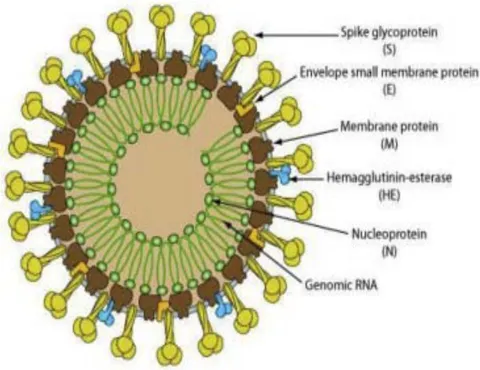
Coronaviruses are a family of positive single-stranded RNA virus, classified under Nidovirales order. These viruses are enveloped, round in shape and approximately 80 to 120 nanometer in diameter. The virion contains an internal helical RNA-protein nucleocapsid surrounded by an envelope made up of lipids and viral glycoproteins. These glycoproteins are spike protein, membrane protein, and small membrane (Figure 1). The spike protein or "S" is a type I glycoprotein, giving the virus its corona or crown-like morphology in the electron microscope. The coronaviruses attach to the cell surfaces through the spike. The membrane protein or "M" is highly hydrophobic and spans the membrane three times. On the other hand, the small membrane protein or "E" spans the membrane twice.
V. MODE OF TRANSMISSION
Origin of COVID-19 is zoonotic in nature. People most at risk of infection from the novel coronavirus were those in close contact with animals such as live animal market workers and those who are caring for people infected with the virus such as family members or healthcare workers. The exact dynamics of how the virus is transmitted is yet to be determined. According to the Centre for Disease Control or CDC, COVID-19 is transmitted via droplets and fomites. The main modes of transmission of Coronavirus are person to person, household transmission, from contact with infected surfaces or objects. COVID -19 can be transmitted between people who are in close contact with one another or within about 3-4 feet. The transmission is through the respiratory droplets produced by the infected person when he or she sneezes or coughs, possible inhalation or (into the lungs) of the droplets landing in the oral cavities or noses of people in close proximity. Furthermore, as per the statistical records on 20th February 2020, in Shenzhen City, among two thousand eight hundred and forty two identified close contacts, 3% were found to be infected with COVID-19.
Recent reports from the World Health Organization or WHO, human-to-human transmission of the COVID-19 virus is mainly occurring in families, especially in China. As per the WHO, a person might be susceptible to COVID-19 if he or she touches a surface or object containing the virus and then touching their own mouth, nose, or face. The lifespan of COVID – 19 virus outside the body depends on various factors like humidity and temperature of environment. However, it ranges from few hours to seven days like on cardboard upto 1 hour and on plastic upto 4 days.
VI. CLINICAL PRESENTATION
According to the Centre for Disease Control or CDC, patients above the age of 50 are more prone to attack and who are with other systemic diseases like diabetes, parkinson's disease and cardiovascular diseases are at high risk. As per the World Health Organization (W.H.O.) statistics, the median age of affected people is 51 years with the majority of cases aged between 30–69 years. Statistical data also reveals that 51.1% of the affected population are males.
Symptoms may appear 2 to 14 days after exposure to virus. The range of appearance of first symptom to death is 6-14 days (median- 14 days) depending upon the age and immunity. The initial clinical Features of COVID-19 include decreased white blood cells, fever, fatigue, coughing and sneezing, runny nose, breathing difficulties like shortness of breath, sore throat. Other symptoms include pneumonia, severe acute respiratory syndrome, lungs inflammation and congestion, cardiovascular damage, diarrhoea, impaired renal functions and failure, bilateral ground-glass opacities on chest CT scans and ultimately can lead to death in critical cases. These features have some alikeness with SARS-CoV and MERS-CoV infections. At this stage, need of mechanical ventilators become crucial with quarantine facility.
VII. DIAGNOSIS
The prime suspects for COVID-19 include patients with fever and lower respiratory tract symptoms. The geographical distribution and recent contact with the suspected patients should also be taken into consideration. Finally, if suspected with coronavirus, infection control measures should be implemented, and public health officials should be notified.
Diagnosis should be based on clinical and epidemiological factors. The clinical criteria for confirming the diagnosis of the severity of Coronavirus is broadly categorized into the following types: Mild, Moderate, Severe and Critical. In case of mild, the symptoms include fever less than 38 degrees centigrade. Patient with moderate illness may be presented with fever, respiratory symptoms and imaging findings of pneumonia. While in case of severe illness, respiratory distress, oxygen saturation less than 93% at rest are reported. In case of critical condition such as respiratory failure, shock and extra pulmonary organ failure, Intensive care unit is necessary.
Specific diagnosis is made by collection of respiratory material from upper and lower respiratory tract. The upper respiratory tract specimen includes nasopharyngeal or oropharyngeal swab while the lower respiratory specimens include sputum or endotracheal aspirate. Other methods of collection of virus include blood and stool. The specimens are to be collected in sterile containers and must be stored at 2 to 8 degree centigrade. In case of delay, the specimens are frozen at minus 20 degree centigrade and then shipped.
The various laboratory investigations include nucleic acid amplification tests (NAAT), Real Time Reverse Transcription Polymerase Chain Reaction (RT-PCR) for COVID 19 to check for evidence of viral load indicating active infection. Other investigations include serological testing for detecting antibodies, viral sequencing and viral culture.
VIII. TREATMENT AND PREVENTIVE MEASURES
The case fatality rate of the SARS-CoV-2 infected patients was much lower than that of SARS and MERS. No effective pharmaceutical therapy is available for COVID-19 till now. The key preventive measures are to follow good hygiene practices like in case of SARS and MERS. In all health care facilities, standard precautions should always be implemented viz. hand hygiene and the use of personal protective equipment (PPE), prevention of needle-stick or sharps injury, safe waste management, cleaning and disinfection of equipment and cleaning of the environment. There is need to implement appropriate infection prevention and control (IPC) to contain and mitigate transmission even in case of mild illness where hospitalization is not indicated.
However, a number of medicines have been suggested as potential investigational therapies, many of which are now being in clinical trials. At present, most of the patients with COVID – 19 have been treated symptomatically like antipyretics, empirical antibiotics, antiviral therapy (oseltamivir), RNA synthesis inhibitors and remdesivir. The first case in US was first treated successfully by Remdesivir. Nowadays, chloroquine shown to have anti-viral activity against SARS-CoV-2. Study conducted by Wang et al. (2020) evaluated in vitro five FDA-approved drugs and two broad spectrum antivirals against a clinical isolate of SARS-CoV-2 and concluded that "chloroquine (is) highly effective in the control of 2019-nCoV infection in vitro". More than 15 trials are registered to check the effectiveness of chloroquine in treatment of COVID – 19.
Healthcare workers are at greater risk to COVID-19. Likewise, in the SARS outbreak, out of total affected, 21% of those were healthcare workers. In china, Dr Li Wenliang who tried to warn others about the same has died too. Hence, it is very crucial to protect health workers to safeguard continuity of care. Hence, healthcare professionals should also be screened for COVID – 19.
IX. INDIAN SCENARIO
India has reported first case of COVID-19 on 30th January 2020 in Kerala. According to the Ministry of Health & Family Welfare (MoHFW), as of April 2020, COVID-19 - 15,122 active cases, 3259 cured, 603 deaths have been reported.[28]
India has had a brush with three respiratory infections outbreaks in the recent past- SARS, MERS and now COVID - 19. All of these had created panic and chaos. Globally, preventive and control measures are being enforced rapidly. Starting from Wuhan city, they are expanding over the world. A detailed advisory on social distancing measures has been issued to stop or slow down the rate and extent of disease transmission. Detailed advisory has also been issued for health along with consultation with professional associations. Quarantine facilities and preparedness regarding availability of testing kits, personal protective equipment (PPEs), medicines, and adequate isolation wards are continuously evaluated by Ministry of Health and Family Welfare (MoHFW). To assure adequate availability of protective gear for all healthcare workers, all public hospitals have been directed. To slow the spread of the illness and to develop specific pharmaceutical treatment, many efforts are being made.
To provide command and control functions, Strategic Health Operations Centre (SHOC) room has been launched by National Centre for Disease Control (NCDC). The national and state health authorities are constantly reviewing the public health preparedness including surveillance, diagnostics, hospital preparedness, infection prevention and control. Honourable PM Narendra Modi made a public appeal to encourage public participation in the response towards COVID-19 by observing national lockdown for 21 days "in order to protect the country, and each of its citizens, a complete ban is being imposed on people from stepping out of their homes." After that he had announced the extension of lockdown till 3 May to tackle the further spread.
A telephonic survey will also being conducted by government of India and people are requested to participate in this. A call from number 1921 will be coming to ask about prevalence and distribution of COVID – 19 symptoms.
High level Group of Ministers (GoM) is constantly reviewing the status of cases in India and implementing steps taken by the Government of India across states.
X. CONCLUSION
From the present review, it can be concluded that COVID – 19, being a public health threat, has challenged the economic, medical as well as public health infrastructure. The specific pharmaceutical treatment is currently under evaluation and development. Hence, till then the public should implement the infection control measures.