I. INTRODUCTION
The fast-changing economic conditions such as global competition, declining profit margin, customer demand for the high-quality product, product variety, and reduced lead-time, etc. had a significant impacts on manufacturing industries. The demand for higher value a lower price is increasing and surviving apparel manufacturers need to improve their operations through producing right first-time quality and waste reduction. This paper discusses the quality and productivity improvement in a manufacturing enterprise through practical study. The work investigates a framework to identify quantify and eliminate sources of variation in an operational process, to optimize the operation variables, improve and sustain process performance with well-executed control plans. The primary quality characteristics are static physical dimensions, and secondary qualitative are the reactions of the clothes to an applied dynamic force. The apparel manufacturer is primarily interested in the secondary characteristics of the fabric and focuses on the seam quality during the fabrication and production of apparel [1].
The application of this practice improves the process performance of the critical operational process, leading to better utilization of resources, decreases variations & maintains consistent quality of the process output. The production process includes a set of workstations, each of has a specific task that carried out selected sequence, for the different styles simultaneously . The outcome of this observation reflected that an industry might gain higher productivity and profitability with improved quality product by minimizing reworks activities. In the present work, the impact of an increase in needle thread tension , , on the fabric is analyzed in Single Needle Lock Stitch sewing machine with stitch type Class 300 and Type 301.
At present, the success of the Readymade Garments sector highly depends on several factors such as manufacturing lead time, quality of the product, production cost, etc. Broken stitch, Skipped stitch, Open seam, and others sewing problems are related to the product quality. The lower quality products are hampered productivity. These flaws can be repairable that leads to rework or non-repairable that leads to rejection. Rework in the garments industry is a regular work that hampers the smooth production rate and focuses poor quality products having an impact on overall factory economy. Minimization of reworks is a must in quality and productivity improvement. Rework is a vital issue for inferiority product and low production rate . Reworks are the non-productive activities focusing on any operations that customer is not willing to pay for it. Non-productive activities describe that the customer does not consider as adding value to this product.
II. MATERIAL AND METHODOLOGY
a) Materials Descriptions
Fabric: We have studied 95% cotton, and 5% Lycra knit composite fabric for a T-Shirt and the fabric weight was 200 gram per square meter.
Sewing thread: Sewing thread applied 100% cotton spun yarn that counts mentioned 40 Tex and stitches per minute (SPI) 12.
b) Methods and process sequence
We have performed this research work on 32 garments line based in Apparel Industry in Bangladesh. Every garments line contained 26 no of the machine. As per Acceptable Quality level (AQL) inspection system, we selected lot size code "J" and sample size 80. Everyday 80 pcs garments we have inspected and similarly, total 560 pcs sample observed during seven days. Different types of sewing tension like 3, 4, 5, 6, and 7 applied in same garments line and found different kinds of several faults..
III. DATA ANALYSIS
| Day | F1 | F2 | F3 | F4 | F5 |
| 1st | 10 | 15 | 5 | 2 | 7 |
| 2nd | 11 | 13 | 4 | 1 | 8 |
| 3rd | 14 | 11 | 3 | 2 | 8 |
| 4th | 12 | 15 | 2 | 2 | 7 |
| 5th | 13 | 13 | 3 | 2 | 8 |
| 6th | 10 | 14 | 3 | 2 | 6 |
| 7th | 14 | 15 | 4 | 2 | 8 |
| TD | 84 | 96 | 24 | 13 | 52 |
| DHU% | 15 | 17.14 | 4.29 | 2.32 | 9.29 |
| Day | F1 | F2 | F3 | F4 | F5 |
| 1st | 12 | 12 | 4 | 2 | 6 |
| 2nd | 10 | 12 | 3 | 3 | 7 |
| 3rd | 12 | 14 | 5 | 2 | 8 |
| 4th | 11 | 14 | 1 | 1 | 6 |
| 5th | 10 | 13 | 2 | 1 | 8 |
| 6th | 9 | 14 | 3 | 2 | 7 |
| 7th | 15 | 14 | 2 | 2 | 8 |
| TD | 79 | 93 | 20 | 13 | 50 |
| DHU% | 14.11 | 16.61 | 3.57 | 2.32 | 8.93 |
| Day | F1 | F2 | F3 | F4 | F5 |
| 1st | 8 | 10 | 4 | 2 | 5 |
| 2nd | 9 | 11 | 3 | 1 | 7 |
| 3rd | 11 | 8 | 4 | 2 | 8 |
| 4th | 10 | 10 | 3 | 3 | 9 |
| 5th | 11 | 11 | 2 | 2 | 8 |
| 6th | 10 | 12 | 1 | 2 | 5 |
| 7th | 10 | 14 | 2 | 0 | 4 |
| TD | 69 | 76 | 19 | 12 | 46 |
| DHU% | 12.32 | 13.57 | 3.39 | 2.14 | 8.21 |
| Day | F1 | F2 | F3 | F4 | F5 |
| 1st | 14 | 11 | 4 | 2 | 6 |
| 2nd | 12 | 12 | 3 | 1 | 8 |
| 3rd | 13 | 15 | 3 | 2 | 7 |
| 4th | 11 | 14 | 4 | 1 | 6 |
| 5th | 13 | 12 | 2 | 0 | 8 |
| 6th | 12 | 14 | 3 | 4 | 6 |
| 7th | 10 | 13 | 2 | 3 | 7 |
| TD | 85 | 91 | 21 | 13 | 48 |
| DHU% | 15.18 | 16.25 | 3.75 | 2.32 | 8.57 |
| Day | F1 | F2 | F3 | F4 | F5 |
| 1st | 11 | 13 | 3 | 3 | 7 |
| 2nd | 13 | 14 | 2 | 4 | 6 |
| 3rd | 15 | 12 | 4 | 2 | 7 |
| 4th | 13 | 14 | 3 | 2 | 8 |
| 5th | 11 | 15 | 4 | 2 | 8 |
| 6th | 14 | 13 | 2 | 3 | 7 |
| 7th | 14 | 14 | 4 | 4 | 7 |
| TD | 91 | 95 | 22 | 20 | 50 |
| DHU% | 16.25 | 16.96 | 3.93 | 3.57 | 8.93 |
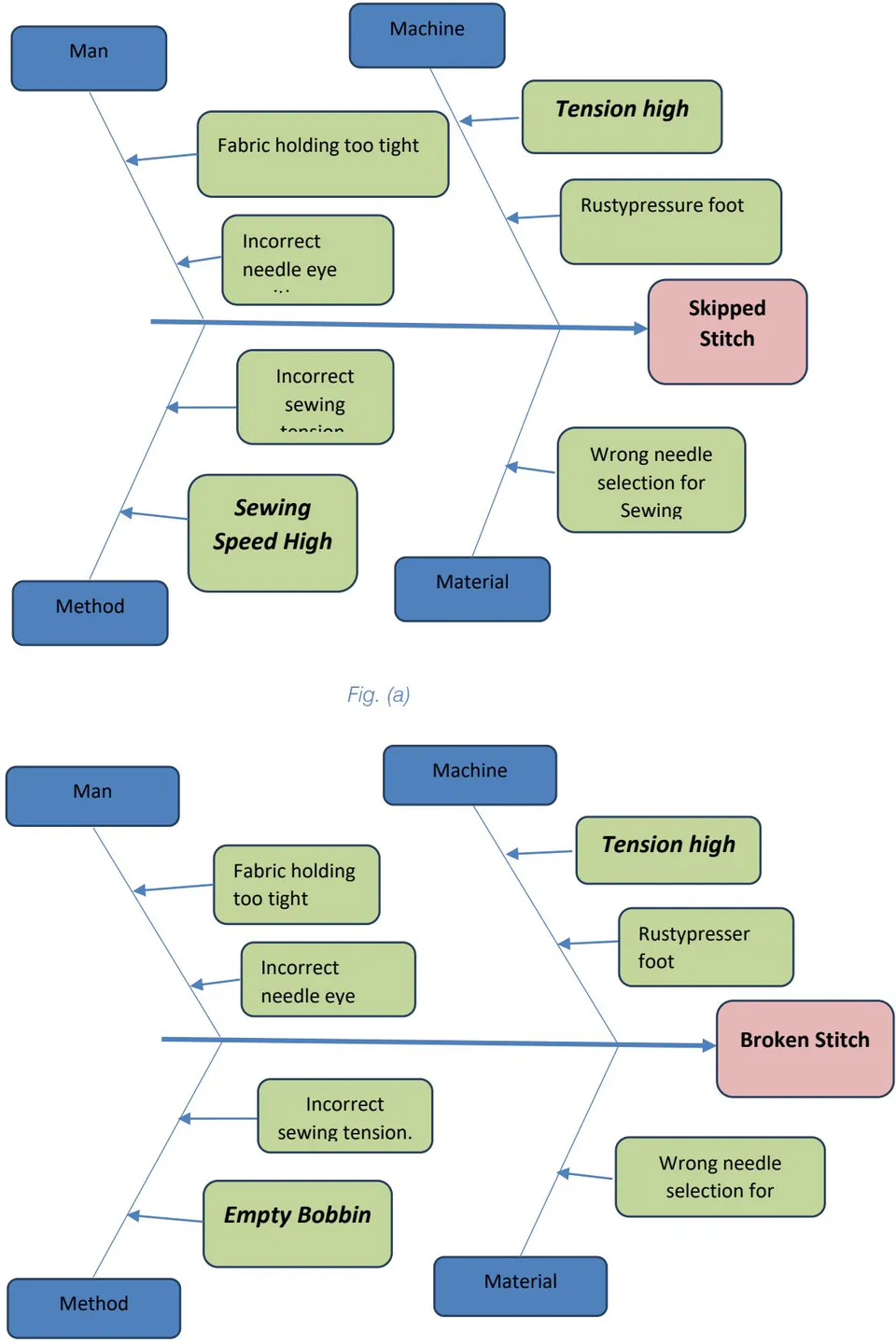
a) Cause and effect diagram of Skipped and Broken Stitch
IV. RESULTS AND DISCUSSION
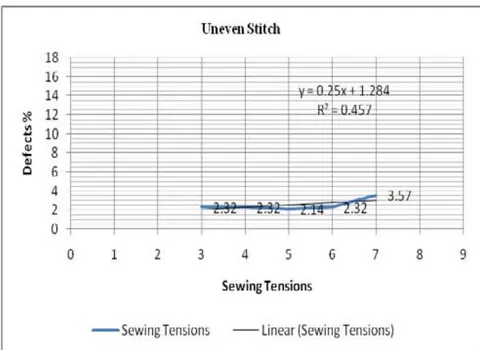
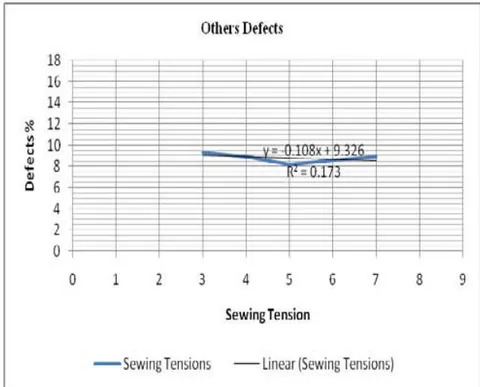
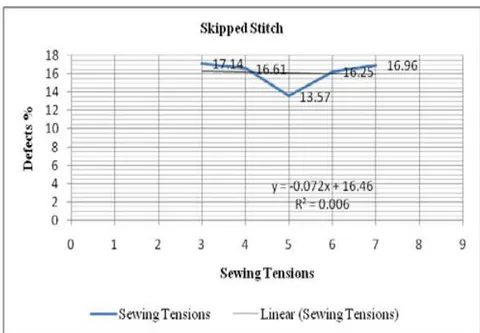
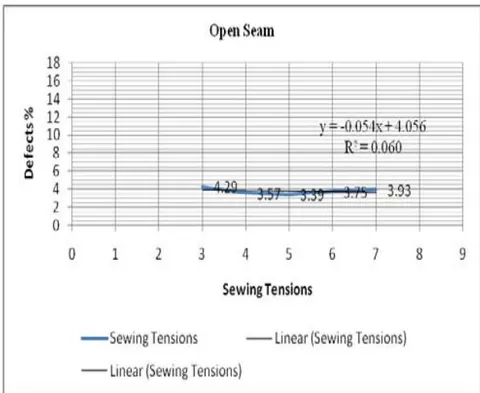
| Sewing Tensions | Broken stitch | Skipped stitch | Open seam | Uneven stitch | Others defects |
| 3 | 15 | 17.14 | 4.29 | 2.32 | 9.29 |
| 4 | 14.11 | 16.61 | 3.57 | 2.32 | 8.93 |
| 5 | 12.32 | 13.57 | 3.39 | 2.14 | 8.21 |
| 6 | 15.18 | 16.25 | 3.75 | 2.32 | 8.57 |
| 7 | 16.25 | 16.96 | 3.93 | 3.57 | 8.93 |
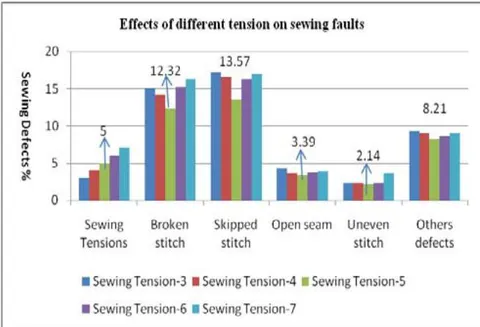
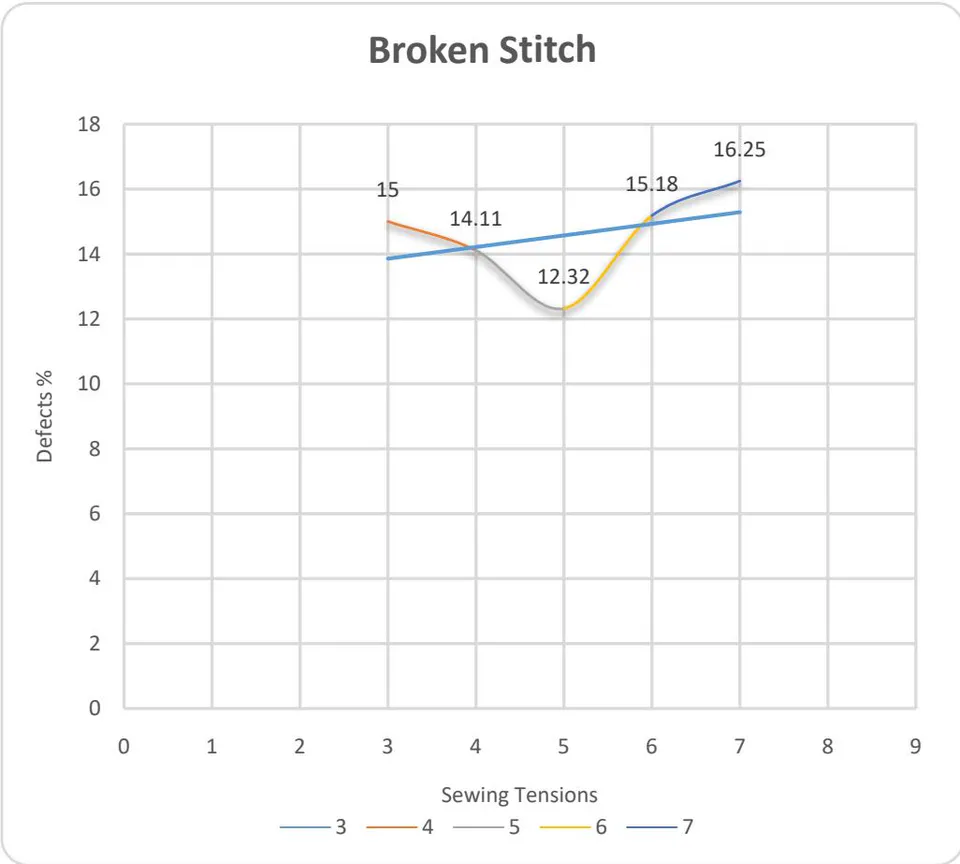
By Analysis the defects% from the above research work we have identified that the top defects of sewing problems are Broken and skipped a stitch. These are about 14.6% and 15.94% respectively of total errors. There are many factors which directly influenced by occurred Skipped and Broken stitch. Among them, we have applied different tensions and found the effects. The tension scale shows 0 to 9 categories, from there we have applied stress 3 to 7 category. "0" class tension that shows loose stitch and "9" category tension exposition too tight stitch. As per our assessment sewing tension "5" shows fewer defects compare to others sewing tensions.
V. CONCLUSION
This study indicates that by eliminating non-productive activities like reworks in the apparel industries time as well as cost are saved by ensuring quality products which has an significant impact on the overall factory.
We have implemented different sewing tensions that were the leading causes for broken stitches as well as skipped stitches. Except for this reason, many other factors like high speed, an empty bobbin, a rusty pressure foot, and material handling by the worker also impact on the same types of faults. We can conduct further research work on the way out to minimize those sewing defects by developing some methods to identify the bobbin condition just before it becomes empty.